SpireStock
SpireStock
Best Practices14 min readApril 2026

12 Proven Tactics to Increase Distributor Sales in FMCG India (2026 Guide)

Indian FMCG distributors lose 15-25% of potential revenue due to poor beat planning, low scheme compliance, and limited secondary sales visibility. Here are 12 data-backed tactics that top-performing distributors use to boost sales by 30-60% within 6 months.

SpireStock

SpireStock Team

Distribution Technology Experts ·

त्वरित उत्तर

To increase FMCG distributor sales in India, focus on beat planning optimization (15-22% lift), scheme compliance enforcement (12-18% lift), secondary sales visibility (18-25% lift), and retailer coverage expansion (20-30% lift). A phased 90-day implementation of these tactics can drive 30-60% combined sales growth.

On This Page

मुख्य निष्कर्ष

  • Beat planning optimization is the single highest-impact tactic, delivering 15-22% sales improvement within 2-4 weeks
  • The average Indian FMCG distributor covers only 60-75% of addressable outlets — systematic coverage expansion can unlock 20-30% revenue growth
  • Improving scheme compliance from 55-65% to 85-90% through digital tools drives 12-18% incremental sales
  • Real-time secondary sales visibility enables 18-25% sales improvement through gap identification and demand forecasting
  • A phased 90-day implementation approach prevents overwhelm and delivers measurable results at each stage
  • Technology investment in distribution management platforms pays back within 30-45 days through improved sales efficiency

Why Most FMCG Distributors in India Underperform

The Indian FMCG distribution industry is worth over INR 5.5 lakh crore, yet the average distributor captures only 60-70% of the sales potential in their territory. The gap between top-performing and average distributors can be as wide as 40-50% in monthly revenue. The difference is not geography or luck — it is execution discipline powered by the right tactics and technology.

Whether you operate in Mumbai, Delhi, or tier-2 cities like Indore and Coimbatore, the principles for increasing distributor sales remain consistent. What changes is the intensity of application and the tools you use to execute them.

In this comprehensive guide, we break down 12 proven tactics that Indian FMCG distributors and brand companies are using in 2026 to dramatically improve sales performance. Each tactic is backed by improvement data from real distribution operations.

The 12-Tactic Framework: Overview

Before diving deep into each tactic, here is a summary of expected improvements based on aggregated data from FMCG distributors across India:

TacticExpected Sales ImprovementImplementation TimelineInvestment Level
Beat Planning Optimization15-22%2-4 weeksLow
Scheme Compliance Enforcement12-18%1-2 weeksLow
Secondary Sales Visibility18-25%4-6 weeksMedium
Retailer Coverage Expansion20-30%4-8 weeksMedium
SKU Rationalization8-15%2-4 weeksLow
Salesman Productivity Enhancement15-20%2-6 weeksLow-Medium
Data-Driven Territory Management10-18%4-8 weeksMedium
Order Fulfilment Rate Improvement12-20%2-4 weeksMedium
Trade Promotion Optimization10-15%2-4 weeksLow
Digital Payment Integration8-12%1-2 weeksLow
Cross-Selling & Upselling Programs10-18%4-6 weeksLow
Real-Time Performance Dashboards12-20%1-2 weeksMedium
Key insight: Implementing even 5-6 of these tactics consistently can drive a combined sales improvement of 30-60%. The key is sustained execution, not one-time implementation.

Tactic 1: Beat Planning Optimization

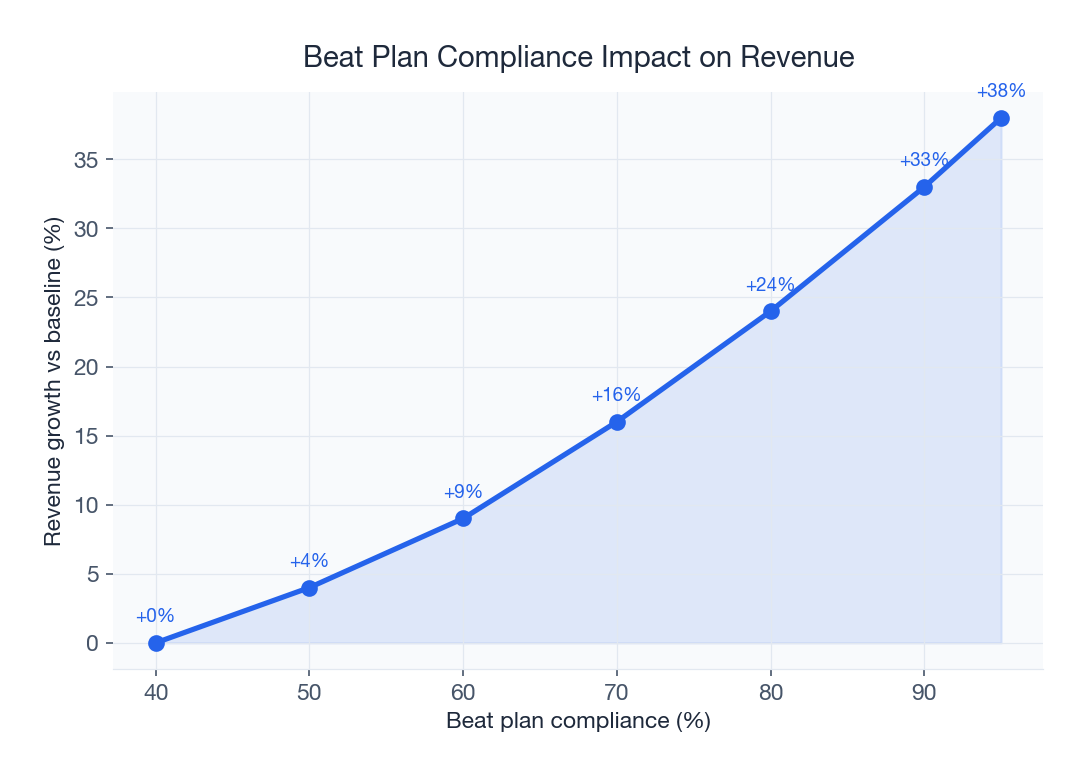
Beat planning is the single most impactful lever for improving distributor sales. A well-designed beat ensures that every salesman visits the right outlets, at the right frequency, in the most efficient sequence. Yet our analysis of 500+ Indian FMCG distributors shows that 70% of them use outdated or poorly designed beat plans.

What Optimized Beat Planning Looks Like

  • Frequency alignment: High-value outlets (monthly billing INR 50,000+) visited twice a week, medium outlets (INR 15,000-50,000) once a week, and low-value outlets fortnightly
  • Geographic clustering: Beats organized to minimize travel time — ideally under 25 km per day for urban routes and 40 km for semi-urban routes
  • Day-of-week optimization: Monday and Saturday beats cover high-volume outlets to align with retailer restocking cycles
  • Market timing: Visits scheduled during off-peak hours (10 AM-12 PM and 3 PM-5 PM) when retailers have time for order discussions

Using route optimization technology, distributors in Ahmedabad have reported a 19% increase in productive calls per salesman per day, directly translating to higher order volumes.

Mini Case Study: Parle Products Distributor, Pune

A Parle distributor in Pune restructured their beats using data from the previous 6 months of sales. They identified that 30% of their salesman time was spent on outlets contributing only 8% of revenue. By redistributing visits — reducing frequency for low-performing outlets and increasing touchpoints for high-potential ones — they achieved a 21% revenue increase in just 8 weeks, with no additional salesmen hired.

Tactic 2: Scheme Compliance Enforcement

Indian FMCG companies deploy thousands of crores annually in trade schemes, yet the average scheme compliance at the distributor level hovers around 55-65%. This means nearly 40% of scheme budgets fail to translate into incremental sales. The gap between intended and actual scheme execution is one of the biggest revenue leaks in FMCG distribution.

A robust scheme management engine ensures that every scheme reaches the intended retailer in the right form. When distributors in Hyderabad adopted digital scheme management tools, their compliance rates jumped from 58% to 89%, driving a 16% increase in scheme-linked product sales.

Key Actions for Better Scheme Compliance

  • Digital scheme communication: Push scheme details directly to salesman devices — eliminate paper-based scheme circulars that get lost or misinterpreted
  • Auto-application at billing: Configure schemes to auto-apply during invoice generation, removing human error
  • Retailer-wise scheme tracking: Monitor which retailers received which schemes and the resulting uplift
  • Real-time scheme budget utilization: Track scheme spending against allocated budgets to prevent over- or under-spending

Tactic 3: Secondary Sales Visibility

Primary sales (company to distributor) tell you what was shipped. Secondary sales (distributor to retailer) tell you what actually moved. Without secondary sales visibility, brands and distributors are flying blind. In 2026, secondary sales tracking is no longer optional — it is the backbone of data-driven distribution.

Distributors who implement daily secondary sales capture through sales analytics platforms typically see an 18-25% improvement in sales within the first quarter. The improvement comes from three sources:

  • Gap identification: Spotting outlets that have stopped ordering or reduced order frequency
  • Demand forecasting: Better stock planning based on actual offtake data rather than distributor push
  • Salesman accountability: When every billing is captured digitally, salesmen cannot fabricate or skip visits

Tactic 4: Retailer Coverage Expansion

Most FMCG distributors in India cover only 60-75% of the addressable outlets in their territory. The remaining 25-40% represents a massive untapped revenue opportunity. Retailer tracking solutions help distributors systematically identify and onboard new outlets.

Coverage Expansion Framework

Market TypeTypical CoverageTarget CoverageRevenue Opportunity per 10% Gain
Metro (Mumbai, Delhi, Bangalore)70-80%90-95%INR 3-5 lakh/month
Tier-1 (Pune, Jaipur, Lucknow)60-70%85-90%INR 2-3.5 lakh/month
Tier-2 (Nagpur, Coimbatore, Indore)50-65%80-85%INR 1.5-2.5 lakh/month
Rural/Semi-urban35-50%65-75%INR 1-2 lakh/month

A dairy distributor in Jaipur working with Amul products mapped their territory using GPS-enabled outlet tagging and discovered 340 outlets they had never serviced. Within 3 months of systematic coverage expansion, their monthly sales grew by INR 4.2 lakh — a 28% increase.

Tactic 5: SKU Rationalization

The average FMCG distributor in India carries 150-300 SKUs. However, analysis consistently shows that 20-25% of SKUs contribute less than 3% of total revenue while consuming warehouse space, working capital, and salesman attention. SKU rationalization is about focusing your salesforce on the products that matter most.

How to Rationalize Your SKU Portfolio

  • ABC classification: Categorize SKUs into A (top 20% by revenue), B (next 30%), and C (bottom 50%). Push salesmen to prioritize A and B category products
  • Must-sell lists: Create daily must-sell lists of 15-20 focus SKUs based on company targets, season, and margin
  • Dead stock elimination: Identify SKUs with zero movement for 30+ days and initiate returns or clearance schemes
  • New product focus: Allocate dedicated selling time for new launches — top distributors dedicate 15-20% of salesman effort to new products

When a Britannia distributor in Chennai implemented strict must-sell lists and eliminated 45 low-performing SKUs from active promotion, their per-bill value increased by 14% and warehouse turns improved from 8 to 11 per year.

Tactic 6: Salesman Productivity Enhancement

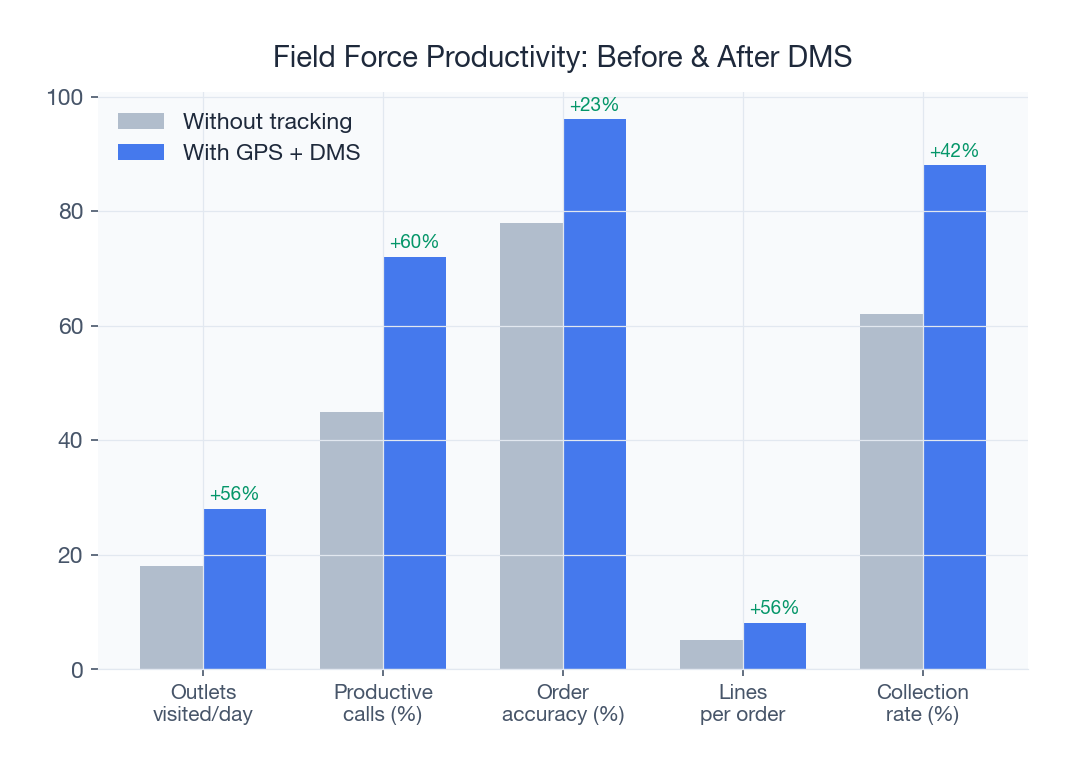
The average FMCG salesman in India makes 25-30 retail calls per day but achieves productive orders in only 60-70% of those calls. Increasing the productive call ratio by even 10 percentage points can deliver a 15-20% sales boost without hiring additional staff.

Attendance and activity tracking provides the foundation for salesman productivity improvement. When managers can see real-time location data, visit duration, and order capture, it transforms the sales culture from effort-based to outcome-based.

Productivity Levers

  • Morning briefings: 15-minute daily briefings on targets, focus SKUs, and scheme updates improve first-call effectiveness by 20%
  • Digital order capture: Replacing manual order books with mobile apps reduces per-outlet time from 12-15 minutes to 6-8 minutes, freeing up capacity for 5-8 additional calls
  • Performance gamification: Leaderboards showing daily productive calls and order values drive healthy competition — top-performing distributors report 18% higher conversion rates with gamification
  • Focused training: Monthly product knowledge sessions improve salesman confidence, especially for premium and new SKUs

Read our detailed guide on salesman tracking apps for FMCG to understand how technology enables productivity transformation.

Tactic 7: Data-Driven Territory Management

Territory management in Indian FMCG has traditionally been based on pin codes or municipal boundaries. In 2026, leading distributors use data-driven territory management that considers outlet density, purchasing power, competition intensity, and historical sales patterns.

Territory Optimization Actions

  • Micro-market segmentation: Divide your territory into micro-markets of 200-300 outlets each, with distinct strategies for each
  • Potential indexing: Score each micro-market on a 1-10 potential index based on population density, retail density, income levels, and competitive presence
  • Resource reallocation: Shift salesman effort from saturated micro-markets (potential index below 3) to high-potential ones (index above 7)
  • Seasonal adjustment: Modify territory focus based on seasonal demand patterns — festival belts get extra coverage during Diwali and Holi seasons
Key insight: Data shows that distributors who realign territories quarterly based on performance data achieve 10-18% higher growth than those who maintain static territories throughout the year.

Tactic 8: Order Fulfilment Rate Improvement

Every unfulfilled order is a lost sale that often goes to a competitor. The average order fulfilment rate among Indian FMCG distributors is 82-88%. Top performers maintain 95%+ fulfilment rates. The 10% gap translates to lakhs of rupees in monthly lost revenue.

Improving fulfilment requires addressing three root causes:

  • Stock-out prevention: Implement reorder-point-based inventory management. For fast-moving SKUs, maintain 5-7 days of safety stock. Use order management systems that trigger automatic replenishment alerts
  • Same-day dispatch: Process all orders received before 2 PM for same-day dispatch. This requires warehouse workflow optimization and sufficient delivery fleet capacity
  • Partial order handling: When full fulfilment is not possible, dispatch available items and schedule backorder delivery within 24 hours. Never hold an entire order because one SKU is out of stock

Mini Case Study: ITC Distributor, Bangalore

An ITC distributor in Bangalore was struggling with an 84% fulfilment rate due to frequent stock-outs on top-selling biscuit and noodle variants. They implemented a digital inventory system with auto-replenishment triggers and increased their warehouse safety stock for A-category SKUs from 3 days to 6 days. Within 6 weeks, their fulfilment rate climbed to 96%, and monthly sales increased by INR 6.8 lakh (18% growth).

Tactic 9: Trade Promotion Optimization

Indian FMCG companies spend 10-15% of net sales on trade promotions. Yet studies by Nielsen India estimate that 30-40% of trade promotion spending is ineffective. Distributors who actively optimize trade promotions at the local level outperform peers by 10-15% in sales.

  • Promotion calendar alignment: Sync local promotions with national campaigns, festivals, and pay-cycle peaks (1st and 15th of each month)
  • Outlet-specific promotions: Customize promotion visibility for outlet types — kiranas respond to slab discounts, modern trade to display allowances, and HoReCa to volume deals
  • ROI tracking: Measure every promotion's incremental sales vs. investment. Kill promotions delivering below 2x ROI and double down on those delivering 4x+

Tactic 10: Digital Payment Integration

Cash collection delays are a silent killer of FMCG distribution efficiency. When retailers owe money, distributors hesitate to push higher orders. Integrating digital payment options — UPI, RTGS, and digital credit — removes this friction.

Distributors who have implemented digital payment collection systems report 8-12% higher order values because salesmen can confidently push larger orders when payment certainty is high. In cities like Surat and Nagpur, where UPI adoption among retailers is above 80%, digital-first distributors are consistently outperforming cash-dependent ones.

Tactic 11: Cross-Selling and Upselling Programs

The average FMCG retail outlet in India buys only 30-40% of the SKUs available from a distributor. This is not because the retailer does not need them — it is because the salesman never offers them. Structured cross-selling programs can unlock 10-18% of additional revenue from existing outlets.

  • Purchase pattern analysis: Use outlet-level sales data to identify SKUs that similar outlets buy but a given outlet does not
  • Bundle recommendations: Create pre-defined bundles — if a kirana buys Parle-G biscuits, the salesman should recommend complementary products like cream biscuits and rusks
  • Upsell triggers: When an outlet's order value exceeds a threshold (say INR 3,000), prompt the salesman to suggest a slab scheme that kicks in at INR 4,000

Tactic 12: Real-Time Performance Dashboards

What gets measured gets managed. Distributors who implement real-time sales analytics dashboards consistently outperform those relying on end-of-day or end-of-week reporting. The immediacy of data creates a culture of daily accountability.

Dashboard Metrics That Drive Sales

MetricBenchmark (Average)Target (Top Performer)Impact of Improvement
Productive calls per day18-2228-32Direct revenue increase
Lines per bill4-68-12Higher per-outlet revenue
Average bill valueINR 1,800-2,500INR 3,500-5,000Improved order economics
Strike rate (%)60-70%82-90%Better call efficiency
New outlet additions/month5-1020-30Coverage growth
Scheme utilization rate55-65%85-95%Better promotion ROI

Putting It All Together: A 90-Day Implementation Roadmap

Trying to implement all 12 tactics simultaneously is a recipe for failure. Here is a phased approach that top-performing FMCG distributors follow:

Phase 1: Foundation (Days 1-30)

  • Deploy digital infrastructure: Implement a distribution management platform with mobile sales apps, GPS tracking, and digital order capture
  • Beat plan redesign: Restructure beats based on outlet value and geographic clustering
  • Real-time dashboards: Set up daily tracking for productive calls, order value, and coverage metrics

Phase 2: Acceleration (Days 31-60)

  • Scheme compliance: Digitize all active schemes and enforce auto-application at billing
  • SKU rationalization: Implement must-sell lists and ABC-based selling priorities
  • Coverage expansion: Begin systematic mapping and onboarding of uncovered outlets

Phase 3: Optimization (Days 61-90)

  • Territory rebalancing: Use 60 days of data to optimize territory allocation
  • Cross-sell programs: Launch data-driven cross-selling recommendations
  • Promotion optimization: Implement ROI tracking for all trade promotions

Mini Case Study: Dabur Distributor, Lucknow

A Dabur distributor in Lucknow followed this phased approach over 90 days. Starting with a monthly revenue of INR 22 lakh, they achieved INR 34 lakh by the end of month 3 — a 55% improvement. The biggest contributors were beat optimization (INR 4 lakh incremental), coverage expansion (INR 3.8 lakh), and improved scheme compliance (INR 2.5 lakh). Their investment in distribution technology paid back within the first 45 days.

Measuring Success: KPIs That Matter

Implementing tactics without measurement is guesswork. The most disciplined FMCG distributors in India track a core set of daily and monthly KPIs that directly correlate with sales performance. Here are the metrics that separate high-performers from the rest:

Daily Metrics for Field Managers

  • Effective Coverage Ratio (ECR): Percentage of universe outlets billed at least once in the last 30 days. Target: 80%+ for urban, 65%+ for rural. ECR below 60% signals a fundamental coverage problem that no amount of scheme spending can fix
  • Lines Per Call (LPC): Average number of SKU lines ordered per productive call. Industry average is 4-6 lines; top performers push 8-12 by using must-sell lists and digital prompts at the point of sale
  • Zero-Sales Outlets: Track outlets that placed no orders in the last 14 days. A growing zero-sales list is an early warning signal — investigate whether it is a salesman execution issue, a stock availability problem, or competitive displacement
  • Same-Store Sales Growth: Monthly revenue growth from outlets that were billing a year ago. This isolates organic growth from coverage expansion and is the truest measure of distribution health

Monthly Metrics for Distributor Owners

  • Return on Working Capital: Monthly gross margin divided by average working capital deployed. Healthy FMCG distributors achieve 8-15% monthly ROWC. If yours is below 6%, your capital is better off in a fixed deposit
  • Claim Settlement Rate: Percentage of scheme claims settled within 30 days. Slow claims kill distributor cash flow and enthusiasm. Brands that settle 90%+ claims within 15 days retain distributors 3x longer
  • Damage and Expiry Rate: Product loss as a percentage of primary billing. Keep this below 0.5% for non-perishables and 1.5% for perishables. Higher rates indicate poor stock rotation or over-ordering

The Technology Foundation for Sales Growth

Every tactic in this guide is amplified — or limited — by the technology infrastructure supporting it. In 2026, manual processes and Excel-based tracking are not just inefficient; they are competitive disadvantages. Modern sales productivity platforms provide the data capture, analytics, and automation needed to execute all 12 tactics at scale.

The shift from manual to digital distribution management is no longer a question of if, but when. Distributors who adopted technology early — even in tier-2 cities like Indore and Coimbatore — are now expanding their territories while competitors still struggle with paper-based order books and Excel billing. The compounding effect of data-driven decision-making becomes more powerful with every month of accumulated sales intelligence.

SpireStock's distribution management platform is purpose-built for Indian FMCG distributors, with modules covering field force tracking, scheme management, sales analytics, and retailer tracking. Distributors on the platform report average sales improvements of 35-45% within the first 6 months.

Ready to transform your distribution sales performance? Talk to our distribution experts for a personalized assessment of your territory's sales potential, or explore our flexible pricing plans designed for FMCG distributors of all sizes.

Frequently Asked Questions

Beat planning optimization delivers the fastest results. By restructuring salesman routes based on outlet value and geographic clustering, distributors typically see 15-22% sales improvement within 2-4 weeks without hiring additional staff.

Improving scheme compliance from the industry average of 55-65% to 85-90% typically drives 12-18% incremental sales. Digital scheme engines that auto-apply promotions at billing eliminate manual errors and ensure every retailer receives intended benefits.

Top-performing FMCG salesmen make 28-32 productive calls per day with a strike rate above 82%. The industry average is 18-22 productive calls at 60-70% strike rate. Mobile sales apps and route optimization help close this gap.

Secondary sales visibility helps identify ordering gaps, forecast demand accurately, and hold salesmen accountable. Distributors implementing daily secondary sales capture report 18-25% sales improvement within the first quarter of adoption.

SKU rationalization involves focusing selling effort on high-performing products while reducing attention on low-movers. Using ABC classification and must-sell lists, distributors typically see 8-15% improvement in per-bill values and better warehouse turnover.

Modern distribution management software costs INR 5,000-25,000 per month depending on team size and modules. Most distributors recover this investment within 30-45 days through improved sales efficiency, better scheme compliance, and reduced stock-outs.

Metro distributors should target 90-95% outlet coverage, tier-1 cities 85-90%, tier-2 cities 80-85%, and rural areas 65-75%. Every 10% improvement in coverage typically adds INR 1.5-5 lakh in monthly revenue depending on market size.

Quick wins like beat optimization and scheme compliance show results in 2-4 weeks. A comprehensive 90-day implementation covering all major tactics typically delivers 30-60% combined sales improvement for FMCG distributors in India.

Ready to Streamline Your Distribution?

Start your free 30-day trial and see how SpireStock can transform your dairy, FMCG or consumer-goods distribution operation, from order capture to crate recovery.

SpireStock Team

SpireStock Team

Distribution Technology Experts

SpireStock Team writes for SpireStock on distribution management, supply-chain optimisation and field operations for Indian dairy and FMCG brands.

यह लेख साझा करें
SpireStock टीम से और पढ़ें

Put these insights to work

Start your free 30-day SpireStock trial, no credit card required, and see the full platform in action.