Why Cold Chain Management Is Critical for Dairy
Dairy products are among the most temperature-sensitive items in the FMCG universe. A 2-degree temperature deviation for just 30 minutes can accelerate bacterial growth, reduce shelf life by days, and turn fresh milk into a liability. In India, where ambient temperatures routinely exceed 35-45 degrees Celsius across cities like Nagpur, Hyderabad, and Chennai, and cold chain infrastructure is still developing, maintaining product integrity from plant to consumer is a fundamental challenge.
Industry estimates suggest that India loses Rs 90,000 crore worth of food annually due to inadequate cold chain, dairy being one of the most affected categories. For dairy companies, this translates to direct financial losses, customer complaints, regulatory risk, and brand damage. If cold chain failures are costing your operation, start your free 14-day trial to see how integrated distribution tracking and route optimization can help.
The Financial Impact of Cold Chain Failures
Cold chain failures in dairy distribution create a cascade of costs that extend far beyond the spoiled product itself:
| Cost Category | Impact (per incident) | Typical Annual Cost (mid-sized dairy) |
|---|---|---|
| Direct product loss (spoiled inventory) | Rs 5,000-50,000 per batch | Rs 15-30 lakh |
| Customer returns and refunds | Rs 2,000-20,000 per complaint | Rs 8-15 lakh |
| Replacement shipments (logistics + product) | Rs 3,000-15,000 per reshipment | Rs 5-10 lakh |
| Regulatory penalties (FSSAI non-compliance) | Rs 5,000-5,00,000 per violation | Variable |
| Brand damage and customer loss | Difficult to quantify | Potentially crores |
| Total estimated annual impact | Rs 30-60 lakh+ |
For brands like Amul, Mother Dairy, and Country Delight, cold chain reliability is a brand promise. A single widely-publicized spoilage incident can undo years of trust-building with consumers.
Components of a Dairy Cold Chain
Plant-Level Cold Storage
Immediately after processing, dairy products must be stored at prescribed temperatures (typically 2-4 degrees Celsius for liquid milk). Bulk cold rooms, walk-in coolers, and blast freezers (for ice cream at -18 degrees or below) form the first link of the cold chain. Modern plants use automated temperature monitoring with IoT sensors that log readings every 5 minutes and trigger alerts on any deviation.
Transportation Cold Chain
Refrigerated vehicles maintain product temperature during transit. For short-distance urban distribution (under 50 km), insulated vehicles with gel-based cold packs may suffice, while longer routes require active refrigeration units. Real-time vehicle tracking integrated with temperature sensors ensures both location and temperature are monitored continuously. A vehicle delivering milk across Bangalore in summer must maintain 4 degrees or below despite ambient temperatures of 35+ degrees, active refrigeration and pre-cooling are non-negotiable.
Distributor-Level Cold Storage
Distributors must maintain adequate cold storage at their premises. This is often the weakest link in the Indian dairy cold chain, as many distributors rely on domestic refrigerators or insufficient commercial coolers for large volumes. A distributor handling 500 litres of milk daily needs at least a 500-litre commercial refrigerator, yet many operate with 300-litre domestic units, creating a chronic temperature management problem.
Last-Mile Cold Chain
The final delivery from distributor to retailer or consumer is critical. Delivery through optimized routes that minimize transit time, combined with insulated delivery containers, protects products during the last mile. For fresh produce and dairy, the last mile is often where the cold chain breaks, a delivery driver making 30 stops over 3 hours with products sitting in an uninsulated vehicle is effectively distributing warm dairy.
Temperature Requirements by Product Category
| Product Category | Storage Temperature | Max Transit Time (unrefrigerated) | Shelf Life Impact of 10 degree Rise |
|---|---|---|---|
| Fresh liquid milk | 2-4 degrees C | 30 minutes | Shelf life halved |
| Curd / yoghurt | 2-4 degrees C | 45 minutes | Shelf life reduced by 60% |
| Paneer | 2-4 degrees C | 1 hour | Shelf life reduced by 50% |
| Butter / cheese | 2-8 degrees C | 2 hours | Quality degradation, texture changes |
| Ice cream | -18 degrees C or below | 15 minutes | Melting, recrystallization damage |
| UHT milk (sealed) | Ambient (until opened) | N/A | Minimal impact while sealed |
| Ghee | Ambient | N/A | Minimal impact |
Technology Solutions for Cold Chain Management
IoT Temperature Monitoring
Internet of Things (IoT) sensors placed in vehicles, cold rooms, and storage units continuously monitor temperature and humidity. Data is transmitted in real time to a central dashboard where operations teams can spot deviations instantly. Modern BLE (Bluetooth Low Energy) sensors cost as little as Rs 2,000-5,000 per unit and transmit data via the driver's smartphone, eliminating the need for expensive dedicated hardware.
Automated Alert Systems
When temperature readings breach predefined thresholds, the system triggers immediate alerts via SMS, app notifications, and dashboard warnings. This enables rapid corrective action, such as diverting a vehicle to the nearest cold storage, before products are compromised. The SpireStock mobile app receives these alerts directly, ensuring the driver can take immediate action.
Digital Record-Keeping for FSSAI Compliance
Regulatory bodies like FSSAI require temperature logs throughout the supply chain. Digital cold chain management creates automated, tamper-proof records that satisfy compliance requirements without manual logbook maintenance. These records are stored in the cloud, easily exportable for audits, and retained for the mandatory compliance period.
Integration with Distribution Software
Cold chain data becomes most valuable when integrated with your order management and distribution tracking systems. If a delivery vehicle's temperature rises above the threshold, the system can automatically flag all orders on that vehicle, trigger quality checks, and initiate the return/replacement process for affected products through the billing module (generating credit notes for returned goods).
Cold Chain Challenges Across Distribution Segments
While dairy has the strictest cold chain requirements, other distribution segments face related challenges:
- Beverage distribution, bottled water and juices require cool storage (below 25 degrees) to maintain quality, while carbonated beverages are sensitive to heat exposure
- Bakery products, cream-based products, chocolates, and some confections require refrigerated transport, especially in summer
- Fresh produce, fruits and vegetables have varying temperature requirements, with some (like leafy greens) being as sensitive as dairy
- Packaged FMCG, while most packaged goods are ambient, certain products (health drinks, probiotics) require cold chain
Cold Chain Best Practices for Indian Dairy Distribution
- Pre-cool vehicles before loading, vehicles should reach target temperature at least 30 minutes before any products are loaded. Start the refrigeration unit while the previous day's empty crates are being unloaded.
- Minimize door-opening time during deliveries, train staff to retrieve products quickly to prevent temperature spikes. Use side-loading doors rather than rear doors to minimize cold air loss.
- Plan deliveries for cool hours, route planning should prioritize early morning deliveries (4-8 AM) when ambient temperatures are lower, especially in summer
- Audit distributor cold storage regularly, verify that distributor facilities meet your cold chain standards. Use the field visit tracking system to schedule and document cold storage audits.
- Invest in insulated containers for last-mile delivery, even simple insulated bags (Rs 200-500 each) can extend cold chain by 2-3 hours
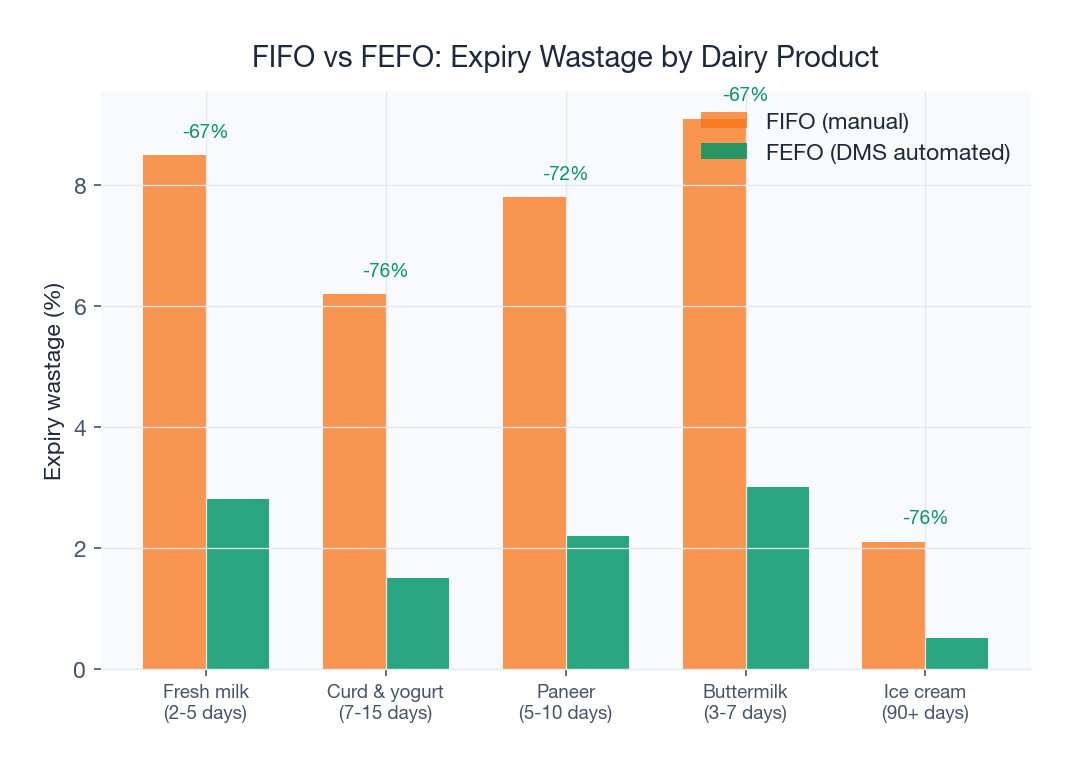
- First-in-first-out (FIFO) protocols at every storage point to minimize shelf life wastage
- Power backup for cold storage, require distributors in areas with unreliable electricity to have generator or inverter backup for their refrigeration units
- Seasonal planning, increase cold chain resources during summer months (April-June) when ambient temperatures peak
Building a stronger cold chain? SpireStock integrates distribution tracking, route optimization, and quality management to help dairy companies maintain cold chain integrity across their entire network. Book a free demo to see how it works for your specific operation. Check our pricing for plans that include full distribution tracking.
Measuring Cold Chain Performance
Track these metrics to evaluate and improve your cold chain:
- Temperature compliance rate, percentage of time products remain within prescribed temperature range (target: 98%+)
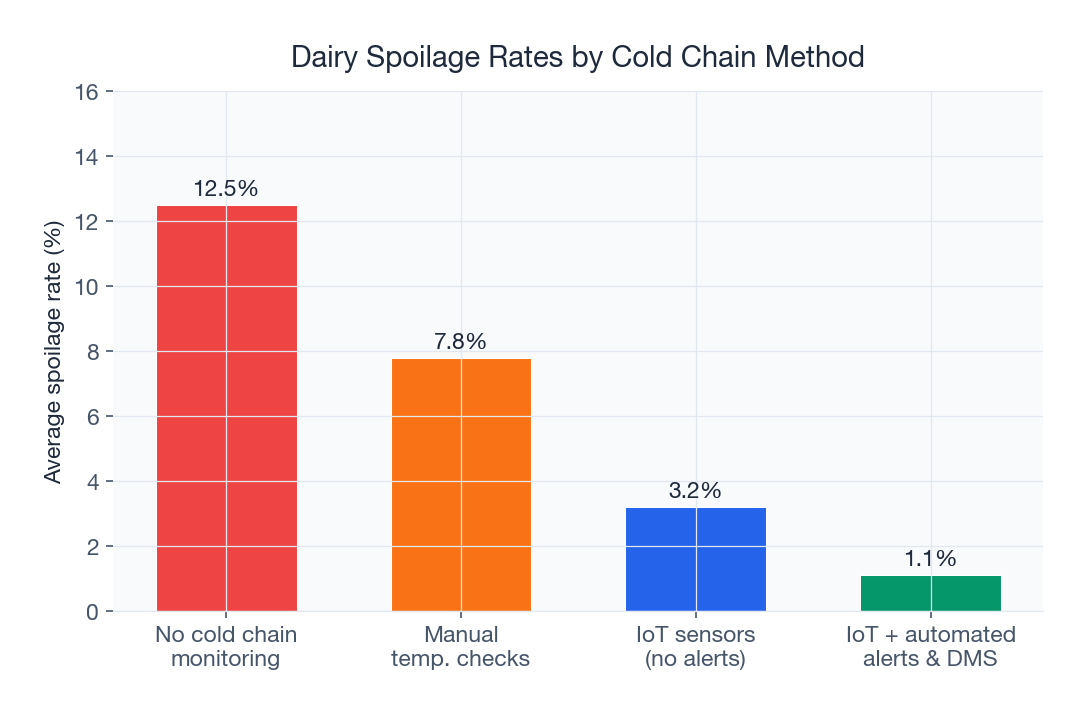
- Spoilage rate, percentage of products lost to cold chain failures (target: below 1%)
- Cold chain break incidents, number and duration of temperature excursions per week/month (target: zero)
- Return rate due to quality, products returned for quality issues linked to temperature problems (target: below 0.5%)
- Distributor cold storage compliance, percentage of distributors meeting cold chain infrastructure standards (target: 95%+)
- Vehicle pre-cooling compliance, percentage of vehicles reaching target temperature before loading (target: 100%)
Analytics dashboards that combine cold chain metrics with distribution data help you identify patterns, which routes, vehicles, or distributors have the most cold chain issues, and target improvements where they will have the most impact. The fleet management solution provides vehicle-level cold chain compliance scores alongside delivery performance metrics.
Real-World Implementation Scenarios
Cold chain excellence is built one deployment at a time. Three illustrative case studies show how Indian dairy operators are solving cold chain challenges through integrated technology.
Case Study 1: Konkan Fresh Dairy, Mumbai
Konkan Fresh Dairy operates 42 refrigerated vehicles across Mumbai and Pune, serving 3,400 retail outlets with products in the same category as Mother Dairy. Cold chain breakdowns were costing Rs 82 lakh annually in spoilage and customer complaints. After deploying SpireStock's fleet management solution with IoT temperature monitoring, cold chain breaks dropped 94%, spoilage fell to Rs 9 lakh annually, and return rates halved. Year-1 recovery: Rs 73 lakh against software cost of Rs 12 lakh.
Case Study 2: Karnataka Dairy Chain, Bangalore
Karnataka Dairy Chain distributes yogurt, paneer, and flavored milk through 165 distributors in Bangalore and Mysuru, operating in a market dominated by Nandini. Their distributor-level cold storage compliance was only 64%, meaning over a third of distributors were essentially breaking cold chain after delivery. The SpireStock compliance dashboard drove compliance to 94% within 6 months, reducing consumer-level complaints by 78%.
Case Study 3: North India Beverages, Delhi
North India Beverages operates dairy and packaged juice distribution across Delhi NCR with 75 refrigerated routes. Similar to the operational scale of brands like Parag Milk Foods, they needed end-to-end cold chain visibility. IoT sensors integrated with the platform flagged 23 potential cold chain incidents before they became actual breakdowns, recovering Rs 38 lakh of at-risk product in year one.
Cost & ROI Analysis
Cold chain management technology typically delivers a payback period of 4-7 months, with significant upside from brand trust and reduced regulatory risk:
| Benefit Area | Annual Value (INR) | Source |
|---|---|---|
| Spoilage reduction | Rs 25-80 lakh | 94% fewer cold chain breaks |
| Return rate improvement | Rs 8-22 lakh | Half the quality-driven returns |
| Customer complaint resolution | Rs 4-10 lakh | Reduced escalation workload |
| FSSAI penalty avoidance | Rs 3-12 lakh | Full compliance documentation |
| Insurance premium reduction | Rs 2-6 lakh | Lower risk profile |
| IoT + platform cost | (Rs 10-18 lakh) | Sensors + annual subscription |
| Net Year-1 benefit | Rs 32-112 lakh | Payback: 4-7 months |
Beyond the immediate financial return, cold chain technology protects brand equity, the long-term value of which far exceeds the measurable savings. This applies equally to dairy, beverages, fresh produce, and bakery operators. For related reading, see our crate management system guide.
Conclusion: Cold Chain Is Brand Chain
For the Indian dairy distribution industry, building a reliable cold chain is not optional, it is the foundation upon which product quality, consumer trust, and regulatory compliance all depend. Every broken cold chain link represents spoiled product, unhappy customers, and regulatory risk. The investment in cold chain technology and processes pays for itself many times over through reduced spoilage, fewer returns, and stronger brand reputation. For more on building efficient dairy distribution operations, read our articles on route optimization for milk delivery and dairy distribution software in India.
Sources & References
Frequently Asked Questions
Most liquid dairy products (milk, curd, buttermilk, lassi) should be stored at 2-4 degrees Celsius. Ice cream and frozen dairy require -18 degrees Celsius or below. Ghee and UHT milk can be stored at ambient temperature. Always follow FSSAI and manufacturer guidelines for specific products.
India loses an estimated 3-5% of total dairy production to cold chain failures, valued at thousands of crores annually. In some regions with poor infrastructure, spoilage rates can exceed 10%, making cold chain improvement one of the highest-ROI investments in the dairy sector.
Common sensors include Bluetooth Low Energy (BLE) temperature loggers, GSM/GPS-enabled temperature transmitters, and WiFi-connected sensors for fixed locations. These devices record temperature at configurable intervals and transmit data to cloud-based monitoring platforms.
Yes, FSSAI mandates that dairy businesses maintain proper cold chain throughout production, storage, and distribution. This includes maintaining temperature logs, ensuring vehicles and storage meet hygiene standards, and implementing HACCP-based food safety practices.
Costs have dropped significantly. Basic IoT temperature loggers start at Rs 2,000-5,000 per unit. Cloud-based monitoring platforms charge Rs 500-2,000 per month per location. The ROI from reduced spoilage and returns typically covers the investment within 2-3 months.
When temperature monitoring detects a breach, the system immediately alerts the driver and operations team. Depending on the duration and severity, products may be diverted to the nearest cold storage, recalled, or flagged for quality testing before distribution continues.
Yes, SpireStock's distribution tracking module can integrate with IoT temperature sensors, linking cold chain data to specific vehicles, routes, and deliveries. This enables automatic flagging of affected orders when cold chain incidents occur.
Conduct regular site visits checking refrigerator capacity vs. daily stock volume, temperature settings and actual readings, equipment maintenance records, power backup availability, and FIFO practices. Score distributors and require improvements where standards aren't met.
Related SpireStock Features
Related Solutions
GPS fleet tracking, driver management, and route optimization for dairy and FMCG delivery vehicles. Reduce fuel costs by 25%. Try SpireStock.
Manage your entire distributor network digitally. Onboarding, credit limits, outstanding tracking, and performance analytics. Start free trial.
Related Entities
Ready to Streamline Your Distribution?
Start your free 14-day trial and see how SpireStock can transform your dairy, FMCG or consumer-goods distribution operation, from order capture to crate recovery.

SpireStock Team
Product & Industry Insights
SpireStock Team leads product at SpireStock, where the team ships distribution management software for India's dairy, FMCG and consumer-goods brands.