The Digital State of Indian Dairy in 2026
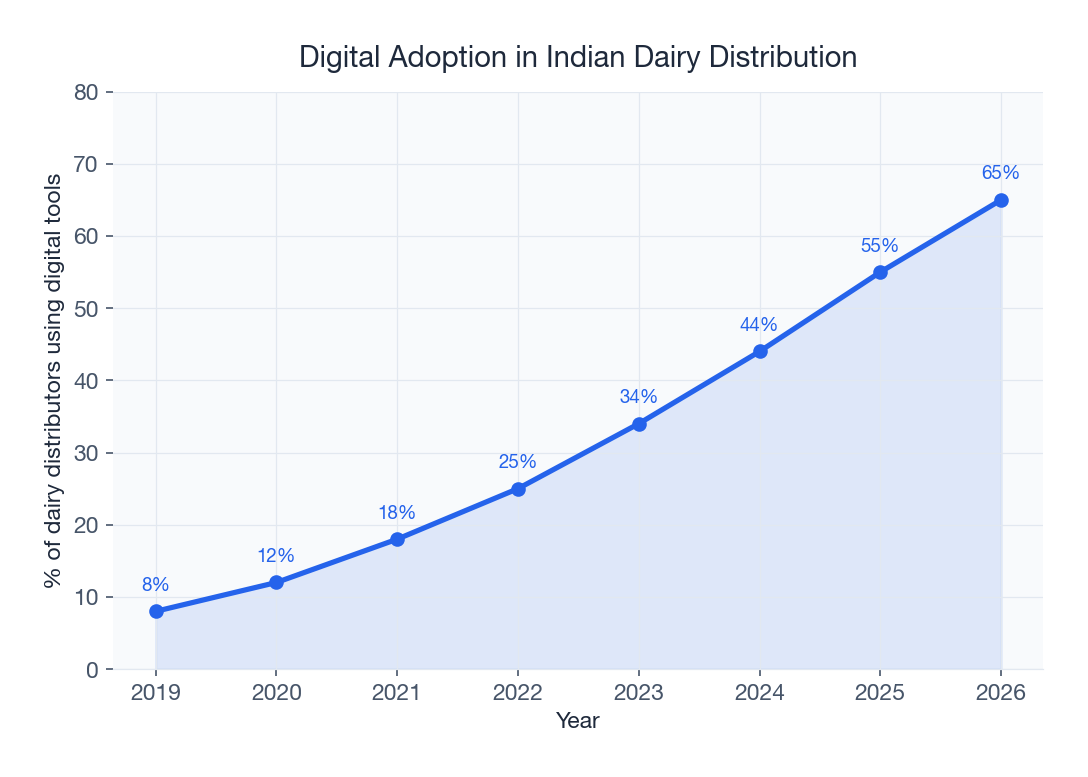
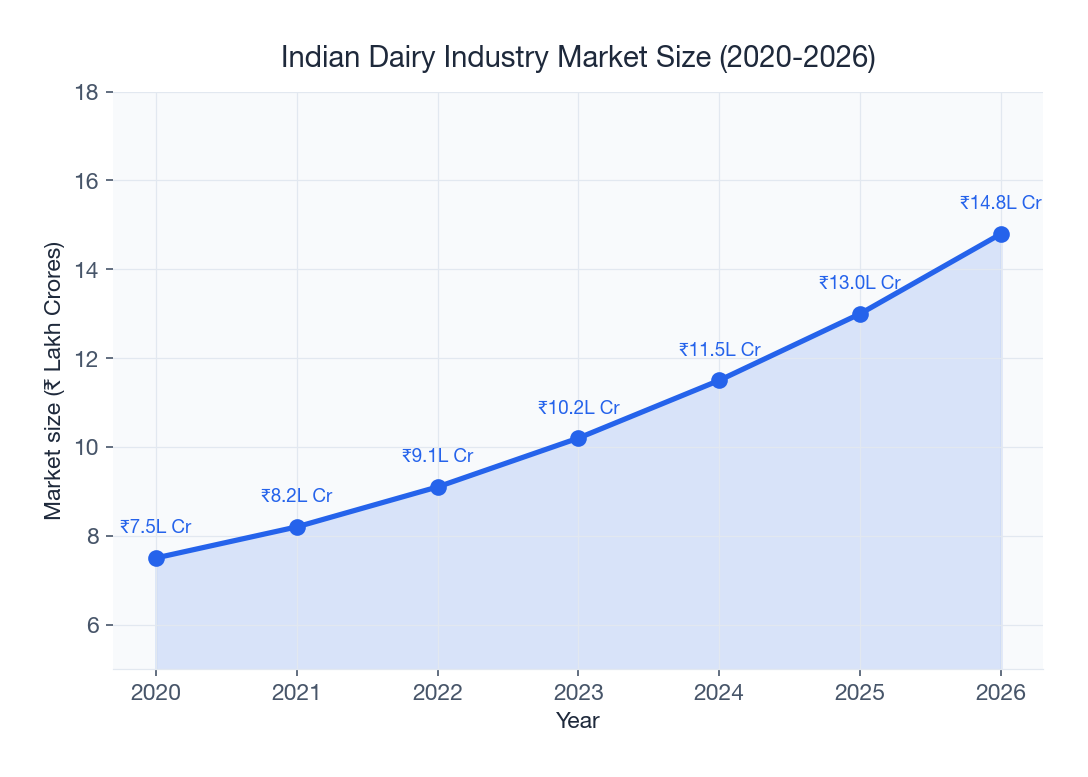
India's dairy industry, the world's largest at over Rs 15 lakh crore in annual turnover, is at a pivotal moment in its digital journey. While large cooperatives like Amul and Mother Dairy have invested in technology for years, the vast majority of India's 15 crore dairy farmers, thousands of processors, and lakhs of distributors still operate with minimal digital infrastructure. The gap between the digitally mature top 5% and everyone else is arguably the single biggest opportunity in Indian FMCG today, and the companies that close it first will pull away from the rest of the pack over the next decade.
The pace of change is accelerating. Cloud computing, affordable smartphones, widespread 4G and emerging 5G connectivity, and purpose-built SaaS platforms have made digital tools accessible to dairy businesses of every size. The question is no longer whether to digitize, but how fast and where to start. A Rs 80-crore regional dairy in Jaipur can now deploy the same software stack that a Rs 2,000-crore national player uses, at a fraction of the cost and in a fraction of the time. What used to require a crore and a year now takes a lakh and a month.
This transformation is not limited to dairy. Parallel shifts are underway across FMCG distribution, beverage distribution, bakery and confectionery, and fresh produce operators, all facing the same perishability and distribution complexity challenges that dairy companies have wrestled with for decades. The playbooks developed in dairy are being exported to every adjacent vertical, and technology partners are racing to meet demand.
Key Areas of Digital Transformation
Distribution and Supply Chain Digitization
This is the area seeing the most rapid adoption. Digital order management, delivery tracking, and automated billing are transforming how dairy products move from plant to consumer. Companies adopting these tools report 40-60% improvements in operational efficiency within the first six months of deployment, and the gains continue compounding as more workflows get digitized.
Field Force Enablement
Sales and delivery teams equipped with mobile apps and GPS tracking are dramatically more productive. Real-time communication between field teams and headquarters eliminates the information delays that have long plagued dairy distribution. A field officer in Chennai can now capture an order, issue a digital invoice, collect UPI payment, and update crate balances in under two minutes at each retail visit, work that used to take half a day of paperwork at the end of every shift.
Data-Driven Decision Making
Analytics platforms are giving dairy companies unprecedented visibility into their operations. From daily sales trends to distributor performance rankings, data is replacing gut feeling in management decisions. Regional heads no longer rely on end-of-month spreadsheets; they see performance unfold in real time and can intervene the same day a pattern emerges.
Cold Chain Monitoring
IoT sensors and cloud-based monitoring platforms are bringing transparency to the cold chain, traditionally one of the most opaque parts of dairy distribution. Real-time temperature monitoring reduces spoilage and ensures compliance with FSSAI requirements, turning a compliance headache into a competitive advantage. The best operators now share temperature logs with their largest retail customers as a quality guarantee.
Financial Digitization
UPI payments, digital invoicing, and automated GST compliance are digitizing the financial layer of dairy distribution. This is particularly impactful in reducing payment collection cycles and improving cash flow management. Distributors who used to pay by bearer cheque now settle via UPI within 24 hours of invoice generation, and reconciliation that used to take a full day per month now happens continuously in the background.
Barriers to Digital Adoption in Indian Dairy
- Technology literacy, many stakeholders in the dairy chain are not comfortable with digital tools, requiring intensive training and support
- Connectivity gaps, despite improvements, internet connectivity remains unreliable in many rural and semi-urban areas where dairy distribution operates
- Change resistance, established processes have deep inertia; convincing distributors and field staff to abandon paper takes persistent effort
- Cost perception, smaller operators perceive technology as expensive, not realizing that SaaS models have made it affordable at Rs 5,000-25,000 per month
- Fragmented industry, the highly fragmented nature of Indian dairy, with thousands of small processors, makes it harder to drive standardized digital adoption
- Integration complexity, connecting new tools to legacy Tally deployments and manual processes requires careful planning
The good news is every one of these barriers is solvable with the right partner, and the ROI window is short enough that objections typically evaporate once the first two months of data come in. Companies that start small and expand usage based on proven wins almost always succeed; companies that try to digitize everything at once often fail.
Adoption Maturity by Company Size
| Company Revenue | % Digitized (2024) | % Digitized (2026) | Primary Driver |
|---|---|---|---|
| Under Rs 50 crore | 8% | 22% | Distributor pressure |
| Rs 50-200 crore | 18% | 41% | Cost savings and growth |
| Rs 200-500 crore | 34% | 63% | Competitive pressure |
| Rs 500-2000 crore | 57% | 82% | Operational efficiency |
| Over Rs 2000 crore | 78% | 94% | Enterprise governance |
The inflection point is clearly at the Rs 50-200 crore band, where adoption is more than doubling over a two-year window. This is where the market is being redefined, and companies that miss this wave will struggle to catch up later.
Success Stories: Indian Dairy Companies Leading the Digital Charge
Forward-thinking dairy companies across India are proving the value of digital transformation:
- Regional dairy brands using SaaS DMS platforms to manage 500+ distributors with teams of just 5-10 people in headquarters, a 10x productivity gain over manual operations
- Cooperative dairies implementing digital milk procurement and quality testing at village collection centres in Gujarat and Karnataka, with automatic quality-based payment calculations
- Urban dairy startups using technology-first models to disrupt traditional distribution with direct-to-consumer delivery in Bangalore and Hyderabad
- Traditional processors digitizing their existing distribution networks to compete with organized players, often recovering the investment in six months or less
- Private-label producers using multi-tenant platforms to serve multiple customer brands from a single infrastructure
The pattern that emerges from all of these success stories is the same: start with one pain point (usually order management or crate tracking), prove the ROI within 60-90 days, then expand to adjacent workflows. Boiling the ocean never works; sequential wins do. A Nandini-affiliated distributor network ran this exact playbook in 2024 and saved Rs 1.4 crore in its first year.
The Technology Stack for a Modern Indian Dairy Company
A well-architected digital stack for dairy typically includes:
- Distribution Management System, order management, delivery tracking, crate management, scheme engine, and route optimization
- Accounting Software, Tally, Busy, or SAP for financial management
- Communication Platform, WhatsApp Business API, SMS gateway for stakeholder communication
- IoT Layer, temperature sensors and GPS trackers for cold chain and fleet monitoring
- Cloud Infrastructure, reliable, scalable hosting for all digital services
- Analytics and BI, dashboards that turn operational data into strategic insight
- Payment gateway, UPI, net banking, and card acceptance integrated with invoicing
The beauty of this stack is that each component is best-in-class, replaceable, and affordable. There is no single vendor lock-in, and you can swap any piece without disrupting the others, a stark contrast to the monolithic ERP deployments of the 2010s that locked companies into expensive, inflexible relationships.
Organizational Change: The Real Challenge
Technology is the easy part. The hard part is changing the habits of hundreds of people, field officers, distributor staff, delivery drivers, accountants, and regional managers, who have done things a certain way for years. Successful digital transformations invest as much in change management as in the software itself, which is why pure technology vendors without implementation capability rarely deliver lasting results.
Practical tactics include running a pilot in one zone before scaling, identifying champions at both headquarters and distributor level, publishing weekly adoption metrics, tying incentive payouts to digital usage, and celebrating early wins publicly. A Rs 320-crore dairy in Karnataka rolled out distributor management software across 180 distributors in 14 weeks by following exactly this playbook, and their field force adoption rate hit 94% within 60 days. Contrast that with companies that skipped change management and saw adoption stuck at 35% a year later, the technology was identical, but the outcome was night and day.
Financial Impact and ROI Expectations
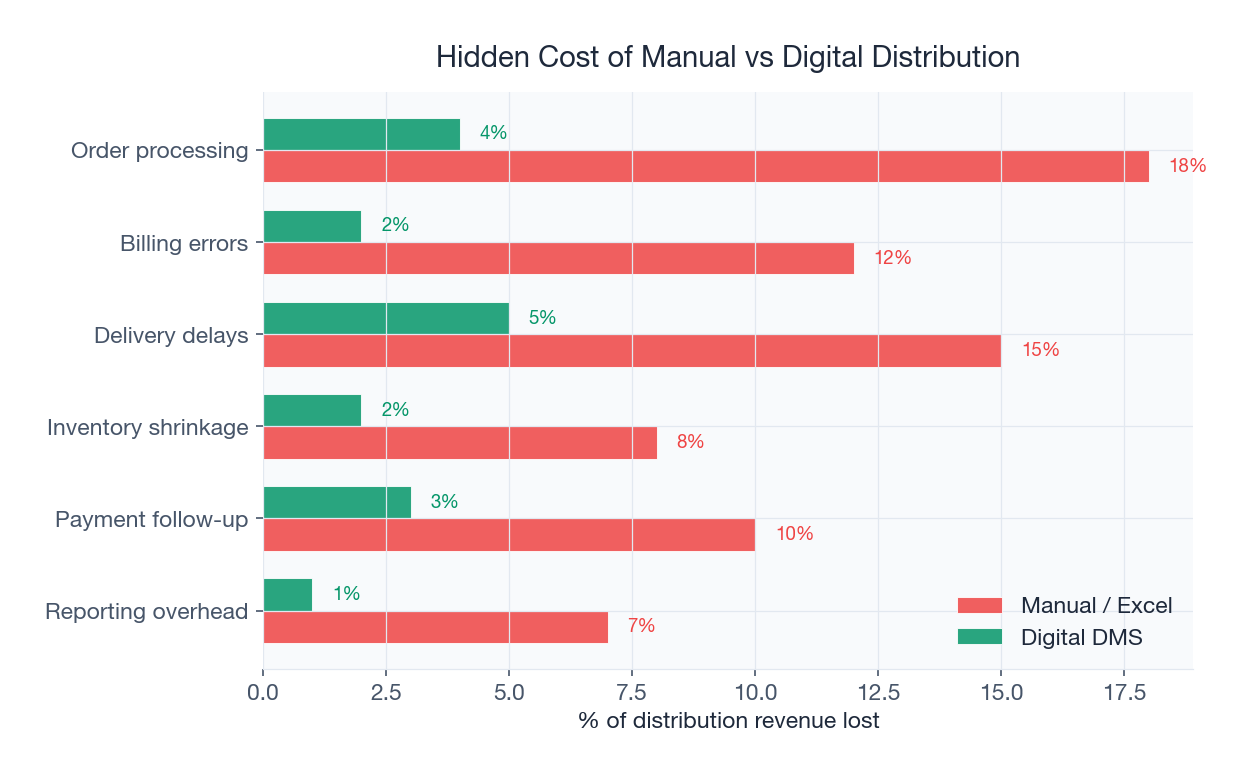
For a mid-sized dairy digitizing its distribution operations, the quantifiable financial benefits typically include 5-8% working capital release from faster collections, 1-2% margin improvement from reduced crate losses and waste, 30-50% reduction in back-office reconciliation effort, and 15-25% field productivity gains. Multiplied across a Rs 150-crore revenue base, these add up to Rs 2-5 crore in annual value from an investment of Rs 10-25 lakh per year. Payback inside 12 months is the norm; payback under six months is common for companies with significant crate pools or large distributor networks.
For a quantitative look at these economics, read our companion analysis on the complete dairy distribution software guide.
The Next Three Years: What to Expect
Between 2026 and 2029, expect AI-powered demand forecasting to become mainstream, blockchain-based traceability to gain traction for premium dairy products, and hyper-local digital marketplaces to emerge for dairy distribution. Companies that build strong digital foundations now will be best positioned to adopt these emerging technologies. Those that wait for the technology to mature will find themselves perpetually behind, because the infrastructure and data foundations required for AI and blockchain can only be built through years of disciplined digital operation.
The FMCG distribution landscape in India is being reshaped by technology. Dairy companies, with their complex perishable supply chains, stand to gain the most from this transformation. Read our companion analyses in ERP vs CRM vs DMS and SaaS vs on-premise for deeper tactical guidance on where to start your own digital journey.
Your Transformation Roadmap
If you are ready to begin your digital journey, talk to our team about a phased rollout tailored to your revenue band and network size. Review SpireStock pricing to understand the investment, and book a demo to see how modern SaaS distribution software could reshape your operations within a quarter. The companies that move now will set the pace for the next decade of Indian dairy and FMCG distribution.
Practical First-Month Roadmap
If you are ready to begin digital transformation but not sure where to start, here is a concrete first-month plan. Week 1: audit your current distribution workflow and identify the three biggest pain points (usually order capture, billing, and crate tracking). Week 2: evaluate 2-3 DMS vendors and run demos with your actual data. Week 3: pilot the chosen platform with your top 10 distributors in one territory. Week 4: measure baseline vs. pilot results and decide on full rollout. This four-week sprint typically generates enough internal momentum to carry the next six months of transformation.
The companies that succeed treat digital transformation as a sequence of small wins rather than a big-bang project. The companies that fail try to change everything at once and stall within the first quarter. Pick the right scope, prove value fast, then expand.
Measuring What Matters
Set clear baseline metrics before you start so you can quantify transformation impact. Key metrics to capture: average order processing time, invoice accuracy rate, days sales outstanding, field force productive hours, crate return rate, and scheme claim accuracy. Measure these monthly through the transformation journey and publish the numbers internally. Transparent measurement keeps the organization aligned and makes it easier to get funding for the next phase of digital investment from your board or promoters.
The Role of Government Initiatives
Government programs are accelerating digital adoption in Indian dairy. Initiatives like the National Digital Livestock Mission, e-NAM for agricultural trade, and various state-level dairy digitization projects are creating infrastructure that private companies can build on. NDDB's work on digital milk quality testing, village-level collection centre digitization, and traceability pilots is particularly valuable for the cooperative sector. Private dairy companies should track these initiatives and participate where possible, many offer subsidies, pilot funding, or access to shared infrastructure that dramatically reduces the cost of digital transformation.
Working With Technology Partners
Most dairy companies do not have large internal IT teams, and digital transformation works best when you find a technology partner that genuinely understands the industry. Look for partners who have deployed similar systems in dairy or adjacent FMCG verticals, who can commit to an implementation team with India-specific experience, and who demonstrate an ongoing investment in product evolution rather than one-time delivery. The wrong partner can stall a project for months; the right partner can ship a working pilot in weeks.
Sources & References
Frequently Asked Questions
While large cooperatives and organized players have made significant progress, the overall industry is still in early stages of digital adoption. Approximately 20-25% of medium-to-large dairy companies use distribution management software, while the majority of small processors still operate manually.
Start with distribution management, order processing, delivery tracking, and invoicing. These areas have the most manual work, highest error rates, and fastest ROI. Once distribution is digitized, expand to cold chain monitoring, advanced analytics, and field force management.
A mid-sized dairy company (Rs 50-200 crore revenue) should budget Rs 5-15 lakh annually for core distribution technology (SaaS subscription, training, integration). This is typically 0.1-0.3% of revenue and delivers 10-20x ROI through efficiency gains.
Yes, reputable SaaS providers use bank-grade encryption, regular backups, and enterprise security practices. Cloud infrastructure from providers like AWS, Azure, and Google Cloud is typically more secure than on-premise servers maintained by small IT teams.
Phase 1 (core distribution digitization) takes 4-8 weeks. Phase 2 (advanced analytics, cold chain integration) takes another 2-3 months. Full digital maturity, including AI-powered forecasting and comprehensive IoT deployment, is a 12-18 month journey.
AI is increasingly used for demand forecasting (predicting order volumes), route optimization (calculating efficient delivery sequences), anomaly detection (flagging unusual patterns in orders or payments), and predictive maintenance (anticipating vehicle or equipment failures before they occur).
Absolutely. Digital systems can track quality parameters from collection to delivery, fat content, SNF levels, adulteration test results, temperature compliance, and shelf life. This data creates accountability and helps identify quality issues early in the chain.
Related SpireStock Features
Related Solutions
Manage your entire distributor network digitally. Onboarding, credit limits, outstanding tracking, and performance analytics. Start free trial.
Boost field sales team productivity with beat planning, GPS attendance, order capture, and performance analytics. Built for Indian FMCG teams.
Related Entities
Ready to Streamline Your Distribution?
Start your free 14-day trial and see how SpireStock can transform your dairy, FMCG or consumer-goods distribution operation, from order capture to crate recovery.

SpireStock Team
Product & Industry Insights
SpireStock Team leads product at SpireStock, where the team ships distribution management software for India's dairy, FMCG and consumer-goods brands.