Channel Conflict: The #1 Strategic Headache in Indian FMCG Distribution
In 2026, a typical Indian FMCG product reaches consumers through at least five channels: general trade (GT) kirana stores, modern trade (MT) supermarkets and hypermarkets, e-commerce marketplaces, direct-to-consumer (D2C) websites, and quick commerce platforms like Blinkit and Zepto. Each channel has different pricing, margins, promotional mechanics, and consumer expectations. And that's where the conflict begins.
When a retailer in Mumbai discovers that the same product they sell for ₹120 is available on quick commerce at ₹99 with a coupon, trust shatters. When a distributor in Delhi finds that the brand is selling directly to large retailers in their assigned territory, they feel betrayed. When a modern trade chain demands a 15% margin that undercuts the general trade MRP, the entire pricing architecture collapses.
Channel conflict isn't new, but its intensity in Indian FMCG has reached crisis levels. The explosion of digital commerce channels, combined with India's uniquely complex distribution ecosystem of over 7.5 million retail touchpoints, has made conflict management a survival skill — not just for brands, but for every distributor in the chain.
Understanding the Three Types of Channel Conflict
| Conflict Type | Definition | Common Indian FMCG Example | Severity in 2026 |
|---|---|---|---|
| Vertical Conflict | Between different levels of the same channel (brand vs. distributor, distributor vs. retailer) | Brand launches D2C store undercutting distributor pricing; brand reduces distributor margin to fund MT discounts | Critical |
| Horizontal Conflict | Between entities at the same level (distributor vs. distributor, retailer vs. retailer) | Two distributors servicing overlapping territories in Bangalore; kirana store vs. neighboring kirana on pricing | High |
| Multichannel Conflict | Between different channel types serving the same consumer | GT vs. MT vs. D2C vs. quick commerce — same product at different prices, different pack sizes, different schemes | Critical |
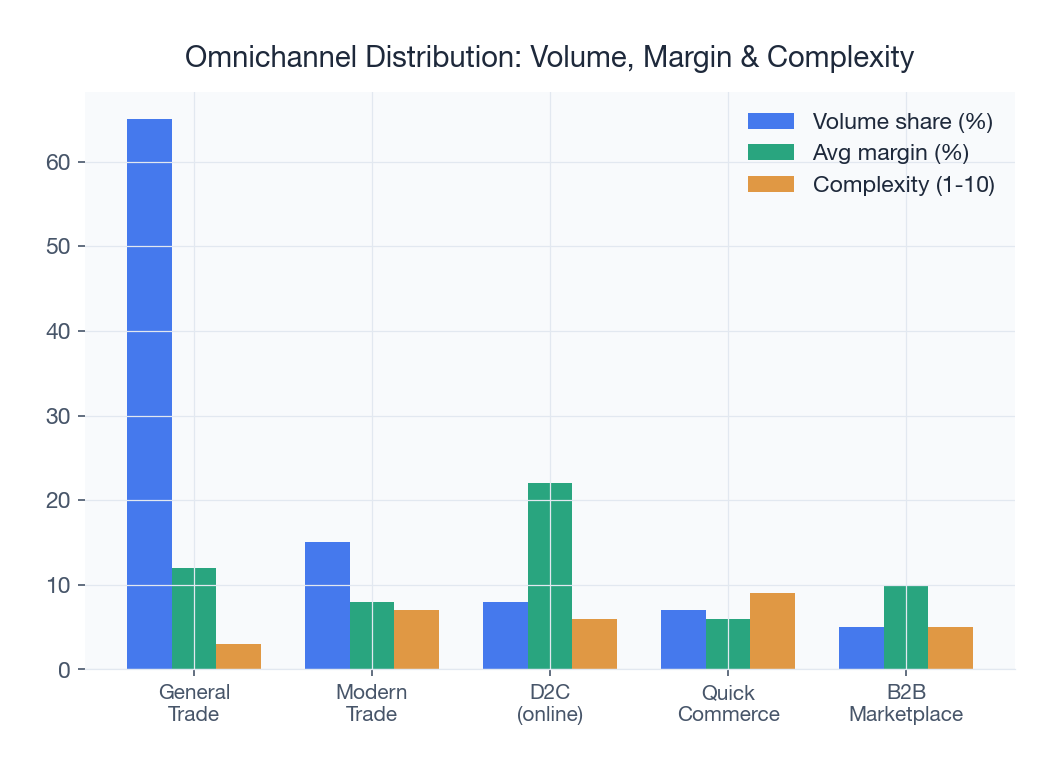
Each type requires different management strategies, but in practice, Indian FMCG companies face all three simultaneously. Let's unpack the root causes before discussing solutions.
Root Cause #1: Pricing Disparity Across Channels
This is the mother of all channel conflicts. When brands offer different trade margins, promotional allowances, and scheme structures across channels, price arbitrage becomes inevitable. The math tells the story:
| Channel | Typical Brand Margin to Channel | Consumer Price (₹100 MRP Product) | Effective Discount to Consumer |
|---|---|---|---|
| General Trade (Kirana) | 8-12% | ₹98-100 | 0-2% |
| Modern Trade (Supermarket) | 18-25% | ₹85-95 | 5-15% |
| E-commerce (Amazon/Flipkart) | 15-20% | ₹80-92 | 8-20% |
| Quick Commerce (Blinkit/Zepto) | 20-30% | ₹85-99 | 1-15% |
| D2C (Brand Website) | N/A (brand's own margin) | ₹75-90 | 10-25% |
The problem is immediately visible. A GT retailer buying from a distributor gets 8-12% margin and sells near MRP. A modern trade chain negotiates 18-25% and runs promotions at ₹85. A consumer comparing prices on their phone sees a ₹15 difference and walks out of the kirana store. The kirana owner blames the distributor. The distributor blames the brand. Trust erodes at every level.
Key insight: In Indian FMCG, the real channel conflict isn't between retailers — it's between the brand's short-term volume ambitions across new channels and the long-term health of its traditional distribution network that still delivers 65-70% of total volume.
Root Cause #2: Territory Violations and Unauthorized Selling
Territory management is foundational to FMCG distribution, yet violations are rampant. A well-defined territory structure is supposed to ensure each distributor has a protected market. In reality, the lines blur constantly.
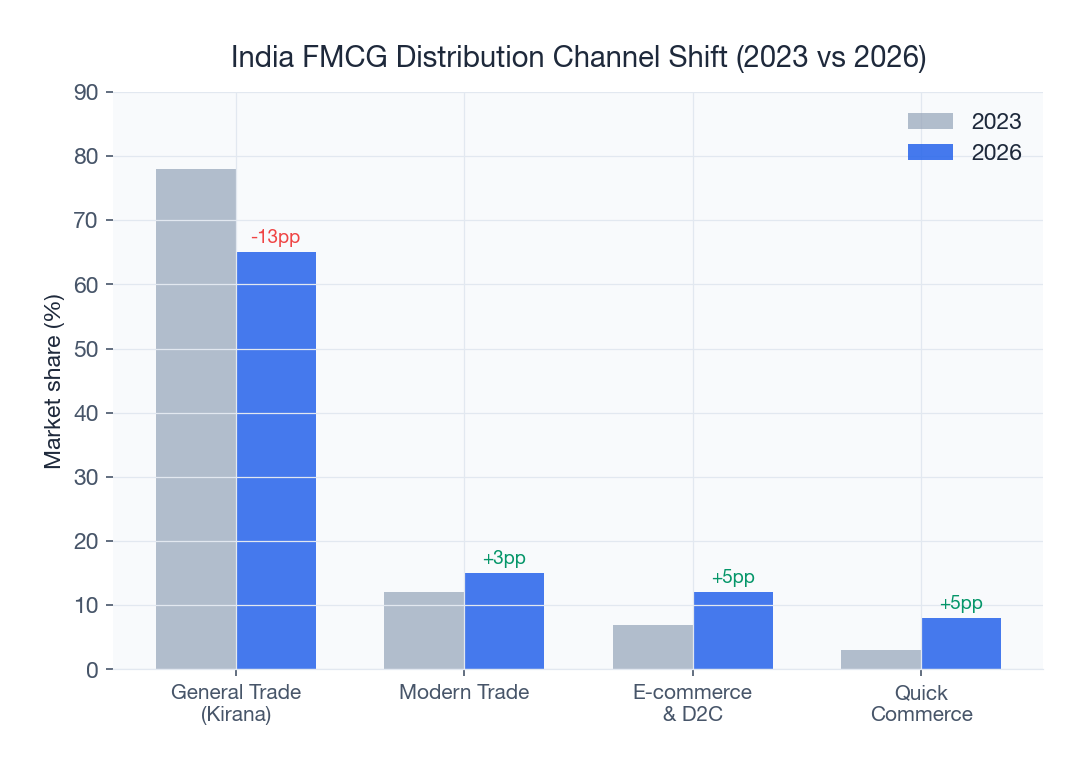
Common territory violation scenarios in Indian FMCG:
- Distributor-to-distributor leakage: Distributor A in Pune offers an extra 2% discount to retailers in Distributor B's territory to hit their monthly target. This is especially common in months when brands announce sales officer incentives tied to billing targets.
- Wholesaler dumping: Wholesalers or semi-wholesalers buy in bulk during scheme periods and resell across territories at razor-thin margins, undermining designated distributors.
- E-commerce arbitrage: Products meant for specific regional markets appear on national e-commerce platforms at disrupted prices. A ₹10 shampoo sachet bundled at ₹90 for a pack of 10 in Chennai shows up on Amazon at ₹75 shipped nationally.
- Brand-direct modern trade supply: The brand supplies D-Mart or Reliance Retail directly, bypassing the distributor whose territory includes those stores.
Without proper distribution tracking, most distributors don't even know they're losing volume to territory violations until the damage is significant — a 10-15% drop in monthly orders from affected retailers.
Root Cause #3: Direct Selling by Brand Companies
The most contentious form of channel conflict occurs when the brand itself becomes a competitor to its distributors. In the last three years, dozens of Indian FMCG brands including startups and legacy players have launched D2C channels, supplied quick commerce platforms directly, or set up their own van-sales operations in select cities.
From the brand's perspective, it's a rational move: D2C gives them consumer data, higher margins, and control over the brand experience. From the distributor's perspective, it's a betrayal — they invested capital, built retailer relationships, and grew the brand in their territory, only to have the brand bypass them when the market matured.
The impact on distributors is measurable. A study by RedSeer Consulting found that in categories where brands launched aggressive D2C channels, distributor volume growth slowed by 8-12 percentage points compared to categories without D2C disruption. In cities like Hyderabad and Bangalore with high digital penetration, the impact was even more pronounced.
Root Cause #4: Scheme and Promotion Inconsistency
Brands frequently run different promotional schemes across channels without coordinating the timing or terms. A "buy 2 get 1 free" offer on modern trade shelves alongside a flat 10% discount on e-commerce while GT gets a trade scheme that translates to only 5% creates visible inequity. Retailers in Nagpur and Coimbatore report that consumers increasingly use smartphones to compare deals in real time — standing inside a kirana store while checking quick commerce prices.
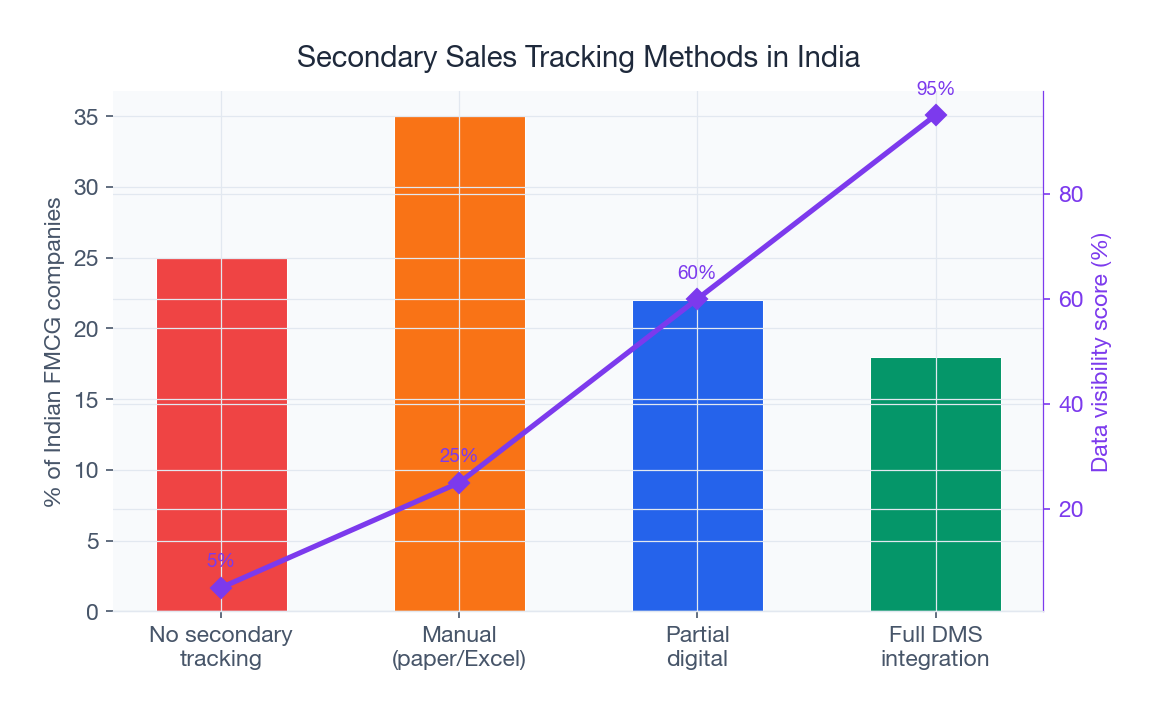
The problem extends to trade schemes as well. When brands like Haldiram's or Bisleri offer volume-based incentives that disproportionately reward large MT accounts over smaller GT distributors, horizontal resentment builds. A GT distributor billing ₹15 lakh per month might earn a 1% bonus, while a modern trade chain billing ₹1 crore gets a 3% bonus — the scale disadvantage compounds the already uneven playing field.
Understanding the nuances of FMCG scheme management is essential for both brands and distributors to navigate this complexity without triggering conflict.
Real Examples of Channel Conflict in Indian FMCG
The GT vs. Quick Commerce Pricing War
In early 2025, several major FMCG brands ran deep-discount promotions exclusively on quick commerce platforms during IPL season. Products that kiranas sold at ₹45 were available at ₹32 on Blinkit with platform-funded discounts. Kirana store owners in Mumbai reported a 20-25% drop in packaged snack sales during this period. Distributor associations in Maharashtra formally protested to brands, threatening to halt purchases.
The Modern Trade Margin Squeeze
A leading dairy brand expanded its modern trade presence aggressively in 2024, offering MT chains 22-25% margins compared to the 10-12% offered to GT distributors. The MT chains used the extra margin to run ₹5-off promotions on bestselling SKUs. Distributors serving dairy distribution in cities like Ahmedabad and Jaipur saw their top retailers reduce order frequency as consumers shifted to nearby supermarkets for daily dairy purchases.
The D2C Territory Overlap
A popular health and nutrition brand with a strong GT distribution network launched a D2C subscription service offering 15% lower prices plus free delivery. Distributors who had built the brand's market presence over 5+ years saw their retailers complain about being unable to match D2C pricing. Several distributors in Kolkata and Lucknow dropped the brand entirely, creating stock-out situations in GT that further pushed consumers to D2C — a vicious cycle.
Conflict Detection: What to Monitor and How
You can't manage what you can't measure. Here's a systematic conflict detection checklist that every distributor and brand manager should implement:
| Conflict Indicator | What to Monitor | Detection Method | Action Threshold |
|---|---|---|---|
| Price undercutting | Consumer prices across channels for top 50 SKUs | Weekly price audit (online + offline) | Price variance > 10% between channels |
| Territory leakage | Orders from retailers in your territory declining | Sales analytics — retailer order frequency trends | >15% drop in order frequency from any beat |
| Unauthorized stock | Your branded stock appearing in non-designated outlets or platforms | Batch number tracking, market visits | Any batch from your allotment found outside territory |
| Scheme arbitrage | Sudden spike in purchases during scheme periods from specific parties | Order pattern analysis | >3x normal purchase volume from any single party |
| MT/GT price gap | Modern trade retail price vs. kirana retail price | Retailer feedback, market surveys | MT selling below GT cost price |
| D2C impact | Sales velocity decline in areas with D2C availability | Pin code-level sales trending | >10% volume decline in D2C-active pin codes |
Resolution Strategy #1: Differentiated Product and Pricing Architecture
The most effective conflict prevention strategy is ensuring that different channels don't compete on identical products. This is how leading Indian FMCG brands manage it:
- Channel-exclusive SKUs: Create different pack sizes, bundle configurations, or product variants for GT, MT, and online. For example, a 200g pack for GT, a 250g "value pack" for MT, and a 180g "trial pack" for D2C. Brands like ITC and Dabur have successfully used this approach.
- Differentiated MRPs: Instead of one MRP across channels with varying discounts, print different MRPs on channel-specific packs. A ₹95 MRP for the GT pack and ₹89 for the MT pack makes the price difference legitimate, not predatory.
- Scheme separation: Run different scheme structures per channel. GT gets buy-one-get-free on specific SKUs; MT gets percentage discounts on different SKUs. No direct price comparison is possible.
Key insight: The goal isn't to eliminate price differences between channels — that's impossible and undesirable. The goal is to make direct price comparisons difficult by ensuring each channel offers a differentiated value proposition through unique SKUs, pack sizes, or bundle configurations.
Resolution Strategy #2: Territory Protection Through Data
Vague territory agreements invite violations. Modern distribution demands pin code-level territory definition with data-backed enforcement. Here's how:
- GPS-tracked sales visits: Use attendance and location tracking to verify that your salespeople operate within defined territories — and to provide evidence when competitors' salespeople encroach on your area.
- Batch-level traceability: Assign specific batches to specific distributors. When those batches appear outside designated territories, the source of leakage is identifiable.
- Retailer-level order mapping: Maintain a digital record of every retailer in your territory with their order history. If a retailer stops ordering, investigate immediately — they may be getting supplied by an unauthorized source.
- Multi-tenant visibility: Brands using multi-tenant workspace platforms can monitor cross-territory patterns without compromising individual distributor data privacy.
Resolution Strategy #3: Minimum Advertised Price (MAP) Policies
MAP policies — where brands specify the minimum price at which a product can be advertised and sold — are gaining traction in Indian FMCG. While legally complex in India (unlike the US where MAP is well-established), brands can enforce pricing discipline through contractual agreements with channel partners.
Implementing MAP in Indian FMCG
- Clear contractual terms: Distribution agreements should specify minimum selling prices and penalties for violations.
- Monitoring infrastructure: Use technology to track online prices daily and conduct weekly offline audits in key markets.
- Graduated enforcement: First violation gets a warning, second reduces scheme benefits, third can lead to supply restrictions.
- Platform-level agreements: Negotiate with e-commerce and quick commerce platforms to prevent below-MAP pricing, including platform-funded discounts that undercut GT.
Resolution Strategy #4: Distributor Compensation for Channel Cannibalization
When a brand's D2C or digital commerce channel genuinely cannibalizes distributor volume, fair compensation is essential to maintain the distribution network. Progressive brands are implementing:
- Hybrid margin models: Distributors receive a reduced margin on D2C orders fulfilled from their territory, even if they didn't process the order. This acknowledges their role in building brand awareness.
- Digital order routing: Online orders within a distributor's territory are routed through the distributor's inventory for fulfillment, preserving their role and margin.
- Growth incentives: Bonuses tied to total territory growth (all channels combined) rather than just GT billing, aligning distributor interests with omnichannel expansion.
- Market development funds: Brands contribute to distributor-managed local promotions that drive foot traffic to GT retailers, supporting the channel that still delivers the bulk of volume.
Resolution Strategy #5: Structured Communication and Governance
Many channel conflicts escalate because there's no formal mechanism for raising and resolving grievances. Successful brands create structured governance:
- Monthly channel review meetings: Include representation from GT distributors, MT key account managers, and digital commerce teams. Share channel-wise performance data transparently.
- Distributor advisory councils: Form regional councils of top distributors who provide input on pricing, schemes, and channel strategy before decisions are made.
- Conflict resolution SLA: Define timelines — territory violation complaints addressed within 7 days, pricing disputes within 14 days, structural changes communicated 30 days in advance.
- Data-driven discussions: Replace emotional arguments with analytical evidence. When a distributor claims territory encroachment, the data should clearly show the pattern.
The Role of DMS Software in Channel Conflict Management
Distribution management software has emerged as the critical infrastructure for both detecting and managing channel conflicts. Here's specifically how a modern DMS platform helps:
- Real-time territory analytics: Pin code-level sales data makes it immediately visible when territory patterns change. A distributor in Indore can see exactly which retailers are reducing orders and correlate it with potential leakage.
- Scheme compliance tracking: Automated scheme application through a scheme management engine ensures all retailers get correct scheme benefits, eliminating the "my competitor's distributor offers better schemes" complaint.
- Price monitoring: Digital invoicing creates a complete record of selling prices, making it possible to identify when products enter the market below agreed thresholds.
- Multi-channel order management: For brands pursuing an omnichannel distribution strategy, a unified platform ensures inventory allocation doesn't inadvertently starve one channel to feed another.
- Retailer-level intelligence: Retailer tracking data reveals which outlets are being served by multiple sources, quantifying the extent of horizontal conflict.
Key insight: Channel conflict management without data is just politics. The brands and distributors that invest in real-time distribution analytics can resolve conflicts based on evidence rather than accusations, leading to faster resolution and fairer outcomes for all channel partners.
The Cost of Unmanaged Channel Conflict
Before we discuss how to build resilience, it's worth quantifying what unmanaged channel conflict actually costs the Indian FMCG ecosystem:
| Cost Category | Impact on Distributor | Impact on Brand | Estimated Annual Cost (Mid-Size Distributor) |
|---|---|---|---|
| Volume loss from price undercutting | 5-15% revenue decline in affected SKUs | GT network deterioration, reduced reach | ₹8-20 Lakh |
| Territory leakage | 10-20% margin erosion from price competition | Distributor attrition, service gaps | ₹5-12 Lakh |
| Retailer relationship damage | Loss of key accounts, reduced loyalty | Shelf space reduction, competitor entry | ₹3-8 Lakh (indirect) |
| Management time on conflict resolution | 15-20% of owner's time spent on disputes | ASM bandwidth consumed by grievances | ₹2-4 Lakh (opportunity cost) |
A mid-size FMCG distributor in a metro city can lose ₹18-44 lakh annually to unmanaged channel conflict — often more than their net profit. For brands, the aggregate cost across hundreds of distributors runs into crores, not counting the harder-to-measure damage to distribution network morale and commitment.
Building a Conflict-Resilient Distribution Network
Channel conflict in Indian FMCG is not going away — if anything, it will intensify as digital channels grow. The distributors and brands that thrive will be those who accept multichannel reality and build systems to manage it, rather than pretending it doesn't exist or fighting to preserve a single-channel world that no longer exists.
For distributors, the action items are clear: demand clear territory agreements with pin code specificity, invest in data systems that document your coverage and market development, diversify across brands so no single brand's channel decisions can destroy your business, and participate actively in brand governance forums where channel strategy is discussed. Understanding why distributors fail often comes down to not managing these strategic risks proactively.
For brands, the imperative is equally clear: protect the GT distribution network that still delivers the majority of your volume, compensate distributors fairly when new channels cannibalize their markets, use differentiated products and pricing to minimize direct channel competition, and invest in technology that provides transparent data to all channel partners.
The distribution challenges of 2026 are fundamentally different from those of even five years ago. But with the right strategy, data infrastructure, and governance frameworks, channel conflict can be managed from a destructive force into a productive tension that drives innovation and better consumer outcomes across all channels.
Managing channel conflicts across your distribution network? Connect with our distribution strategy experts to see how SpireStock provides the analytics and territory management tools you need, or view our pricing plans designed for multi-channel FMCG operations.
Sources & References
- RedSeer Consulting — India FMCG Omnichannel Distribution Report 2025
- Nielsen India — Modern Trade vs General Trade Performance Review 2025
- Federation of Indian Chambers of Commerce and Industry (FICCI) — Channel Strategy in Indian FMCG 2025
Frequently Asked Questions
Channel conflict occurs when different distribution channels — general trade, modern trade, e-commerce, D2C, and quick commerce — compete against each other for the same consumers, typically through pricing differences. It creates tension between brands, distributors, and retailers.
There are three types: vertical conflict (between different levels like brand vs. distributor), horizontal conflict (between same-level entities like two distributors in overlapping territories), and multichannel conflict (between different channel types like GT vs. MT vs. D2C).
Modern trade chains negotiate 18-25% margins from brands compared to 8-12% for GT distributors. This margin gap enables MT to run consumer promotions at prices below what kirana stores can offer, driving consumers away from traditional retail and reducing GT distributor volumes.
Effective strategies include channel-exclusive SKUs with different pack sizes, differentiated pricing architectures, MAP (Minimum Advertised Price) policies, territory protection with pin code-level agreements, and distributor compensation models for D2C cannibalization.
DMS platforms provide real-time territory analytics, automated scheme compliance tracking, price monitoring through digital invoicing, multi-channel order management, and retailer-level intelligence that quantifies conflict impact with data rather than assumptions.
MAP is a brand policy specifying the minimum price at which a product can be advertised and sold across channels. It prevents deep discounting by any single channel that would undercut other channel partners, though enforcement in India requires strong contractual agreements.
Key protections include written agreements with pin code-level specificity, GPS-tracked sales visits for evidence, batch-level product traceability, digital retailer order mapping to detect volume shifts, and active participation in distributor associations for collective bargaining.
Yes, as quick commerce and D2C channels continue growing at 40-50% annually while GT grows at 5-8%, conflict will intensify. However, brands and distributors investing in data-driven conflict management and differentiated channel strategies can manage it as productive tension.
Related SpireStock Features
Powerful dashboards with sales trends, MIS reports, and distribution analytics.
Isolated workspaces for each customer with custom branding and configuration.
Real-time GPS tracking of vehicles and drivers with route optimization for faster deliveries.
Related Industries
Streamline FMCG distribution with order management, beat planning, retailer tracking, and GST billing. Built for Indian FMCG supply chains.
Distribution management for consumer goods brands. Manage distributors, retailers, schemes, and sales analytics across India. Start free trial.
Manage beverage distribution with cold chain tracking, crate management, route optimization, and real-time delivery monitoring. Try SpireStock free.
Related Solutions
Manage your entire distributor network digitally. Onboarding, credit limits, outstanding tracking, and performance analytics. Start free trial.
Track and manage your retail network. Geo-tag outlets, capture secondary sales, manage beats, and monitor retailer performance. Try SpireStock.
Automate trade schemes, incentives, and promotional offers. Flat, bulk-pack, quantitative, and FOC schemes with ROI tracking. Try SpireStock.
Related Entities
Ready to Streamline Your Distribution?
Start your free 14-day trial and see how SpireStock can transform your dairy, FMCG or consumer-goods distribution operation, from order capture to crate recovery.

SpireStock Team
Distribution Technology Experts
SpireStock Team writes for SpireStock on distribution management, supply-chain optimisation and field operations for Indian dairy and FMCG brands.