Why Small Distributors in India Are Stuck Between Paper and Enterprise Software
India has over 7 million distributors and sub-distributors, and the vast majority are small businesses. A typical small distributor handles Rs 50 lakh to Rs 5 crore in annual turnover, employs 3-15 people, manages 50-300 retail outlets, and operates 1-5 delivery vehicles. These businesses form the backbone of India's FMCG distribution network, delivering everything from milk to biscuits to soap in cities like Lucknow, Surat, and Pune.
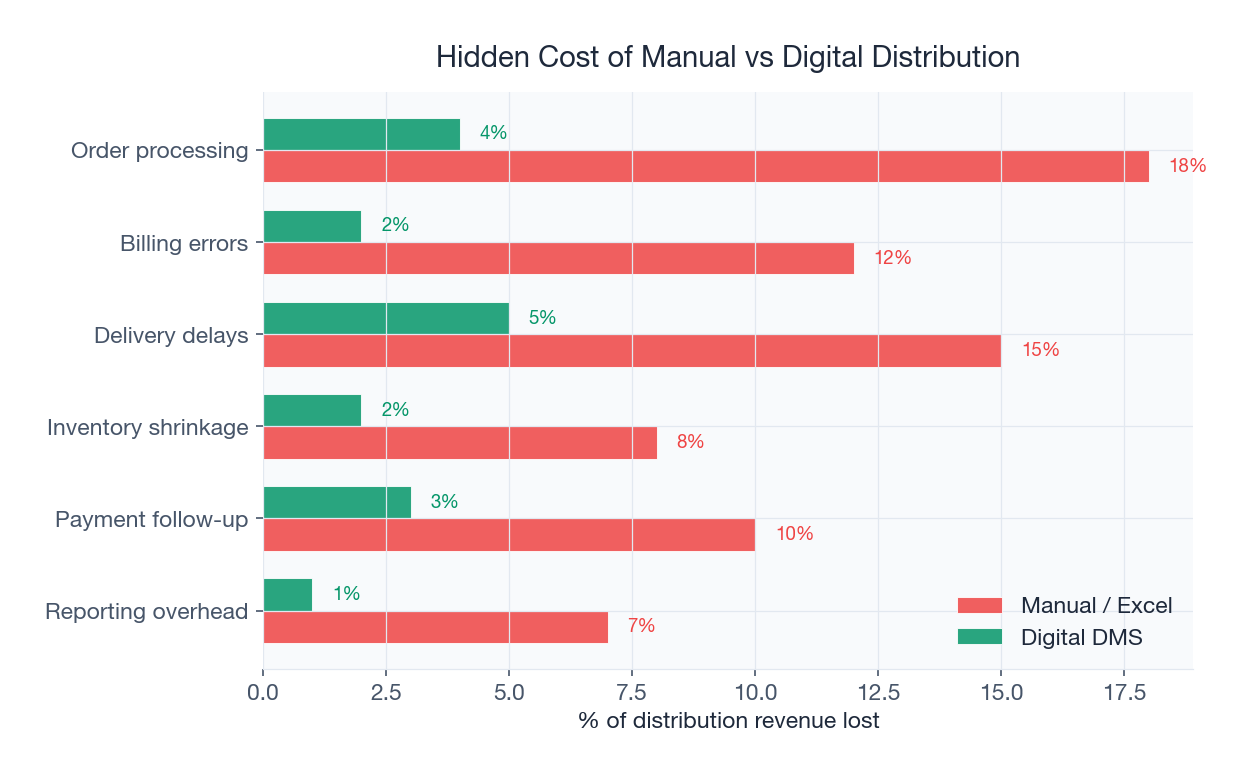
Yet these small distributors face a painful technology gap. On one side, they have outgrown paper registers and WhatsApp-based order management — the errors, disputes, and inefficiencies are costing them real money. On the other side, enterprise distribution software designed for companies with Rs 100+ crore turnover is too expensive (Rs 5-15 lakh annually), too complex (6-month implementations), and too feature-heavy (90% of capabilities never used).
The result? Most small distributors continue limping along with manual processes, losing Rs 3-8 lakh annually to inefficiencies they know exist but feel powerless to fix. This guide helps small business owners find the right balance — affordable, practical distribution software that solves real problems without overwhelming their teams or budgets.
What Small Distributors Actually Need vs Enterprise Features
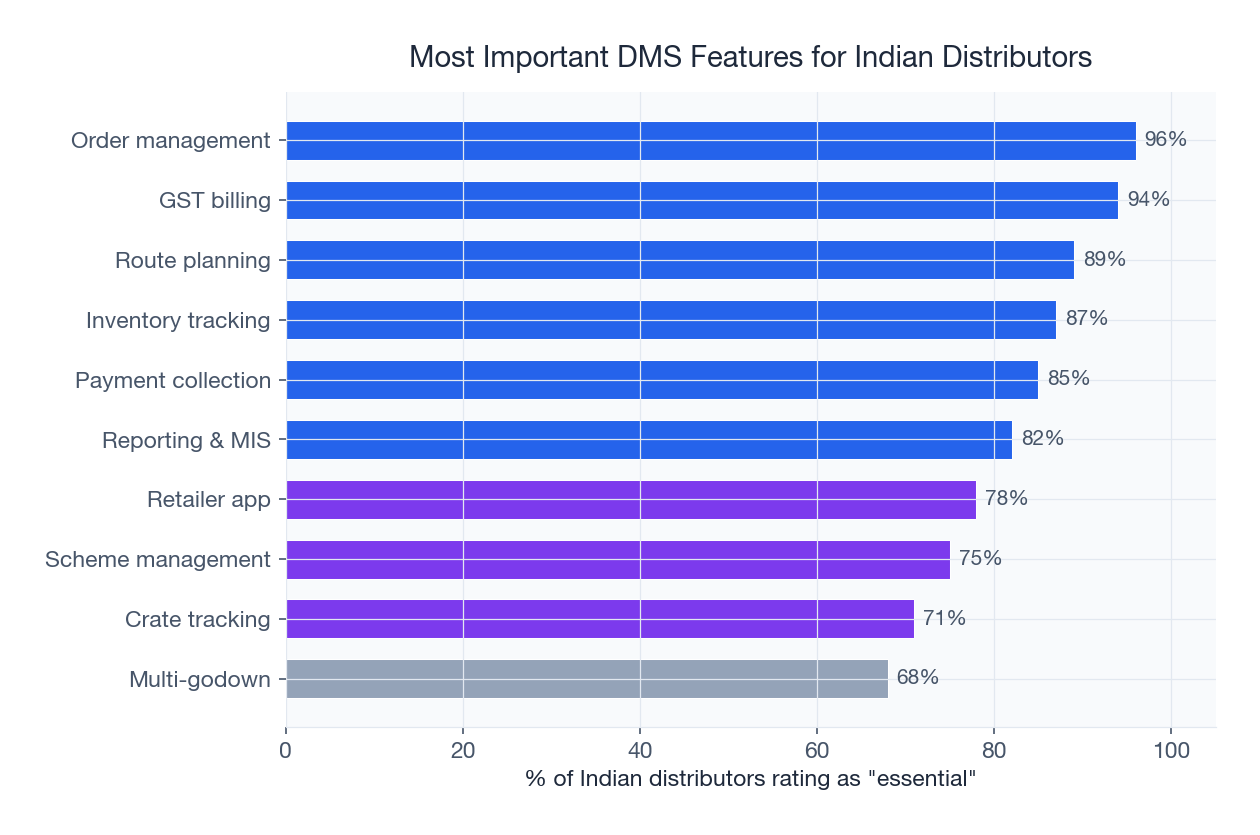
Enterprise DMS platforms pack in hundreds of features designed for large-scale operations — multi-country support, complex approval hierarchies, advanced BI tools, custom API marketplaces, and white-label portals. Small distributors need none of these. Here is what actually matters for a business handling Rs 1-5 crore in annual distribution:
Must-Have Features (Non-Negotiable)
| Feature | Why It Matters for Small Distributors | Monthly Impact |
|---|---|---|
| Order management | Eliminates phone-call ordering, reduces errors by 90% | Saves 2-3 hours daily |
| GST-compliant invoicing | Auto-generates correct invoices, handles credit notes | Saves Rs 15,000-25,000/month in billing staff time |
| Payment tracking | Real-time outstanding visibility, payment reminders | Reduces collection cycle by 5-8 days |
| Basic inventory | Stock visibility across godown, prevents stockouts | Reduces dead stock by 20-30% |
| Mobile app | Run operations from phone — no desktop/laptop needed | Enables anytime-anywhere management |
High-Value Features (Implement in Phase 2)
- Route optimization — Valuable once you have 3+ delivery vehicles; saves 15-25% on fuel
- Sales analytics — Useful once you have 3-6 months of digital data to analyze
- Scheme management — Important if you handle 5+ active trade schemes simultaneously
- Distribution tracking — GPS-based delivery tracking for accountability and customer confidence
Features You Can Skip (Enterprise-Only)
- Multi-country/multi-currency support
- Complex approval hierarchies (10+ levels)
- Custom BI and data warehouse integrations
- White-label distributor portals
- Advanced demand forecasting with ML models
- Multi-plant production scheduling
Understanding this distinction saves small businesses from paying Rs 3-5 lakh annually for features they will never touch. Focus on the must-haves first, graduate to phase-2 features as your business grows, and ignore enterprise features until you genuinely need them. Read our distribution software features checklist for a comprehensive comparison.
The Real Cost of Distribution Software for Small Businesses
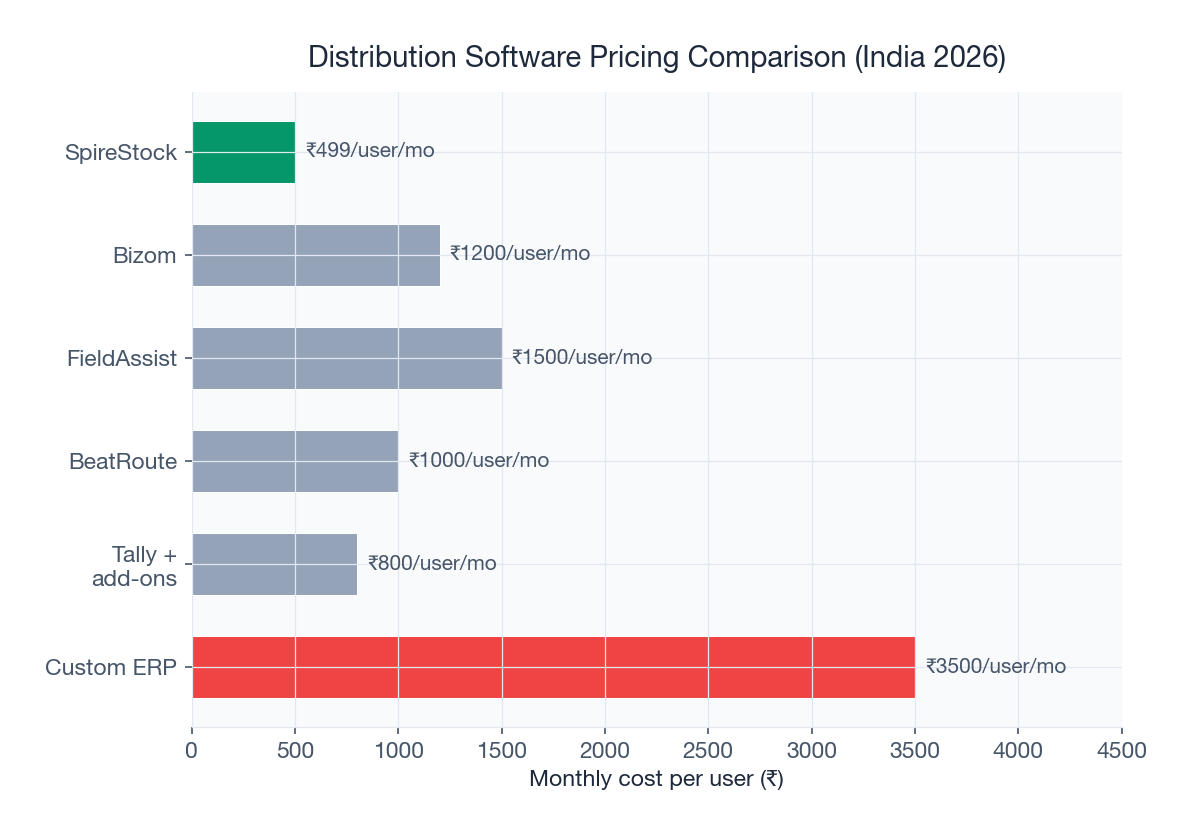
Cost is the primary concern for small distributors. The good news: cloud-based SaaS models have made distribution software accessible at price points that were unimaginable a decade ago. Here is a realistic cost breakdown for a small distributor in India:
| Cost Component | Enterprise DMS | Cloud DMS for Small Business |
|---|---|---|
| Monthly subscription | Rs 30,000-1,00,000 | Rs 3,000-15,000 |
| Implementation/setup | Rs 2-10 lakh | Rs 0-25,000 (often included) |
| Training | Rs 50,000-2,00,000 | Rs 0-10,000 (video + remote) |
| Hardware requirements | Servers, desktops, scanners | Existing smartphones only |
| IT staff needed | 1-2 dedicated | None (vendor-managed) |
| Annual total (Year 1) | Rs 8-20 lakh | Rs 40,000-2,00,000 |
At Rs 5,000-10,000 per month, a cloud-based distribution management system costs less than a part-time data entry operator. For a distributor spending Rs 15,000-20,000 monthly on a billing clerk who also handles order entry and payment follow-ups, the software pays for itself immediately while delivering significantly better accuracy and speed.
ROI Calculation for Small Distribution Operations
Small distributors are often sceptical about software ROI — "I only do Rs 2 crore turnover, is it worth it?" The answer is almost always yes. Here is a realistic ROI calculation for a distributor with Rs 2 crore annual turnover, 150 retail outlets, and 2 delivery vehicles:
Cost Savings
- Billing staff reduction — Partial automation saves Rs 8,000-12,000/month (reduced from 1 FTE to part-time)
- Order error elimination — Manual errors cost 1-2% of turnover = Rs 2-4 lakh/year. Software reduces to near zero
- Faster payment collection — Reducing collection cycle from 25 days to 18 days unlocks Rs 3-5 lakh in working capital
- Fuel savings from route planning — Even basic route sequencing saves 10-15% fuel = Rs 15,000-25,000/month for 2 vehicles
- Reduced stockouts and dead stock — Inventory visibility saves 1-2% of stock value = Rs 1-2 lakh/year
Total Annual Benefit: Rs 5-8 lakh
Total Annual Cost: Rs 60,000-1,80,000
ROI: 3x-8x return on investment
Even in the most conservative scenario, the payback period is under 4 months. For detailed calculation methodology, see our ROI and payback calculation guide. Compare this to the cost of continuing with manual distribution processes.
Implementation Without an IT Team
The biggest fear for small distributors considering software adoption is: "Who will set it up and maintain it? I don't have an IT person." This is where cloud-first, mobile-first platforms fundamentally change the equation.
What Cloud-First Means for Small Businesses
- No servers to buy or maintain — Everything runs on the vendor's infrastructure
- No installation — Access via web browser or mobile app download
- Automatic updates — New features, GST rate changes, and security patches applied automatically
- No backups to worry about — Data backed up continuously by the vendor
- No IT staff needed — Vendor handles all technical maintenance
The SpireStock mobile app is designed so that a distributor owner with basic smartphone skills can start placing orders, generating invoices, and tracking payments within 30 minutes of signing up. The onboarding flow walks users through setup step-by-step in Hindi and English.
A Realistic Implementation Timeline for Small Distributors
| Week | Activity | Time Required |
|---|---|---|
| Week 1 | Sign up, add products and retailers, configure GST settings | 2-3 hours |
| Week 2 | Start placing orders and generating invoices digitally | Normal work hours |
| Week 3 | Add delivery tracking and payment recording | 1-2 hours setup |
| Week 4 | Run parallel (paper + digital) for confidence, then switch fully | Normal work hours |
Total implementation effort: 5-8 hours of dedicated setup time spread over 4 weeks. No consultants, no IT team, no project managers. Compare this to enterprise DMS implementations that take 3-6 months and require a dedicated project team.
What to Look for in Distribution Software as a Small Business
Not all affordable software is good software. Small distributors should evaluate options against these practical criteria:
1. Truly Mobile-First Design
If the software was designed for desktop and then "made responsive" for mobile, it will be painful to use on a phone. Small distributor owners and their staff do 90% of their work from smartphones. The mobile app should be the primary interface, not an afterthought. Test by trying to create an order, generate an invoice, and record a payment entirely on your phone — if any step requires a laptop, move on.
2. Simple Pricing with No Hidden Costs
Beware of software that advertises Rs 999/month but charges extra for SMS notifications, e-invoicing, additional users, data storage, or support calls. Ask for all-inclusive pricing. For a small distributor, expect to pay Rs 3,000-15,000/month for a complete solution. Check SpireStock pricing for transparent, all-inclusive plans designed for small businesses.
3. Vernacular Language Support
Your delivery staff in Kolkata may be comfortable in Bengali, your salesmen in Chennai in Tamil, and your billing person in Ahmedabad in Gujarati. Multi-language support is not a luxury for Indian small businesses — it is a necessity for adoption. At minimum, look for Hindi and English support, with regional languages as a bonus.
4. Offline Capability
Small distributors operate in areas where internet connectivity is unreliable — basement godowns, narrow market lanes in old city areas, and rural delivery routes. The app must work offline and sync automatically when connectivity returns. This is non-negotiable for distributors operating in tier-2 and tier-3 cities.
5. WhatsApp/SMS Integration
Your retailers are on WhatsApp. Invoice delivery, payment reminders, and order confirmations via WhatsApp have 95%+ open rates compared to 30% for app notifications. Look for built-in WhatsApp integration that sends invoices as PDFs and payment reminders automatically.
6. Tally/Busy Integration
Almost every small distributor in India uses Tally or Busy for accounting. Your distribution software must sync data with these platforms without manual re-entry. Two-way sync — orders and invoices flowing from DMS to Tally, and payment entries flowing back — eliminates double work and reconciliation headaches.
Common Objections from Small Distributors (And Honest Answers)
"My business is too small for software"
If you handle more than 30 orders per week and manage more than Rs 5 lakh in monthly sales, you are losing money to manual inefficiency. A distributor doing Rs 50 lakh annually typically loses Rs 2-3 lakh to order errors, billing mistakes, and payment delays. Software at Rs 5,000/month (Rs 60,000/year) recovers this easily.
"My staff won't adopt it"
This is the most legitimate concern. The solution is choosing software that is genuinely simple — fewer clicks than the alternatives, not more. Start with just 2-3 features (orders, invoices, payments) and add complexity only after the team is comfortable. The best distributor management platforms are designed so that a delivery boy with basic smartphone literacy can use the app after 15 minutes of training.
"I can't afford the monthly cost"
Calculate your current cost of manual operations: billing person salary (Rs 12,000-18,000/month), order errors (Rs 5,000-15,000/month in write-offs and disputes), extra fuel from unplanned routes (Rs 3,000-8,000/month), and payment follow-up time (owner's time worth Rs 500-1,000/hour). The total manual cost is Rs 25,000-50,000/month. Software at Rs 5,000-10,000/month is a fraction of this.
"What if the software company shuts down?"
Choose a platform that allows data export (your data belongs to you) and has a track record of at least 2-3 years. Cloud-based platforms with transparent pricing and a growing customer base are lower-risk than bootstrapped startups offering unsustainably cheap pricing.
Success Stories: Small Distributors Who Made the Switch
A dairy distributor in Surat handling Rs 1.8 crore annual turnover with 120 retail outlets and 2 delivery vehicles implemented SpireStock in 2024. Before software: 1 full-time billing person, 15+ daily phone calls for orders, Rs 25-day average collection cycle, and monthly disputes with 8-10 retailers over invoices or returns. After 3 months on SpireStock:
- Billing person moved to part-time (Rs 8,000/month saving)
- Orders received via app — zero phone calls for order-taking
- Collection cycle dropped to 16 days (Rs 4 lakh working capital freed)
- Invoice disputes dropped to 1-2 per month
- Owner saved 2 hours daily previously spent on manual coordination
Monthly software cost: Rs 7,500. Monthly savings: Rs 22,000+ in direct costs, plus the owner's time freed for business development.
An FMCG sub-distributor in Lucknow handling beverages and packaged snacks across 200 outlets saw similar results. Digital order management eliminated the 3-hour morning routine of calling retailers for orders. Automated invoicing with correct GST calculations eliminated the monthly CA visit for invoice corrections. Payment collection tracking gave real-time visibility into Rs 18 lakh of outstanding receivables that were previously tracked in a notebook.
Getting Started: A No-Risk Approach
The best way for a small distributor to evaluate distribution software is through a free trial with real data. Not a demo with fake data — an actual trial where you enter your products, your retailers, and your daily orders for 2-4 weeks.
- Step 1 — Sign up for a free 14-day trial with no credit card required
- Step 2 — Add your top 50 retailers and 20-30 products (takes 1-2 hours)
- Step 3 — Process real orders for 2 weeks alongside your existing manual process
- Step 4 — Compare: time spent, accuracy, visibility, and your own comfort level
- Step 5 — Decide based on real experience, not sales pitches
If the software does not demonstrably improve your daily operations within 2 weeks of real use, it is not the right fit. But if it does — and for most small distributors handling dairy, FMCG, or beverages, it will — you will wonder why you waited so long.
Built for small businesses, scales as you grow. SpireStock's starter plans are designed for distributors with Rs 50 lakh to Rs 5 crore turnover. No IT team needed, no contracts, cancel anytime. Start your free trial today.
This guide covers one part of the picture. For the category as a whole — what a DMS does, the modules that matter, how it differs from ERP and SFA, and what it costs in India — see our distributor management system guide.
Sources & References
- MSME Ministry, Ministry of Micro, Small and Medium Enterprises — MSME Statistics
- IBEF, India Brand Equity Foundation — FMCG Industry Report
- NASSCOM, NASSCOM — SaaS Adoption in Indian SMEs
Frequently Asked Questions
Cloud-based distribution management software for small businesses in India typically costs Rs 3,000-15,000 per month, with little to no setup fees. This includes order management, GST-compliant invoicing, payment tracking, and a mobile app. Total annual cost ranges from Rs 40,000-2,00,000, compared to Rs 8-20 lakh for enterprise solutions.
Yes, modern cloud-first distribution software requires no IT staff. Everything runs on the vendor's servers, accessed via a smartphone app. A typical small distributor can set up the system in 5-8 hours spread over 4 weeks — adding products, retailers, and GST settings — with vendor-provided training via video and remote support.
If you handle more than 30 orders per week and manage more than Rs 5 lakh in monthly sales, distribution software will deliver positive ROI. Distributors with Rs 50 lakh or more annual turnover typically see 3x-8x return on their software investment through reduced errors, faster collections, and saved staff time.
Start with five must-have features: order management, GST-compliant invoicing, payment tracking, basic inventory management, and a mobile app. Add route optimization, sales analytics, and scheme management in phase 2 once you have 3-6 months of digital data. Skip enterprise features like multi-country support and advanced BI tools.
Most small distributors see positive ROI within 2-4 months. Direct savings come from reduced billing staff costs (Rs 8,000-12,000/month), eliminated order errors (1-2% of turnover), faster payment collection (5-8 day improvement), and fuel savings (10-15%). For a Rs 2 crore distributor, annual benefits typically total Rs 5-8 lakh against costs of Rs 60,000-1,80,000.
Good cloud-based distribution apps support offline mode, allowing field staff to take orders, generate invoices, and record deliveries without internet. Data syncs automatically when connectivity returns. This is essential for distributors operating in tier-2 and tier-3 Indian cities where connectivity is unreliable in basement godowns and narrow market lanes.
Related SpireStock Features
Related Industries
Streamline FMCG distribution with order management, beat planning, retailer tracking, and GST billing. Built for Indian FMCG supply chains.
End-to-end dairy distribution software for milk, curd, paneer, and ghee brands. Manage orders, crates, cold chain, and GST billing in one platform.
Related Solutions
Manage your entire distributor network digitally. Onboarding, credit limits, outstanding tracking, and performance analytics. Start free trial.
Track distributor and retailer payments. Cash, UPI, cheque collection with reconciliation, ageing reports, and credit limit management.
Related Entities
Ready to Streamline Your Distribution?
Start your free 14-day trial and see how SpireStock can transform your dairy, FMCG or consumer-goods distribution operation, from order capture to crate recovery.

SpireStock Team
Distribution Technology Experts
SpireStock Team writes for SpireStock on distribution management, supply-chain optimisation and field operations for Indian dairy and FMCG brands.