The Multi-Plant Reality of Growing Dairy Companies
As dairy companies grow, they inevitably expand from a single production facility to multiple plants, sometimes across different cities or states. This growth is exciting but creates exponential complexity in distribution management. Each plant may have different product lines, capacity constraints, delivery territories, and operational schedules. Coordinating all of this into a seamless distribution operation is a massive organizational challenge that many companies underestimate until they are already in the middle of it.
The numbers tell the story. A single-plant dairy with 80 distributors and Rs 90 crore in revenue may be reasonably manageable on manual processes. The same company with three plants, 220 distributors, and Rs 280 crore in revenue cannot be run on spreadsheets, the volume of daily decisions and the number of failure modes both scale non-linearly. Brands operating across dairy distribution and adjacent FMCG distribution categories face the same curve.
Similar challenges emerge in beverage distribution, bakery and confectionery, and consumer goods companies that operate multiple production facilities. Brands like Amul, which runs dozens of plants across Gujarat and elsewhere, and Mother Dairy with its multi-state footprint, have spent years perfecting multi-plant coordination systems, and the lessons are increasingly accessible to smaller operators through modern SaaS platforms.
Key Challenges in Multi-Plant Dairy Distribution
Order Routing
When a distributor's order contains products from different plants, the order management system must split and route the order correctly. Plant A handles liquid milk, Plant B produces curd and buttermilk, and Plant C makes ice cream, a single distributor order may need fulfillment from all three, each with different dispatch schedules and lead times.
Inventory Visibility
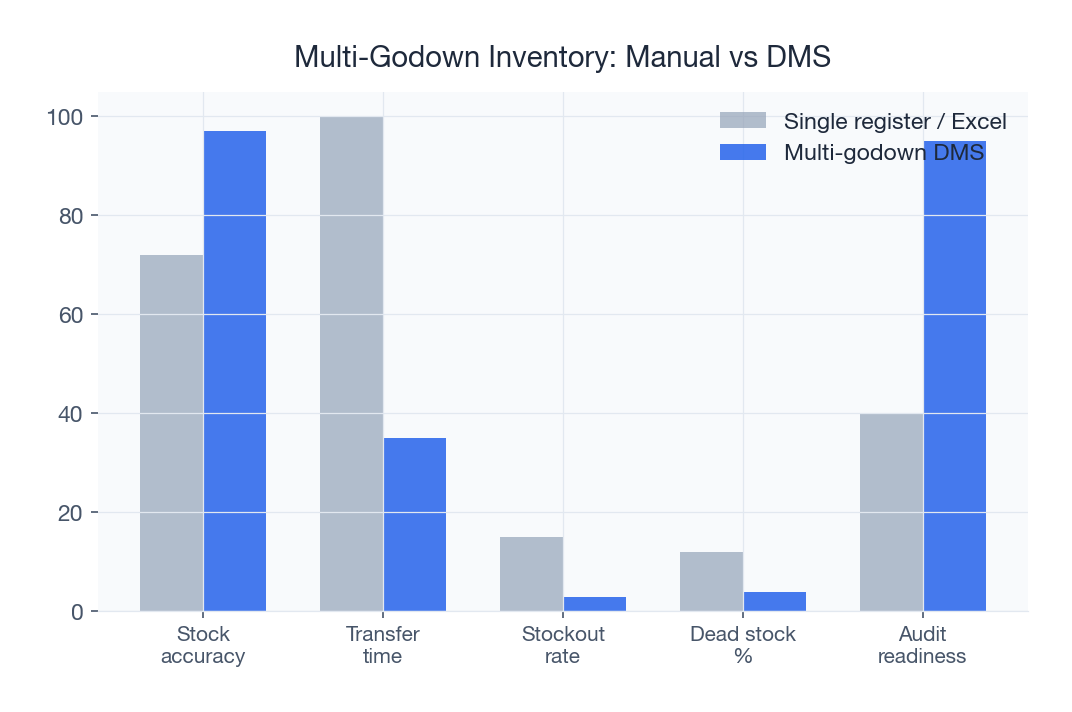
Production volumes, stock levels, and dispatch capacities differ across plants. Without unified visibility, one plant might be overproducing while another faces stockouts. Real-time inventory data across all plants enables balanced production planning and optimal dispatch allocation, preventing the classic "one plant drowning in stock while another runs out" pattern.
Pricing and Scheme Consistency
Prices and trade schemes must be consistent across plants, a distributor should not get different pricing based on which plant fulfills their order. The scheme engine must apply rules uniformly regardless of the sourcing plant, and billing from invoice and billing must reconcile cleanly even when multiple plants contribute to a single invoice.
Logistics Coordination
Multi-plant operations may require cross-docking (consolidating products from multiple plants before final delivery), hub-and-spoke distribution models, or direct-from-plant delivery based on geography. Route planning must account for these complex logistics flows and adapt daily to production schedules that may shift plant-to-plant.
Distribution Model Comparison
| Model | Complexity | Cost Efficiency | Best For |
|---|---|---|---|
| Direct dispatch | Low | Medium | Geographic clusters with clear plant-territory mapping |
| Hub-and-spoke | Medium | High | National brands with widespread distributor network |
| Cross-docking | High | Very high | Speed-sensitive categories with short shelf life |
| Hybrid (mixed) | Very high | Maximum | Multi-category brands over Rs 300 crore revenue |
Technology Solutions for Multi-Plant Management
Unified Digital Platform
The foundation of multi-plant management is a single digital platform that spans all locations. SpireStock's multi-tenant workspace architecture allows you to manage multiple plants, each with their own product catalogs, production schedules, and dispatch operations, while maintaining unified reporting and analytics at the company level. This is dramatically different from running separate systems per plant and trying to stitch the data together afterwards.
Centralized Order Management with Plant-Level Routing
Distributors place orders once through the app. The system automatically splits the order by product-plant mapping and routes each portion to the correct plant for fulfillment. The distributor experiences a single, seamless ordering process without having to understand your internal supply chain architecture.
Cross-Plant Analytics
Analytics dashboards aggregate data across all plants while allowing drill-down to plant-specific, territory-specific, or product-specific views. This gives management both the big picture and the detail needed for operational decisions.
Standardized Processes
While each plant may have unique operational aspects, core processes, order processing, delivery, billing, crate management, should follow standardized workflows. This ensures consistency, enables staff mobility between plants, and simplifies training. It also makes process audits dramatically faster.
Crate Management Across Plants
Crate tracking in a multi-plant setup is non-trivial: crates move from Plant A to a distributor, then back to Plant B (which is geographically closer). The system must handle these inter-plant movements cleanly so asset balances stay accurate and no plant feels it is losing inventory.
Distribution Models for Multi-Plant Operations
- Direct dispatch, each plant ships directly to distributors in its designated territory. Simplest model but limits product availability per distributor.
- Hub-and-spoke, products from multiple plants consolidate at regional hubs before last-mile distribution. Better product availability but adds handling time and cost.
- Cross-docking, products from different plants meet at a transfer point and are combined onto delivery vehicles without intermediate storage. Fast but requires precise timing.
- Hybrid, different models for different product categories or geographies. Most large dairy companies use a hybrid approach.
Choose the model that matches your product mix, geography, and service-level commitments. A national brand shipping ice cream from three plants to 500+ distributors across Mumbai, Bangalore, and Hyderabad will almost always land on hybrid, while a regional dairy with two nearby plants can often stick with direct dispatch.
Scaling from One Plant to Many
If you are planning to expand from a single plant, preparation is key:
- Start with digital, digitize your distribution processes at the first plant before adding more. It is far easier to replicate a digital process than to digitize a manual one at scale.
- Standardize first, create standard operating procedures that can be deployed at new plants with minimal customization.
- Choose scalable technology, select platforms that support multi-plant from day one, even if you start with one. Migrating between systems during growth is painful and disruptive.
- Plan territory boundaries, clearly define which plant serves which territory to avoid overlap and optimize logistics.
- Design handover protocols, specify exactly how product and asset ownership transfers between plants in cross-plant deliveries.
Production-Distribution Sync
Multi-plant operations introduce a production planning problem on top of the distribution challenge. Each plant's production must align with the distribution demand it is expected to fulfil, which requires demand forecasting data flowing back from the DMS into the plant's ERP or MES system. The best deployments build this loop early; the worst push the problem to month-end when it is already too late. Pair distributor management with proper production-demand sync and you unlock a level of operational efficiency that single-plant operators struggle to match.
Case Study: Regional Dairy With Three Plants
A Rs 380-crore regional dairy operating plants in Ahmedabad, Jaipur, and Udaipur deployed SpireStock's multi-plant architecture in 2024. Within six months, they reported a 14% reduction in inter-plant stock imbalances, a 22% reduction in cross-plant freight costs (through better route planning), and full visibility into distributor ledgers that had previously been fragmented across plant-level spreadsheets. Total annual savings: Rs 2.3 crore. Total software investment: Rs 38 lakh over three years. The CFO calls it the best operational investment of the past five years.
Managing multi-plant operations across the dairy distribution network
Managing multi-plant operations requires technology that scales with your ambition. The right platform turns multi-plant complexity from a growth barrier into a competitive advantage in the broader FMCG distribution landscape. The larger you get, the more the operational lift from a unified platform compounds, and the harder it becomes for smaller competitors to match your consistency and service levels.
For related reading, review our guides on milk distribution management systems and choosing distributor management software. Both complement the multi-plant discussion with tactical detail.
Ready to Scale Confidently?
Talk to our team about how SpireStock handles multi-plant orchestration at scale, review SpireStock pricing to understand the commercial structure for multi-site deployments, or book a demo tailored to your current plant footprint and expansion plans. We can show you exactly how a distributor in one geography would order products manufactured across three different plants, without any visible complexity on their end. Explore multi-plant distribution for the full solution view.
Organizational Structure for Multi-Plant Operations
The technology is only half the challenge; the other half is organizational design. Successful multi-plant operators typically centralize three things and distribute three others. Centralize: pricing and scheme decisions, brand and marketing strategy, and distributor agreements. Distribute: daily operational decisions, local relationship management, and plant-specific quality control. Getting this balance wrong, either over-centralizing or over-distributing, is the most common cause of multi-plant operational dysfunction.
Regional heads at each plant should have clear authority over daily operations but should operate within guardrails set by central pricing, credit, and scheme teams. This is how brands like Mother Dairy manage the tension between central standardization and local responsiveness.
Reporting Governance and Monthly Rituals
Multi-plant companies need a disciplined reporting cadence. A typical structure: weekly zone reviews (plant-level) on Mondays, bi-weekly regional reviews (multi-plant) on alternate Fridays, monthly national reviews on the first Tuesday of every month, and quarterly strategic reviews with plant heads and senior leadership. Each review has a fixed agenda, fixed participants, and fixed data sources, predictability is what makes the rhythm sustainable.
Integration with Production Planning
The ultimate sophistication is feeding distribution demand data back into production planning so each plant produces exactly what its distribution network needs. This closes the end-to-end loop and is the hallmark of a mature multi-plant operation. Most operators reach this stage in year 2 or 3 of their digital transformation journey, and the operational leverage is significant, typically 3-5% reduction in overall waste and a meaningful improvement in service levels.
Cross-Plant Quality Standardization
Multi-plant operators face a subtle but critical challenge: ensuring consistent product quality across all plants. A customer in Bangalore should get the same curd texture, milk fat content, and ghee quality whether the product came from your Karnataka or your Tamil Nadu plant. This requires standardized production protocols, shared quality testing procedures, and regular cross-plant audits. The distribution technology supports this by tagging every batch with its source plant, so any quality issue can be traced back and addressed at the source within hours rather than weeks.
Financial Consolidation and Inter-Plant Pricing
Multi-plant operations introduce an internal pricing dimension: when Plant A supplies product to a distributor in Plant B's territory, how is the inter-plant transfer priced? This matters for management accounting, plant profitability calculations, and tax purposes. The best systems handle transfer pricing automatically based on configurable rules, feeding data into both the DMS and the corporate ERP. Without this automation, finance teams spend days every month reconciling inter-plant movements, and the numbers are often wrong even after the work is complete.
Lessons From Companies That Tried and Failed
A Rs 250-crore dairy in western India attempted multi-plant distribution without a unified platform in 2023. Each plant ran on different software, distributor data was fragmented, and the central team spent most of their time reconciling conflicting numbers. After 14 months of struggle, they scrapped the fragmented approach and rolled out a unified DMS across all plants. Within eight weeks, visibility and control were restored. The lesson: do not try to manage multi-plant complexity with multi-system fragmentation. Unified platforms are not a nice-to-have; they are the precondition for multi-plant operational health.
Unified Brand Experience Across Plants
From the distributor's perspective, multi-plant complexity should be invisible. They should see one price list, one order screen, one invoice, one ledger, one support channel. Behind the scenes, your operations team can run whatever complexity is needed to coordinate multiple plants. The difference between a well-run multi-plant operation and a poorly-run one is how well this invisibility is maintained. A distributor in Bangalore should never need to know or care which plant manufactured the curd they ordered yesterday.
Achieving this requires tight integration between plant-level production systems and the central DMS. Every product must be tagged with its source plant for internal tracking, but that tag should never surface to the distributor-facing interface. The best deployments treat plant attribution as internal metadata, visible only to operations and finance teams who need it for inter-plant accounting and quality tracing.
Sources & References
Frequently Asked Questions
When a distributor places an order, the system automatically identifies which products are manufactured at which plant and splits the order accordingly. Each plant receives only the portion they need to fulfill, while the distributor sees a single, unified order.
Yes, distributors place orders from a unified product catalog without needing to know which plant produces what. The system handles the routing transparently. The distributor experience is identical to ordering from a single plant.
Pricing is managed centrally in the system and applied uniformly regardless of the fulfilling plant. The scheme engine also ensures trade incentives are consistent across the network, preventing pricing discrepancies.
The system can be configured to redirect orders to an alternate plant or flag the shortfall for manual resolution. Inventory visibility across all plants enables proactive production adjustments before stockouts occur.
SpireStock generates consolidated invoices for the distributor regardless of how many plants fulfilled the order. Internally, inter-plant transfers and cost allocations are tracked for management accounting purposes.
Yes, each plant can have its own production calendar, order cutoff times, and dispatch schedules. The system manages these independently while maintaining a unified view for distributors and management.
Crate tracking works across the entire network, assets dispatched from any plant are tracked to the receiving distributor. Returns can come back to any plant, with inter-plant crate transfers managed through the system for optimal asset rebalancing.
Reports are available at multiple levels: company-wide aggregates, plant-wise breakdowns, territory-wise analysis, and product-wise performance. Managers can compare plant efficiency, fulfillment rates, and delivery performance across the network.
Related SpireStock Features
End-to-end order lifecycle from placement to delivery with multi-level approval workflows.
Isolated workspaces for each customer with custom branding and configuration.
Powerful dashboards with sales trends, MIS reports, and distribution analytics.
Related Solutions
Manage distribution across multiple production units and plants. Centralized control with plant-level autonomy for dairy and FMCG brands.
Manage your entire distributor network digitally. Onboarding, credit limits, outstanding tracking, and performance analytics. Start free trial.
Related Entities
Ready to Streamline Your Distribution?
Start your free 14-day trial and see how SpireStock can transform your dairy, FMCG or consumer-goods distribution operation, from order capture to crate recovery.

SpireStock Team
Product & Industry Insights
SpireStock Team leads product at SpireStock, where the team ships distribution management software for India's dairy, FMCG and consumer-goods brands.