The Last Mile Problem: Where 40% of Your Distribution Budget Disappears
In India's ₹6.5 lakh crore FMCG market, getting products from the factory to the distributor warehouse is the easy part. The real battle — and the real cost — lies in the last mile: moving products from the distributor's godown to the retailer's shelf. For every ₹100 a brand spends on distribution, approximately ₹38-42 is consumed by last mile operations alone.
This was already a significant challenge. Then came quick commerce. Platforms like Blinkit, Zepto, and Swiggy Instamart have conditioned Indian consumers — and increasingly, retailers — to expect deliveries within hours, not days. A kirana store owner in Mumbai who receives Blinkit inventory drops twice a day now questions why his FMCG distributor takes 48 hours to fulfil a routine order.
The good news? Traditional FMCG distributors do not need to become quick commerce platforms. But they absolutely need to modernize their last mile operations with technology. This guide covers how route optimization, real-time tracking, and delivery management software can transform your last mile from a cost centre into a competitive advantage.
Understanding Last Mile Delivery Costs in Indian FMCG Distribution
Before you can optimize, you need to understand where the money goes. Here is a detailed breakdown of last mile delivery costs for a typical FMCG distributor operating in an Indian metro city.
Cost Breakdown: Where Every Rupee Goes
| Cost Component | % of Last Mile Cost | Monthly Cost (₹) for ₹50L Billing Distributor | Optimization Potential |
|---|---|---|---|
| Fuel & Vehicle Running | 28-32% | ₹56,000-64,000 | 25-35% savings via route optimization |
| Delivery Staff Salaries | 30-35% | ₹60,000-70,000 | 15-20% savings via productivity improvement |
| Vehicle Maintenance & Depreciation | 12-15% | ₹24,000-30,000 | 10-15% savings via optimized load planning |
| Returns & Re-delivery | 8-12% | ₹16,000-24,000 | 40-60% reduction via digital POD & pre-confirmation |
| Damage & Pilferage in Transit | 5-8% | ₹10,000-16,000 | 50-70% reduction via tracking & accountability |
| Loading/Unloading & Handling | 5-7% | ₹10,000-14,000 | 20-30% savings via load optimization |
| Administrative & Communication | 3-5% | ₹6,000-10,000 | 60-80% savings via automated dispatch |
For a distributor billing ₹50 lakh per month, last mile operations cost ₹1.8-2.3 lakh monthly — that is ₹22-28 lakh annually. Even a 25% reduction translates to ₹5.5-7 lakh in annual savings, which goes straight to the bottom line. For context, this saving alone can fund a distributor's entire DMS subscription for 3-4 years.
Six Pillars of Last Mile Delivery Software
Effective last mile delivery software for FMCG distribution is not just about GPS tracking. It is an integrated system that optimizes every step from order finalization to delivery confirmation. Here are the six essential capabilities.
1. Intelligent Route Optimization
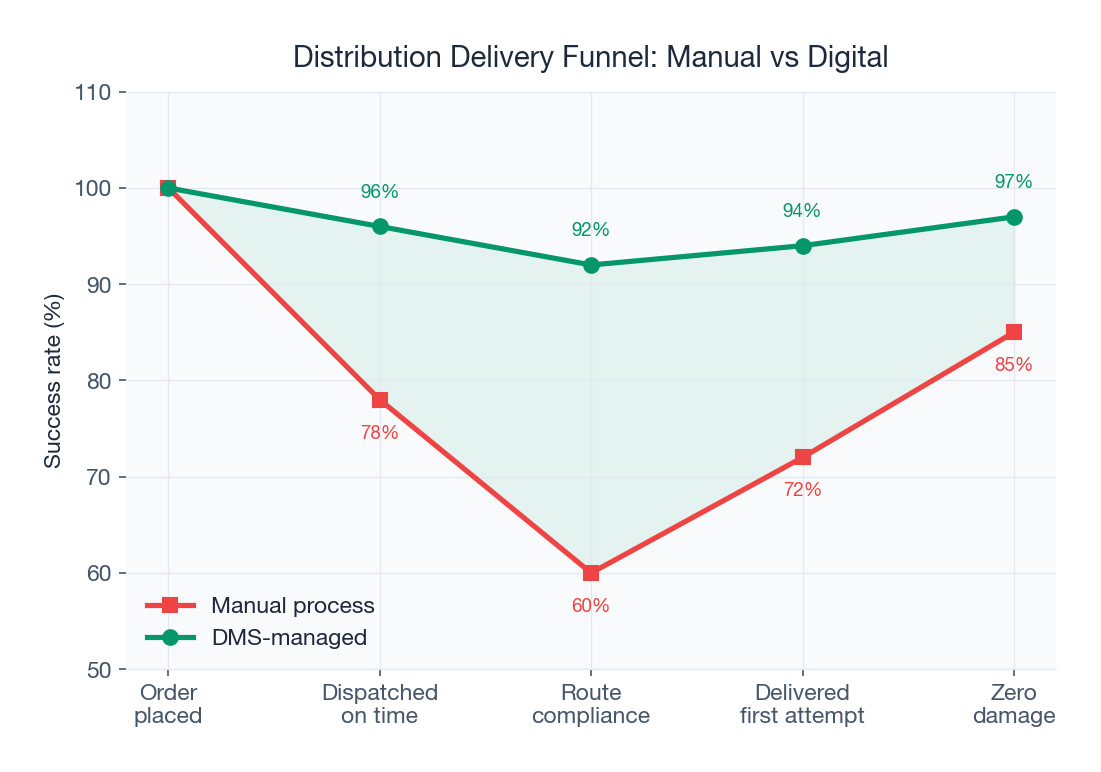
Route optimization is the single highest-impact feature, delivering 25-35% fuel savings for most distributors. But FMCG route optimization in India is fundamentally different from e-commerce delivery routing.
In e-commerce, each delivery is a single package to a single address. In FMCG distribution, a delivery vehicle carries 50-200 SKUs across 25-40 retail outlets in a single trip. The route must account for:
- Delivery Window Constraints: Kirana stores in market areas of Delhi want deliveries before 9 AM (before customer rush). Restaurants and hotels want afternoon deliveries. Medical stores have specific receiving hours.
- Vehicle Capacity and Load Sequencing: A Tata Ace carrying 1.2 tonnes needs deliveries loaded in reverse route order — the last delivery stop is loaded first. Software must calculate load plans that match the optimized route.
- Traffic Pattern Intelligence: Bangalore's Outer Ring Road at 9 AM versus 11 AM can mean a 45-minute difference for the same stretch. Smart routing incorporates historical traffic data.
- Road and Access Restrictions: Many Indian cities restrict heavy vehicle movement during peak hours. Narrow lanes in old city areas of Hyderabad or Kolkata require smaller vehicles.
- Multi-Stop Efficiency: SpireStock's route optimization engine uses algorithms that consider all these constraints simultaneously, generating routes that typically reduce total kilometres driven by 20-30% compared to driver-chosen routes.
Key insight: A dairy distributor in Pune handling Heritage Foods products reduced their daily delivery kilometres from 180 km to 125 km across 4 vehicles after implementing route optimization — saving ₹45,000 per month in fuel alone.
2. Real-Time Delivery Tracking and ETA
Real-time tracking is no longer a luxury — it is a baseline expectation in 2026. Distribution tracking gives three critical capabilities:
- Live Vehicle Location: Know exactly where every delivery vehicle is at any moment. This eliminates the constant phone calls between the godown supervisor and delivery boys that waste 30-45 minutes per vehicle per day.
- Accurate ETA for Retailers: When a retailer calls asking "where is my order?", the distributor's billing operator can give a precise answer: "Your delivery is 3 stops away, expected by 11:30 AM." This retailer confidence translates to order stickiness.
- Route Adherence Monitoring: Identify when delivery boys deviate from the planned route. Unauthorized stops (personal errands, other deliveries) are a major source of delay and pilferage.
- Geofence Alerts: Set up geofences around key retailer locations. The system automatically logs arrival and departure times, creating an auditable delivery timeline without manual entry.
3. Digital Proof of Delivery (POD)
Paper-based delivery challans are the bane of Indian FMCG distribution. They get lost, get wet, are illegible, and create reconciliation nightmares at month-end. Digital POD solves this permanently.
- OTP-Based Confirmation: The retailer receives an OTP on their registered mobile number. They share it with the delivery boy to confirm receipt. This creates an indisputable digital record.
- Photo Proof: For high-value deliveries or dispute-prone retailers, the delivery app captures a timestamped, geotagged photo of delivered goods at the shop.
- Partial Delivery Handling: If a retailer refuses part of an order (damaged goods, excess quantity), the delivery boy records the partial delivery with reasons in the app. This triggers automatic credit note generation.
- E-Signature Capture: For distributors who need formal acknowledgment, touchscreen signature capture on the delivery boy's phone replaces paper sign-offs.
4. Delivery Boy Mobile App with Offline Support
This is where many delivery management solutions fail in Indian conditions. Network connectivity in delivery areas — especially in wholesale markets, basement godowns, and rural territories — is unreliable. SpireStock's mobile app is built for these realities.
- Offline-First Architecture: The app downloads the day's delivery manifest, route, and retailer details at the start of the day. All delivery confirmations, photos, and notes are recorded locally and synced when connectivity returns.
- Low-End Device Support: Runs smoothly on Android devices with 2GB RAM — the ₹6,000-8,000 smartphones that delivery staff typically carry.
- Vernacular Interface: Navigation and key actions available in Hindi, Tamil, Telugu, Marathi, Bengali, and Gujarati — because delivery boys in Chennai or Kolkata should not be forced to operate in English.
- One-Tap Actions: Mark delivered, record return, capture photo, call retailer — all accessible within one tap from the main screen. Minimal training required.
5. Auto-Dispatch and Load Optimization
Manual dispatch — where a godown supervisor decides which orders go on which vehicle — is inefficient and error-prone. Automated dispatch uses algorithms to optimize load allocation.
- Weight and Volume Balancing: Distribute orders across vehicles to maximize utilization without exceeding capacity. A Tata Ace loaded to 80% capacity on every trip (instead of alternating between 50% and 110%) reduces total trips needed.
- Priority-Based Sequencing: High-value orders, perishable goods, and time-sensitive deliveries get dispatched first. A ₹50,000 order to a modern trade outlet should not wait behind ₹2,000 kirana deliveries.
- Dynamic Re-routing: If a vehicle breaks down or a retailer shop is closed, the system can dynamically reassign pending deliveries to another vehicle that is geographically close.
- Return Vehicle Utilization: For distributors handling crate management (especially in beverage and dairy distribution), return trips are used for crate and empty bottle collection, maximizing both outbound and return vehicle utilization.
6. Return Handling and Exception Management
Returns are the most expensive part of last mile operations. Every returned delivery effectively costs 2x — the outbound delivery cost plus the return logistics. In perishable FMCG, returns also mean product wastage.
- Pre-Delivery Confirmation: The system sends an automated SMS or WhatsApp message to the retailer 30 minutes before expected delivery, confirming the shop is open and the order is still needed. This alone reduces "shop closed" returns by 40-50%.
- Real-Time Return Authorization: If a retailer wants to partially reject an order, the delivery boy initiates a return request on the app. The supervisor approves or denies in real-time, eliminating the "bring it all back and we will sort it at the godown" approach.
- Automated Credit Notes: Approved returns automatically generate credit notes in the billing system, eliminating the 2-3 day lag that causes retailer complaints about pending credits.
Case Study: Dairy Distributor in Mumbai Cuts Last Mile Costs by 32%
Rajesh Traders, a dairy distributor in western Mumbai handling products for two major dairy brands, was spending ₹2.8 lakh per month on last mile delivery for ₹65 lakh monthly billing — a 4.3% delivery cost ratio. Their challenges were typical: 6 delivery vehicles running inefficient routes, 15% of deliveries requiring re-attempts due to "shop closed" or order discrepancies, and zero visibility into delivery status once vehicles left the godown.
The Transformation
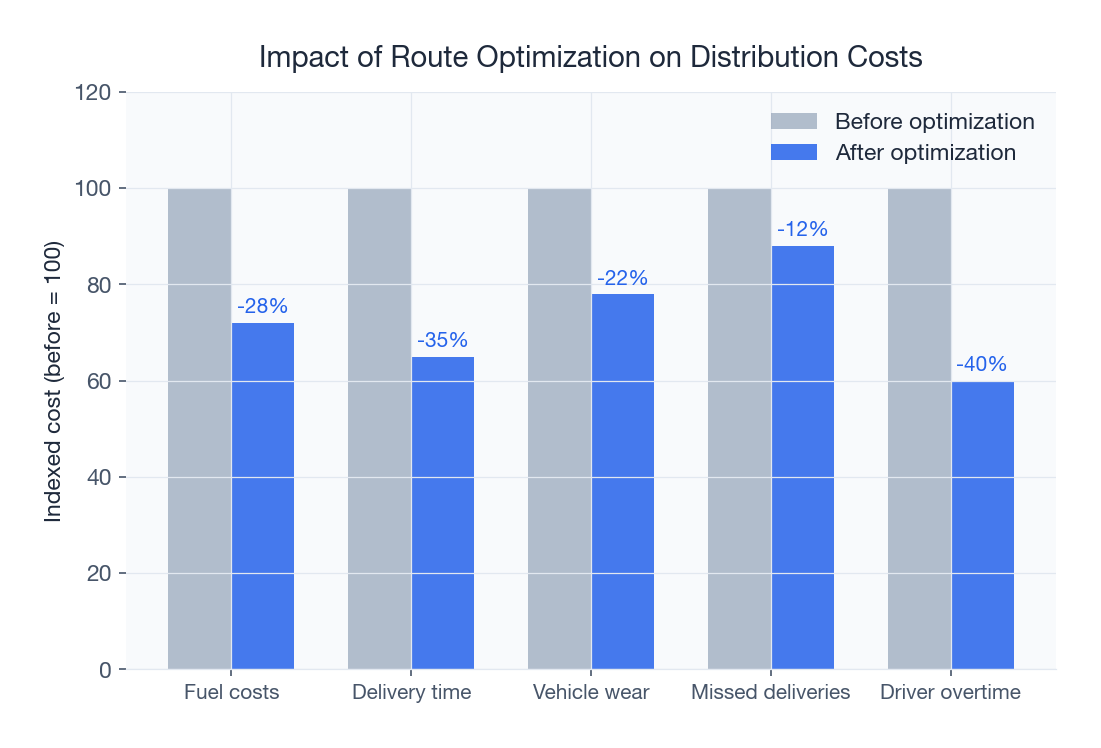
After implementing delivery management software with route optimization and digital POD, here were the results over 90 days:
| Metric | Before Implementation | After 90 Days | Improvement |
|---|---|---|---|
| Daily Kilometres (all vehicles) | 210 km | 148 km | -29.5% |
| Monthly Fuel Cost | ₹72,000 | ₹49,000 | -32% |
| Delivery Attempts per Order | 1.18 (18% re-delivery) | 1.05 (5% re-delivery) | -72% re-deliveries |
| Average Deliveries per Vehicle per Day | 28 | 36 | +28.6% |
| Delivery Completion by 1 PM | 62% | 88% | +42% |
| Monthly Delivery Cost (total) | ₹2,80,000 | ₹1,90,000 | -32.1% |
| Retailer Delivery Complaints | 35-40/month | 8-10/month | -75% |
| Transit Damage/Pilferage | ₹18,000/month | ₹4,500/month | -75% |
The ₹90,000 monthly saving allowed Rajesh Traders to add a dedicated cold-chain vehicle for premium products, actually increasing their service capability while spending less overall.
How Quick Commerce Is Reshaping Last Mile Expectations
The rise of Blinkit, Zepto, and Swiggy Instamart has fundamentally altered delivery expectations in Indian metro cities. While traditional FMCG distributors deliver to retailers (B2B), the consumer-facing speed of quick commerce creates a cascade effect.
The New Competitive Reality
- Retailer Expectations Have Shifted: A kirana store owner in Delhi's Laxmi Nagar sees Blinkit delivering to his neighbours in 10 minutes. He now expects his distributor to at least provide same-day delivery with accurate ETAs.
- Freshness Bar Is Higher: Quick commerce platforms deliver milk and bread that was packaged hours ago. Traditional distributors handling Amul or Britannia products cannot afford 48-hour delivery cycles for perishables anymore.
- Data Expectations: Quick commerce has made real-time inventory visibility and order tracking standard. Retailers now expect their FMCG distributors to provide similar digital transparency.
How Traditional Distributors Can Compete
The answer is not to match 10-minute delivery — that is neither necessary nor economically viable for B2B distribution. Instead, traditional distributors compete on:
- Reliability Over Speed: A retailer does not need 10-minute delivery. They need consistent, on-time delivery at a predictable time every day or every other day. Route-optimized, software-managed delivery achieves this.
- Credit and Relationships: Quick commerce operates on prepayment or immediate payment. Traditional distributors offer 7-21 day credit periods — a significant advantage for small retailers managing cash flow. Effective payment collection processes maintain this advantage while managing risk.
- Full-Range Service: A kirana store gets 200-500 SKUs from their FMCG distributor in a single delivery. Quick commerce dark stores stock 2,000-5,000 SKUs but split across many categories. The distributor's category depth is unmatched.
- Cost Advantage: Quick commerce platforms spend ₹25-40 per delivery on last mile. A well-optimized FMCG distributor spends ₹8-15 per retail outlet delivery. This cost structure allows better pricing to retailers.
Key insight: The distributors who will thrive are not those fighting quick commerce, but those adopting quick commerce's technology — route optimization, real-time tracking, digital POD — while maintaining traditional distribution's relationship and credit advantages.
Cold Chain Last Mile: Special Requirements for Perishables
For distributors handling dairy products, frozen foods, or fresh produce, the last mile has an added complexity: temperature control. A broken cold chain in the last mile can spoil an entire vehicle load worth ₹50,000-2 lakh.
- Temperature-Monitored Vehicles: IoT sensors inside delivery vehicles that log temperature every 5 minutes. Any breach above the threshold triggers an alert to the supervisor and the delivery boy.
- Insulated Delivery Containers: For distributors using open vehicles (auto-rickshaws, bikes), insulated crates with gel packs maintain 2-8°C for 3-4 hours — sufficient for most urban delivery routes.
- First-Out Delivery Prioritization: Perishable items are loaded last (for first unloading) and delivered to the nearest stops first. The software's route optimizer factors in product shelf life as a constraint.
- Expiry Management Integration: The delivery app flags products approaching expiry (within 30% of shelf life remaining), prompting the delivery boy to highlight this to the retailer and offer FIFO placement advice.
Implementation Roadmap: Going Live in 30 Days
Implementing last mile delivery software does not require a massive IT transformation. Here is a practical 30-day roadmap for Indian FMCG distributors.
Week 1: Foundation Setup
Map your retailer master with accurate GPS coordinates (the delivery app can capture these during the first week's deliveries). Configure vehicle profiles with capacity, type, and driver assignments. Set up delivery zones that align with your existing beat plans.
Week 2: Driver Training and Pilot
Install the mobile app on delivery staff phones. Conduct 2-hour training sessions — focus on practical use, not features. Run a 5-day pilot on 2 routes with the most tech-comfortable delivery boys. Gather feedback and adjust workflows.
Week 3: Expanded Rollout
Roll out to all routes. Enable route optimization for all vehicles. Activate digital POD (start with OTP confirmation, add photo proof in week 4). Begin monitoring delivery completion rates, route adherence, and time-per-stop metrics through distribution tracking.
Week 4: Optimization and Automation
Enable auto-dispatch based on week 1-3 data. Activate pre-delivery SMS/WhatsApp notifications. Set up automated exception alerts (delivery delayed more than 30 minutes, vehicle off-route, temperature breach). Review first month's data and calculate cost savings.
Measuring ROI: The Numbers That Matter
When evaluating last mile delivery software, focus on these measurable KPIs to track your return on investment:
- Cost Per Delivery Stop: Calculate total monthly last mile cost divided by total delivery stops. Best-in-class Indian FMCG distributors achieve ₹8-12 per stop. If you are above ₹18, there is significant room for optimization.
- Delivery Completion Rate: Percentage of orders delivered on the first attempt. Target: above 95%. Every re-delivery attempt costs ₹40-80 in fuel, time, and opportunity cost.
- Vehicle Utilization Rate: Percentage of vehicle capacity (weight and volume) used per trip. Target: 75-85%. Below 60% means you are running too many trips; above 90% leads to overloading and damage.
- Delivery Time Window Adherence: Percentage of deliveries completed within the promised time window. Target: above 85%. This directly correlates with retailer satisfaction and order frequency.
- Fuel Cost Per ₹1 Lakh Billing: Normalize fuel costs against billing volume. Benchmark: ₹800-1,200 per ₹1 lakh billing for urban distribution. Above ₹1,500 signals route inefficiency.
Integration with the Broader Distribution Technology Stack
Last mile delivery software delivers maximum value when integrated with your broader distribution management system. The key integration points are:
- Order Management: Confirmed orders from order management automatically flow into the delivery dispatch queue. No manual re-entry or transfer of paper orders.
- Invoice and Billing: Delivery confirmation triggers automatic invoice generation. Partial deliveries auto-adjust invoice amounts. This reduces the billing team's work by 2-3 hours daily.
- Fleet Management: Fleet management integration tracks vehicle maintenance schedules, insurance renewals, and fuel consumption patterns alongside delivery metrics.
- Secondary Sales Tracking: Every completed delivery is a secondary sales data point. Integrated systems give brands real-time secondary sales visibility without waiting for monthly reports.
- Scheme and Promotion Execution: Delivery boys can verify and apply retailer schemes at the point of delivery, ensuring promotional stock reaches the right outlets.
Common Pitfalls to Avoid
Based on implementations across distributors in Ahmedabad, Surat, Nagpur, and other Indian cities, these are the most common mistakes when adopting last mile delivery software:
- Skipping GPS Coordinate Mapping: Route optimization is only as good as your location data. Investing 1 week in accurate geocoding of your retailer base pays dividends for years.
- Forcing Digital on Unwilling Drivers: Start with the youngest, most tech-comfortable delivery staff. Their success creates peer pressure for others to adopt. Forcing the most senior, tech-resistant driver first guarantees complaints.
- Ignoring Offline Capability: Choosing delivery software that requires constant internet connectivity will fail in Indian market conditions. Insist on offline-first architecture.
- Over-Optimizing Routes on Day One: Start with route tracking only (understanding current routes) before switching to optimized routes. Drivers resist unfamiliar routes. A phased approach builds trust.
- Not Involving Retailers: Brief your top 50 retailers that deliveries will now come with OTP confirmation and ETAs. Present it as a service upgrade, not a surveillance measure.
The Future of Last Mile in Indian FMCG: 2026 and Beyond
Several emerging trends will further reshape last mile delivery for FMCG distribution in India:
- Electric Vehicle Adoption: With fuel costs at ₹105+ per litre and EV running costs at ₹1-1.5 per km versus ₹6-8 per km for diesel, electric three-wheelers and mini-trucks are becoming economically viable for last mile. Euler Motors and Mahindra Electric are already seeing strong adoption among urban distributors.
- Autonomous Route Learning: AI-powered systems that learn from driver behaviour, traffic patterns, and retailer availability to continuously improve routes without manual intervention.
- Unified B2B and B2C Last Mile: As omnichannel distribution grows, distributors will handle both retailer deliveries and direct-to-consumer orders from the same vehicle, requiring flexible delivery software.
- Predictive Delivery Scheduling: Using historical order patterns to pre-stage deliveries before orders are even placed — especially for staple categories with predictable demand cycles.
Start Optimizing Your Last Mile Today
The last mile does not have to be the weakest link in your distribution chain. With the right technology — intelligent route optimization, real-time tracking, digital proof of delivery, and a delivery boy app built for Indian conditions — you can turn your last mile into a competitive moat.
SpireStock's integrated fleet management and route optimization platform is purpose-built for Indian FMCG distributors. From Bisleri distributors in Mumbai to Country Delight partners in Delhi, distributors using SpireStock report an average 30% reduction in last mile costs within 90 days of implementation.
Ready to cut your delivery costs and delight your retailers? Schedule a demo with our logistics experts to see route optimization in action on your actual delivery data, or check our pricing to find the right plan for your fleet size.
Sources & References
Frequently Asked Questions
Last mile delivery accounts for approximately 38-42% of total FMCG distribution costs in India. For a distributor billing ₹50 lakh per month, this translates to ₹1.8-2.3 lakh in monthly last mile expenses covering fuel, salaries, vehicle maintenance, returns, and handling.
Route optimization software typically delivers 25-35% savings on fuel costs for FMCG distributors. This is achieved by reducing total kilometres driven, eliminating route overlaps, optimizing delivery sequences, and factoring in traffic patterns and delivery time windows.
Digital proof of delivery replaces paper challans with OTP confirmation, timestamped geotagged photos, or e-signatures captured on the delivery boy's smartphone. It eliminates delivery disputes, enables automatic credit note generation for returns, and creates auditable delivery records.
Quality delivery software uses offline-first architecture. The app downloads the daily delivery manifest and route at the start of the day, records all delivery confirmations locally, and syncs when connectivity returns. This is essential for Indian market conditions where network coverage is inconsistent.
Traditional distributors compete through reliability (consistent on-time delivery), credit terms (7-21 day payment periods), full-range service (200-500 SKUs per delivery), and lower cost per stop (₹8-15 versus quick commerce's ₹25-40). Technology helps match speed expectations without the cost structure.
For urban territories, three-wheelers like Piaggio Ape or Mahindra Treo handle narrow lanes effectively. For wider coverage, Tata Ace or Ashok Leyland Dost mini-trucks are standard. Electric three-wheelers are gaining popularity due to running costs of ₹1-1.5 per km versus ₹6-8 for diesel.
A practical implementation takes 30 days. Week 1 covers retailer GPS mapping and vehicle setup. Week 2 involves driver training and a pilot on 2 routes. Week 3 is full rollout with digital POD. Week 4 enables auto-dispatch and automated alerts. Cost savings are measurable from month one.
Best-in-class Indian FMCG distributors achieve ₹8-12 per delivery stop. The industry average is ₹15-20 per stop. If your cost exceeds ₹18 per stop, there is significant room for optimization through route planning, load balancing, and reducing re-delivery attempts.
Related SpireStock Features
Related Industries
Streamline FMCG distribution with order management, beat planning, retailer tracking, and GST billing. Built for Indian FMCG supply chains.
End-to-end dairy distribution software for milk, curd, paneer, and ghee brands. Manage orders, crates, cold chain, and GST billing in one platform.
Manage beverage distribution with cold chain tracking, crate management, route optimization, and real-time delivery monitoring. Try SpireStock free.
Related Solutions
GPS fleet tracking, driver management, and route optimization for dairy and FMCG delivery vehicles. Reduce fuel costs by 25%. Try SpireStock.
Manage your entire distributor network digitally. Onboarding, credit limits, outstanding tracking, and performance analytics. Start free trial.
Related Entities
Ready to Streamline Your Distribution?
Start your free 14-day trial and see how SpireStock can transform your dairy, FMCG or consumer-goods distribution operation, from order capture to crate recovery.

SpireStock Team
Distribution Technology Experts
SpireStock Team writes for SpireStock on distribution management, supply-chain optimisation and field operations for Indian dairy and FMCG brands.