Why Dairy Distribution Is One of India's Best Business Opportunities in 2025
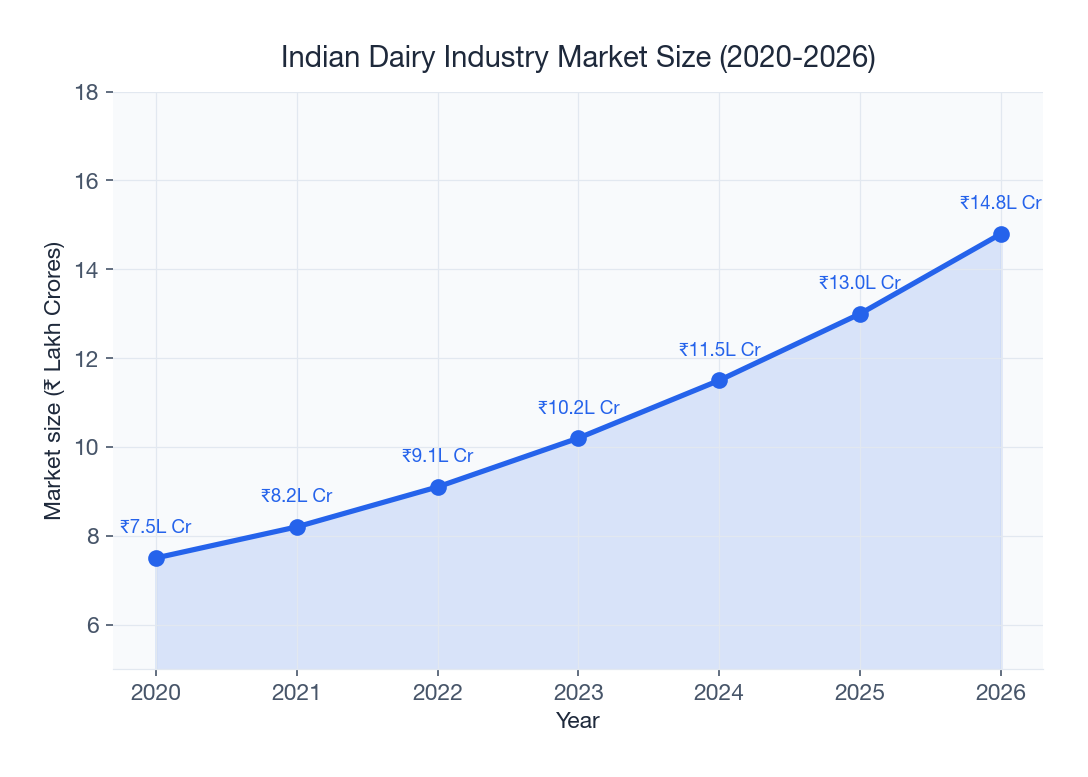
India is the world's largest milk producer, with annual production exceeding 230 million tonnes (source: National Dairy Development Board, Annual Report 2024-25). The dairy market is valued at over Rs 11 lakh crore and growing at 6-8% annually. Yet the distribution infrastructure connecting producers to consumers remains fragmented and underleveraged, creating an opportunity for well-organized distribution businesses.
The demand side is relentless: dairy products are consumed daily by over 80% of Indian households. Unlike discretionary FMCG categories, dairy demand is recession-proof, season-resistant, and growing with urbanization. The supply side is modernizing rapidly, with brands like Amul, Mother Dairy, and Nandini expanding their distribution footprints aggressively. They need distribution partners who can handle the complexity of perishable, daily-delivery, temperature-sensitive logistics.
This guide covers every step from legal registration to your first 90 days of operations. Whether you are an entrepreneur starting fresh or an existing distributor expanding into dairy, use this as your implementation roadmap.
Step 1: FSSAI Licensing and Legal Requirements
The Food Safety and Standards Authority of India (FSSAI) is the primary regulatory body for food distribution in India. Dairy distribution requires specific licensing under Schedule 4 of the FSS Act.
Types of FSSAI License for Dairy Distribution
- Basic Registration, For operations with annual turnover up to Rs 12 lakh. Suitable only for very small, single-city distributors. Application via Form A on the FSSAI FoSCoS portal.
- State License, For operations with annual turnover between Rs 12 lakh and Rs 20 crore. This covers most new dairy distribution businesses. Apply via Form B on FoSCoS.
- Central License, For operations with turnover above Rs 20 crore, or those operating across multiple states. Required if you import dairy products or operate in more than one state.
Key Schedule 4 requirements for dairy distribution:
- Temperature-controlled storage facilities maintaining 2°C to 8°C for chilled dairy products
- Separate storage for different product categories (milk, curd, paneer, cheese, ice cream)
- Traceability records from receipt to delivery, batch numbers, dates, temperatures
- Pest control measures in storage facilities
- Trained food safety supervisor (FoSTaC certified), at least one per facility
- Annual health check-up records for all staff handling dairy products
Timeline: FSSAI State License processing takes 30-60 days from application submission. Apply early, do not wait until your infrastructure is ready.
Other Legal Requirements
- GST Registration, Mandatory. Dairy products fall under multiple GST slabs: fresh milk (0%), packaged dairy (5%), butter and cheese (12%), ice cream (18%). Ensure your GST registration covers the correct HSN codes: 0401 (milk), 0403 (curd/buttermilk), 0405 (butter/ghee), 0406 (cheese/paneer).
- Shop & Establishment License, From your local municipal corporation. Required for operating a business premises.
- Trade License, From local municipal authority. Specific to food distribution in most cities.
- Vehicle Fitness Certificate, All delivery vehicles must have valid fitness certificates and, for refrigerated vehicles, additional certification for food transport.
Step 2: Cold Chain Infrastructure
Cold chain is the single most critical infrastructure investment in dairy distribution. Dairy products are perishable, a break in the cold chain does not just reduce quality, it creates a food safety hazard. The FSSAI mandates that chilled dairy products must be maintained between 2°C and 8°C throughout the distribution chain, and frozen products (ice cream, frozen desserts) must stay below -18°C.
Cold Storage Setup
- Walk-in cold room, Minimum 200-500 sq ft for a starting operation. PUF (Polyurethane Foam) insulated panels, 2-3 HP compressor unit, digital temperature monitoring with alerts. Cost: Rs 4-8 lakh depending on size and location.
- Temperature monitoring, Install IoT-based temperature sensors that log readings every 15 minutes and send SMS/app alerts if temperature breaches threshold. FSSAI auditors check temperature logs. Cost: Rs 30,000-80,000 per cold room.
- Backup power, Cold rooms need uninterrupted power. A 5 KVA generator or inverter backup is essential for areas with power cuts. Budget Rs 1.5-3 lakh.
- Separate zones, Maintain separate temperature zones for chilled products (2-8°C) and frozen products (-18°C and below). Cross-contamination between zones is an FSSAI violation.
For comprehensive cold chain management strategies, see our guide on cold chain management for dairy in India.
Delivery Vehicle Cold Chain
- Insulated vehicles, At minimum, use insulated delivery vans (Tata Ace Insulated, Mahindra Supro Insulated). Cost: Rs 6-9 lakh per vehicle. For longer routes, invest in refrigerated vehicles (reefer vans) at Rs 10-16 lakh per vehicle.
- Ice boxes and gel packs, For last-mile delivery from vehicle to retailer, use insulated crates with gel packs to maintain temperature. Budget Rs 500-1,200 per insulated crate.
- Temperature loggers in vehicles, Place data loggers in each vehicle. Brands increasingly require proof of cold chain maintenance during transit.
Step 3: Securing Your First 10 Distributors (or Brand Partnerships)
Your business model determines whether you are a super-distributor (distributing to sub-distributors) or a direct distributor (delivering to retailers). Either way, securing your first 10 partnerships, with brands or sub-distributors, is the foundation.
- Start with regional brands, National brands like Amul have stringent distributor requirements (warehouse size, vehicle fleet, capital). Regional dairy brands are more accessible for new entrants and often offer better margins. Identify 3-5 regional dairy brands in your target market.
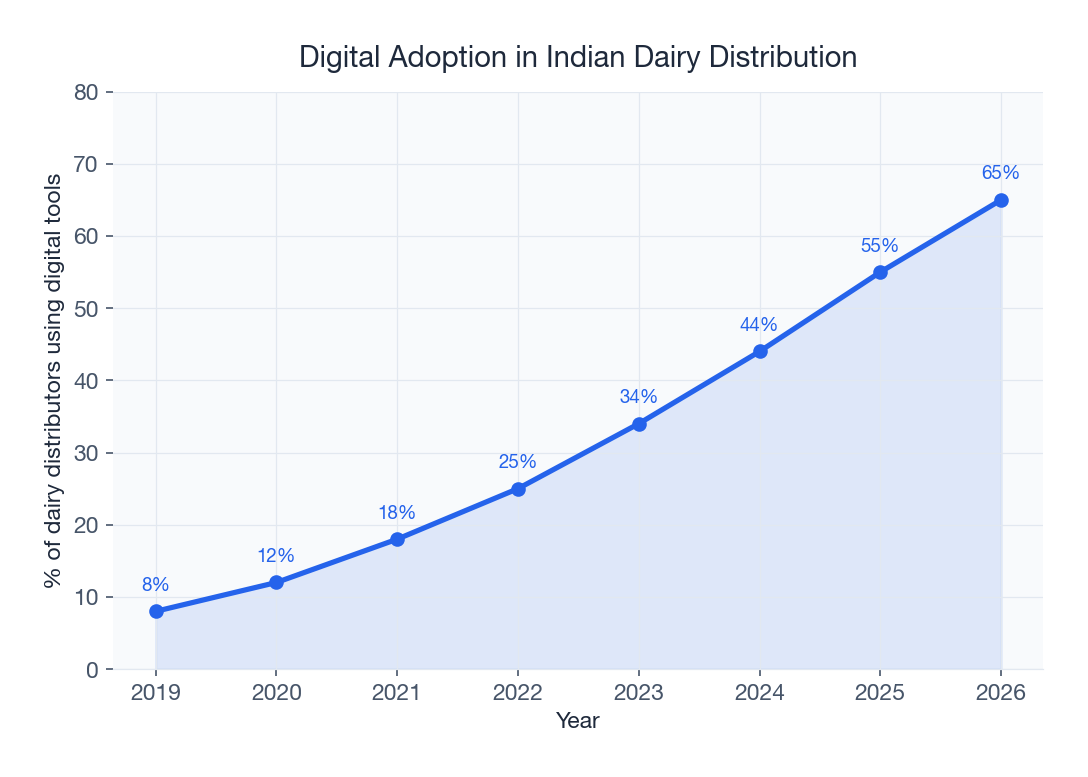
- Prepare your pitch, Brands evaluate distributors on: infrastructure (cold chain, warehouse), reach (number of retail outlets you can service), financial stability (working capital, credit history), and technology readiness (digital billing, order management). Having distribution software in place from day one gives you a competitive edge.
- Offer exclusive territory coverage, Brands want distributors who will cover every outlet in a territory, not just the easy ones. Propose a detailed territory plan with outlet mapping and delivery schedules.
- Start with 2-3 brands maximum, Handling too many brands at launch splits your attention and working capital. Master operations with 2-3 brands before expanding.
For strategies on building and managing distributor relationships, read our guide on how to manage dairy distributors.
Step 4: Route Design and Delivery Planning
Route design for dairy distribution is more constrained than general FMCG because of the perishability factor. Fresh milk and curd must reach retailers within a 4-6 hour window from dispatch. This means your routes must be planned for speed and coverage, not just efficiency.
Route Design Principles
- Map all retail outlets, Before designing routes, physically map every outlet in your territory. Record GPS coordinates, delivery window preferences, average order size, and cold storage availability at the outlet.
- Cluster by geography, Group outlets into clusters that a single vehicle can cover within the delivery window. Each cluster becomes a beat (daily route).
- Sequence for speed, Within each beat, sequence deliveries to minimize travel time. Start with outlets farthest from the warehouse and work back, this ensures the longest-traveling products spend the least time in transit.
- Account for daily variation, Dairy orders vary by day of week (higher on weekends, lower on Mondays). Design flexible routes that can handle +/- 20% volume variation without adding vehicles.
- Build contingency routes, Monsoon, festivals, and road closures disrupt routes. Have alternate routes planned for your top 20% outlets (by revenue).
Once operational, route optimization software can dynamically adjust routes based on real-time conditions, but the initial design should be done manually with local knowledge.
Step 5: Crate Investment and Management
Dairy distribution runs on returnable crates, plastic crates that carry milk pouches, curd cups, and other products from plant to retailer and back. Crate management is one of the biggest operational challenges in the industry, with losses costing the sector an estimated Rs 500 crore annually across India.
Crate Investment Calculation
| Parameter | Value | Notes |
|---|---|---|
| Daily delivery volume | 5,000 litres | Starting operation |
| Litres per crate | 20 | Standard dairy crate |
| Crates in daily circulation | 250 | 5,000 / 20 |
| Crate cycle time | 3 days | Dispatch → deliver → return |
| Total crates needed | 750 | 250 x 3 (cycle buffer) |
| Buffer stock (20%) | 150 | For damage, delays, peaks |
| Total crate investment | 900 crates | |
| Cost per crate | Rs 180 | Standard HDPE dairy crate |
| Total investment | Rs 1.62 lakh | 900 x Rs 180 |
As your business grows, crate inventory must grow proportionally. Digital crate tracking from day one prevents the losses that plague manual operations. For detailed strategies, see how to reduce crate loss in dairy distribution.
Step 6: Working Capital Planning
Dairy distribution is a working-capital-intensive business. You buy inventory daily from brands, deliver on credit to distributors/retailers, and collect payment 7-21 days later. The gap between cash outflow and inflow must be funded from working capital.
Working Capital Calculation
- Daily inventory purchase: Rs 3-5 lakh (for a starting operation handling 5,000-10,000 litres/day)
- Credit period given to retailers: 7-14 days
- Credit period received from brand: 3-7 days (often less for new distributors)
- Net working capital cycle: 7-10 days of sales value
- Working capital needed: Rs 20-50 lakh (depending on scale and credit terms)
Funding sources:
- Own capital, The safest option. Most dairy distributors start with Rs 25-50 lakh of own funds.
- Bank overdraft/CC limit, Against stock or property. Interest: 10-14% per annum. Banks like SBI, Bank of Baroda, and HDFC have specific schemes for food distribution businesses.
- Brand credit, As you build a track record, brands extend longer credit periods. Moving from 3-day to 14-day credit significantly reduces working capital needs.
- NBFC working capital loans, Faster approval than banks but higher interest (16-22%). Use as bridge financing, not long-term.
Step 7: Software Selection, Build Digital from Day One
The biggest advantage a new dairy distribution business has over incumbents is the ability to be digital-native from day one. Existing distributors struggle with the transition from paper to digital (see our guide on digitizing family dairy businesses). You do not have that legacy problem.
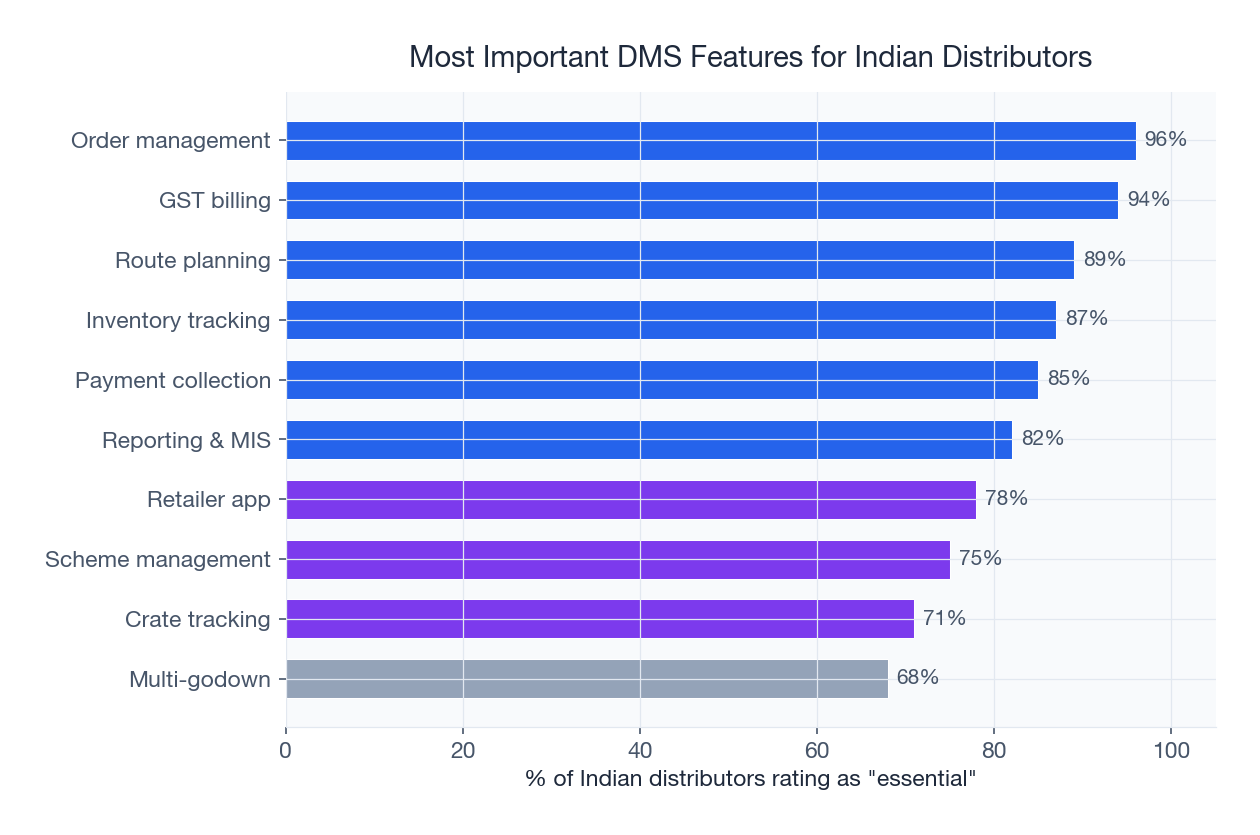
Select your distribution software before you start operations, not after. The software should handle:
- Order management with recurring daily orders
- GST-compliant billing with e-invoicing
- Crate tracking from day one
- Route optimization for your delivery fleet
- Sales analytics for performance monitoring
- Mobile app for field staff and distributors
For a detailed evaluation framework, use our 30-point DMS buyer's checklist.
Startup Cost Breakdown
Here is a realistic startup cost breakdown for a dairy distribution business in India, assuming a mid-sized starting operation (5,000-10,000 litres/day, 50-100 retail outlets, 1 city):
| Category | Investment (Rs lakh) | Notes |
|---|---|---|
| FSSAI licensing and legal | 0.50-1.00 | Including CA fees, documentation |
| Cold room (walk-in, 300 sq ft) | 5.00-8.00 | PUF panels, compressor, monitoring |
| Delivery vehicles (3 insulated) | 18.00-27.00 | Tata Ace Insulated or equivalent |
| Crates (900 units) | 1.60-2.00 | HDPE dairy crates + buffer |
| Temperature monitoring (IoT) | 0.80-1.50 | Cold room + vehicle loggers |
| Generator/power backup | 1.50-3.00 | 5 KVA for cold room backup |
| Warehouse deposit and setup | 3.00-6.00 | Rent deposit + basic infrastructure |
| Distribution software (Year 1) | 2.00-5.00 | SaaS license + implementation |
| Working capital (first 3 months) | 25.00-50.00 | Inventory funding gap |
| Miscellaneous (uniforms, stationery, insurance) | 1.00-2.00 | |
| Total Startup Investment | 58.40-105.50 |
The range is wide because vehicle costs (new vs. used), warehouse location (metro vs. tier-2 city), and working capital needs (dependent on credit terms) vary significantly. A lean start in a tier-2 city can begin at Rs 60 lakh; a well-capitalized start in a metro city may require Rs 1 crore+.
The First 90-Day Execution Plan
Here is a week-by-week execution plan for launching your dairy distribution business:
- Weeks 1-2: Legal and Setup
- Apply for FSSAI State License via FoSCoS portal
- Register GST with correct HSN codes (0401, 0403, 0405, 0406)
- Open current bank account with overdraft/CC facility application
- Secure warehouse location and begin cold room installation
- Weeks 3-4: Infrastructure
- Complete cold room installation and temperature monitoring setup
- Purchase or lease delivery vehicles (start with 2-3)
- Order crates (initial 900 units for 5,000 litre/day operation)
- Select and sign up for distribution software, begin data entry
- Weeks 5-6: Brand Partnerships
- Meet 5-8 dairy brands with your infrastructure and territory plan
- Negotiate terms with 2-3 brands (margins, credit, delivery expectations)
- Sign distribution agreements
- Enter product catalogs and pricing into distribution software
- Weeks 7-8: Market Mapping
- Map 100-150 retail outlets in your territory (GPS, contact, order patterns)
- Design initial delivery routes (5-8 beats covering all outlets)
- Onboard outlets, explain your delivery schedule, ordering process, and terms
- Set up distribution software routes and beats
- Weeks 9-10: Soft Launch
- Begin deliveries to 30-50 outlets (Phase 1, most accessible, highest potential)
- Run all operations through distribution software from day one
- Monitor cold chain compliance, delivery timing, and order accuracy daily
- Collect feedback from retailers on product range, delivery quality, and pricing
- Weeks 11-12: Expand and Optimize
- Expand to remaining outlets (full territory coverage)
- Optimize routes based on 2 weeks of delivery data
- Begin crate reconciliation, track every crate from day one
- First billing cycle collection, establish payment discipline early
- Week 13 (Day 90): Review and Plan
- Review: outlet coverage, daily volume, route efficiency, crate loss rate, payment collection DSO
- Identify top 10 and bottom 10 outlets by performance
- Plan next quarter: add brands, expand territory, or deepen existing coverage
- Financial review: actual vs. projected costs and revenue
Key Metrics to Track from Day One
- Daily dispatch volume (litres/units), Are you growing week over week?
- Delivery success rate, What percentage of planned deliveries actually happen?
- Cold chain compliance, Are temperature logs within 2-8°C throughout the chain?
- Crate return rate, Track weekly. Loss above 5% in the first 90 days indicates a crate management problem.
- DSO (Days Sales Outstanding), Target under 14 days from the start. Do not let payment discipline slip in the early days.
- Route efficiency, Cost per delivery drop. Use analytics to track this from week 1.
- Returns/damage rate, Dairy returns above 2% indicate cold chain or quality issues.
Common Mistakes New Dairy Distributors Make
- Starting without FSSAI license, Operating without a valid FSSAI license carries penalties up to Rs 5 lakh and potential imprisonment. Never start operations before your license is issued.
- Underestimating working capital, The most common cause of early-stage failure. Budget 50% more working capital than your initial estimate.
- Ignoring cold chain from the start, Temperature excursions in the first few weeks damage your reputation with brands and retailers. Invest in cold chain before you invest in marketing.
- Too many brands too early, Start with 2-3 brands, master the operations, then expand. Each additional brand adds complexity in ordering, storage, billing, and scheme management.
- Manual operations with "plans to digitize later", Going manual first creates habits and data gaps that are expensive to fix later. Be digital-native from day one. For implementation guidance, see DMS implementation mistakes to avoid.
Conclusion: The Opportunity Is Now
India's dairy distribution sector is at an inflection point. The market is growing, brands are investing in distribution expansion, and technology is making it possible for well-organized distributors to operate at efficiency levels that were impossible five years ago. The barrier to entry is not zero, you need Rs 60 lakh to Rs 1 crore to start properly, but the recurring revenue nature of dairy distribution (daily orders, daily delivery, daily collection) means that well-run operations become cash-flow positive within 6-12 months.
The key is to start right: get your licensing in order, invest in cold chain infrastructure, secure 2-3 brand partnerships, design efficient routes, track every crate, and run on distribution software from day one. The first 90 days set the trajectory for the next 10 years. If you are ready to start, reach out to our team for guidance on setting up your distribution technology stack from day one.
Sources & References
Frequently Asked Questions
Total startup investment ranges from Rs 58 lakh to Rs 1.05 crore depending on scale and location. Major cost components: delivery vehicles (Rs 18-27 lakh), cold room (Rs 5-8 lakh), working capital (Rs 25-50 lakh), warehouse (Rs 3-6 lakh), and distribution software (Rs 2-5 lakh). A lean start in a tier-2 city can begin around Rs 60 lakh.
Most new dairy distribution businesses need an FSSAI State License (turnover Rs 12 lakh to Rs 20 crore). Apply via Form B on the FoSCoS portal. Requirements include temperature-controlled storage (2-8°C), traceability records, FoSTaC certified food safety supervisor, and annual staff health check-ups. Processing takes 30-60 days.
FSSAI mandates chilled dairy products (milk, curd, paneer, buttermilk) at 2°C to 8°C throughout the distribution chain. Frozen products (ice cream, frozen desserts) must stay below -18°C. Temperature must be monitored and logged at storage and during transit. Breaches are FSSAI violations.
For a 5,000 litre/day operation: you need approximately 250 crates in daily circulation (at 20 litres per crate), multiplied by a 3-day cycle time (750 crates), plus 20% buffer (150 crates) = 900 total crates. At Rs 180 per crate, initial investment is approximately Rs 1.62 lakh. Scale proportionally as volume grows.
Well-run dairy distribution operations typically become cash-flow positive within 6-12 months. The daily-order nature of dairy means revenue starts from day one. Profitability depends on route efficiency, crate loss control, payment collection discipline, and working capital management. Digital operations from day one accelerate the path to profitability.
Start with software from day one. New operations have the advantage of being digital-native, no legacy habits to change, no historical data gaps to fill. Going manual first creates inefficiencies that become expensive to fix later. Modern distribution software costs Rs 2-5 lakh in the first year and pays for itself through crate tracking, route optimization, and billing accuracy.
Related SpireStock Features
End-to-end order lifecycle from placement to delivery with multi-level approval workflows.
Real-time GPS tracking of vehicles and drivers with route optimization for faster deliveries.
GST-compliant invoicing with HSN codes, gate passes, and financial ledger.
Related Solutions
Manage your entire distributor network digitally. Onboarding, credit limits, outstanding tracking, and performance analytics. Start free trial.
GPS fleet tracking, driver management, and route optimization for dairy and FMCG delivery vehicles. Reduce fuel costs by 25%. Try SpireStock.
Related Entities
Ready to Streamline Your Distribution?
Start your free 14-day trial and see how SpireStock can transform your dairy, FMCG or consumer-goods distribution operation, from order capture to crate recovery.

SpireStock Team
Distribution Technology Experts
SpireStock Team writes for SpireStock on distribution management, supply-chain optimisation and field operations for Indian dairy and FMCG brands.