The Art and Science of Dairy Distributor Management
Your distributors are your distribution. No matter how good your dairy products are, their success in the market depends entirely on how effectively your distributor network operates. Yet many Indian dairy companies, from regional brands in Pune and Ahmedabad to national players serving Mumbai's 50 lakh-litre daily milk market, still treat distributor management as a reactive, relationship-driven activity rather than a systematic, data-driven discipline. The result is predictable: veteran distributors quietly underperform for years while newer partners never get the support they need to succeed, and leadership teams only realise the gap when a competitor starts winning their best retail outlets.
The stakes are enormous. India's organized dairy market is projected to cross Rs 22 lakh crore by 2027, with distribution networks handling over 180 million litres of milk every single day. A single under-performing distributor in a metro territory can cost a dairy brand Rs 40-60 lakh in annual revenue and leak thousands of crates into untracked circulation. Scale that up across a 200-distributor network and the cost of mediocrity becomes a figure any CFO would flag for immediate attention. This guide provides a practical framework for managing dairy distributors in 2026, combining proven relationship practices with modern technology to build a high-performing dairy distribution network.
The playbook is equally relevant if you operate in adjacent categories like FMCG distribution, beverage distribution, or bakery and confectionery. The underlying discipline is identical; only the product perishability curve changes. Operators in consumer goods face the same fundamental question: how do you drive accountability, visibility, and growth across a network of independent partners whose economic interests are not always perfectly aligned with yours? The answer lies in systems, not personalities.
Building a Strong Distributor Onboarding Process
Selection Criteria That Actually Predict Success
Not every distributor is the right fit for your dairy brand. Define clear criteria before the first meeting: adequate cold storage capacity (minimum 4,000 litres for a mid-sized territory), financial stability with a CIBIL score above 700 for the proprietor and the last three years of ITR available, existing retailer relationships with at least 150-200 active outlets in the target territory, willingness to invest Rs 8-15 lakh in working capital and infrastructure, and compatibility with your digital systems. Brands like Amul and Mother Dairy have refined these criteria over decades and continue to tighten them as the market matures. Apply a written scorecard to every candidate and walk away from anyone scoring below 70% on the basics, the future pain of trying to rehabilitate a poorly selected distributor always outweighs the short-term revenue they bring.
Structured Onboarding That Sticks
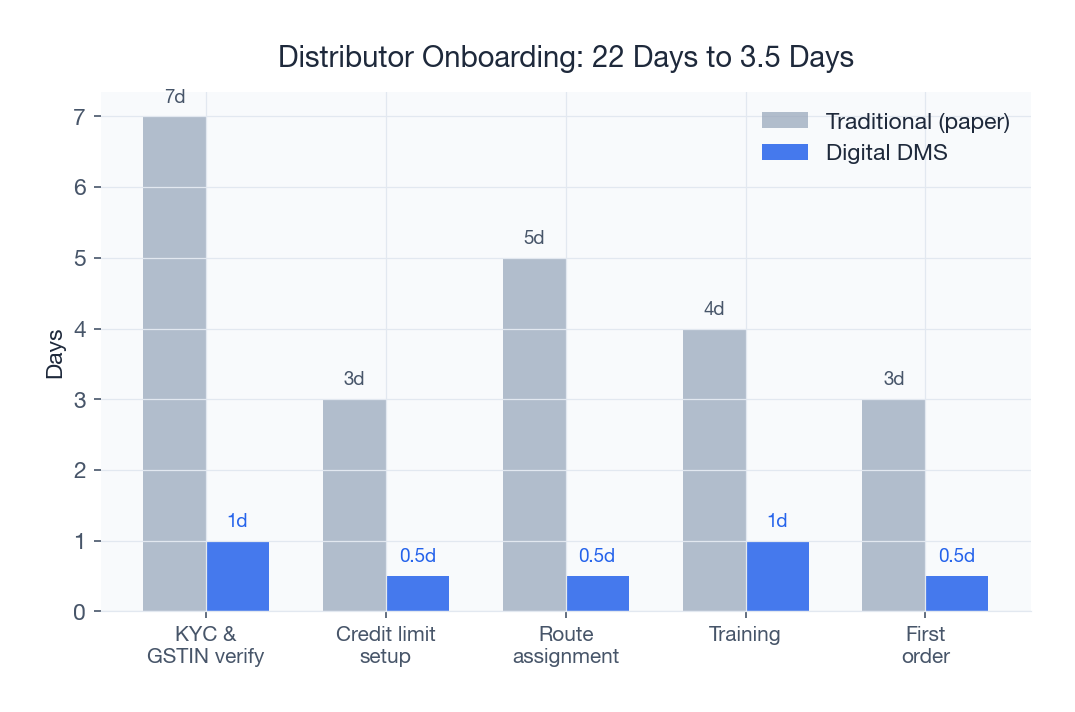
Create a standardized onboarding kit that includes territory definition, product catalog, pricing structure, scheme details, credit terms, delivery expectations, and technology training. Using a digital ordering platform from day one establishes the right habits early. Distributors onboarded on paper processes take 18-24 months longer to digitize later, because by then their staff have invested years in manual workflows they are reluctant to abandon. Pair structured onboarding with distributor management workflows so every new signup follows the same fifteen-step checklist, and assign a dedicated onboarding manager whose sole KPI for the first 45 days is new-distributor activation.
First 90 Days: The Make-or-Break Window
Industry data shows that 62% of distributor relationships that fail within five years show warning signs in the first 90 days. Define a formal onboarding scorecard covering the first order cycle, retailer activation count, compliance on cold-chain checks, and app login frequency. Share scores weekly with both the distributor and your zonal sales manager. Any new distributor scoring below 70% on the onboarding scorecard in week 8 should trigger an intervention call with the regional head. Waiting till month 3 is almost always too late; by then habits have formed and fixing them costs five times the effort of fixing them at week 8.
Territory Definition and Retailer Mapping
Precise territory boundaries prevent 80% of future conflicts. Define each distributor's territory down to the pin-code and retail-outlet level, and import it into your DMS so the system automatically blocks out-of-territory orders. In dense markets like Delhi-NCR, where two distributors may operate within 400 metres of each other, digital territory enforcement is the only sustainable way to avoid daily complaints and shadow pricing wars.
Setting Clear Performance Expectations
The Six Core KPIs Every Dairy Distributor Must Hit
- Monthly sales targets, set realistic, data-driven targets per SKU and per territory (e.g. 85,000 litres of toned milk, 12,000 kg of curd, 800 kg of ghee)
- Market coverage, define the number of retail outlets to be serviced, typically 180-320 outlets in urban territories
- Order frequency, daily ordering discipline is critical for dairy; anything below 26 orders a month is a red flag
- Payment terms, clear credit periods (7/14/21 days) and consequences for overdue payments
- Crate return rates, minimum 94% return percentage for returnable assets
- Cold chain compliance, mandatory 2-6 degree Celsius cold storage with IoT temperature logging
KPI Benchmark Table by Distributor Tier
| KPI | Tier 1 (Metro) | Tier 2 (City) | Tier 3 (Semi-urban) |
|---|---|---|---|
| Monthly revenue target | Rs 85 lakh+ | Rs 35-75 lakh | Rs 12-30 lakh |
| Retail outlets served | 280-420 | 180-260 | 90-160 |
| Daily SKU coverage | 45-60 | 30-45 | 18-28 |
| Crate return rate | 96%+ | 93%+ | 90%+ |
| DSO (days sales outstanding) | 9 days | 12 days | 16 days |
| App login frequency | Daily | Daily | 5-6 days/week |
| Wastage rate | Under 0.8% | Under 1.2% | Under 1.8% |
Document these expectations in a formal distributor agreement and review them jointly during quarterly business reviews. Tie scheme eligibility to tier-appropriate thresholds, distributors who clear Tier 1 KPIs unlock better credit terms and exclusive scheme access. Publish the distributor ranking board every month so everyone sees where they stand. Competition between peers drives more behaviour change than headquarter memos ever will, and the distributors who sit in the top quartile become your natural champions for new product launches, territory expansion experiments, and technology pilots.
Leveraging Technology for Distributor Management
Digital Ordering and Communication
Replace phone calls and WhatsApp groups with a structured mobile ordering platform. This ensures orders are captured accurately, cutoff times are enforced (typically 6 PM for next-morning dispatch), and every communication is documented. Distributors can access their ledger, delivery status, and scheme details through the same app, reducing phone calls to your sales office by 70-80% and freeing up customer-service staff for higher-value work like field coaching and problem resolution.
Performance Dashboards
Sales analytics provide objective, real-time visibility into distributor performance. Use dashboards to track order volumes, growth trends, product mix, payment behavior, and crate returns. Data removes subjectivity from performance conversations, a 34% drop in toned-milk volume across a Bangalore territory stops being a rough quarter narrative and becomes a specific week with a specific list of retailers who dropped off the order history. That specificity is what turns review meetings from excuses into action plans.
Automated Scheme Management
Trade schemes are a key lever for driving distributor behavior. An automated scheme engine ensures schemes are applied correctly, transparently, and consistently across your entire network, eliminating the Rs 40-80 lakh per year that mid-sized dairies typically lose to miscalculated or duplicated scheme payouts. It also builds distributor trust because they see exactly what they earned and why.
Route Optimization for Last-Mile Efficiency
Distributor efficiency is capped by the efficiency of their last-mile delivery to retailers. Deploy route optimization so each distributor van visits the maximum number of outlets in the minimum time, with minimum fuel burn. A 15% route efficiency gain translates to 2-3 extra retailer visits per day per vehicle, and directly to top-line growth. Over a year, that compounds to hundreds of extra retailer interactions per van and lakhs of rupees in incremental revenue without adding a single new resource.
Communication and Relationship Building
Regular Review Cadence
- Daily, order confirmations and delivery updates (automated via system)
- Weekly, sales performance summaries and issue resolution calls
- Monthly, detailed business reviews with targets vs. actuals and a joint action plan
- Quarterly, strategic discussions on growth plans, territory expansion, and new products
- Annually, contract renewal, credit limit revision, and long-term business commitments
Field Visits and Support
Your sales team should visit distributors regularly, not just to sell, but to understand their challenges, help them grow their retail network, and provide market intelligence. Field activity tracking ensures your team maintains the required visit cadence, with GPS-verified check-ins replacing the old verbal reports. Rolling this out alongside a sales productivity solution typically lifts field visit compliance from 55% to 92% within a single quarter, and the compound effect on distributor satisfaction is measurable within two quarters.
Joint Business Planning
Treat your top 20% of distributors as strategic partners, not order-takers. Conduct annual joint business planning sessions covering growth targets, new SKU launches, infrastructure investments, and territory expansion. Brands like Nandini in Karnataka have used this partnership model to build distributor loyalty that competitors cannot easily break. The sessions typically run half a day and surface more actionable intelligence than a month of market-visit reports. Distributors who participate in JBP sessions are also dramatically less likely to defect to a competitor offering a few extra percentage points of margin.
Distributor Councils and Peer Learning
Once a quarter, bring together 10-15 of your best distributors for a regional council. Let them share what is working in their territories, surface common problems, and feed ideas back to your product and operations teams. The feedback you collect in a single council session is worth ten market-visit reports from your own managers because it comes unfiltered from the people closest to the retail interface.
Managing Distributor Finances
Financial management is often the most sensitive aspect of the distributor relationship. Establish clear processes for:
- Credit limit setting, based on distributor volume, payment history, and financial standing
- Payment collection, systematic follow-up with automated reminders tied to your payment collection workflow
- Claim settlement, timely processing of returns, damages, and scheme claims within 7 working days
- Ledger reconciliation, monthly reconciliation of accounts with distributor sign-off
- Working capital support, channel financing partnerships with banks or NBFCs for peak-season credit needs
Link distributor financial data into invoice and billing so that every credit decision is backed by live outstanding, aging, and scheme-claim data rather than end-of-month Excel exports. The difference is dramatic: companies that manage credit through live DMS dashboards typically see bad-debt ratios drop from 1.8% of revenue to under 0.4% inside 12 months, freeing crores of working capital for growth investments and far tighter conversations with banks about cash conversion.
Handling Distributor Issues and Conflict
Common issues in dairy distribution include late payments, territory encroachment, under-ordering, poor cold chain practices, and low crate returns. Address these with a graduated response: first conversation, then formal warning, then credit restriction, and finally replacement consideration. Always document everything, digital systems make this automatic. In 2025, a Rs 400-crore regional dairy in Jaipur reduced distributor disputes by 78% within a year of rolling out a digital audit trail across its 240-distributor network.
The same discipline applies in consumer goods and fresh produce distribution, where perishability and route complexity create similar pressure points. Keep a conflict playbook handy: pre-written email templates, escalation decision trees, and standard operating procedures for the twelve most common disputes. Speed matters. Unresolved distributor conflicts rarely die on their own; they escalate. The playbook should live inside your DMS so any regional manager can pull it up in seconds when a situation flares, which also means every interaction is logged and learnings feed into the next iteration of the playbook.
Scaling Your Distributor Network
As your dairy brand grows, you will need to add distributors, split territories, and potentially introduce sub-distributor tiers. Plan for this growth by using multi-tenant workspace capabilities that let you manage complex distributor hierarchies without losing control or visibility. Expansion decisions become data-driven: pull a heatmap of retail coverage gaps, model the new territory's revenue potential, and onboard the new partner on the same standardized playbook you used for distributor number one.
For deeper reading, review our companion guides on payment collection from dairy distributors and choosing the right distributor management software to cement the operational foundation. Both are packed with operator-level detail that complements the strategic framework in this post. Building strong relationships across the FMCG distribution network is a continuous journey; the combination of clear processes, fair policies, regular engagement, and modern technology creates the foundation for a distribution network that drives sustained growth over five, ten, and twenty-year horizons. If you are ready to operationalize this playbook, talk to our team about a guided 30-day rollout, or review SpireStock pricing to understand the investment for your distributor base. For a tailored walkthrough against your current network, book a demo and we will map every KPI in this guide to your existing operations line by line, distributor by distributor, so you see exactly where the quick wins and the long-term plays are hiding.
Sources & References
Frequently Asked Questions
Evaluate potential distributors on: cold storage capacity, financial stability, existing retail network in the target territory, experience with perishable products, willingness to adopt digital ordering systems, and references from other brands they carry.
Monthly performance reviews covering sales vs. targets, payment compliance, crate returns, and market coverage are standard. Quarterly strategic reviews should cover growth plans and territory optimization. Daily/weekly monitoring through dashboards catches issues early.
Top challenges include inconsistent order placement, late payments, poor cold storage practices, low crate return rates, territory disputes between distributors, and resistance to adopting digital systems. Each requires specific management strategies.
Start with a performance improvement conversation using data. Identify if the issue is capability (needs training/support), motivation (needs better schemes), or structural (territory is too large/small). Set a 60-90 day improvement plan with specific milestones before considering replacement.
Credit terms vary by region and company, but typically range from 7-21 days for dairy distribution. Some companies operate on cash-and-carry for new distributors and graduate to credit terms based on performance. Always set credit limits based on monthly volume and payment history.
Define territories precisely using pin codes, geographic boundaries, and retail outlet lists. Use digital systems to enforce territory restrictions on orders and deliveries. Regular monitoring of sales patterns can detect unauthorized cross-territory selling early.
This depends on your market strategy. Exclusive distributors may invest more in your brand but limit your coverage. Non-exclusive arrangements allow broader reach but dilute focus. Many dairy companies use semi-exclusive arrangements, exclusive within dairy but allowing non-competing categories.
Lead with benefits: faster order confirmation, transparent scheme tracking, real-time delivery updates, and instant ledger access. Start with tech-savvy distributors who can champion the system. Offer a transition period where both paper and digital work, then set a firm cutoff date for digital-only ordering.
Related SpireStock Features
Real-time GPS tracking of vehicles and drivers with route optimization for faster deliveries.
Powerful dashboards with sales trends, MIS reports, and distribution analytics.
Flexible incentive schemes, flat, bulk-pack, and quantitative, applied automatically.
Related Solutions
Manage your entire distributor network digitally. Onboarding, credit limits, outstanding tracking, and performance analytics. Start free trial.
Boost field sales team productivity with beat planning, GPS attendance, order capture, and performance analytics. Built for Indian FMCG teams.
Related Entities
Ready to Streamline Your Distribution?
Start your free 14-day trial and see how SpireStock can transform your dairy, FMCG or consumer-goods distribution operation, from order capture to crate recovery.

SpireStock Team
Product & Industry Insights
SpireStock Team leads product at SpireStock, where the team ships distribution management software for India's dairy, FMCG and consumer-goods brands.