The Unique Challenge of Digitizing a Family Dairy Business
Across India, tens of thousands of dairy distribution businesses have been passed down through generations. From Pune to Jaipur, from Lucknow to Coimbatore, these family-run operations form the backbone of India's Rs 11 lakh crore dairy industry. The patriarch or matriarch who started the business 40 years ago built systems, paper ledgers, verbal agreements, mental route maps, that worked. Those systems carried the family through decades of growth. Now the next generation sees the need for technology, but the path from paper to digital is rarely a straight line.
This is not a technology problem. It is a change management problem. The software exists, platforms like SpireStock's order management can handle everything from billing to crate tracking. The real question is: how do you bring your family along on the journey without breaking the trust and institutional knowledge that made the business successful in the first place?
According to the National Dairy Development Board (NDDB), India has over 1.9 lakh dairy cooperatives and thousands of private dairy distribution businesses. A 2024 FICCI report on family businesses noted that only 22% of Indian family-run distribution companies have adopted any form of digital operations management, the lowest among all organized sectors. The opportunity, and the challenge, is enormous.
Understanding the Resistance: Why Elders Push Back
Before you can solve the problem, you need to understand it. When the senior generation resists technology, they are not being stubborn for the sake of it. Their resistance is rooted in legitimate concerns:
- Loss of control, Paper ledgers are tangible. The senior partner can flip through them, cross-check numbers, and feel confident. A digital dashboard feels abstract and removes that tactile control.
- Fear of exposure, In many family businesses, certain financial arrangements (cash transactions, informal credit to trusted retailers) exist in a grey area. Digitization makes everything transparent, which can feel threatening.
- Competence anxiety, Learning a new system at 60+ years of age is genuinely difficult. The fear of appearing incompetent in front of younger family members or employees is a powerful deterrent.
- If it ain't broke mentality, The business has survived and grown for decades. Why change what works? This is especially strong when the business is profitable.
- Dependency concern, "What happens when the internet goes down?" or "What if the software company shuts down?" are not unreasonable questions from someone who has weathered multiple economic cycles with nothing but a register and a pen.
Each of these concerns deserves a genuine answer, not dismissal. The worst approach is to frame this as "old vs. new" or "traditional vs. modern." Frame it instead as "protecting the legacy by making it stronger." Read more about this mindset in our guide on dairy distribution software in India.
The Phased Rollout Strategy That Works
The single biggest mistake families make is trying to go digital all at once. A full ERP deployment on day one is a guaranteed recipe for conflict and failure. Instead, use a four-phase approach that builds confidence incrementally.
Phase 1: Mobile Billing App (Weeks 1-4)
Start with the simplest, most visible win: digital billing. Replace the paper challan with a mobile billing app that generates GST-compliant invoices on the spot. This works because:
- It solves a real pain point (GST compliance, e-invoicing mandates)
- The output is a printed invoice, still tangible, still paper
- It does not disrupt any other workflow
- The senior generation can see the GST returns file automatically, a clear, undeniable benefit
During this phase, run parallel systems. Keep the paper register going alongside the app. This gives everyone a safety net and allows the family to verify that the digital numbers match the manual ones. According to the GST Council's 2024 mandate, all businesses with turnover above Rs 5 crore must use e-invoicing, this regulatory pressure actually helps your case.
Phase 2: Digital Order Collection (Weeks 5-10)
Once billing is stable, move to digital order collection. Distributors place orders through the mobile app instead of calling in. This phase is where you start seeing real time savings, typically 2-3 hours per day that the sales team previously spent on phone calls. The key training approach here is to start with your 10 most tech-friendly distributors and let their success pull the others along.
Phase 3: Route and Delivery Management (Weeks 11-16)
With orders flowing digitally, add route optimization and delivery tracking. This phase shows dramatic cost savings, fuel costs drop 20-30%, delivery accuracy improves, and the fleet becomes visible in real time. For the senior generation, the ability to see every vehicle on a map (without making phone calls) is often the "aha moment" that converts skeptics into advocates.
Phase 4: Analytics and Full Integration (Weeks 17-24)
Only after the operational modules are stable do you introduce analytics dashboards, scheme management, and full ERP integration. By this point, the family has 4+ months of digital data and can see trends that were invisible in the paper era.
| Phase | Module | Timeline | Key Metric | Senior Generation Buy-in Factor |
|---|---|---|---|---|
| 1 | Mobile Billing | Weeks 1-4 | 100% GST-compliant invoices | Tangible output (printed invoice), regulatory compliance |
| 2 | Order Collection | Weeks 5-10 | 2-3 hours/day saved | Fewer phone calls, order accuracy visible |
| 3 | Route & Delivery | Weeks 11-16 | 20-30% fuel savings | Fleet visibility on map, cost reduction |
| 4 | Analytics & Integration | Weeks 17-24 | Full data visibility | Business insights impossible without digital data |
Training Strategy: Start with the Mobile, Not the Dashboard
Traditional IT training starts with the admin dashboard, the most complex screen in any software. For family dairy businesses, invert this completely:
- Train delivery staff first, they use the simplest interface (scan, deliver, collect OTP) and their adoption creates data that makes the system valuable
- Train distributors second, order placement via app is straightforward and they see immediate benefit (order confirmation, invoice copy)
- Train the operations team third, dispatch, route assignment, and crate reconciliation
- Train the senior generation last, but train them only on the dashboard and reports, the part that gives them oversight without requiring daily data entry
This is counterintuitive but critical. The senior generation's role in a digitized operation is oversight, not operations. They need to see reports, approve exceptions, and monitor KPIs, not enter orders or generate invoices. Design their training around reading dashboards on a tablet, not typing on a keyboard. Many of our most successful implementations involve a dedicated 10-inch tablet mounted in the senior partner's office, showing a live dashboard that refreshes automatically. No login required, no navigation needed, just a single screen with the numbers that matter.
Preserving Institutional Knowledge During the Transition
The most valuable asset in a 3-generation business is not the infrastructure or the customer list, it is the institutional knowledge locked in the senior generation's heads. Which retailers always pay late but are worth keeping because of volume? Which routes flood during monsoon and need alternate planning? Which distributors need personal attention to stay loyal? This knowledge, accumulated over 40 years, is irreplaceable. Digitization must capture it, not discard it.
Practical steps to preserve institutional knowledge:
- Retailer notes, Have the senior generation dictate notes about each key retailer that get entered as CRM notes in the system. "Sharma ji pays on the 15th only" or "Don't send new salesman to Gupta Stores, owner only deals with Ramesh"
- Route annotations, Map every route deviation, seasonal change, and local knowledge onto the digital route plan. The senior generation knows that the Hadapsar route takes 45 extra minutes on Thursdays because of the weekly market
- Credit history, Before going digital, document every outstanding balance, informal credit arrangement, and payment pattern. This historical context is crucial for the distributor management system to work effectively
- Relationship mapping, Document which distributors are related to each other, which retailers have personal connections to the family, and which accounts require special handling
This exercise has a powerful secondary benefit: it makes the senior generation feel valued. They are not being sidelined, they are being asked to contribute their unique expertise to make the new system better. According to a 2023 study by the Indian School of Business on family business transitions, "involvement in knowledge transfer" was the single strongest predictor of senior generation support for technology adoption.
Handling the Financial Conversation
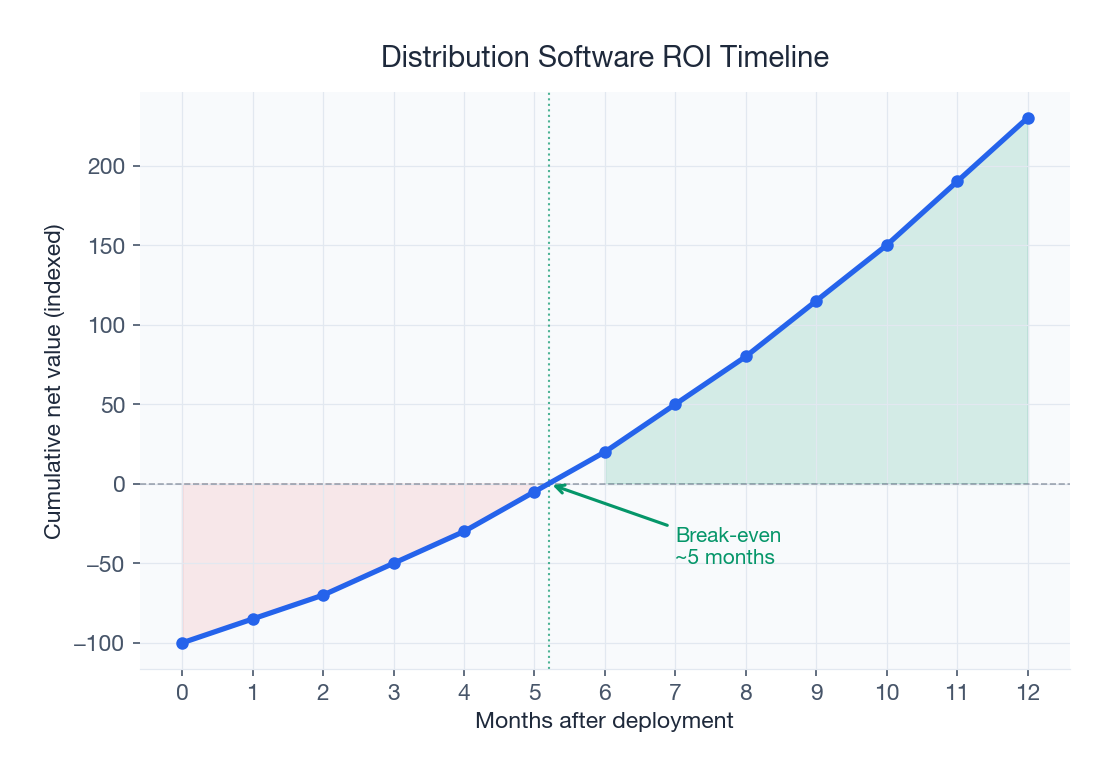
In family businesses, the money conversation is often the hardest. The senior generation sees software as an expense; the younger generation sees it as an investment. Bridge this gap with hard numbers specific to your operation:
| Cost/Saving Category | Typical Annual Impact (INR) | How It's Measured |
|---|---|---|
| Software subscription | Rs 6-12 lakh (cost) | Monthly SaaS fee x 12 |
| Crate loss reduction | Rs 15-30 lakh (saving) | Compare annual crate purchase before vs. after |
| Fuel savings | Rs 8-18 lakh (saving) | Fleet fuel bills before vs. after route optimization |
| Billing staff reduction | Rs 4-8 lakh (saving) | FTE reduction in accounts team |
| Payment cycle improvement | Rs 5-15 lakh (working capital freed) | DSO reduction x average outstanding |
| Scheme leakage prevention | Rs 3-10 lakh (saving) | Audit of scheme disbursement accuracy |
For a detailed framework on calculating these numbers for your specific operation, see our guide on ROI of distribution software. The typical payback period for a family dairy operation with 100+ distributors is 4-6 months, well within a single financial year.
Common Pitfalls and How to Avoid Them
- Going too fast, Resist the temptation to "rip the band-aid off." A 6-month phased rollout has a 3x higher success rate than a big-bang implementation (source: NASSCOM FMCG Technology Adoption Report, 2024)
- Underestimating training time, Budget 2x the training hours you think you need. For senior staff above 50 years, plan for 3-4 short sessions (30 minutes each) rather than one long training
- Not having a parallel run, Run paper and digital systems simultaneously for at least 4 weeks per phase. This is non-negotiable for family business buy-in
- Ignoring internet reliability, Many dairy distribution territories have patchy connectivity. Ensure your software has robust offline capability with automatic sync when connectivity returns
- Making it a generational battle, The moment digitization becomes "young vs. old," you have lost. Position it as "protecting what our family built" and involve the senior generation in every major decision
- Neglecting the field team, Delivery drivers and salesmen can make or break adoption. Invest in their training and provide incentives for app usage compliance
For a comprehensive list of implementation mistakes, read our post on 10 DMS implementation mistakes Indian distributors make.
The 90-Day Milestone Plan
Here is a concrete milestone plan that has worked for dozens of family dairy operations:
- Day 1-7: Family alignment meeting. All decision-makers agree on the "why" and the phased approach. Designate a project champion (ideally someone respected by both generations).
- Day 8-14: Data cleanup. Enter all distributor details, product catalogs, pricing, and outstanding balances into the system. This is tedious but essential.
- Day 15-30: Phase 1 pilot, billing app with 20-30 distributors. Parallel run with paper.
- Day 31-45: Evaluate Phase 1 results. Fix issues. Expand billing to all distributors.
- Day 46-60: Phase 2, digital order collection with pilot group.
- Day 61-75: Expand order collection. Begin route planning module setup.
- Day 76-90: First monthly review with full digital data. Present savings report to senior generation. This is usually the turning point.
By day 90, you should have hard evidence, in rupees saved and hours recovered, that makes the case for continuing the digital journey. The remaining phases (route optimization, analytics, scheme management) become much easier to justify once the family has seen real results.
Regulatory Tailwinds That Help Your Case
Several regulatory developments in India actually make the case for digitization stronger:
- E-invoicing mandate, GSTN now requires e-invoicing for businesses with turnover above Rs 5 crore. This is expanding to lower thresholds. Digital billing is not optional anymore.
- FSSAI compliance, The Food Safety and Standards Authority of India requires traceability records for dairy products. Digital systems make compliance automatic rather than a separate exercise.
- E-way bill integration, Interstate movement of goods above Rs 50,000 requires an e-way bill. Integrated software generates these automatically.
- Bank and NBFC requirements, Increasingly, working capital lenders want digital transaction records. A well-maintained DMS strengthens your credit profile.
These regulatory pressures are not going away, they are intensifying. Early adoption positions your family business ahead of the compliance curve rather than scrambling to catch up.
Conclusion: Honouring the Past While Building the Future
Digitizing a 3-generation family dairy distribution business is not about replacing what works. It is about amplifying it. The relationships, the market knowledge, the reputation, these are assets that no software can create. What software can do is free the family from the drudgery of manual processes so they can focus on what they do best: building relationships and growing the business.
The families that navigate this transition successfully share one trait: they treat digitization as a family project, not a technology project. Everyone has a role, everyone's concerns are heard, and the pace respects the comfort level of all stakeholders. If you are beginning this journey, schedule a consultation with our team, we have guided hundreds of family dairy businesses through exactly this transition.
Sources & References
Frequently Asked Questions
A phased rollout typically takes 5-6 months from first module (billing) to full integration (analytics). The key is starting with billing in weeks 1-4, then adding order management, route optimization, and analytics progressively. Rushing the process increases resistance and failure rates.
Train them last, not first. Let delivery staff and distributors create data first, then train seniors only on dashboards and reports, the oversight layer. Use a dedicated tablet with a single live dashboard screen. Keep sessions short (30 minutes) and focus on reading data, not data entry.
Design the system so their workflow barely changes. They continue oversight and decision-making through a simple dashboard. The operational users (billing, dispatch, sales) handle the digital workflows. Many successful implementations have the senior partner reviewing a dashboard daily without ever logging into the full system.
Yes, run parallel systems for at least 4 weeks per phase. This builds trust by proving the digital numbers match manual records. Most families naturally stop maintaining paper within 2-3 months once confidence builds.
Most modern platforms work on 2G speeds for basic operations and sync fully on 4G. Offline capability is essential, the app should capture transactions offline and sync when connectivity returns. For rural distribution routes in India, offline mode is non-negotiable.
For a mid-sized operation (100-300 distributors), expect Rs 6-12 lakh annually in software costs plus Rs 2-4 lakh one-time implementation. Savings from crate loss reduction, fuel optimization, and billing efficiency typically deliver payback within 4-6 months.
Related SpireStock Features
Related Solutions
Manage your entire distributor network digitally. Onboarding, credit limits, outstanding tracking, and performance analytics. Start free trial.
Track distributor and retailer payments. Cash, UPI, cheque collection with reconciliation, ageing reports, and credit limit management.
Related Entities
Ready to Streamline Your Distribution?
Start your free 14-day trial and see how SpireStock can transform your dairy, FMCG or consumer-goods distribution operation, from order capture to crate recovery.

SpireStock Team
Distribution Technology Experts
SpireStock Team writes for SpireStock on distribution management, supply-chain optimisation and field operations for Indian dairy and FMCG brands.