What Is ONDC?
The Open Network for Digital Commerce (ONDC) is India's most ambitious attempt to democratize digital commerce. Unlike a marketplace such as Amazon or Flipkart where a single company controls the platform, ONDC is an open protocol -- a set of standards and APIs that allow any buyer application and any seller application to discover and transact with each other. Think of it as UPI for commerce: just as UPI allowed any bank's app to send money to any other bank, ONDC allows any buyer app to discover products listed on any seller app.
Launched by the Department for Promotion of Industry and Internal Trade (DPIIT) under the Ministry of Commerce, ONDC is backed by a Section 8 (not-for-profit) company with shareholders including Quality Council of India, Protean eGov Technologies, and several financial institutions. The protocol went live in pilot mode in late 2022 and has since scaled rapidly. By mid-2026, ONDC has achieved significant milestones:
- 326 million+ cumulative orders processed across the network
- 400+ cities with active buyer and seller participation
- 60+ buyer apps and 150+ seller apps live on the network
- 12+ categories including grocery, food delivery, mobility, fashion, electronics, and increasingly, B2B wholesale
- Average daily order volume crossing 1.2 million transactions
For FMCG distributors in India, ONDC is the government's answer to platform monopolies in digital commerce. Its goal is to ensure that no single platform controls the buyer-seller relationship, that small businesses can access digital commerce without paying 25-40% commissions, and that India's 12 million kirana stores and hundreds of thousands of distributors are not left behind in the digital economy. The question every distributor should ask is not whether ONDC will affect their business, but when and how.
How ONDC Works for FMCG
Unlike traditional e-commerce where listing, discovery, transaction, and fulfillment all happen within a single company's ecosystem, ONDC unbundles these functions across independent participants connected by an open protocol.
The ONDC Architecture
The network operates through three types of participants:
- Buyer Apps (BAPs): Consumer-facing or retailer-facing applications through which orders are placed. For B2B kirana ordering, apps like Kiko Live and emerging distributor-focused platforms allow kirana owners to browse catalogs and place orders.
- Seller Apps (SPPs): Applications through which sellers -- brands, distributors, wholesalers -- list products and manage orders. Seller apps allow distributors to create digital catalogs, set pricing, and receive orders from any buyer app on the network.
- ONDC Gateway: The central registry and routing layer connecting buyer apps to seller apps. When a kirana in Pune searches for a product on a buyer app, the gateway broadcasts this to all relevant seller apps, aggregates responses, and presents options to the buyer.
The revolutionary aspect is interoperability. A kirana using Buyer App X can discover and order from a distributor listed on Seller App Y. Neither party needs to be on the same platform -- fundamentally different from how digital commerce has worked anywhere in the world.
The FMCG Transaction Flow on ONDC
A typical B2B FMCG transaction works like this: A distributor in Ahmedabad lists their catalog on a seller app. A kirana owner opens a buyer app and searches by product or category. The ONDC gateway routes this search to all relevant seller apps. The buyer app displays options from multiple sellers with transparent pricing and ratings. The kirana selects a seller and places the order, which routes through ONDC to the seller app. The distributor fulfills and delivers. Payment settles through ONDC's reconciliation layer.
The core implication: ONDC makes any FMCG distributor discoverable to any kirana store in their delivery area, without either party needing to be on the same platform.
ONDC's B2B Play: Kirana Ordering Reimagined
While ONDC's B2C story has captured most media attention, the B2B commerce play is where the real transformation potential lies for FMCG distribution. ONDC's B2B segment has been growing at 45-55% quarter-over-quarter through 2025 and into 2026.
How Kiranas Order Today
Consider how a typical kirana in a tier-2 city like Jaipur orders inventory today: the distributor's salesman visits 2-3 times per week, takes verbal orders transcribed into an order book, and relays them via phone call or WhatsApp. The kirana orders from only 3-5 territory-assigned distributors with no visibility into alternatives. Trade schemes and discounts are communicated informally, and the kirana rarely knows if they are getting the best price. If they want to stock a product their current distributors do not carry, there is no efficient discovery mechanism.
What ONDC Changes
ONDC addresses each friction point. Kiranas can browse catalogs and place orders anytime through a buyer app, eliminating dependence on salesman visits. Through ONDC, a kirana is no longer limited to territory-assigned distributors -- they can discover any distributor selling in their area. When multiple sellers list the same product, prices are visible side by side, forcing competitive pricing. Brands can also sell directly to kiranas through seller apps, creating a brand direct-to-kirana channel that did not exist at scale before.
The implications are profound. The super stockist layer, which exists primarily to aggregate demand and extend credit across large territories, faces potential disintermediation. If a kirana can order directly from a brand or regional distributor through ONDC, the super stockist's intermediary role becomes harder to justify. See our distribution management software guide for more on these channel dynamics.
Key insight: ONDC does not replace distributors. It replaces the information asymmetry that has defined distributor-kirana relationships for decades. Distributors who compete on service quality, fulfillment speed, and transparent pricing will thrive.
Impact on Traditional Distribution Channels
ONDC's potential to reshape FMCG distribution channels is significant, but the impact will not be uniform across the traditional distribution pyramid.
Disintermediation Risk: Super Stockists
Super stockists are the most vulnerable layer in the ONDC era. Their primary value has traditionally rested on three pillars: breaking bulk (buying truckloads from brands and selling in smaller lots to distributors), extending credit to smaller distributors who cannot buy directly, and aggregating demand across large territories so that brands have a single billing point per region.
ONDC potentially undermines each of these pillars. If brands can list directly on the network and sell in distributor-sized lots, the bulk-breaking function loses relevance. If fintech integration through OCEN (Open Credit Enablement Network) enables digital credit for distributors and kiranas, the credit extension role diminishes. And the ONDC protocol itself aggregates demand digitally, replacing the physical aggregation that super stockists provide.
That said, disintermediation will not happen overnight. Many super stockists have deep capital reserves, decades-long relationships with brands, and logistical infrastructure that cannot be replicated digitally. In categories requiring cold chain capability -- dairy, frozen foods, ice cream -- the physical infrastructure of super stockists remains essential and difficult to bypass.
Distributor Role Evolution
For distributors, ONDC means role transformation rather than elimination. The traditional bundled role -- order-taking, warehousing, credit extension, delivery, scheme execution, relationship management -- gets unbundled:
| Function | Traditional Role | Post-ONDC Role |
|---|---|---|
| Order-taking | Salesman visits kirana, takes order manually | Kirana orders digitally; salesman focuses on merchandising |
| Product discovery | Salesman introduces new products | Kirana discovers products across network; distributor competes on catalog breadth |
| Pricing | Opaque, negotiated individually | Transparent, visible alongside competitor pricing |
| Fulfillment | Distributor delivers from godown | Core differentiator; speed, reliability, and accuracy matter most |
| Credit | 7-21 day credit to retailers | Remains critical; ONDC does not solve kirana working capital needs |
Distributors whose competitive advantage rests on territorial exclusivity and information asymmetry will be most affected. Those whose advantage rests on operational excellence -- fast delivery, accurate orders, consistent stock, transparent schemes -- will benefit.
Brand Direct-to-Kirana Opportunities
For FMCG brands, ONDC opens a direct-to-kirana channel that has been extremely difficult to build independently. A mid-sized brand with Rs 200-500 crore revenue can list on a seller app and become discoverable to kiranas across its target geography without building a field force. This is powerful for new product launches, direct pricing, and market intelligence. However, fulfillment remains a complex operation that brands prefer to outsource, so the distributor's role shifts from exclusive channel partner to fulfillment provider competing on delivery quality.
Opportunities for Forward-Thinking Distributors
For distributors willing to adapt, ONDC presents more opportunity than threat. The protocol levels the playing field, giving efficient, digitized distributors access to markets and retailers they could never reach through traditional channel appointments.
Become an ONDC Seller
The most direct opportunity is to register as a seller on the ONDC network through a seller app. This involves selecting a seller app partner (several are available with varying features and pricing), digitizing your product catalog with accurate descriptions, images, pricing, and real-time availability, and defining your serviceable pin codes and delivery capabilities.
Once listed, your catalog becomes discoverable to every kirana in your delivery area using any buyer app on the ONDC network. For a distributor in Mumbai currently serving 400 kiranas through salesman visits, ONDC potentially opens access to thousands more -- without hiring additional field staff. Do not wait for ONDC to achieve critical mass before registering. Early movers build order history, accumulate seller ratings, and refine their ONDC operations before competition intensifies.
Reach Kiranas Beyond Your Current Territory
Traditional FMCG distribution is intensely territorial. ONDC dissolves these boundaries. If you have the fulfillment capability to deliver to a wider area, ONDC allows kiranas outside your traditional territory to discover and order from you. A distributor with efficient distribution tracking can extend their delivery radius and capture incremental volume. The key constraint is no longer brand appointment -- it is fulfillment capability.
Build a Digital Catalog That Sells
On ONDC, your catalog is your storefront. Unlike traditional distribution where the salesman is your primary sales channel, on ONDC your product listings need to sell themselves. This means accurate product information (name, brand, weight, pack size, HSN code), clear product images, competitive pricing inclusive of applicable schemes, real-time stock availability, and clear delivery timelines. Distributors who invest in building high-quality digital catalogs will outperform those who treat ONDC listing as an afterthought.
Transparent Pricing Builds Trust
One of the most common complaints from kirana owners about traditional distribution is pricing opacity. "Is the distributor passing on the full scheme benefit?" "Am I getting the same price as the shop across the street?" ONDC enforces price transparency by design. When multiple sellers list the same product, prices are visible side by side.
Smart distributors will use this transparency as a trust-building mechanism. When a kirana can see that your price for Parle biscuits is competitive with every other listed distributor, and your delivery reliability is consistently high, you build a digital reputation that drives repeat orders. This is where transparent, GST-compliant invoicing and automated sales tracking become essential enablers.
Challenges and Limitations
Despite the promise, ONDC faces significant challenges that will temper its near-term impact on FMCG distribution.
Adoption Remains Early
While 326 million cumulative orders is impressive, much of ONDC's current volume is concentrated in food delivery and mobility. Grocery and FMCG B2B ordering account for a smaller share. A distributor listing today should not expect a flood of orders immediately. The network effects that will drive explosive growth have not yet reached critical mass in most cities.
Kirana Digital Literacy
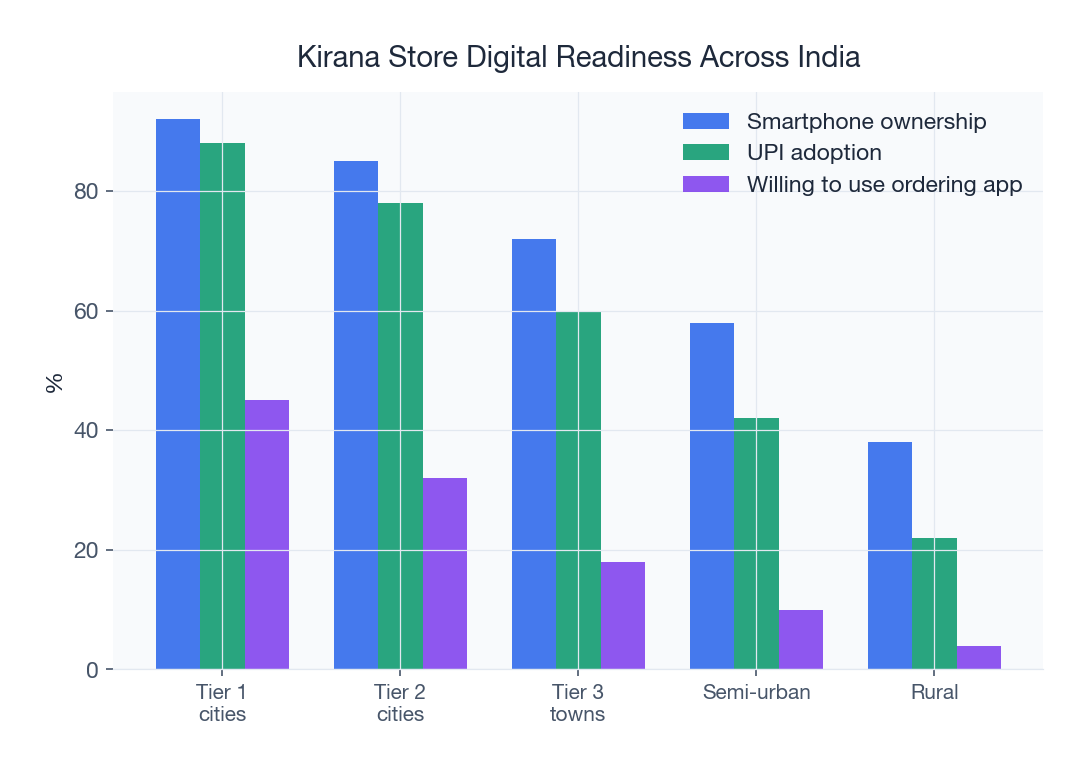
India's 12 million kirana stores vary enormously in digital readiness. Metro kirana owners are comfortable with smartphones and app-based ordering. In tier-3 and tier-4 towns, many store owners use basic phones and prefer phone-call ordering. ONDC's FMCG success depends on user-friendly buyer apps with vernacular language support and on-ground training -- the kind of retailer enablement that distribution management platforms are uniquely positioned to provide.
Logistics and Fulfillment: ONDC's Blind Spot
This is the critical limitation: ONDC is a discovery and transaction protocol. It does not solve logistics. When a kirana orders FMCG products through a buyer app, someone still needs to pick, pack, and deliver those products. ONDC does not operate warehouses, run delivery fleets, or manage cold chains for perishable dairy products. This is exactly where traditional distributors add irreplaceable value.
For dairy distributors, the cold chain requirement is a powerful moat. Delivering curd and paneer to kiranas across Bangalore by 7 AM requires refrigerated vehicles, optimized routes, and early-morning operations that no protocol can digitize. Read our guide on what a DMS is for more on the technology behind efficient fulfillment.
Quality Control, Returns, and Credit Gaps
In traditional distribution, quality issues are handled through established relationships -- the salesman handles replacements on his next visit. On ONDC, returns involve multiple parties and protocols, making resolution more complex for perishable goods where rejection rates run 5-15%. ONDC's Issue and Grievance Management framework is still maturing.
Credit is another gap. Indian kirana commerce runs on 7-21 day credit from distributors, an estimated Rs 2-3 lakh crore outstanding at any time. ONDC transactions are primarily digital-payment-based. While OCEN (Open Credit Enablement Network) integration promises digital credit, it remains in pilot stage. Until credit is seamlessly available, many kiranas will prefer traditional distributors who offer familiar terms.
How to Prepare Your Distribution Business for ONDC
Whether ONDC transforms FMCG distribution in 12 months or 36 months, the preparation steps improve your operations regardless of ONDC adoption.
Step 1: Register as an ONDC Seller
Select a seller app partner and register your business. You will need GSTIN, PAN, FSSAI license (for food products), bank account verification, and defined serviceable pin codes. Early movers build order history, accumulate ratings, and refine operations before competition intensifies.
Step 2: Digitize Your Product Catalog
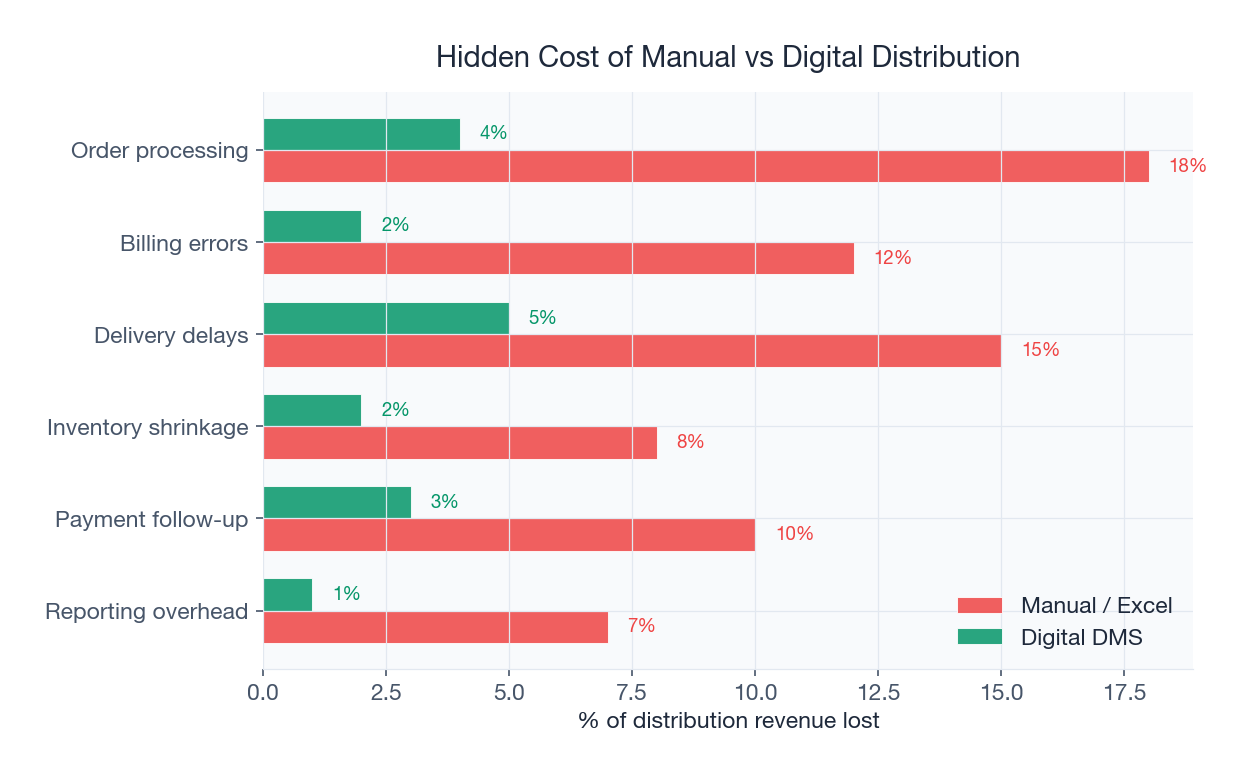
Your ONDC catalog needs to be comprehensive, accurate, and dynamically updated. Every SKU you distribute should have correct product name, brand, category, weight, pack size, HSN code, GST rate, MRP, your selling price (inclusive of applicable schemes), product images, and real-time stock availability. If you are currently managing your catalog on paper or in spreadsheets, the transition to ONDC will be painful.
A distribution management system that maintains a digital product master with real-time inventory makes ONDC catalog management straightforward -- your DMS catalog becomes the single source of truth that feeds both your ONDC listings and your traditional operations. No manual duplication, no sync errors, no stale pricing.
Step 3: Integrate Your DMS with ONDC APIs
The real efficiency gains come when your distribution management software talks directly to the ONDC network. Without integration, managing ONDC alongside your existing operations becomes a manual, error-prone process of maintaining two systems. With integration, ONDC is simply another order channel feeding into your existing workflow:
- Catalog sync: Your product catalog, pricing, and stock levels update automatically on ONDC when they change in your DMS
- Order routing: ONDC orders flow directly into your existing order pipeline alongside traditional orders
- Inventory deduction: Stock is immediately deducted when an ONDC order is confirmed, preventing overselling
- Delivery tracking: Status updates flow back to the ONDC network, giving buyers real-time visibility
- Invoice generation: GST-compliant invoices are auto-generated for ONDC orders just as for traditional ones
Step 4: Ensure Fulfillment Capability
On ONDC, fulfillment is your reputation. The network tracks on-time delivery rate, order accuracy, and cancellation rate -- metrics that influence your visibility on buyer apps. Invest in optimized delivery routes through route planning tools, picking accuracy checks, capacity for incremental volume, and cold chain integrity for perishable products.
ONDC vs Quick Commerce vs Traditional Distribution
With three models competing for FMCG volumes, distributors need to understand where each adds value. For a deep dive into quick commerce, read our analysis of how quick commerce is disrupting FMCG distribution.
| Dimension | ONDC | Quick Commerce | Traditional Distribution |
|---|---|---|---|
| Model | Open protocol connecting buyer and seller apps | Closed platform with owned dark stores | Brand-appointed distributor with territory rights |
| Primary buyer | Kirana stores (B2B) and consumers (B2C) | Urban consumers (B2C only) | Kirana stores (B2B) |
| Fulfillment | Seller (distributor/brand) handles delivery | Platform dark stores + gig delivery fleet | Distributor fleet delivers to kiranas |
| Geographic reach | 400+ cities; expanding to tier-2/3 | 25-30 metro cities only | Pan-India including rural |
| Credit | Limited; OCEN integration in pilot | No credit (digital payment only) | 7-21 day credit; core value proposition |
| Price transparency | High (multi-seller comparison) | High (platform-set pricing) | Low (opaque, negotiated) |
| Commission | Low (1-3% protocol fees) | High (25-40% to brands) | Moderate (5-12% distributor margin) |
| Cold chain | Depends on seller infrastructure | Basic refrigeration in dark stores | Strong; built over decades |
| Distributor risk | Medium-term: role evolution | Near-term: volume loss in metros | Baseline |
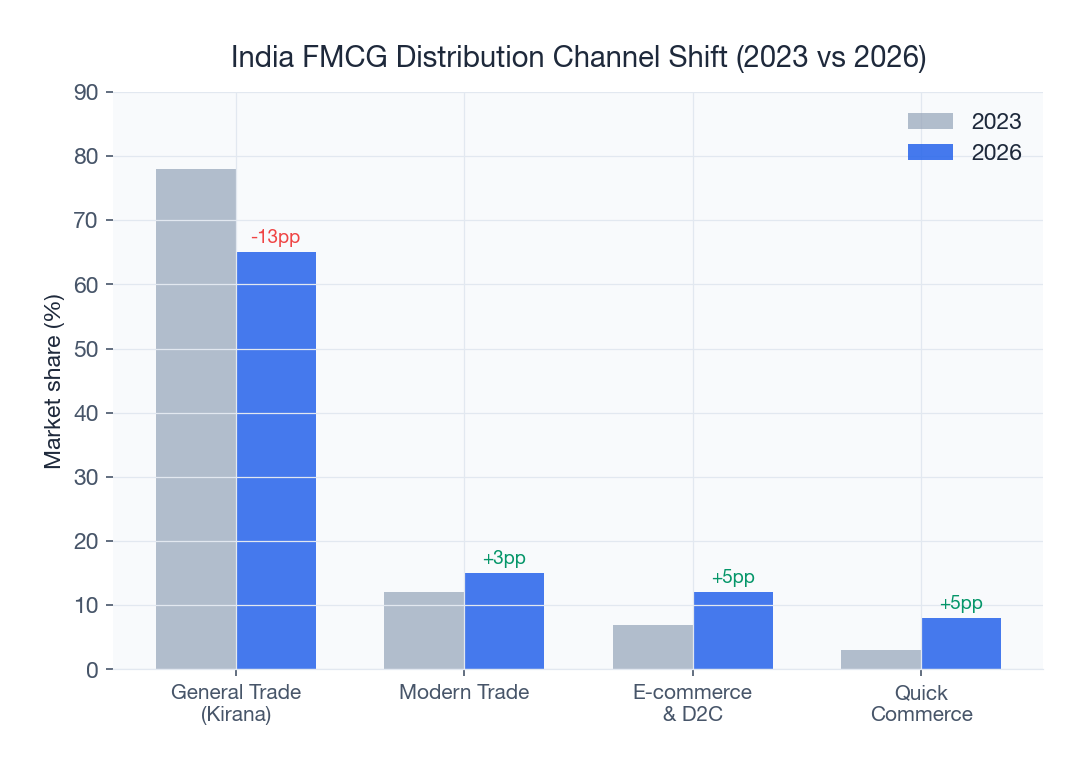
The key insight from this comparison: ONDC is not a direct competitor to distributors the way quick commerce is. Quick commerce bypasses distributors entirely by building a parallel supply chain from manufacturer to dark store to consumer. ONDC, by contrast, can make existing distributors more accessible and competitive by giving them digital visibility to a wider kirana base. The threat from ONDC is not elimination but evolution -- distributors who do not adapt their role may lose share to more efficient operators on the same network, but the network itself needs distributors to function.
Case Studies: Early Adopters on ONDC
Case Study 1: Mehta FMCG Distributors, Ahmedabad
Mehta FMCG Distributors handles multi-brand distribution across Ahmedabad and Gandhinagar, serving 520 retail outlets. In early 2025, they registered as an ONDC seller, listing 680 SKUs across snacks, personal care, and household products. The first three months were slow -- barely 15-20 orders per week. But by month six, orders climbed to 80-100 weekly as more kiranas adopted buyer apps.
By mid-2026, ONDC accounts for 12% of Mehta's total order volume. Critically, 35% of ONDC orders come from kiranas outside their traditional territory -- shops they had never served before. "We are reaching kiranas in Bopal that we could never justify sending a salesman to. The orders come in digitally, we add them to existing delivery runs, and the cost of serving these new outlets is almost zero." Mehta integrated their order management workflow to handle ONDC orders alongside traditional ones seamlessly.
Case Study 2: Lakshmi Dairy Products, Chennai
Lakshmi Dairy Products distributes milk, curd, paneer, and buttermilk across central Chennai, serving 280 outlets with 8 refrigerated vehicles. As a dairy distributor, they faced a unique ONDC challenge: perishable products requiring cold chain delivery before 7 AM with razor-thin margins (4-6% on milk, 8-10% on value-added dairy).
Lakshmi registered on ONDC but limited their catalog to value-added dairy (paneer, flavored yogurt, cheese, lassi) where margins were higher, excluding fresh milk which they continued serving only through route-based delivery. Within four months, ONDC brought orders from 45 new kiranas -- small general stores and juice shops that had been buying paneer from local markets at higher prices. ONDC worked for products where discovery matters, but did not replace the daily relationship-based milk delivery that depends on route consistency and cold chain trust.
Case Study 3: Gupta Trading Company, Jaipur
Gupta Trading Company distributes snacks, beverages, and confectionery across Jaipur with 340 outlets and 6 vehicles. What made their ONDC journey notable was integration: they connected their distribution management software with the ONDC seller app so catalog updates, pricing changes, and inventory levels synced automatically. When a kirana searched for snack products, Gupta's catalog appeared with real-time availability and competitive pricing including trade schemes.
Result after eight months: 95 new kirana customers, Rs 8.5 lakh in incremental monthly billing, at effectively zero customer acquisition cost. "Our ONDC customers reorder because we deliver on time, every time. On the network, your delivery record is your reputation."
SpireStock and ONDC Readiness
The common thread across every ONDC preparation strategy is a modern distribution management system. Without one, managing ONDC alongside traditional operations means separate catalogs, separate order tracking, separate invoicing, and separate inventory management. A DMS eliminates this duplication.
How SpireStock Prepares You for ONDC
- Digital catalog management: Maintain a comprehensive product master with pricing, schemes, and stock levels that feeds directly into ONDC seller apps. Every SKU has proper categorization, HSN codes, and GST rates -- the data infrastructure ONDC requires.
- Unified order pipeline: Whether an order comes from a salesman, phone call, WhatsApp, or ONDC buyer app, it enters the same order management workflow. Your staff works from a single, unified order list.
- Real-time inventory: ONDC penalizes sellers who accept orders they cannot fulfill. SpireStock ensures stock availability data is always current, preventing overselling that damages seller ratings.
- Route-optimized fulfillment: ONDC orders from new kiranas need to slot into existing delivery routes efficiently. SpireStock's route planning handles this without increasing costs disproportionately.
- GST-compliant invoicing: Automated billing generates compliant invoices for ONDC orders with correct HSN codes, tax calculations, and e-invoicing support.
- Analytics across channels: Sales analytics showing performance across traditional and ONDC channels side by side -- which products sell better through which channel, where ONDC demand is growing, and where to focus fulfillment investment.
The Bigger Picture: Digital Readiness Beyond ONDC
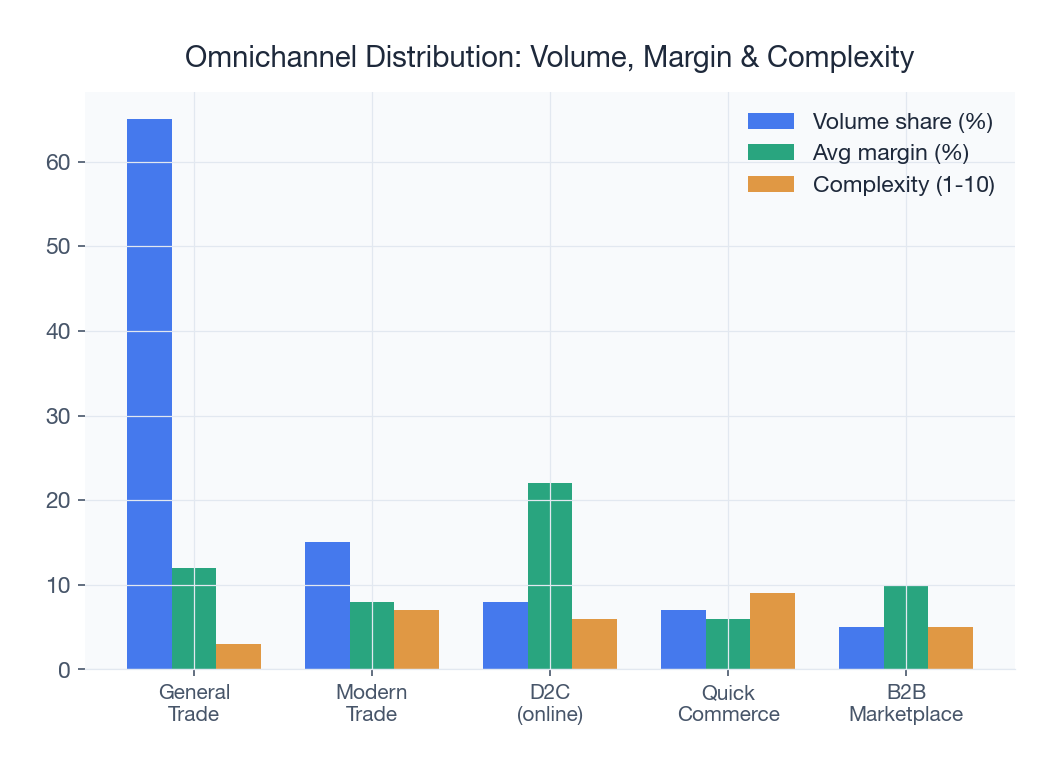
ONDC is one manifestation of a broader digital transformation sweeping Indian FMCG distribution. Quick commerce, e-B2B platforms (Udaan, JioMart, ElasticRun), brand D2C apps, and ONDC are all digitizing what was once an entirely manual, relationship-driven industry. The distributors who will thrive in this new landscape are those who have invested in digital infrastructure -- not just for ONDC, but for the entire spectrum of digital commerce that is reshaping how India buys and sells consumer goods.
A modern DMS is the foundation of this digital readiness. It is not a cost -- it is the infrastructure that makes your distribution business compatible with every digital commerce channel that emerges, whether ONDC today or whatever protocol comes next. Explore our pricing plans to find the right fit, or book a free demo to see how SpireStock positions your distribution business for the ONDC era.
The bottom line: ONDC is not a disruptor coming to replace Indian FMCG distributors. It is a protocol that rewards operational excellence, price transparency, and fulfillment reliability. Distributors who have these qualities will find ONDC expanding their market. Those who have survived on territorial exclusivity and information control will need to adapt. The time to prepare is now -- and preparation starts with digitizing your distribution operations.
Sources & References
- ONDC, Open Network for Digital Commerce Official Website
- DPIIT, Department for Promotion of Industry and Internal Trade
- IBEF, FMCG Sector Overview: India Brand Equity Foundation
- RedSeer Consulting, ONDC Network Growth and Adoption Metrics 2025-26
- NielsenIQ, India FMCG Channel Share and Digital Commerce Trends
Frequently Asked Questions
ONDC (Open Network for Digital Commerce) is a government-backed open protocol that enables any buyer app and any seller app to transact with each other -- like UPI for commerce. For FMCG distributors, ONDC allows kiranas to discover and order from any listed distributor in their delivery area, breaking territorial exclusivity and introducing price transparency. Distributors who compete on fulfillment quality and service will benefit; those who rely solely on territorial monopolies face pressure.
No. ONDC is a voluntary open network with no government mandate requiring participation. However, as kirana adoption of buyer apps grows, distributors not on the network will miss orders from digitally-active retailers. Early registration allows distributors to build order history and seller ratings before competition intensifies.
Quick commerce platforms bypass distributors entirely by sourcing from manufacturers and delivering to consumers from owned dark stores. ONDC, by contrast, is an open protocol that can make existing distributors more discoverable and accessible to kirana stores. ONDC does not replace distributors -- it depends on them for fulfillment. Quick commerce eliminates them from the supply chain.
Yes. The ONDC protocol supports any product category including perishable goods. However, the distributor must have their own cold chain delivery infrastructure since ONDC does not provide logistics. Dairy distributors with established refrigerated fleets and cold chain expertise are well-positioned to serve ONDC orders, especially for higher-margin value-added dairy products.
ONDC transaction costs are significantly lower than traditional marketplace commissions. Most seller apps charge 1-3% per transaction or a small monthly subscription fee. The ONDC protocol itself does not charge sellers directly. Compare this to quick commerce platforms that charge brands 25-40% in commissions.
Not in the foreseeable future. ONDC is a discovery and transaction layer that depends entirely on existing physical distribution infrastructure for fulfillment. It does not solve logistics, credit extension, or cold chain management. Traditional distributors who provide reliable fulfillment, credit, and relationship support will find ONDC amplifying their reach rather than replacing their role.
Four key steps: (1) Register as an ONDC seller through a seller app, (2) Digitize your product catalog with accurate pricing, images, and real-time stock levels, (3) Integrate your distribution management software with ONDC APIs for unified order management, (4) Invest in fulfillment capability since delivery performance directly impacts your ONDC seller rating and visibility.
Currently, ONDC transactions are primarily digital-payment-based with limited credit facilities. Integration with OCEN (Open Credit Enablement Network) is in pilot stage and promises to bring digital credit to ONDC transactions. Until credit is widely available on the network, many kiranas will continue to prefer traditional distributors who offer familiar 7-21 day credit terms.
Related SpireStock Features
End-to-end order lifecycle from placement to delivery with multi-level approval workflows.
GST-compliant invoicing with HSN codes, gate passes, and financial ledger.
Real-time GPS tracking of vehicles and drivers with route optimization for faster deliveries.
Powerful dashboards with sales trends, MIS reports, and distribution analytics.
Related Industries
Streamline FMCG distribution with order management, beat planning, retailer tracking, and GST billing. Built for Indian FMCG supply chains.
End-to-end dairy distribution software for milk, curd, paneer, and ghee brands. Manage orders, crates, cold chain, and GST billing in one platform.
Related Entities
Ready to Streamline Your Distribution?
Start your free 14-day trial and see how SpireStock can transform your dairy, FMCG or consumer-goods distribution operation, from order capture to crate recovery.

SpireStock Team
Distribution Technology Experts
SpireStock Team writes for SpireStock on distribution management, supply-chain optimisation and field operations for Indian dairy and FMCG brands.