The Digital Imperative for Indian Dairy
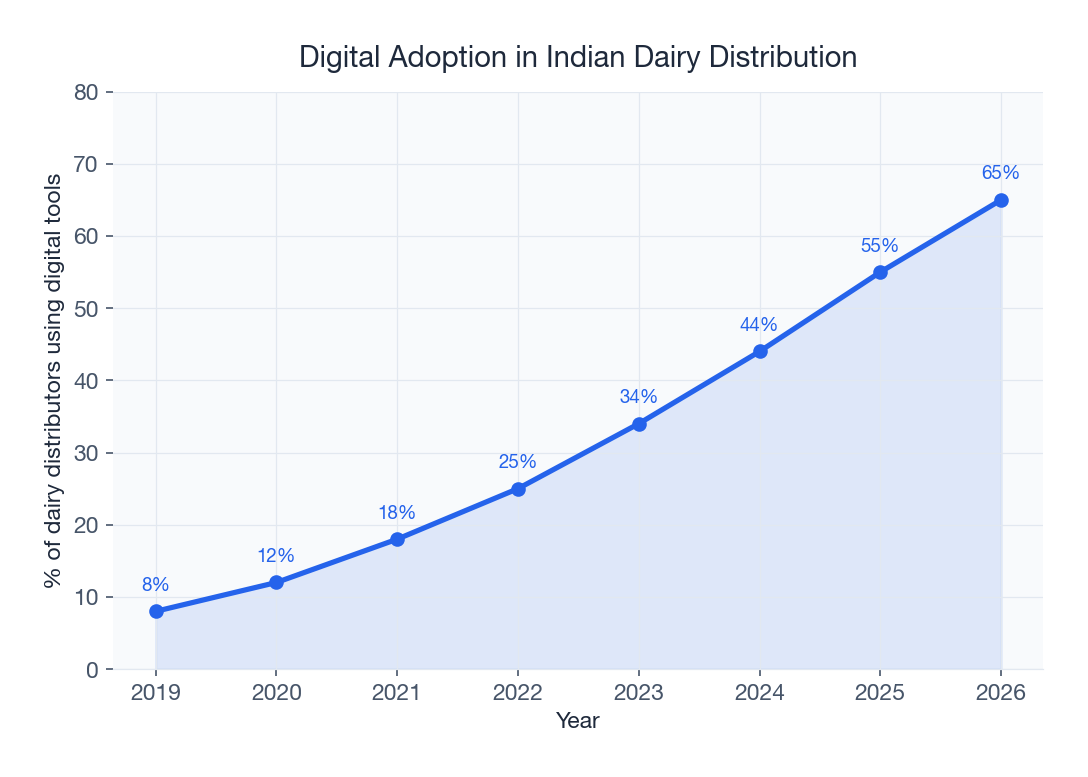
India's dairy industry, valued at over Rs 12 lakh crore, stands at a digital crossroads. While the industry has been a global leader in cooperative models and milk procurement, its distribution, supply chain, and retail interfaces have lagged behind in technology adoption. That is changing rapidly in 2025-2026, driven by competitive pressure from D2C startups like Country Delight, consumer expectations shaped by quick commerce, and the availability of affordable, purpose-built digital solutions.
From cooperative giants like Amul and Nandini to private brands like Mother Dairy, every serious player is now running a multi-year digital roadmap. This trend report maps the transformation across the full value chain, benchmarks ROI, and shows where the biggest opportunities lie for regional dairies and new entrants.
Digital Transformation Across the Dairy Value Chain
1. Procurement and Collection
IoT-enabled milk collection centres now automate quality testing, volume measurement, and farmer payment. BMC (Bulk Milk Cooler) monitoring systems track temperature and volume in real-time, ensuring quality from the first mile. Digital payment to farmers via UPI has replaced paper chits across most cooperatives.
2. Processing and Production
Smart manufacturing systems optimize product mix based on demand signals, minimize wastage through precise production scheduling, and ensure quality control through automated testing and traceability. Multi-plant operators use multi-plant distribution tooling to orchestrate production across locations.
3. Distribution and Supply Chain
This is where the biggest transformation opportunity lies. Distribution was historically the most manual part of the dairy value chain. Digital platforms now automate:
- Order processing from placement through delivery
- Route planning for time-sensitive dairy deliveries
- Returnable asset tracking across the network
- GST-compliant billing and payment collection
- Real-time visibility into distribution operations
- Analytics for data-driven decision making
4. Retail and Consumer Interface
Digital ordering platforms, e-commerce integration, and direct-to-consumer models are creating new channels for dairy products. Retailers use apps for ordering, consumers track product freshness through QR codes, and subscription models enable recurring dairy deliveries to homes in Mumbai, Bangalore, and Hyderabad.
Key Technologies Driving the Transformation
Cloud Computing and SaaS
Cloud-based platforms have democratized digital technology for the dairy industry. Even small cooperatives and regional dairies can now access enterprise-grade distribution management tools through affordable SaaS subscriptions, without investing in IT infrastructure. Multi-tenant workspaces let groups run every plant or region in an isolated environment while sharing a single corporate view.
Mobile and Offline-First Apps
India's dairy distribution operates in diverse connectivity environments, from 4G urban areas to no-signal rural villages. Mobile apps with offline capability enable digital operations everywhere, with data syncing when connectivity is available.
IoT and Sensor Technology
Temperature sensors, GPS trackers, and automated weighing systems provide real-time data from every point in the dairy supply chain. When integrated with distribution software, this data enables proactive management rather than reactive firefighting.
Data Analytics and AI
Analytics platforms transform the massive data generated by digital operations into actionable insights. AI models predict demand, optimize routes, detect anomalies, and help managers make better decisions faster.
Before vs After: A Digital Transformation Snapshot
| Capability | Traditional (2020) | Digital (2026) | Impact |
|---|---|---|---|
| Order placement | Phone/WhatsApp, avg 8 min per order | App, 90 seconds per order | -80% time |
| Invoicing | Manual Tally entry, 20% error rate | Automated, GST e-invoice, <1% error | -95% errors |
| Crate reconciliation | Monthly paper, 15-25% loss | Real-time digital, 3-5% loss | -80% crate loss |
| Route planning | Manual, 60-75% optimal | Algorithmic, 90-98% optimal | -25% delivery cost |
| Payment collection | Cash / cheque, 30-day cycle | UPI & digital collection, 7-day cycle | -75% working capital drag |
| Secondary sales visibility | Monthly distributor claims | Daily dashboard | +20% forecast accuracy |
Implementation Challenges and Solutions
Resistance to Change
The dairy industry's traditional workforce may resist digital adoption. Solution: Phased implementation starting with the most visible pain points, vernacular language support, and designating digital champions within each territory.
Connectivity Gaps
Rural connectivity remains a challenge for dairy operations that span urban and rural areas. Solution: Offline-first mobile apps that work without internet and sync when connectivity is available.
Integration with Legacy Systems
Many dairy companies have existing Tally, ERP, or custom systems. Solution: Choose platforms with API-based integration that complement rather than replace existing investments.
Scale and Diversity
India's dairy industry ranges from small village cooperatives to multi-billion-dollar corporations. Solution: Cloud-based platforms that scale from 10 to 10,000 distributors without architecture changes.
The ROI of Dairy Digital Transformation
Companies that have digitized dairy distribution operations report:
- 60% faster order processing, from phone-based to digital workflows
- 25-30% reduction in delivery costs, through route optimization
- 80% fewer crate losses, through digital crate tracking
- 50% improvement in data visibility, from real-time dashboards
- 3-6 month ROI, investment payback through operational savings
Regulatory Tailwinds
GST 2.0, e-invoicing mandates for turnovers above Rs 5 crore, FSSAI digital licensing, and Central Government PLI schemes for dairy processing are all pushing the industry toward digital systems whether individual operators like it or not. Brands that move proactively avoid the last-minute scramble that hit cooperatives during the 2023 e-invoice rollout.
Getting Started
Digital transformation doesn't require a big-bang approach. Start with the highest-impact, lowest-friction areas, typically order management and billing digitization, and expand from there. SpireStock's platform supports phased implementation, letting you digitize one process at a time while building toward a fully connected dairy distribution operation. Book a free assessment, check our pricing, or read more transformation stories on the SpireStock blog.
Digital Maturity Model for Indian Dairies
Not every dairy is at the same starting point. We use a five-level maturity model to help leadership teams understand where they are and what the next step looks like:
| Level | Characteristics | Typical Time to Next Level |
|---|---|---|
| Level 1: Paper | Orders on phone, invoices on Tally, no digital field operations | 3-6 months to Level 2 |
| Level 2: Spreadsheets | Excel consolidation, WhatsApp groups, basic tracking | 6-9 months to Level 3 |
| Level 3: Digital Operations | Mobile app for field force, integrated billing, real-time dashboards | 9-12 months to Level 4 |
| Level 4: Data-Driven | Analytics dashboards, scheme ROI, demand forecasting, crate tracking | 12-18 months to Level 5 |
| Level 5: AI-Enabled | Predictive forecasting, dynamic routing, automated scheme optimisation | Continuous improvement |
Most regional Indian dairies are at Level 1 or Level 2. Amul and Mother Dairy have pockets at Level 4-5. The average maturity progression takes 2-3 years but can be compressed to 12-18 months with focused investment and a good platform.
Detailed Roadmap: From Paper to AI in 18 Months
This is the roadmap we recommend to mid-sized dairies (Rs 50-500 crore revenue) looking to move quickly:
- Month 1-2: Foundation, Baseline audit, platform selection, pilot city choice. Bangalore, Chennai, and Hyderabad are popular pilot cities.
- Month 3-4: Core go-live, Order management, billing, and distribution tracking in pilot
- Month 5-6: Expansion, Add route optimisation and crate management; roll out to second pilot territory
- Month 7-9: Scale, Full network rollout with standardised processes
- Month 10-12: Analytics, Secondary sales dashboards, scheme engine, distribution tracking deep dive
- Month 13-15: Advanced capabilities, Demand forecasting, route-level cold chain analytics
- Month 16-18: AI enablement, Predictive models, dynamic routing, retailer churn alerts
Investment Profile
A typical digital transformation for a mid-sized dairy costs Rs 80 lakh to Rs 2.5 crore over 18 months, broken roughly as:
- Platform licensing (Rs 25-60 lakh), SaaS subscriptions for core modules across users and territories
- Implementation (Rs 15-40 lakh), Configuration, data migration, integrations with existing Tally or ERP
- Hardware (Rs 20-50 lakh), Mobile devices, handheld printers, IoT sensors, router upgrades
- Training and change management (Rs 10-25 lakh), Vernacular training materials, field-force workshops, e-learning
- Internal effort (Rs 10-30 lakh), Internal project team time and productivity dip during cutover
Payback typically happens in 6-12 months via lower crate losses, reduced delivery costs, higher secondary sales visibility, and fewer billing disputes.
Change Management: The Make-or-Break Factor
Even the best platform fails if users do not adopt it. Successful dairy transformations share a few change management traits:
- Visible CEO sponsorship, the transformation is a business priority, not an IT project
- Dedicated internal product owner empowered to make tradeoffs
- Vernacular training in Hindi, Tamil, Kannada, Telugu, Gujarati, Marathi, whichever languages your field force speaks
- Early wins celebrated publicly to build momentum
- Clear incentives tied to adoption metrics (app usage, on-time delivery, crate return)
- A realistic view of productivity dip during the first 30-60 days, do not set impossible targets that force users back to shortcuts
The Role of Multi-Plant and Multi-Tenant Architectures
Most Indian dairy groups run multiple plants, depots, and brands. A modern transformation should include multi-plant distribution and multi-tenant workspaces from day one. This ensures that growth and acquisitions do not require rebuilding the platform. Cooperatives in Gujarat, Karnataka, and Tamil Nadu have used this architecture to onboard new processing units and federations without disrupting existing operations.
What Digital Transformation Feels Like Six Months In
Six months into a focused programme, here is what leadership typically experiences:
- Morning review meetings shrink from two hours to 30 minutes because data is already in the dashboard
- Field officers stop arguing about targets because the scoreboard is visible in the app
- Finance stops reconciling crate deposits manually; the ledger ties out automatically
- Regional managers spot trends in Lucknow or Jaipur within hours, not weeks
- Scheme ROI conversations become grounded in evidence, not anecdote
- Customer complaints drop because deliveries and billing are more predictable
These feel like small wins individually; together they compound into a fundamentally different operating model, and that is the real prize of digital transformation.
Common Dairy Transformation Traps
Several patterns show up repeatedly in stalled or failed dairy digitisation efforts. Watch for these:
- The big-bang rollout, Trying to digitise every process across every territory simultaneously. Almost always ends in rollback.
- The IT-led programme, When the transformation is "owned" by IT rather than operations, adoption never materialises.
- The custom-built trap, Building a bespoke platform instead of adopting a proven dairy-specific SaaS. Three years later the internal team has burned Rs 8-15 crore and has nothing to show.
- The feature obsession, Endless scope creep during implementation. Ship the MVP, get real users, then iterate.
- The training shortcut, Rolling out without vernacular training and in-field support.
- The data-island problem, Pockets of new digital tools that do not talk to each other, leaving users with worse visibility than paper.
Aligning Digital Transformation With FSSAI and GST
A well-executed digital transformation is also a compliance upgrade. FSSAI cold chain records, GST e-invoices, FSS (Transport) rules, and EPR reporting all become significantly easier when the underlying data is digital by default. Many operators treat this compliance upside as the first argument for the business case, because it turns a soft benefit into a hard one. When auditors show up, the difference between "three days to produce records" and "three minutes" is obvious, and increasingly regulators expect the latter.
Cross-Industry Learnings
Dairy leaders often look to other industries for inspiration. A few transferrable lessons:
- From beverage distribution, how to manage seasonal volume swings with technology
- From bakery and confectionery, how to handle fragile goods with returns discipline
- From fresh produce, how to build supply traceability from farm to fork
- From FMCG distribution, how to run complex scheme engines at scale
Dairy is unique but not exceptional. Borrow what works and customise it for the cold chain and shelf-life realities of milk.
The Dairy CIO Agenda for 2026-2028
Chief information officers at dairy companies have a crowded roadmap. The five priorities that matter most:
- Unifying data, Single version of truth across procurement, processing, distribution, and retail
- Cloud migration, Moving away from on-premise legacy ERPs toward SaaS-based distribution platforms
- Mobile-first operations, Every field role covered by purpose-built mobile apps
- Cybersecurity and data privacy, Compliance with the Digital Personal Data Protection Act for consumer data
- AI enablement, Starting with demand forecasting and expanding to operations automation
Measuring Transformation Success
A transformation is successful if leadership can answer "yes" to these questions after 18 months:
- Can we see daily operations data from any plant, depot, or distributor without asking anyone?
- Have total distribution costs dropped by at least 10%?
- Is customer complaint volume 40%+ lower than baseline?
- Are our FSSAI and GST audits stress-free?
- Do our field officers and distributors prefer the new system over the old one?
- Can we onboard a new distributor in 30 days instead of 90?
If the answer is "yes" across the board, congratulations, you have built a genuine digital operating model. If not, identify the gaps and double down on them before declaring victory.
Sources & References
Frequently Asked Questions
Digital transformation is impacting every part of the dairy value chain, from IoT-enabled milk collection and smart manufacturing to automated distribution management and direct-to-consumer delivery. The biggest opportunity is in distribution, which was historically the most manual link in the chain.
Companies report 60% faster order processing, 25-30% delivery cost reduction, 80% fewer crate losses, and 50% improvement in operational visibility. Typical investment payback is 3-6 months.
Start with high-impact, low-friction areas, typically digital order management and billing. This provides quick wins and builds organizational comfort with technology. Then expand to route optimization, crate tracking, and analytics.
Yes. Cloud-based SaaS platforms like SpireStock have made enterprise-grade distribution technology accessible to small and mid-sized dairies at affordable monthly subscriptions. No IT infrastructure investment is needed.
Modern dairy distribution apps like SpireStock work fully offline. Field staff can process orders, record deliveries, and manage crates without internet. Data syncs automatically when connectivity is restored.
Related SpireStock Features
Related Solutions
Manage your entire distributor network digitally. Onboarding, credit limits, outstanding tracking, and performance analytics. Start free trial.
Boost field sales team productivity with beat planning, GPS attendance, order capture, and performance analytics. Built for Indian FMCG teams.
Related Entities
Ready to Streamline Your Distribution?
Start your free 14-day trial and see how SpireStock can transform your dairy, FMCG or consumer-goods distribution operation, from order capture to crate recovery.

SpireStock Team
Distribution Technology Experts
SpireStock Team writes for SpireStock on distribution management, supply-chain optimisation and field operations for Indian dairy and FMCG brands.