The Hidden Cost of Near-Expiry Stock
Shrinkage from expiry and product damage accounts for 15-20% of total retail shrinkage in India, making it one of the largest controllable cost centres in FMCG distribution. Yet most distributors treat expiry losses as an unavoidable cost of doing business rather than a problem that can be systematically engineered out of operations. This attitude costs the Indian FMCG industry an estimated Rs 25,000-30,000 crore annually in expired stock.
Consider a mid-sized FMCG distributor turning over Rs 50 crore annually. If just 2% of inventory is written off due to expiry, that is Rs 1 crore lost every year. For distributors handling perishable categories like dairy, bakery products, or fresh beverages, the percentage climbs to 3-5%, translating to Rs 1.5-2.5 crore in annual losses across godowns from Mumbai to Chennai.
The critical variable is the detection window. When a distributor identifies near-expiry stock 60 days before the expiry date, there are dozens of options: redistribute to high-velocity outlets, run markdown promotions, negotiate returns with the brand, or activate liquidation channels. When that same stock is discovered 10 days before expiry, the options collapse to one: write it off. The 60-day vs 10-day detection window is entirely determined by systems, processes, and technology.
Modern perishable goods distribution software with batch-level tracking and automated alerts transforms this equation. Distributors who implement systematic expiry management consistently reduce write-offs by 70-85% within the first year. The financial impact is straightforward: a distributor who moves from 3% write-offs to 0.5% on a Rs 40 crore operation saves Rs 1 crore annually, enough to fund the entire technology investment many times over.
What Is SLOB Stock?
SLOB stands for Slow-moving, Liquidated, Obsolete, and Bad stock. While near-expiry stock is a time-bound problem, SLOB represents a broader category of inventory that has lost or is losing its commercial value. Each component requires a fundamentally different management approach.
Slow-Moving Stock sells at a rate significantly below its replenishment cycle. A product that takes 90 days to sell through when your average category turns in 15 days is slow-moving. Common FMCG examples include low-demand SKU variants in non-native markets, oversized pack formats in price-sensitive territories, and premium products stocked in mass-market channels. This is the most recoverable SLOB category because the product itself is still viable and the problem is location and volume, not product quality. The correct action is demand-driven redistribution or targeted promotions.
Liquidated Stock has been marked down below original margin to accelerate sell-through, including near-expiry products at steep discounts and damaged-packaging goods. Well-managed liquidation programs recover 40-70% of original value versus complete write-off.
Obsolete Stock can no longer be sold through normal channels regardless of price: expired products, discontinued SKUs, and items with superseded formulations or packaging that cannot legally be sold. Obsolete stock is a pure loss. The only actions available are return to the brand (if the return policy allows), donation, or disposal. The goal is not recovery but speed: how quickly can it be identified, documented, and removed to free up space and working capital?
Bad Stock is inventory damaged beyond saleability through compromised packaging, transit damage, or cold chain failures. Every unit represents a preventable process failure requiring disposal plus root cause analysis.
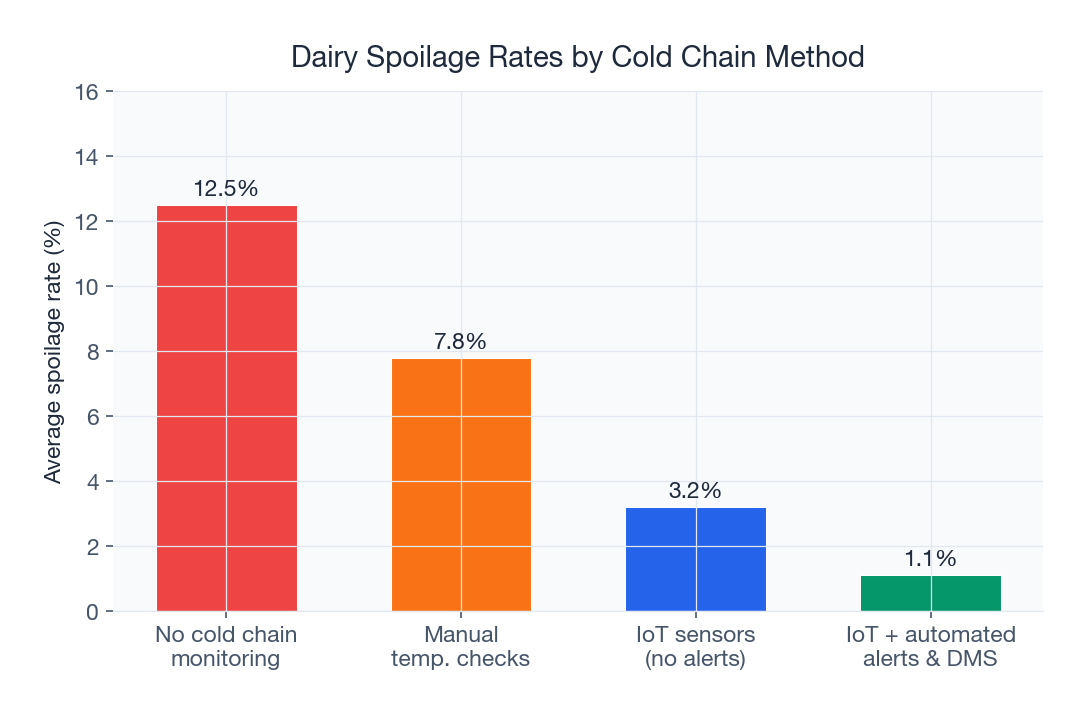
Effective SLOB management requires separate identification, tracking, and action plans for each category. A distributor management system with batch tracking and aging analysis makes this categorization automatic rather than manual.
Root Causes of Near-Expiry Accumulation
Near-expiry stock accumulates through a chain of decisions, each seemingly reasonable in isolation, that collectively push inventory past the point of recovery. Here are the seven primary drivers in Indian FMCG distribution.
1. Over-ordering: Ordering more than the market can absorb within the product shelf life. This happens when distributors order based on gut feel, sales teams inflate projections to meet primary targets, or minimum order quantities force excess stocking.
2. Poor demand forecasting: Most Indian FMCG distributors forecast using last month's sales and seasonal intuition. Without sales analytics capturing secondary sales data and SKU-outlet trends, distributors are essentially guessing, and guessing wrong by 20% on a 90-day shelf life product creates a near-expiry problem within a single quarter.
3. Scheme-driven channel stuffing: Quarterly and year-end targets incentivize brands to push excess stock through aggressive trade schemes. "Buy 100, get 20 free" looks attractive, but if the distributor can only sell 80 units, the free goods become near-expiry stock. A robust order management system tracking actual sell-through gives distributors evidence to negotiate realistic order sizes.
4. Inadequate FIFO/FEFO enforcement: Warehouse staff stack new arrivals in front of older stock, picking processes ignore batch dates, and dispatch systems are batch-blind. The oldest 10-15% of inventory perpetually ages in the back of the godown.
5. No batch-level tracking: SKU-level tracking tells you how much stock you have. Batch-level tracking tells you how much time each unit has left. Without this visibility, near-expiry identification is manual, inconsistent, and almost always too late. Modern distribution tracking systems maintain batch-level records from receipt through dispatch.
6. Seasonal demand shifts: Products with strong seasonal patterns create predictable near-expiry problems when distributors fail to taper ordering before demand declines. Sales do not drop overnight; they decline over 6-8 weeks, and distributors ordering on monthly averages miss this curve.
7. New product launch failures: With new product failure rates exceeding 70% in Indian FMCG, launch-related near-expiry stock is chronic. The mitigation is conservative initial stocking: start with 2-week cover rather than 6-week cover, and scale up only after actual demand data emerges.
FIFO vs FEFO: Which Approach Works for FMCG
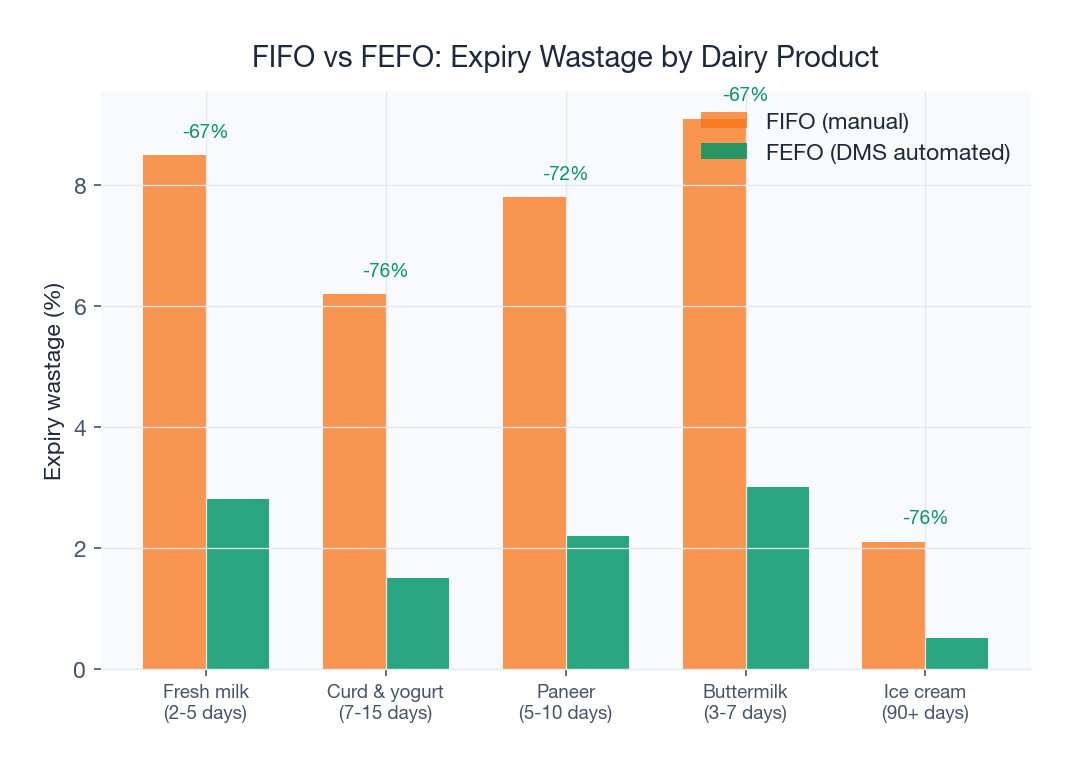
FIFO (First In, First Out) dispatches inventory in the order it was received. It works when all incoming batches have identical shelf lives or when the product is non-perishable with 12-24 month shelf lives.
FEFO (First Expiry, First Out) dispatches based on expiry date regardless of receipt order. This matters because receipt order and expiry order frequently diverge: different production batches have different remaining shelf lives, returned goods re-enter with shorter life, and inter-depot transfers bring varied expiry profiles.
For any product with shelf life under 6 months, FEFO is categorically superior. The data is unambiguous: distributors implementing FEFO achieve write-off rates of 0.5-1.2%, compared to 3-5% for FIFO-only operations handling identical product categories. The reason is mathematical: FIFO creates blind spots wherever receipt order and expiry order diverge, and those blind spots are where near-expiry stock hides until it is too late.
Consider a practical example. A dairy distributor receives 200 cases of buttermilk on June 1 (expiry: July 15) and 300 cases on June 5 (expiry: July 5). Under FIFO, the June 1 batch ships first because it arrived first. But the June 5 batch expires 10 days earlier. By the time FIFO works through the June 1 batch, the June 5 batch has only days of shelf life remaining. Under FEFO, the June 5 batch ships first because it expires first, ensuring neither batch reaches critical shelf life before dispatch.
Implementing FEFO at the Distributor Godown
FEFO requires three capabilities. First, batch-level receiving: every shipment logged with batch number, manufacturing date, and expiry date via barcode scanning. Second, expiry-sequenced storage: products with earliest expiry in the most accessible locations, with colour-coded tags (green for 60+ days, yellow for 30-60, red for under 30). Third, system-enforced dispatch: SpireStock's order management module automatically allocates the earliest-expiring batch to every outgoing order without requiring warehouse staff to make batch decisions.
A distributor handling Rs 30 crore of perishable inventory who moves from 4% write-offs (FIFO) to 0.8% (FEFO) saves Rs 9.6 lakh per year, covering implementation costs within the first quarter.
The Expiry Management Lifecycle
Effective expiry management spans six stages, and the earlier you intervene, the more value you recover.
Stage 1: Procurement. Demand-driven ordering and minimum remaining shelf life (MRSL) requirements ensure you reject shipments with less than 60-75% of shelf life remaining. A distributor accepting a 90-day product with only 40 days remaining has already lost half the management window.
Stage 2: Receipt and Batch Tagging. Every shipment logged with batch number, manufacturing date, expiry date, and quantity. Automated barcode scanning eliminates manual entry errors. The distribution tracking module creates an unbroken chain of batch visibility from receipt through dispatch.
Stage 3: FEFO Storage. Products with earliest expiry dates occupy the most accessible positions. New stock slots behind existing stock in expiry sequence, creating a physical fail-safe that complements digital FEFO enforcement.
Stage 4: Expiry-Aware Dispatch. The system allocates the earliest-expiring batch with sufficient remaining shelf life for the destination channel. A modern trade retailer can handle 30-day stock; a rural kirana store needs 60+ days. Intelligent FEFO considers destination consumption velocity.
Stage 5: Aging Alerts. Automated alerts at 60, 30, 15, and 7 days trigger escalating actions. At 60 days: flag for priority dispatch. At 30 days: initiate redistribution. At 15 days: activate markdown procedures. At 7 days: trigger return processing. Sales analytics dashboards display aging inventory alongside channel velocity data for quick decision-making.
Stage 6: Action. The hierarchy is: markdown and sell at reduced margin; redistribute to liquidation channels; negotiate brand returns; donate to food banks; dispose per FSSAI regulations. Each action recovers progressively less value, which is why early monitoring is critical.
Technology Solutions for Expiry Management
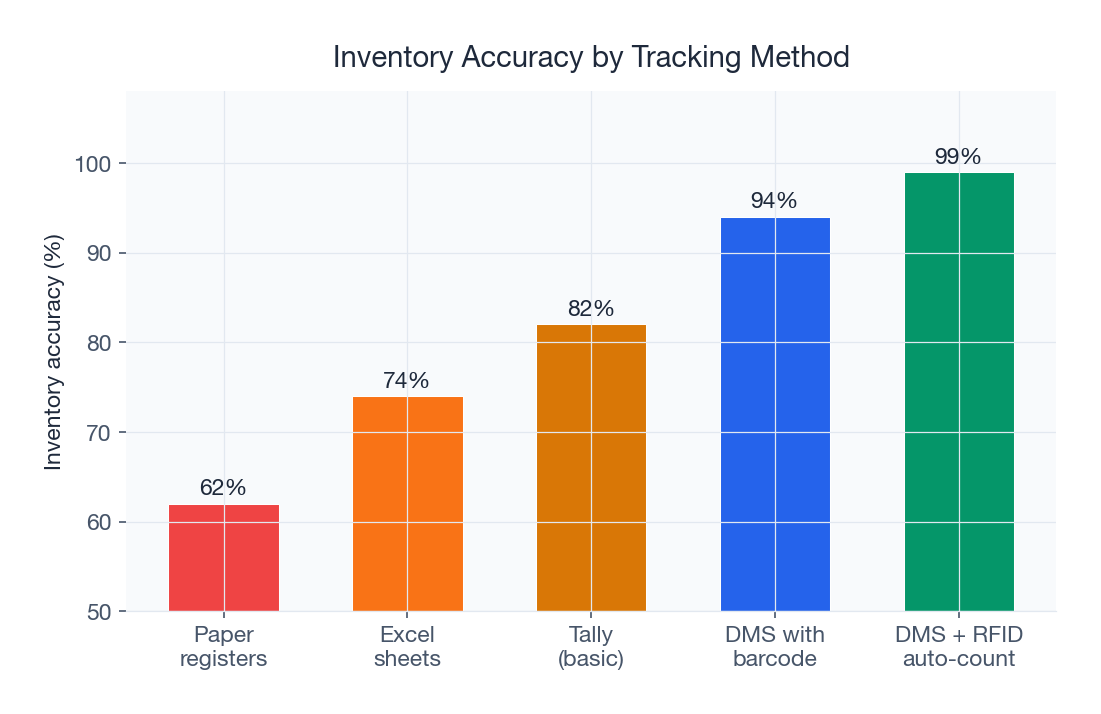
Manual expiry management works at small scale. But beyond 200 SKUs and 5,000 cases, manual tracking becomes a liability. Technology is the difference between 4% write-offs and 0.5%.
Batch-Level Tracking in DMS: Every unit of inventory is associated with a specific batch carrying manufacturing date, expiry date, and source. When order management processes a dispatch, it deducts from the specific batch that expires first, not just the SKU total.
Automated FEFO Dispatch: The system allocates batches in expiry sequence without human intervention. Pickers receive instructions specifying exact batch, shelf location, and quantity. No judgment calls, no convenience-based picking.
Expiry Countdown Alerts: Configurable alerts at 60/30/15/7 days create an escalating notification framework. The 60-day alert goes to the inventory manager. The 30-day alert escalates to the sales manager with a redistribution plan. The 15-day alert triggers automated near-expiry reports. The 7-day alert flags for return processing or disposal.
Near-Expiry Redistribution Logic: This is where technology becomes genuinely transformative. A smart DMS does not just flag near-expiry stock; it recommends where to send it. By analysing sell-through velocity by outlet, the analytics engine identifies retailers where near-expiry product will sell within remaining life. A product with 30 days of shelf life sitting idle in a godown serving low-frequency outlets can be redirected to a high-traffic modern trade store where it sells in 5-7 days, turning a near-expiry problem into a targeted sales opportunity.
Return Management Automation: Generating return requests, calculating credit note values, creating GST documentation, and tracking physical returns through integrated billing compresses manual 2-4 week return processing to 2-3 days.
Strategies to Reduce SLOB Stock by 80%
Reducing SLOB by 80% is not aspirational. It is the documented outcome of distributors who implement the seven strategies below systematically. Each strategy addresses a specific root cause of SLOB accumulation, and together they form a comprehensive framework that transforms inventory management from a reactive clean-up exercise into a proactive value-preservation system.
1. Demand-driven ordering: Replace gut-feel ordering with data based on actual secondary sales from order management. This typically reduces order quantities by 15-25% while maintaining fill rates.
2. Dynamic safety stock: Static safety stock levels, the same buffer quantity regardless of season or demand trend, are a guaranteed source of SLOB. Dynamic safety stock adjusts buffer levels based on actual demand volatility, upcoming promotions, seasonal patterns, and shelf life. A 30-day shelf life product should carry less safety stock than a 180-day product, even if both have the same daily sales rate. Dynamic algorithms reduce average inventory holding by 20-30% while maintaining service levels above 95%.
3. Near-expiry markdown programs: Structured discount schedules, such as 10% at 45 days, 20% at 30 days, 35% at 15 days, and 50% at 7 days, turn near-expiry stock into revenue rather than write-offs. When communicated to retailers in advance, markdowns become a predictable clearing mechanism.
4. Retailer exchange schemes: Retailers return near-expiry products for fresh stock on a one-for-one basis. This protects retailers from expiry losses and pulls near-expiry product back into the distribution system for redistribution. Particularly effective for bakery products with shelf lives measured in days.
5. Liquidation channels: Every FMCG distributor should maintain active relationships with 2-3 liquidation channels, factory outlets, discount retail chains, institutional buyers (canteens, hostels, catering companies), and online discount platforms. The key is establishing these relationships before you need them. When near-expiry stock is identified at the 30-day threshold, having a pre-negotiated buyer who can take delivery within 48 hours means recovering 40-60% of value versus recovering nothing.
6. Donation programs: Products safe for consumption but past best-before date can go to food banks and NGOs. Tax benefits under Section 80G of the Income Tax Act and proper documentation for GST treatment add financial value alongside ethical value.
7. SKU rationalization: Quarterly performance reviews using sales analytics identify chronically SLOB-prone SKUs. Reduce stocking depth, restrict to high-velocity outlets, or delist entirely. A portfolio of 450 efficient SKUs beats 600 where 200 generate SLOB.
Case Studies
Case Study 1: Dairy Distributor Cutting Expiry Losses from 4% to 0.8%
Shivam Dairy Products distributes milk, curd, paneer, lassi, and flavoured dairy through 180 distributors across Pune, Nashik, and Aurangabad. With 70% of SKUs having shelf lives under 21 days, near-expiry management is existential. Their 4.2% write-off rate meant Rs 1.68 crore in annual losses on Rs 40 crore turnover. Warehouse staff followed informal FIFO but frequently dispatched newer, more accessible stock. Batch tracking was recorded in a register that was updated sporadically. Near-expiry products were discovered only during weekly godown inspections, by which point stock often had less than 5 days of life remaining. Returns to the plant required paper-based approvals taking 10-14 days.
Shivam deployed barcode-based batch capture at receiving, FEFO-enforced dispatch instructions for pickers, automated alerts at 14/7/3-day thresholds (compressed for short-shelf-life dairy), automated return request generation, and integrated crate management tracking returnable assets alongside product batches.
| Metric | Before | After (12 Months) | Impact |
|---|---|---|---|
| Annual expiry write-off rate | 4.2% | 0.8% | 81% reduction |
| Annual write-off value | Rs 1.68 crore | Rs 32 lakh | Rs 1.36 crore saved |
| Near-expiry detection window | 3-5 days | 14+ days | 3x earlier detection |
| Return processing time | 10-14 days | 2 days | 85% faster |
| FEFO compliance rate | ~40% | 99.5% | Near-perfect compliance |
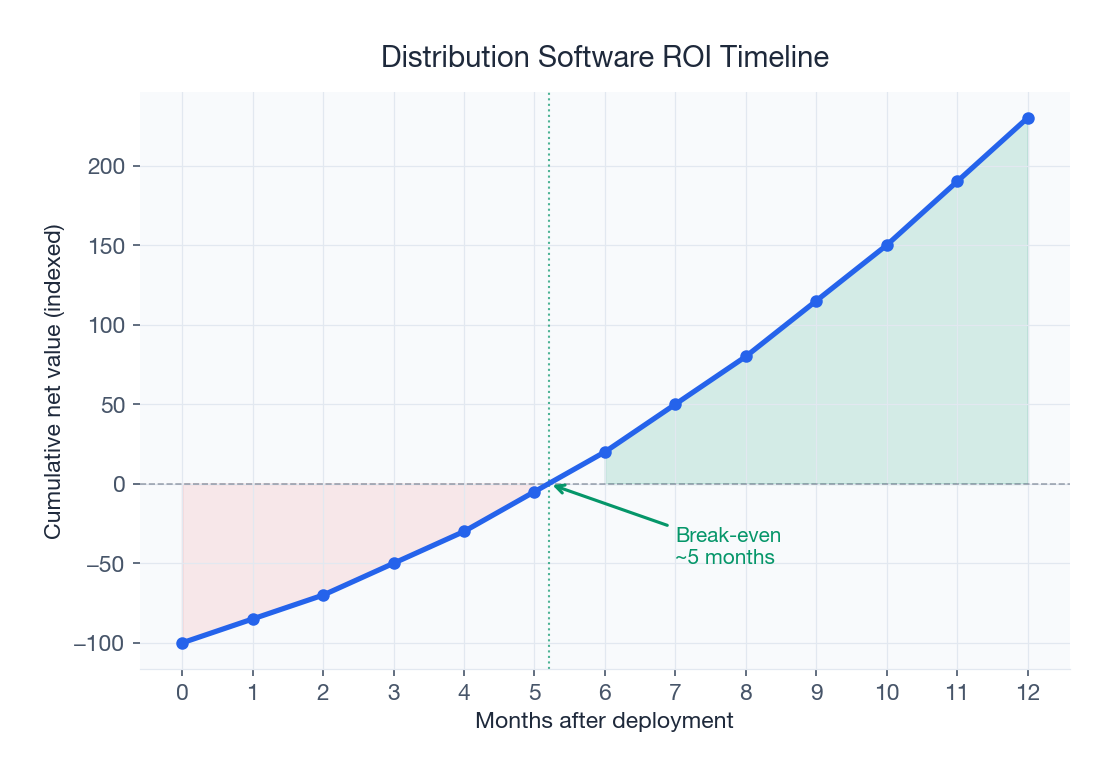
ROI: The DMS investment of Rs 11.4 lakh annually was recovered within 5 weeks through reduced write-offs alone.
Case Study 2: FMCG Snacks Company Handling Seasonal SLOB
Tastee Snacks distributes namkeen, chips, and extruded snacks through 220 distributors across Gujarat and Rajasthan. Product shelf lives range from 90-180 days, which sounds comfortable but becomes problematic during seasonal transitions. Sales spike 40-50% during Diwali and wedding season, then drop 30-35% in post-festive periods. The SLOB problem concentrated in two windows: January-February (post-Diwali overhang) and July-August (post-wedding season). During these windows, 8-12% of channel inventory was slow-moving, with 3-4% ultimately expiring. Annual losses exceeded Rs 85 lakh.
Tastee deployed demand-driven ordering with seasonal adjustment, structured markdown schedules shared with distributors quarterly, and two liquidation channel partners (a discount retail chain and a catering company). Analytics-powered seasonal demand curves enabled ordering to taper 6 weeks before each expected demand decline. Post-season SLOB dropped from 8-12% to 2-3% of channel stock. Annual write-offs fell from Rs 85 lakh to Rs 18 lakh (79% reduction). Markdown recovery improved from 15% to 55% of near-expiry value, recovering Rs 22 lakh that would have been complete write-offs. Net annual savings: Rs 67 lakh after accounting for DMS costs.
Case Study 3: Bakery Brand Eliminating Bread Returns Through Forecasting
FreshBake Bakeries produces and distributes bread, buns, cakes, and pastries through 95 distributors across Bangalore and Mysore. Bread, with a shelf life of 3-5 days, presents the most extreme expiry management challenge in FMCG. Their daily return rate for unsold bread averaged 18%, meaning nearly one in five loaves dispatched came back unsold and was destroyed. At a daily dispatch value of Rs 12 lakh, this represented Rs 2.16 lakh in daily losses, or Rs 6.5 crore annually. Route salesmen ordered based on the previous day's sales plus a 15-20% buffer regardless of day-of-week patterns, weather, or local events.
SpireStock's order management with outlet-level demand forecasting analysed 90 days of historical sales data at each outlet, generating daily demand predictions adjusted for day-of-week, weather impact, and seasonal trends. Orders auto-generated within a +/-10% manual adjustment band for route salesmen. Real-time dispatch tracking provided same-day visibility into unsold quantities, enabling mid-day redistribution from overstocked outlets to understocked ones (35-45 redistribution events daily). Daily return rate dropped from 18% to 4.5%, saving Rs 4.88 crore annually, a return exceeding 30x on the Rs 14 lakh DMS investment. Stockout rates actually improved from 8% to 3% despite lower production volumes.
GST and Accounting Treatment of Expired Stock
Incorrect GST treatment of expired inventory triggers compliance issues and missed credit reversals. Here is the complete framework for Indian FMCG distributors.
ITC Reversal: Under Section 17(5)(h) of the CGST Act, input tax credit must be reversed for goods written off or destroyed. The total cost of expired stock is the product cost plus the reversed GST. A product purchased at Rs 100 with 12% GST costs Rs 112 when written off, not Rs 100.
Credit Notes for Returns: When near-expiry stock is returned to the brand, the credit note reduces the brand's output tax and the distributor's ITC. Credit notes must reference original invoice numbers with proper HSN codes. SpireStock's billing module generates return-linked credit notes automatically.
Destruction Certificates: Required for GST compliance and income tax deductions. Must include date, location, complete inventory with batch numbers, method of destruction, signatures of at least two witnesses (preferably including a CA), and photographic evidence. This documentation supports write-off as a business loss under Section 37(1) of the Income Tax Act.
FSSAI Disposal: Expired food products must be physically destroyed or denatured to prevent re-entry into the supply chain. Dairy products go through biogas plants or approved waste handlers. Packaged goods must be shredded or crushed. Violations carry penalties up to Rs 5 lakh and potential license suspension.
Write-Off Procedure: The accounting treatment follows a structured seven-step process. First, segregate all expired stock in a dedicated section of the godown. Second, prepare a detailed inventory listing with purchase invoices, batch numbers, quantities, and values. Third, obtain management approval for the write-off. Fourth, reverse ITC in the GST returns for the period in which the stock is written off. Fifth, account for the write-off as an expense under "Goods Lost/Destroyed." Sixth, file the destruction certificate and supporting documentation. Seventh, claim the loss as a deduction under Section 37(1) of the Income Tax Act as a business loss incurred wholly and exclusively for business purposes. The entire process must be completed within the financial year in which the stock expires to avoid complications in subsequent filings.
A distributor management system that tracks batch-level expiry data, generates credit notes automatically, and creates disposal documentation saves 40-60 hours per quarter in compliance-related work while ensuring every expired unit is accounted for correctly.
Building an Expiry-Proof Distribution Operation
Building a distribution operation that consistently achieves near-zero expiry write-offs requires alignment across three dimensions: technology, process, and people. Technology without process creates expensive dashboards that nobody acts on. Process without technology creates manual checklists that break under scale. And both fail without people who understand why expiry management matters and are trained to execute it daily. Here is the comprehensive checklist.
Technology Foundation
- Deploy batch-level tracking in your DMS with manufacturing and expiry dates on every unit. SKU-level tracking is insufficient.
- Enable FEFO-enforced dispatch with system-generated picking instructions specifying exact batch and location.
- Configure expiry countdown alerts at 60/30/15/7 days with defined escalation paths. Adjust thresholds for short-shelf-life products like bakery and dairy.
- Implement demand forecasting at SKU-outlet level using analytics modules capturing secondary sales data.
- Automate return and credit note processing through your billing system.
- Build aging dashboards showing inventory across green (60+ days), yellow (30-60), amber (15-30), and red (under 15) zones.
Process Framework
- Establish MRSL standards: reject incoming goods with less than 60-75% of shelf life remaining.
- Conduct weekly aging reviews with disposition actions for all yellow and amber zone stock.
- Create standing markdown programs with pre-defined discount schedules communicated to retailers in advance.
- Maintain active liquidation relationships with 2-3 bulk buyers for short-notice absorption.
- Document every disposal with destruction certificates and GST-compliant write-off entries.
- Review SKU performance quarterly, reducing depth or delisting chronic SLOB generators.
People and Culture
- Train warehouse staff on FEFO principles and expiry-sequenced storage organization.
- Make expiry metrics visible with daily/weekly write-off numbers displayed in the godown.
- Incentivize zero-expiry performance with recognition for teams achieving below-target write-off rates.
- Assign clear ownership: one accountable person per godown with authority to trigger markdown, redistribution, and returns.
- Build brand pushback capability by equipping procurement teams with sell-through data to resist channel stuffing.
Ready to eliminate expiry losses? SpireStock's batch tracking, FEFO dispatch, and expiry alert modules have helped hundreds of FMCG distributors reduce write-offs by 70-85% within the first year. Book a free demo or check pricing to see how near-expiry management works for your distribution operation.
Sources & References
- FSSAI, Food Safety and Standards Authority of India
- GST Council, Goods and Services Tax Council, India
- IBEF, India Brand Equity Foundation, FMCG Sector
- RAI, Retailers Association of India
Frequently Asked Questions
SLOB stands for Slow-moving, Liquidated, Obsolete, and Bad stock. It represents inventory that has lost or is losing commercial value. Each category requires different management actions: slow-moving stock needs redistribution, liquidated stock needs markdown programs, obsolete stock needs return or disposal, and bad stock needs root cause analysis of handling failures.
FIFO (First In, First Out) dispatches inventory in the order it was received. FEFO (First Expiry, First Out) dispatches based on expiry date, shipping the batch closest to expiry first regardless of when it arrived. For perishable FMCG products with shelf lives under 6 months, FEFO reduces expiry write-offs from 3-5% to 0.5-1.2% compared to FIFO.
The most effective strategies are demand-driven ordering based on secondary sales data, FEFO-enforced dispatch, automated expiry countdown alerts at 60/30/15/7 days, structured markdown programs, retailer exchange schemes, liquidation channel partnerships, and quarterly SKU rationalization. Distributors implementing these strategies consistently reduce write-offs by 70-85%.
Under Section 17(5)(h) of the CGST Act, input tax credit must be reversed for goods written off or destroyed. The total cost of expired stock includes the product cost plus reversed GST. Destruction certificates with witnesses, photographic evidence, and proper documentation are required. Credit notes from brands for returned stock must reference original invoices with correct HSN codes.
Batch-level tracking associates every unit of inventory with specific manufacturing and expiry dates. This enables FEFO dispatch (shipping earliest-expiring batches first), automated alerts when batches approach expiry thresholds, near-expiry redistribution to high-velocity outlets, and accurate write-off documentation. SKU-level tracking only tells you quantity; batch-level tracking tells you remaining shelf life.
FSSAI requires that expired food products be physically destroyed or denatured to prevent re-entry into the supply chain. Dairy products typically go through biogas plants or approved waste handlers. Packaged goods must be shredded or crushed to prevent repackaging. Violations carry penalties up to Rs 5 lakh and potential license suspension.
Most FMCG distributors achieve ROI within 6-10 weeks of implementing batch tracking and FEFO dispatch. A distributor with Rs 30 crore in perishable inventory reducing write-offs from 4% to 0.8% saves Rs 9.6 lakh annually, far exceeding typical DMS subscription costs. Bakery and dairy distributors with high-waste products often see payback within 3-4 weeks.
Best practice is to reject incoming shipments with less than 60-75% of total shelf life remaining. For a product with a 90-day shelf life, this means accepting only shipments with at least 54-67 days of remaining life. MRSL standards prevent near-expiry problems from starting at the procurement stage and give distributors adequate time for the full management lifecycle.
Related SpireStock Features
End-to-end order lifecycle from placement to delivery with multi-level approval workflows.
Real-time GPS tracking of vehicles and drivers with route optimization for faster deliveries.
Powerful dashboards with sales trends, MIS reports, and distribution analytics.
GST-compliant invoicing with HSN codes, gate passes, and financial ledger.
Related Industries
Streamline FMCG distribution with order management, beat planning, retailer tracking, and GST billing. Built for Indian FMCG supply chains.
End-to-end dairy distribution software for milk, curd, paneer, and ghee brands. Manage orders, crates, cold chain, and GST billing in one platform.
Distribution software for bakeries and confectionery brands. Manage short-shelf-life products, daily dispatch, returns, and retailer credit efficiently.
Related Entities
Ready to Streamline Your Distribution?
Start your free 14-day trial and see how SpireStock can transform your dairy, FMCG or consumer-goods distribution operation, from order capture to crate recovery.

SpireStock Team
Distribution Operations Experts
SpireStock Team writes for SpireStock on distribution management, supply-chain optimisation and field operations for Indian dairy and FMCG brands.