Why FMCG Distribution Is a Lucrative Business in India
India's Fast-Moving Consumer Goods market is one of the largest and most resilient sectors in the country, valued at over Rs 25 lakh crore in 2026. This is not a speculative tech startup or a volatile commodity play -- FMCG distribution is the backbone of everyday consumer commerce. People buy toothpaste, biscuits, soap, cooking oil, and milk every single day, regardless of economic cycles, elections, or stock market crashes. That fundamental demand stability is what makes FMCG distribution one of the most bankable business models in India.
The numbers are compelling. India has over 8 lakh active FMCG distributors serving approximately 12 million kirana stores and retail outlets across the country. The market has been growing consistently at 10-12% annually, driven by rising incomes in tier-2 and tier-3 cities, increasing brand consciousness among rural consumers, and the expansion of organized distribution into previously underserved territories. Unlike many other sectors where growth has been uneven, FMCG distribution has delivered reliable expansion year after year.
For a new distributor, the economics are straightforward. Average trade margins range from 5% to 8% depending on the product category, brand, and territory. While these margins may seem thin, they work because of volume and velocity. A distributor handling Rs 50 lakh in monthly turnover at a 6% margin earns Rs 3 lakh per month in gross profit, before deducting operating costs. A well-run operation in a metro or tier-1 city can achieve monthly turnover of Rs 1 crore to Rs 2 crore, translating to Rs 5-16 lakh in gross profit. Distributors who add multiple brands, invest in infrastructure, and leverage technology to optimize operations routinely cross Rs 10 lakh in monthly net income within 3-5 years.
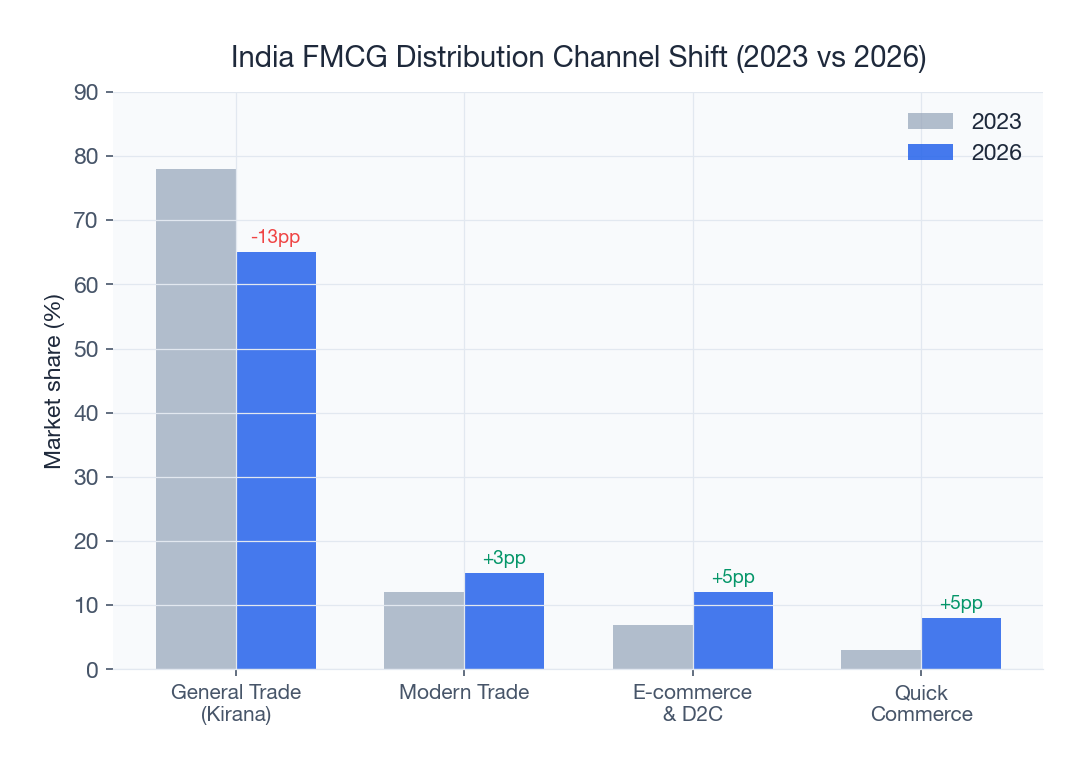
What makes this especially attractive is that general trade (kirana stores) still accounts for roughly 80% of FMCG sales in India. Modern trade (supermarkets, hypermarkets) handles about 12%, and e-commerce around 8%. This means the traditional distribution model, where a distributor serves hundreds of kirana outlets through a network of salesmen and delivery vehicles, remains the dominant and most important channel for FMCG brands. If you are considering starting a distribution business, you are entering the largest and most enduring sales channel in the Indian economy.
Capital Requirements and Investment
The first question every aspiring distributor asks is: how much money do I need? The honest answer depends heavily on your city, product category, and scale ambitions, but here is a realistic breakdown of the investment required to start an FMCG distribution business in India in 2026.
Godown/Warehouse Deposit: You will need a warehouse, and in most cities, landlords require a security deposit of Rs 2-5 lakh in addition to monthly rent. The rent itself varies dramatically: Rs 15,000-30,000 per month for a 1,000-2,000 sq ft space in a tier-2 city like Jaipur, up to Rs 50,000-1,50,000 in metros like Mumbai or Delhi. For dairy distribution, you will need cold storage infrastructure, which adds Rs 3-8 lakh depending on capacity.
Initial Stock Investment: Brands expect distributors to maintain 15-30 days of stock depending on the category and replenishment cycle. For a single FMCG brand, initial stock investment ranges from Rs 5 lakh for a small brand in a tier-3 city to Rs 20 lakh or more for a major brand in a metro market. If you plan to distribute multiple brands simultaneously, multiply accordingly. This is typically the single largest component of your investment.
Delivery Vehicle: You need at least one vehicle to start. A used Tata Ace (mini truck) costs Rs 3-5 lakh, a new one Rs 6-8 lakh, and a larger tempo like the Mahindra Bolero Pickup runs Rs 8-15 lakh. Many new distributors start with one vehicle and add more as coverage expands. In dense urban areas, two-wheelers (Rs 70,000-1,50,000 each) handle last-mile delivery effectively.
Staff Salaries: A bare-minimum team includes one salesman, one delivery person, and one billing/administrative staff member. Monthly salary costs start at Rs 50,000-70,000 in tier-2 and tier-3 cities, scaling to Rs 1.5-2 lakh per month in metros. You should budget for at least 2-3 months of salary reserves before revenue stabilizes.
Technology: A distribution management system (DMS) costs Rs 5,000-15,000 per month depending on the plan and scale. This is a non-negotiable investment -- more on this in Step 7.
| Investment Component | Tier-2/3 City | Metro/Tier-1 City |
|---|---|---|
| Godown deposit | Rs 2-3 lakh | Rs 3-5 lakh |
| Initial stock | Rs 5-10 lakh | Rs 10-20 lakh |
| Delivery vehicle(s) | Rs 3-8 lakh | Rs 5-15 lakh |
| Staff (3-month reserve) | Rs 1.5-2 lakh | Rs 4.5-6 lakh |
| Technology/DMS | Rs 15K-45K | Rs 15K-45K |
| Miscellaneous (furniture, stationery, permits) | Rs 50K-1 lakh | Rs 1-2 lakh |
| Total | Rs 12-25 lakh | Rs 25-50 lakh |
The total investment ranges from approximately Rs 15 lakh for a single-brand operation in a smaller city to Rs 50 lakh or more for a multi-brand setup in a major metro. Some distributors start even leaner by renting vehicles instead of buying and sub-leasing shared warehouse space, bringing the entry point down to Rs 10-12 lakh.
Step 1: Choose Your Product Category
Not all FMCG categories are created equal. Your choice of category determines your capital needs, margin profile, operational complexity, and competitive landscape. Here is a realistic comparison of the major categories:
Dairy Products: Margins of 3-5% on liquid milk, 8-12% on value-added dairy (curd, paneer, butter, cheese). Requires cold storage and cold chain vehicles, making the capital requirement higher (Rs 25-50 lakh). However, daily consumption patterns mean guaranteed recurring revenue. Competition is moderate in most territories since dairy brands are selective about appointing distributors. Shelf life is the biggest challenge -- spoilage can eat into margins if inventory management is poor. Read more about this category in our guide to dairy distribution.
Snacks and Biscuits: Margins of 6-10%. Lower capital requirement (Rs 12-25 lakh) since no cold chain is needed. High volume, fast rotation, but intense competition since every general store stocks multiple snack brands. Shelf life of 3-6 months gives more operational breathing room than dairy.
Beverages: Margins of 5-8% for carbonated drinks, 8-12% for juices and health drinks. Seasonal demand (summer peaks) creates working capital pressure. Heavy products (liquid is bulky) mean higher delivery costs. Capital requirement: Rs 15-35 lakh.
Personal Care: Margins of 8-12%. Excellent shelf life (12-24 months), lower spoilage risk, and relatively compact products that are easy to warehouse and transport. Capital requirement: Rs 10-20 lakh. Competition is fierce in metros but moderate in tier-2 and tier-3 cities where brand penetration is still growing.
Home Care: Margins of 6-10%. Similar advantages to personal care in terms of shelf life and handling. Bulky products (detergent packs, liquid cleaners) require more warehouse space per unit of revenue. Capital requirement: Rs 10-20 lakh.
For first-time distributors, personal care and snacks offer the best risk-reward profile: decent margins, manageable capital requirements, long shelf life, and simpler logistics. Dairy offers the highest barriers to entry but also the strongest moat once established, since brands rarely replace a performing dairy distributor. Many successful distributors start with one category and expand into adjacent ones as they build infrastructure and relationships.
Step 2: Register Your Business
Starting an FMCG distribution business in India requires several registrations and licenses. The process is straightforward but must be completed before you approach brands for appointment. Here is the complete checklist:
Business Registration: Register as a proprietorship (simplest), partnership firm, LLP, or private limited company. Most small and mid-size distributors operate as proprietorships or partnerships. An LLP or Pvt Ltd structure makes sense if your initial investment exceeds Rs 25 lakh or if you plan to raise external capital.
GST Registration: Mandatory for all FMCG distributors. You need GST registration under the regular scheme (not composition scheme) since you will need to claim input tax credit on purchases. Apply online at gst.gov.in with your PAN, Aadhaar, business address proof, and bank account details. Processing takes 3-7 working days.
FSSAI License: Required if you distribute any food products -- and most FMCG categories include food items. A State FSSAI License (for turnover up to Rs 12 crore) costs Rs 2,000-5,000 annually. A Central FSSAI License (for turnover above Rs 12 crore) costs Rs 7,500 annually. Apply online at foscos.fssai.gov.in. Processing takes 30-60 days, so apply early.
Shop and Establishment License: Required by every state's Shops and Establishments Act. Apply at your municipal corporation or through the state's online portal. Fees vary by state, typically Rs 500-5,000.
Trade License: Issued by your local municipal corporation. Required to operate a business from a specific premises. Fees range from Rs 1,000-10,000 depending on the city and premises size.
Drug License (if applicable): If you plan to distribute OTC health supplements, mosquito repellents, or certain personal care products classified as cosmetics/drugs, you may need a Drug License from the state Drug Controller. Consult with a compliance advisor for your specific product portfolio.
Documents Checklist
- PAN card (individual and business entity)
- Aadhaar card of proprietor/partners/directors
- Address proof for business premises (rent agreement or ownership deed)
- Bank account statement or cancelled cheque
- Passport-size photographs
- NOC from landlord (if rented premises)
- Partnership deed or MOA/AOA (if partnership/company)
- Electricity bill for the business premises
- FSSAI Food Safety Supervisor certificate (for food distribution)
Budget Rs 15,000-30,000 for all registrations and compliance setup if you handle them yourself, or Rs 30,000-50,000 if you use a CA/compliance agency. Ensure all registrations are complete before approaching brands -- no reputed FMCG company will appoint a distributor without valid GST registration and FSSAI license (for food categories).
Step 3: Secure a Godown/Warehouse
Your warehouse is the nerve center of your distribution operation. Getting this right from day one prevents costly relocations and operational disruptions later. Here is what you need to consider:
Location: Choose a location that is central to your target retail territory. Proximity to the market reduces delivery time and fuel costs. Avoid residential areas where heavy vehicle access may be restricted. Industrial zones or commercial areas near main roads are ideal. Ensure the location allows loading and unloading space for tempos and trucks.
Size Requirements: A starting operation serving 200-400 retailers typically needs 1,000-2,000 sq ft. As you scale to 500-1,000 outlets and add brands, plan for 2,000-5,000 sq ft. Calculate storage needs based on your category -- snacks and personal care products are compact, while beverages and home care products require more cubic footage per unit of revenue.
FSSAI Compliance: If you distribute food products, your godown must meet FSSAI storage standards. This includes proper ventilation, pest control measures, raised pallets (products should not touch the floor directly), separate storage for different product categories, clean and dry conditions, and adequate lighting. FSSAI inspectors can visit your premises, and non-compliance can result in license cancellation.
Cold Storage for Dairy: Dairy distribution requires maintained cold chain from receipt to delivery. Invest in walk-in coolers or cold rooms (Rs 3-8 lakh depending on capacity), backup power (generator or large inverter), and temperature monitoring systems. Product temperature must stay between 2-8 degrees Celsius throughout storage.
Rent vs Own Analysis: For new distributors, renting is almost always the right choice. Buying a warehouse ties up Rs 30 lakh to Rs 2 crore in capital that could be deployed as working capital for stock and growth. Renting preserves flexibility -- if your territory shifts or you need to scale, relocating a rented space is far easier than selling property. Consider buying only after 5+ years of stable operations when you have predictable territory and strong cash flow.
Negotiate a lease term of at least 3 years with a renewal option. FMCG brands prefer distributors with stable premises, and a short lease signals instability. Ensure the lease agreement permits commercial/warehousing use and allows for the modifications you may need (racking, cold storage installation, signage).
Step 4: Get Brand Appointments
Securing a distributorship appointment from a reputed FMCG brand is the most critical step in building your business. Brands are selective because a bad distributor damages their market presence, retail relationships, and scheme execution. Here is how the process works and what companies look for:
How to approach FMCG companies: Most large FMCG companies have a regional sales team structure -- Area Sales Managers (ASMs) or Territory Sales Officers (TSOs) who manage distributor appointments for specific geographies. Start by identifying the ASM for your target territory. You can find them through the company's website (look for "become a distributor" sections), through existing retailers who can share their current distributor/ASM contact details, or through trade associations and FMCG distribution networks.
Prepare a one-page profile that covers your investment capacity, infrastructure (godown, vehicles), relevant experience (even if in a different industry), knowledge of the local retail landscape, and the number of retail outlets you can cover. If you have existing distribution experience or a retail network from another brand, highlight this prominently -- it dramatically improves your chances.
What brands look for in a distributor:
- Capital adequacy: Ability to invest Rs 5-20 lakh in opening stock and maintain 15-30 days of inventory
- Infrastructure: A suitable godown in the right location, delivery vehicles, and basic office setup
- Market knowledge: Understanding of the local retail landscape, key markets, and consumer preferences
- Existing retail network: Relationships with retailers in the territory are a major advantage, though not always mandatory for new distributors
- Dedicated focus: Most brands prefer distributors who can commit dedicated salesforce and vehicles to their brand rather than being one of ten brands sharing attention
- Technology readiness: Increasingly, brands want distributors who use or are willing to adopt a distributor management system (DMS)
Typical appointment terms: Brand appointments are usually on an annual renewable basis. The brand provides product supply at agreed trade terms (MRP minus retailer margin minus distributor margin). You are expected to achieve coverage targets (number of outlets served), billing targets (monthly sales volume), and scheme execution compliance. Brands provide sales team support through company salesmen (CSOs) who work alongside your team. Underperformance can lead to appointment termination, typically with 30-90 days notice.
Start by targeting 1-2 brands rather than trying to get five appointments simultaneously. Managing multiple brands well requires experience and infrastructure that most new distributors build over 6-12 months. Regional and emerging brands are often easier to get appointed for than large multinationals, and they can provide equally good or better margins while you build your capabilities.
Step 5: Build Your Delivery Fleet
Your delivery fleet determines how many outlets you can serve, how quickly you can fulfill orders, and a significant portion of your operating costs. Getting the fleet composition right is essential for profitability.
Vehicle types and their use cases:
- Tata Ace / Ashok Leyland Dost (mini trucks): The workhorses of FMCG distribution. Payload capacity of 750 kg to 1.25 tonnes. Ideal for primary delivery runs covering 15-30 retail outlets per trip. Cost: Rs 5-8 lakh new, Rs 3-5 lakh used.
- Mahindra Bolero Pickup / Tata Intra: Medium-capacity vehicles (1.25-2 tonnes) for distributors with higher volume or serving wholesale markets. Cost: Rs 8-15 lakh.
- Two-wheelers with carrier: For dense urban areas where narrow lanes and parking constraints make larger vehicles impractical. A bike with a carrier rack handles 50-100 kg loads for last-mile delivery to small kirana stores. Cost: Rs 70,000-1,50,000.
- Refrigerated vehicles: Essential for dairy and frozen food distribution. Refrigerated Tata Ace variants cost Rs 8-12 lakh. Non-negotiable if your product portfolio includes temperature-sensitive items.
Owned vs rented vehicles: New distributors face a classic dilemma. Buying vehicles requires substantial upfront capital but gives you full control and lower per-km costs over time. Renting or leasing preserves capital and offers flexibility, but costs more per kilometer. A practical approach: own your primary delivery vehicle and rent additional capacity during peak periods (festivals, scheme-driven demand spikes). Vehicle financing at 10-12% interest through NBFCs is widely available, with loan tenures of 3-5 years.
Route planning basics: Even before implementing digital route optimization, plan your delivery routes systematically. Group nearby outlets into clusters, assign each cluster to a specific delivery day or time window, and sequence stops to minimize backtracking. A well-planned route allows one vehicle to serve 20-30 outlets per day in an urban setting. Poor route planning can cut this to 12-15 outlets, effectively halving your delivery capacity with the same cost.
Step 6: Hire and Train Your Team
Your team is the face of your distribution business. Retailers interact with your salesman and delivery boy daily -- their competence, reliability, and behaviour directly affect retailer satisfaction, order volumes, and brand reputation.
Essential roles for a starting operation:
- Salesman (1-2): Visits retailers, takes orders, manages relationships, communicates schemes, handles complaints. Salary: Rs 12,000-18,000 per month in tier-2/3 cities, Rs 18,000-30,000 in metros, plus incentives of Rs 3,000-8,000 based on targets.
- Delivery Boy (1-2): Loads, delivers, and collects payments. Salary: Rs 10,000-15,000 in tier-2/3 cities, Rs 15,000-22,000 in metros.
- Billing/Admin Staff (1): Generates invoices, manages accounts receivable, reconciles stock, handles returns. Salary: Rs 12,000-20,000. Must be comfortable with computers and, ideally, with distribution billing software.
- Godown Boy (1): Manages warehouse operations -- receiving stock, organizing storage, loading vehicles, maintaining inventory hygiene. Salary: Rs 8,000-15,000.
For a new operation, you might start with 3-4 people (combining roles where possible) and scale as coverage expands. Many distributor owners personally handle sales in the early months to understand the market before hiring dedicated salesmen.
Training essentials: Train your team on product knowledge (every SKU, its MRP, margin, shelf life, and target consumer), sales technique (how to pitch new products, handle objections, and execute schemes at retail), operational discipline (loading sequence, delivery confirmation, cash handling, and return processing), and technology (using the mobile app for order capture, delivery proof, and attendance tracking). A well-trained salesman can manage 150-200 outlets efficiently, while an untrained one struggles with 80-100.
Step 7: Set Up Technology From Day One
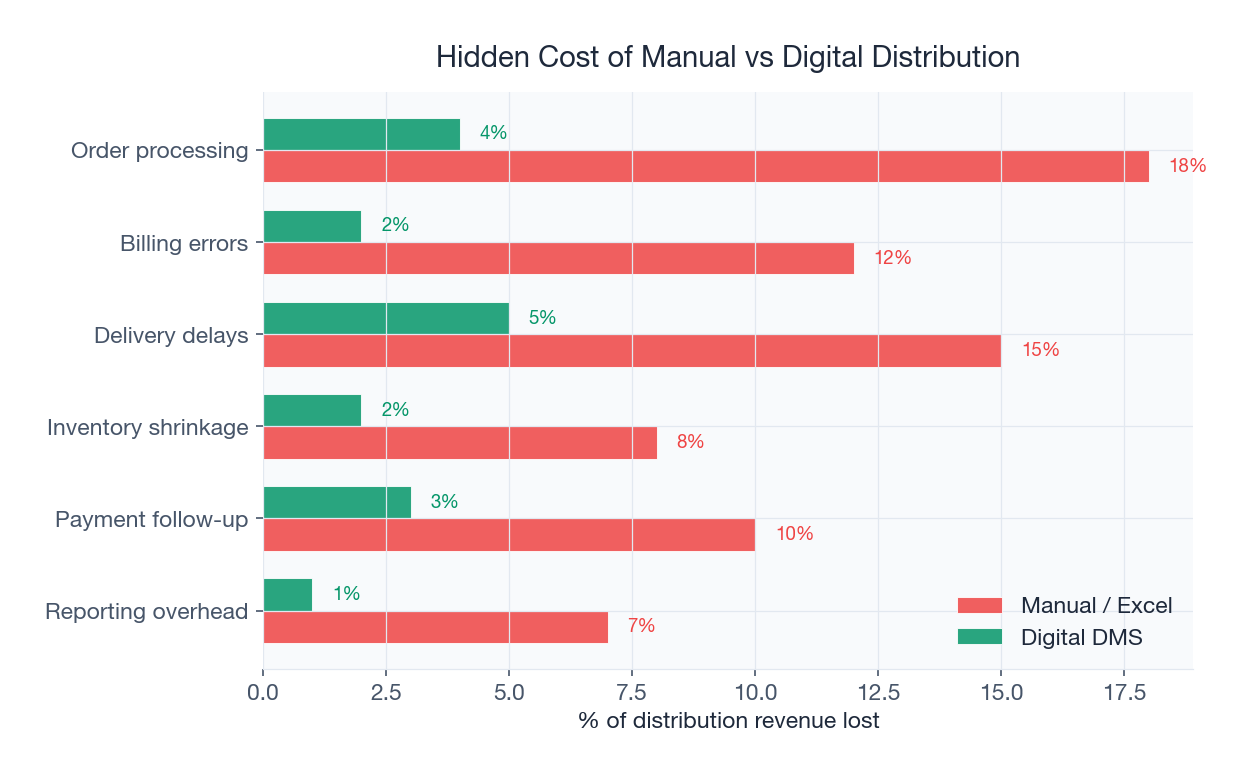
This is where most new distributors make a costly mistake. They start with manual registers or Tally for billing, plan to "upgrade later," and then spend years struggling with the inefficiencies of manual processes. By the time they switch to a proper distribution management system, they have lost lakhs to billing errors, stock discrepancies, scheme leakage, and poor credit management.
Why not Tally? Tally is an excellent accounting software, but it was not designed for distribution operations. It cannot handle route planning, field sales tracking, real-time inventory visibility across locations, scheme engine logic, or OTP-based delivery confirmation. Running distribution on Tally is like running a restaurant on Excel -- technically possible, but operationally painful. We have covered this in detail in our Tally to DMS migration guide.
What a DMS gives you from day one:
- Order management: Digital order capture via mobile app, eliminating paper order books and phone-based order taking. Every order is timestamped, attributable, and trackable.
- Automated billing: GST-compliant invoices generated in seconds with accurate scheme deductions, trade discounts, and credit note calculations. No manual calculation errors.
- Route optimization: Plan delivery routes that minimize distance and fuel costs while ensuring all outlets are served within their preferred time windows.
- Sales analytics: Real-time dashboards showing SKU-wise sales, retailer-wise performance, territory trends, and target achievement. Make data-driven decisions from week one, not year one.
- Credit management: Track outstanding payments by retailer, set credit limits, flag overdue accounts, and automate payment reminders. This alone can save lakhs by preventing bad debts.
- Crate tracking: If you distribute dairy or beverages, digital crate management prevents the leakage that silently erodes margins.
SpireStock's distributor management platform is built specifically for Indian FMCG and dairy distributors. Our starter plans begin at Rs 5,000 per month, making professional-grade distribution technology accessible even to new distributors. You get mobile apps for your field team, a web dashboard for operations management, and integrated analytics -- all designed for the way Indian distribution actually works. Check our pricing plans to find the right fit for your scale.
Step 8: Launch and Scale
You have your registrations, godown, brand appointment, vehicle, team, and technology in place. Now it is time to launch. Here is how to think about the first year and beyond.
First 30 days -- Establish your foundation (Target: 100-200 retailers): Focus relentlessly on coverage, not depth. Your salesman should be visiting 15-25 new outlets every day, introducing your brands, taking first orders, and establishing delivery reliability. Do not chase large orders from a few outlets -- instead, ensure you are visible and reliable across a wide base. Deliver on time, every time, in these first 30 days. First impressions with retailers are everything. Use your DMS mobile app from day one to log every visit, order, and delivery.
Days 31-90 -- Deepen penetration (Target: 200-500 retailers): Once your initial base is established, focus on increasing order frequency and average order value from existing retailers. Introduce new SKUs that complement your initial range. Begin executing trade schemes that the brand provides. Identify your top 50 retailers (the 80/20 rule applies strongly in distribution) and ensure they receive priority service. Start analyzing sales data from your analytics dashboard to identify fast-moving and slow-moving SKUs.
Months 4-12 -- Scale systematically (Target: 500-1,000 retailers): Add your second delivery vehicle. Consider hiring an additional salesman to cover new territories. Approach your brand for expanded territory or additional sub-brands. This is also the right time to explore a second brand appointment -- ideally in a complementary category (e.g., if you started with snacks, add beverages or personal care). Ensure your technology scales with you; a good DMS handles this growth without additional infrastructure.
Year 2-3 -- Expand territory and categories (Target: 1,000-2,000+ retailers): By year two, you should have a clear understanding of your market, strong retailer relationships, and proven operational capability. This is when you scale aggressively. Add brands to fill category gaps. Expand into adjacent territories. Consider adding a sub-distributor network for far-flung areas. Distributors who reach 1,500+ outlets with 3-5 brands typically achieve monthly turnover of Rs 50 lakh to Rs 2 crore and net monthly income of Rs 3-10 lakh.
Common Mistakes New Distributors Make
Having worked with hundreds of FMCG distributors across India, we have seen the same mistakes destroy promising businesses. Here are the pitfalls to avoid:
1. Over-investing in stock: New distributors, eager to impress the brand, often load up on 45-60 days of stock instead of the recommended 15-25 days. This locks up working capital, increases spoilage risk (especially for food and dairy), and creates cash flow crises when payments from retailers come in slowly. Start lean, measure sell-through rates, and let data guide your stocking decisions.
2. Ignoring credit management: Extending credit to retailers is a reality of Indian distribution, but undisciplined credit management is the single biggest reason distributors fail. Set clear credit limits for each retailer based on their purchase history. Track outstanding amounts daily using your DMS. Cut supply to chronic defaulters, even if it means short-term revenue loss. A distributor who allows Rs 10-15 lakh in overdue receivables is effectively funding an interest-free loan to retailers from their own pocket.
3. No technology from the start: We have covered this extensively, but it bears repeating. Distributors who start with manual processes and switch to a DMS after 2-3 years universally say the same thing: "I wish I had started digital from day one." The cost of a DMS (Rs 5,000-15,000/month) is trivially small compared to the losses from billing errors, stock discrepancies, and poor route planning. Read our comprehensive distribution management software guide to understand the full landscape.
4. Poor route planning: Sending delivery vehicles on ad hoc routes based on "experience" rather than systematic planning wastes 20-30% of fuel costs and reduces outlet coverage. A vehicle that could serve 25 outlets per day on an optimized route serves only 15-18 on a poorly planned one. Invest in route optimization from the start.
5. Single-brand dependency: Relying on a single brand makes your business fragile. If the brand changes distributors, revises trade terms unfavourably, or faces a market downturn, your entire revenue stream is at risk. Aim to have 2-3 brands within your first 12-18 months. Diversification also improves your delivery economics since the same vehicle and salesman can serve multiple brands on the same route.
6. Neglecting retailer relationships: Some distributors treat retailers as transactional endpoints -- deliver stock, collect money, move on. The best distributors build genuine partnerships with their retailers: helping them manage shelf placement, advising on festive stock-up, promptly resolving complaints, and proactively communicating scheme changes. Retailers who trust you will give you shelf space priority and stick with you even when competitors offer marginally better trade terms.
Financial Projections: Sample P&L for Year 1, 2, and 3
Here is a realistic financial projection for a new FMCG distributor starting in a tier-2 city with an initial investment of Rs 20 lakh, distributing one brand in year one and adding a second brand in year two. These numbers are based on conservative assumptions and actual performance data from distributors in our network.
Year 1: Building the Foundation
| Item | Monthly (Avg) | Annual |
|---|---|---|
| Revenue (turnover) | Rs 25 lakh | Rs 3 crore |
| Gross margin (6%) | Rs 1.50 lakh | Rs 18 lakh |
| Scheme income | Rs 25,000 | Rs 3 lakh |
| Gross income | Rs 1.75 lakh | Rs 21 lakh |
| Godown rent | Rs 20,000 | Rs 2.4 lakh |
| Staff salaries (4 people) | Rs 55,000 | Rs 6.6 lakh |
| Vehicle expenses (fuel, maintenance) | Rs 25,000 | Rs 3 lakh |
| Technology (DMS) | Rs 8,000 | Rs 96,000 |
| Miscellaneous (phone, electricity, stationery) | Rs 10,000 | Rs 1.2 lakh |
| Total operating cost | Rs 1.18 lakh | Rs 14.16 lakh |
| Net profit | Rs 57,000 | Rs 6.84 lakh |
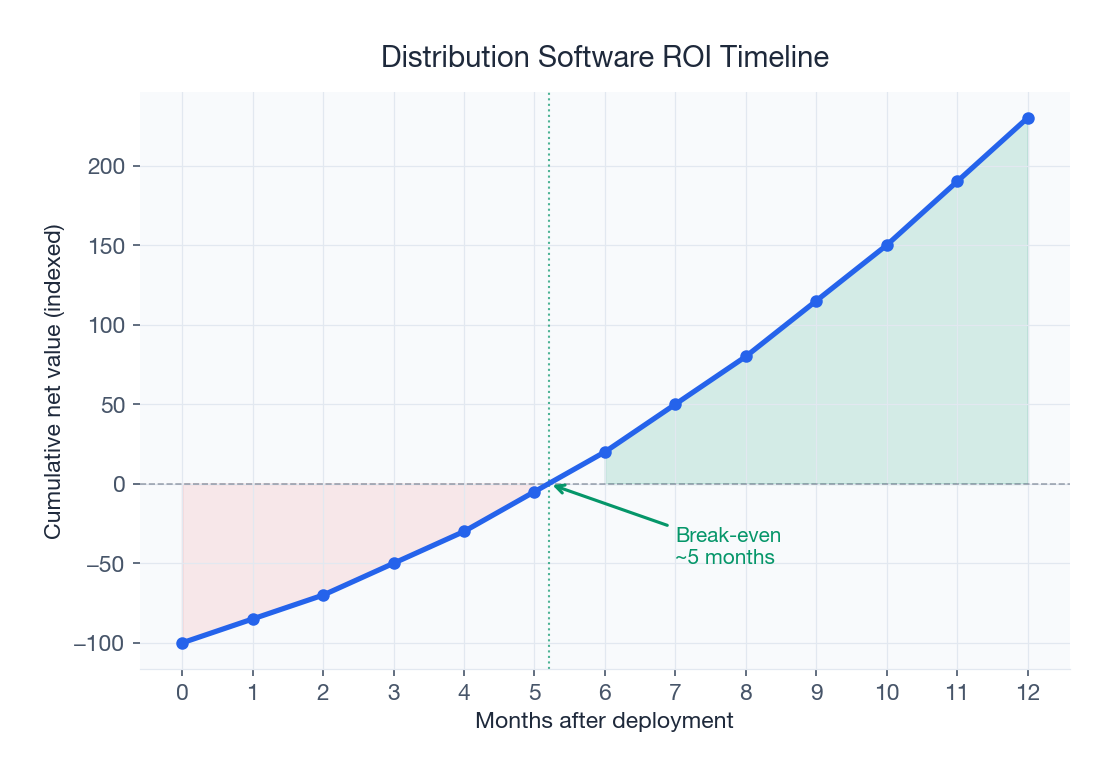
Year one is about survival and establishment. Net profit of Rs 6-7 lakh represents a 34% return on the Rs 20 lakh investment, which is solid for a first year. Many distributors are break-even or marginally profitable in the first 3-4 months before volumes stabilize.
Year 2: Growth Phase
| Item | Monthly (Avg) | Annual |
|---|---|---|
| Revenue (2 brands, expanded territory) | Rs 55 lakh | Rs 6.6 crore |
| Gross margin (6.5%) | Rs 3.58 lakh | Rs 42.9 lakh |
| Scheme income | Rs 55,000 | Rs 6.6 lakh |
| Gross income | Rs 4.13 lakh | Rs 49.5 lakh |
| Godown rent (larger space) | Rs 30,000 | Rs 3.6 lakh |
| Staff salaries (7 people) | Rs 1.10 lakh | Rs 13.2 lakh |
| Vehicle expenses (2 vehicles) | Rs 45,000 | Rs 5.4 lakh |
| Technology (DMS) | Rs 12,000 | Rs 1.44 lakh |
| Miscellaneous | Rs 15,000 | Rs 1.8 lakh |
| Total operating cost | Rs 2.12 lakh | Rs 25.44 lakh |
| Net profit | Rs 2.01 lakh | Rs 24.06 lakh |
Year two shows the power of scaling. Revenue more than doubles as you add a second brand and expand coverage. Operating costs increase but at a slower rate than revenue, demonstrating the operating leverage inherent in distribution. Net profit of Rs 24 lakh represents a 120% return on the original investment.
Year 3: Maturity and Compounding
| Item | Monthly (Avg) | Annual |
|---|---|---|
| Revenue (3 brands, full territory) | Rs 1 crore | Rs 12 crore |
| Gross margin (7%) | Rs 7 lakh | Rs 84 lakh |
| Scheme income | Rs 1 lakh | Rs 12 lakh |
| Gross income | Rs 8 lakh | Rs 96 lakh |
| Godown rent | Rs 40,000 | Rs 4.8 lakh |
| Staff salaries (12 people) | Rs 2 lakh | Rs 24 lakh |
| Vehicle expenses (3-4 vehicles) | Rs 80,000 | Rs 9.6 lakh |
| Technology (DMS) | Rs 15,000 | Rs 1.8 lakh |
| Miscellaneous | Rs 25,000 | Rs 3 lakh |
| Total operating cost | Rs 3.60 lakh | Rs 43.2 lakh |
| Net profit | Rs 4.40 lakh | Rs 52.8 lakh |
By year three, a well-managed distributor can achieve Rs 50+ lakh in annual net profit. At this stage, the business becomes self-funding -- profits cover all expansion capital, and the Rs 20 lakh initial investment has generated cumulative returns exceeding 400%. This is precisely why FMCG distribution attracts serious entrepreneurs: the returns compound as scale builds, and the business generates strong, predictable cash flows.
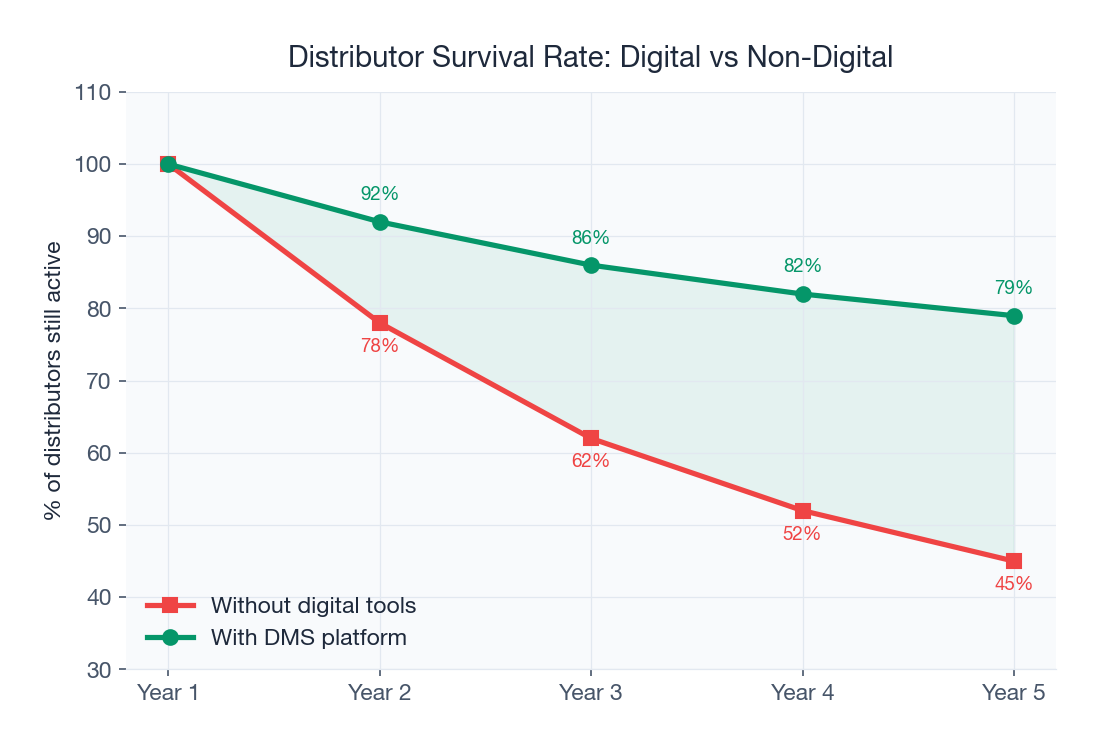
These projections assume disciplined credit management (outstanding receivables under 15 days), systematic route optimization (using digital route planning), and proper inventory management through a DMS. Distributors who operate without technology typically achieve 30-40% lower net margins due to higher operating costs and revenue leakage.
Getting Started: Your Action Plan
Starting an FMCG distribution business in India is not complicated, but it requires methodical execution. Here is your action plan, condensed:
- Weeks 1-2: Research your target category and territory. Talk to existing retailers to understand brand demand and competitive gaps.
- Weeks 3-4: Register your business, apply for GST and FSSAI license. Begin warehouse search.
- Weeks 5-6: Secure your godown. Purchase or arrange delivery vehicle. Begin approaching FMCG brand ASMs for appointment discussions.
- Weeks 7-8: Finalize brand appointment. Set up your DMS platform. Hire initial team.
- Week 9: Receive opening stock. Train your team on products, processes, and technology.
- Week 10: Launch. Start market coverage with 15-25 outlet visits per day per salesman.
From idea to first delivery in 10 weeks is realistic and achievable. The Indian FMCG distribution market is large enough that there is room for well-run new entrants in virtually every territory across the country. What separates successful distributors from failed ones is not the size of their initial investment -- it is operational discipline, technology adoption, and the willingness to build systematically rather than chase shortcuts.
Ready to build your distribution business on a solid technology foundation? Contact SpireStock for a free consultation on setting up your distribution operations with the right tools from day one. Or explore our pricing plans to find the right fit for your scale and budget.
Sources & References
Frequently Asked Questions
The total investment ranges from Rs 12-25 lakh for a single-brand operation in a tier-2 or tier-3 city to Rs 25-50 lakh for a multi-brand setup in a metro city. The major components are initial stock (Rs 5-20 lakh), delivery vehicle (Rs 5-15 lakh), godown deposit (Rs 2-5 lakh), staff salaries for 2-3 months (Rs 1.5-6 lakh), and technology (Rs 5,000-15,000 per month).
You need GST registration (mandatory), FSSAI license (if distributing food products), Shop and Establishment license from your municipal corporation, and a trade license. If distributing OTC health products or certain cosmetics, a Drug License may also be required. Budget Rs 15,000-50,000 for all registrations and compliance setup.
Average FMCG distributor margins range from 5% to 8% of turnover, depending on the product category and brand. Dairy margins are 3-5% on liquid milk and 8-12% on value-added products. Personal care offers 8-12%, snacks 6-10%, and beverages 5-8%. Additional income comes from scheme incentives, display fees, and volume bonuses.
Contact the brand's Area Sales Manager (ASM) for your target territory. Prepare a profile showcasing your investment capacity, godown infrastructure, delivery vehicles, market knowledge, and any existing retail network. Brands evaluate capital adequacy, infrastructure, local market understanding, and technology readiness. Starting with regional or emerging brands is often easier and can offer comparable margins.
Cold storage is mandatory only if you distribute dairy products, frozen foods, or other temperature-sensitive items. For ambient FMCG categories like snacks, personal care, and home care, a standard warehouse with proper ventilation and pest control is sufficient. Cold storage setup costs Rs 3-8 lakh depending on capacity.
A Distribution Management System (DMS) is software that manages order capture, billing, route planning, inventory, credit tracking, and sales analytics for distributors. Starting with a DMS from day one prevents billing errors, stock discrepancies, and credit defaults that plague manual operations. Cloud-based DMS platforms like SpireStock start at Rs 5,000 per month.
A well-run distributor with 2-3 salesmen and 2 delivery vehicles can effectively serve 500-1,000 retail outlets. Scaling beyond 1,000 outlets typically requires 5-7 salesmen, 3-4 vehicles, and robust technology. Top distributors in metro cities serve 2,000-3,000 outlets with teams of 12-15 people.
Most new FMCG distributors achieve break-even within 3-4 months and meaningful profitability by month 6-8. Year one net profits typically range from Rs 5-10 lakh on a Rs 15-25 lakh investment. By year three, well-managed distributors can achieve Rs 40-50 lakh in annual net profit with cumulative ROI exceeding 400% on the original investment.
Related SpireStock Features
End-to-end order lifecycle from placement to delivery with multi-level approval workflows.
GST-compliant invoicing with HSN codes, gate passes, and financial ledger.
Zone, town, and route-based delivery management with optimization.
Powerful dashboards with sales trends, MIS reports, and distribution analytics.
Complete returnable crate tracking across plant, transporter, and retail levels.
Mobile app for distributors, retailers, and delivery teams.
Related Industries
Streamline FMCG distribution with order management, beat planning, retailer tracking, and GST billing. Built for Indian FMCG supply chains.
End-to-end dairy distribution software for milk, curd, paneer, and ghee brands. Manage orders, crates, cold chain, and GST billing in one platform.
Related Entities
Ready to Streamline Your Distribution?
Start your free 14-day trial and see how SpireStock can transform your dairy, FMCG or consumer-goods distribution operation, from order capture to crate recovery.

SpireStock Team
Distribution Technology Experts
SpireStock Team writes for SpireStock on distribution management, supply-chain optimisation and field operations for Indian dairy and FMCG brands.