India's Gig Economy Meets FMCG Distribution
India's gig economy is no longer a fringe phenomenon. NITI Aayog estimates the country will have 23.5 million gig workers by 2029-30, up from approximately 7.7 million in 2020-21. These are not just food delivery riders and cab drivers. Last-mile delivery has become the fastest-growing gig segment, with platforms like Porter, Shadowfax, Loadshare, and Delhivery building massive on-demand driver networks across tier-1, tier-2, and tier-3 cities.
At the same time, FMCG distribution in India is facing a workforce crisis that shows no signs of abating. Distributor after distributor reports the same problem: they cannot hire and retain delivery staff. Annual attrition for frontline delivery and sales roles runs at 30-50%, and in some urban markets it exceeds 60%. The reasons are familiar: low wages (Rs 10,000-15,000 per month for delivery boys), gruelling physical conditions, no career progression, and a gig economy that offers better pay with more flexibility.
The convergence is obvious. FMCG distribution needs reliable last-mile delivery. The gig economy has millions of workers available on demand. Why not connect the two?
The answer, as distributors across beverage and FMCG verticals are discovering, is more nuanced than either enthusiasts or skeptics suggest. Gig-based delivery works brilliantly in some contexts and fails catastrophically in others. The distributors who are getting it right are not choosing between owned fleets and gig workers. They are building hybrid models that deploy each where it makes sense, managed through technology that treats both workforce types as part of a single distribution engine.
The Traditional FMCG Delivery Model
Indian FMCG distribution has operated on the same workforce model for four decades: owned fleet, full-time staff, fixed routes, and relationship-driven delivery. A typical distributor employs 5-30 delivery boys on full-time salaries. Each is assigned fixed routes covering 20-40 retail outlets per day. He loads at the godown every morning, follows a predetermined beat plan, delivers goods, collects payments, communicates trade schemes, and returns to settle accounts.
This repetition builds something no app can replicate: relationships. The delivery boy knows that Sharma ji's shop opens late on Tuesdays, that the medical store wants only half-cases, that the college canteen route needs extra stock during exams. He knows who pays promptly and who requires the distributor owner to call personally. This operational intelligence keeps distribution running smoothly.
The owned fleet model offers deep retailer trust, consistent brand representation, reliable credit collection, institutional knowledge of buying patterns, scheme communication capability, and direct accountability. For categories requiring selling alongside delivery, particularly dairy, confectionery, and personal care, it remains the gold standard.
But the limitations are equally clear. Fixed costs stay high regardless of demand. Scaling for seasonal peaks requires permanent hiring. Attrition at 40% annually creates perpetual recruitment cycles. Geographic expansion means committing to staff before revenue justifies it. And the model assumes a supply of workers willing to do physically demanding work for Rs 10,000-15,000 per month, an assumption the gig economy has shattered.
The Gig Delivery Model
The gig delivery model for B2B distribution borrows consumer delivery infrastructure but applies it differently. Instead of delivering food from restaurant to apartment, gig drivers deliver cases of goods from distributor godowns to retail outlets.
How B2B Gig Delivery Platforms Work
Platforms like Shadowfax, Porter, and Loadshare offer B2B logistics where distributors post delivery tasks and available drivers accept assignments. Pricing is per-delivery or per-kilometre, with surge pricing during peak demand. The platform handles driver availability, route assignment, proof of delivery, and payment settlement. Swiggy Genie and Dunzo have also entered B2B delivery in select cities, bringing consumer-grade tracking and automated dispatching to commercial distribution.
The Variable Cost Advantage
The single biggest advantage is cost variability. An owned delivery boy costs Rs 12,000-18,000 per month whether he delivers 500 cases or 50. A gig driver costs nothing on days with no deliveries and scales linearly with volume. The per-delivery cost typically runs Rs 25-60 per drop in urban areas. For a route with 25 deliveries per day, that translates to Rs 16,000-39,000 per month. At the lower end, gig is comparable to owned fleet costs. At the higher end, significantly more expensive. The math depends on route density, drop size, and city.
What Gig Platforms Handle Well
Physical movement of goods from A to B. Digital proof of delivery with photographs and timestamps. Real-time tracking visible to the distributor. Flexible scaling: need 3 drivers today and 8 tomorrow? Done. No recruitment, no training, no HR overhead.
When Gig Makes Sense for FMCG
Gig delivery is not universally good or bad for FMCG distribution. It excels in specific, identifiable contexts. Distributors who deploy gig workers in these scenarios see genuine cost savings and operational benefits.
Urban High-Density Routes
In metro cities where retail outlets are densely packed, a gig driver can complete 20-30 drops within a 5-kilometre radius in a single shift. The per-drop cost stays low because distances are short. For commodity products where the retailer knows what he wants and the delivery is purely logistical, gig works well. Commercial areas of Mumbai, Bangalore, Delhi, and Chennai are ideal candidates.
Commodity Product Delivery
Products requiring no selling effort are natural gig candidates: packaged water, basic staples, standard-size beverage cases, and cleaning supplies. The retailer reorders the same items every week. No scheme to explain, no new variant to introduce. The delivery is purely physical, and a gig driver handles it as efficiently as an employed delivery boy.
Top-Up and Emergency Deliveries
Every distributor faces unplanned demand: a retailer runs out mid-week, an event creates sudden demand, or a delayed shipment requires emergency redistribution. Deploying an owned fleet vehicle for a single top-up delivery is wasteful. A gig driver handles it within hours at a fraction of the cost. This use case alone justifies having a gig channel ready.
New Market Testing
When testing demand in a new area before committing to full-time staff, gig delivery provides low-risk entry. Cover the area with gig drivers for 2-3 months, measure order volumes, and decide whether permanent staff is justified. The alternative, hiring full-time delivery boys for an unproven market, risks Rs 3-5 lakh in wasted salaries.
Seasonal Demand Spikes
Festival seasons, wedding seasons, and summer peaks create volumes exceeding regular fleet capacity by 30-50%. Hiring temporary staff for 6-8 weeks is impractical: recruitment takes 2 weeks, training takes 2 more, and by the time the new hire is productive, the season is half over. Gig drivers activate within days and release when demand normalizes. This is perhaps the highest-ROI use case for gig in FMCG distribution.
When Gig Does Not Work
The enthusiasm for gig delivery often ignores the functions that Indian FMCG delivery boys perform beyond physically moving boxes. In many distribution setups, the delivery boy is also a salesman, a payment collector, a scheme communicator, and a relationship manager. Gig cannot replace any of these roles.
Relationship Selling
In categories like dairy, confectionery, and personal care, the delivery interaction is a selling interaction. The delivery boy recommends new SKUs, adjusts order quantities based on shelf observation, and cross-sells from related categories. A gig driver who arrives, drops boxes, takes a photo, and leaves cannot perform any of these functions. Distributors who have tried pure gig for relationship-intensive categories report 15-30% drops in secondary sales within the first quarter.
Credit Collection
Approximately 60-70% of FMCG transactions at the kirana level involve credit. The delivery boy who has visited a retailer for 6 months knows his payment rhythm and has the relationship that enables firm-but-friendly collection conversations. Handing credit collection to a gig driver the retailer has never seen escalates outstanding receivables. Distributors report 40-60% increases in overdue payments when gig workers handle credit-heavy routes.
Complex Product Handling
Cold chain products (dairy, frozen foods, ice cream) require temperature-controlled transport and time-sensitive delivery windows. Fragile products (glass bottles, premium packaging) need handling expertise from training. Gig platforms offer general-purpose vehicles without specialized equipment. A gig driver treating glass-bottled beverages like a food delivery package creates breakage, returns, and complaints.
Rural and Semi-Urban Routes
Gig platform coverage drops dramatically outside tier-1 cities. In tier-3 towns and rural areas, the driver pool is thin, unreliable, and expensive. A route covering 15 outlets across 40 kilometres of rural roads does not work on gig economics. Driver cost exceeds a full-time salary, and availability is inconsistent.
Scheme Communication
FMCG companies run 10-20 active trade schemes at any time, each with specific eligibility criteria and claim processes. Communicating these to retailers is a function owned staff perform during visits. Gig drivers have no scheme knowledge, no training, and no incentive to spend time on promotional offers. Scheme uptake drops 40-60% when gig replaces owned delivery on scheme-heavy routes.
Hybrid Models: The Best of Both Worlds
The distributors achieving the best results are not debating "owned versus gig." They are building hybrid models that deploy each resource type where it delivers the most value. This is not a compromise. It is a deliberate strategy that optimizes cost, quality, and flexibility simultaneously.
Core Routes: Owned Fleet
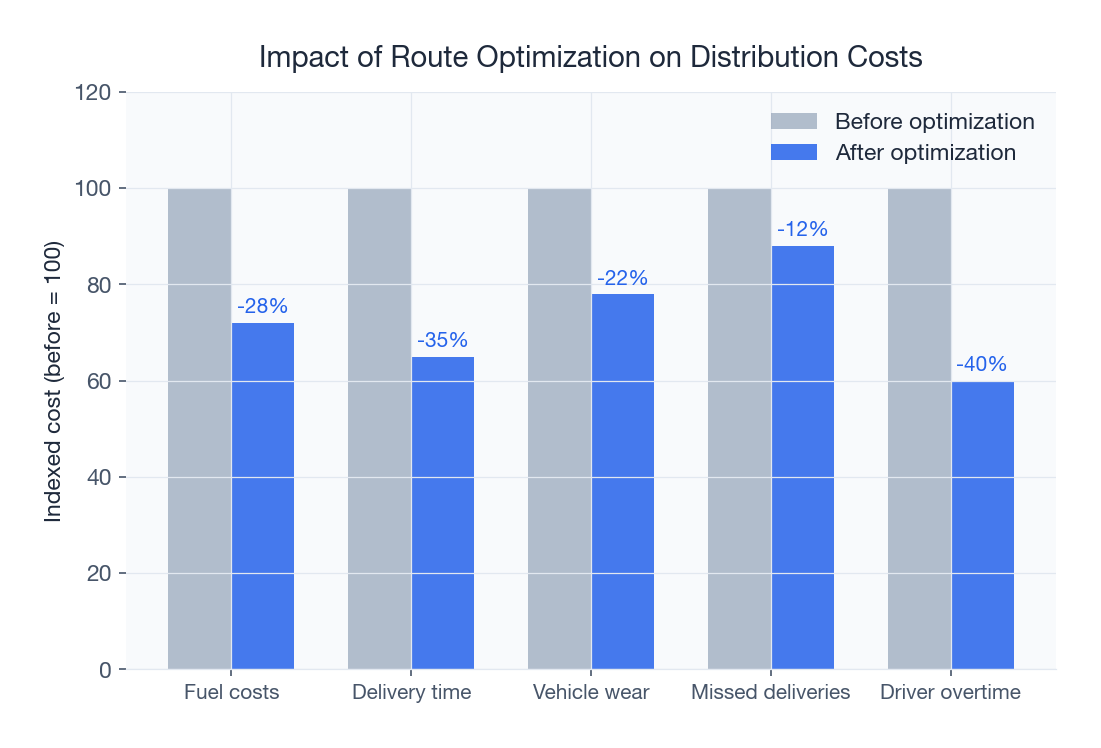
High-value routes with relationship-intensive retailers, credit collection, and complex product handling remain with owned fleet. These are typically 60-70% of routes representing 75-85% of revenue. Route optimization technology ensures these core routes are designed for maximum efficiency, reducing the number of owned staff needed.
Overflow and New Territory: Gig
New territories, low-density routes, and overflow deliveries go to gig platforms. These represent 20-30% of delivery volume but would require 30-40% more permanent staff to cover internally. Routing them to gig keeps fixed costs aligned with proven revenue.
Seasonal Peaks: Gig
During Diwali, wedding season, or summer peaks, volume spikes 30-50% above baseline. The distributor activates gig capacity for 4-8 weeks. Per-delivery cost is higher, but total cost is lower than maintaining year-round capacity for peak demand.
How to Structure a Hybrid Model
Classify every route as Core (owned), Flex (gig-eligible), or Hybrid (owned primary, gig backup). Core routes have assigned full-time staff with fixed beats. Flex routes are posted to gig platforms daily based on order volume. Hybrid routes use owned staff normally with gig support when volume exceeds capacity. Classification is reviewed monthly based on revenue, delivery success rates, and retailer feedback. A Flex route generating consistent volume graduates to Core. A Core route losing revenue might be tested as Flex.
This requires technology managing both workforce types through a single system, where distribution tracking and fleet management solutions become essential. Without unified visibility, hybrid models create operational chaos.
Managing Gig Workers: Challenges
Deploying gig workers in FMCG distribution introduces operational challenges that consumer delivery platforms do not face. A failed food delivery means a customer orders from another restaurant. A failed FMCG delivery means a retailer switches to a competitor distributor, potentially permanently.
Cash Handling Risk
Handing Rs 20,000-50,000 in daily collections to a gig worker with no long-term relationship creates obvious risk. Solutions include UPI collection at point of delivery, cash-on-delivery limits for gig routes, and restricting gig to prepaid or credit routes only. Distributors using gig for cash-heavy routes without safeguards report 3-5% higher cash discrepancies.
Product Knowledge Gaps
An owned delivery boy knows that the "blue pack" is the 500ml variant and the "green one" is the 200ml. He knows which products need refrigeration and that outlet 37 always wants the larger carton. Gig drivers lack this knowledge entirely, resulting in wrong deliveries and frustrated retailers. Digital pick lists with product photos through a mobile app partially address this gap but never fully eliminate it.
Brand Representation
An owned delivery boy in branded uniform, arriving on schedule, reinforces the distributor's reputation. A gig driver in civilian clothes, rushing through drops to maximize earnings, projects a different image. Some distributors provide branded vests and greeting scripts, but compliance is inconsistent.
Quality Control and Accountability
When an owned delivery boy makes a mistake, there is a clear accountability chain. When a gig driver errs, the distributor's recourse is limited to a platform complaint. Building quality control into gig delivery requires robust proof-of-delivery systems, retailer feedback loops, and performance scoring.
Attrition Even Higher Than Full-Time
Ironically, gig workers have even higher churn. The average gig partner stays active for 4-8 months before switching platforms or leaving. The gig driver who has learned a distributor's routes will likely be replaced by a new driver within months.
Technology Requirements
Managing a mixed workforce of owned staff and gig workers requires technology that most distributors do not currently have. The traditional van sales management approach assumes a fixed workforce with fixed routes. Hybrid models demand dynamic, real-time systems.
Unified Route Assignment
The system must assign routes to owned staff through fixed beat plans while posting overflow routes to gig platforms via API. Route optimization must consider both workforce types: owned staff get priority on core routes, gig drivers are assigned by availability and proximity. A single dashboard shows all routes regardless of who delivers them.
Digital Proof of Delivery
For gig deliveries without direct supervision, proof of delivery is critical: geo-tagged photographs, digital signature or OTP confirmation, timestamped records, and condition verification for cold chain products. The field sales app must capture all of this automatically, creating auditable records for every drop.
Payment Tracking
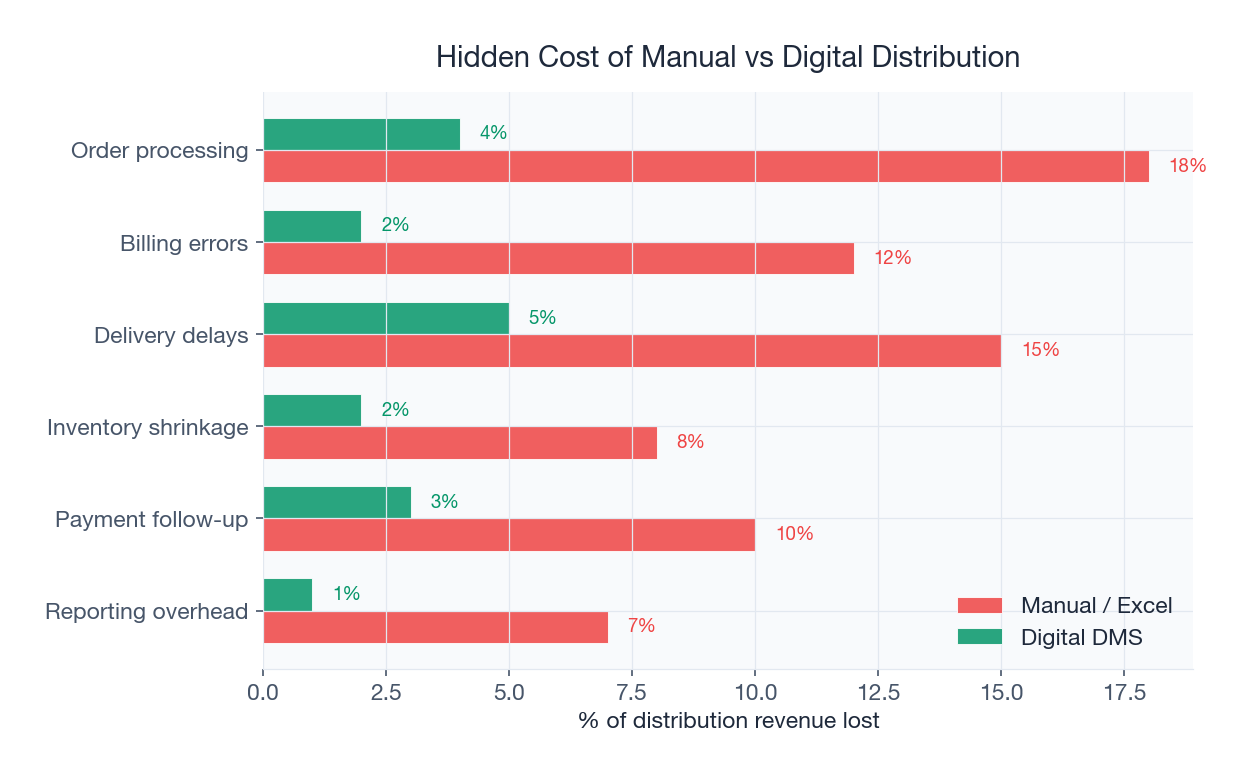
With mixed collection methods (cash from owned staff, UPI from gig routes, credit for established retailers), the system must reconcile all payment streams in real time. Distribution tracking showing outstanding amounts by route and collection method is essential. Without this, cash leakage on gig routes goes undetected until month-end.
Performance Scoring
Owned staff are measured on attendance, beat adherence, and collection efficiency. Gig drivers on delivery success rate, time per drop, damage rate, and retailer satisfaction. The system must track these separately and generate route-level reports that inform Core/Flex/Hybrid classification.
How DMS Manages Mixed Workforce
A modern DMS integrates owned workforce management (beat planning, attendance, incentives) with gig platform APIs (task posting, driver assignment, proof of delivery) into a single operational layer. The distributor manages routes, not workforce types. The system recommends whether each route should be served by owned staff or gig based on cost, complexity, and performance data. Sales productivity tools provide the analytics layer for data-driven decisions.
Cost Comparison: Owned vs Gig vs Hybrid
The cost debate between owned and gig delivery is often oversimplified. A proper comparison must include hidden costs that make the headline numbers misleading.
Monthly Cost Per Route: Owned Fleet
A full-time delivery boy costs more than his salary suggests. Base salary: Rs 12,000-16,000. ESI/PF/statutory: Rs 2,000-3,000. Vehicle fuel/maintenance: Rs 3,000-5,000. Device allowance: Rs 500-1,000. Training (amortized): Rs 1,000-2,000. Recruitment (amortized): Rs 500-1,000. Supervisor time (10%): Rs 1,500-2,500. Insurance: Rs 500-800. Total monthly cost per route: Rs 21,000-31,300, not the Rs 14,000 on the ledger.
Monthly Cost Per Route: Gig
A gig route with 25 drops per day at Rs 35-50 per drop for 26 working days: delivery charges Rs 22,750-32,500, platform commission Rs 1,000-3,000, quality control staff time Rs 1,500-2,500, cash handling losses Rs 1,000-3,000. Total quantifiable monthly cost: Rs 26,250-41,000. Gig is 25-30% more expensive for regular daily delivery, but has zero cost on non-delivery days, changing the math for low-frequency routes.
Monthly Cost Per Route: Hybrid
For a distributor with 15 routes: 10 core routes (owned fleet) at Rs 25,000 average = Rs 2,50,000. 3 flex routes (gig) at Rs 30,000 = Rs 90,000. 2 hybrid routes at Rs 28,000 = Rs 56,000. Total: Rs 3,96,000. Compare with 15 owned routes: Rs 3,75,000, or 15 gig routes: Rs 4,50,000. Hybrid costs 5.6% more than pure owned but saves 12% versus pure gig, with better flexibility and service quality.
The Hidden Cost Factor
The most important hidden cost is revenue impact. Gig delivery on relationship-intensive routes depresses sales 15-30%. For a route generating Rs 5 lakh monthly, a 20% depression means Rs 1 lakh in lost revenue, dwarfing delivery cost savings. Route classification (Core vs Flex) is critical. Deploying gig on wrong routes does not save money. It destroys revenue.
Case Studies
Two distributor experiences illustrate how hybrid models work in practice, with different geographies, product categories, and approaches.
Case Study 1: Urban Distributor in Bangalore
A multi-brand FMCG distributor covering 450 outlets across East and South Bangalore operated with 18 owned delivery staff. By mid-2025, 4 positions were unfilled and 3 of the remaining 14 were in their first month. Route coverage sat at 78%, with delivery delays causing retailer complaints and competitor incursion.
They implemented a hybrid model over 8 weeks: classified routes into Core (12 routes with credit collection and scheme-active brands), Flex (4 routes in new commercial areas with commodity products), and Hybrid (2 mixed-profile routes). They integrated Shadowfax for Flex delivery and Porter for Hybrid overflow through a unified distribution tracking system. Critically, they upgraded remaining owned staff: Rs 2,000 monthly raises, product training, branded uniforms, and data allowances.
Results after 6 months: route coverage reached 98%. Delivery complaints dropped 65%. Owned staff attrition fell from 40% to 18%. Total delivery cost increased 8% but secondary sales grew 22% due to consistent coverage, making the net impact strongly positive.
Case Study 2: Seasonal Expansion in North India
A beverage distributor in Lucknow faced summer volumes (April-July) exceeding capacity by 40%. Previous summers meant 60-hour weeks, missed deliveries, and 2-3 resignations from burnout creating coverage gaps lasting well past the season.
In 2025, they activated 4-6 gig drivers through Porter for afternoon runs while owned staff handled morning peak. Gig drivers covered simplified manifests: pre-packed standard orders placed through the retailer app or WhatsApp. No credit collection, no scheme communication, pure delivery. Every gig delivery included a checklist with product photos. The route optimization system generated efficient routes. Payment was UPI-only, eliminating cash risk.
Results: summer capacity increased 45% without a permanent hire. Zero owned staff resigned (workload stayed manageable). Per-delivery cost was 18% higher on gig routes, but total seasonal cost was 32% lower than hiring temporary staff. When the season ended, costs immediately returned to baseline.
The Future: AI-Managed Gig Fleets
The hybrid model described above is a transitional step. The future of FMCG last-mile delivery will be shaped by AI systems that manage mixed workforces with a sophistication that human dispatchers cannot match.
Algorithmic Dispatch
AI-powered dispatch will analyze order urgency, product type, retailer relationship score, driver location, traffic, and cost to assign each delivery to the optimal resource. A high-value retailer expecting a launch? Assign the owned salesman who has visited for 8 months. Routine water delivery to a prepaid account? Route to the nearest gig driver. These decisions, currently made by supervisors on intuition, will be made algorithmically.
Dynamic Pricing and Cost Optimization
AI will continuously optimize cost-quality tradeoffs. During peak periods, it calculates where gig surge pricing exceeds delivery value and recommends deferring non-urgent drops. Over time, the system learns demand patterns, booking gig drivers in advance for predicted peaks and releasing owned staff early on slow days.
Performance-Based Routing
As AI accumulates performance data, it routes based on individual strengths. Gig driver X has 99% success with beverages but 92% with fragile goods? Assign beverages to X. Owned delivery boy Y has the highest satisfaction scores in South Bangalore? Assign him the most important outlets. Performance-based routing improves quality without increasing costs.
Predictive Workforce Planning
AI trained on historical data (seasonal patterns, festival calendars, weather, promotional schedules) will predict demand 2-4 weeks ahead: "Week 3 of April needs 35% more capacity. Pre-book 5 gig drivers for Tuesday through Thursday." This transforms workforce management from reactive firefighting to proactive optimization.
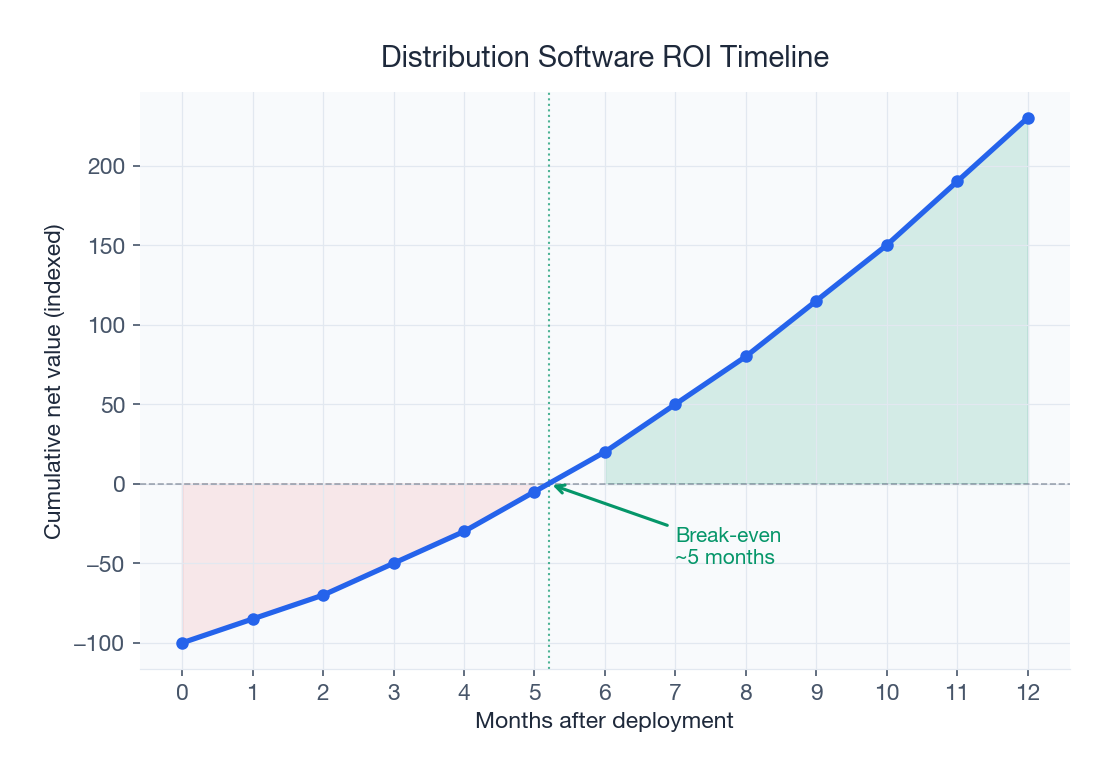
Platforms like SpireStock are building this future. The foundation is a unified system managing both workforces, capturing drop-level performance data, and continuously optimizing route classification. Distributors adopting this technology now will have a 2-3 year data advantage when AI-managed dispatch becomes mainstream.
Making the Transition
The path forward is methodical testing, not dramatic transformation. Start with 2-3 routes fitting the "Flex" profile: commodity products, urban density, low credit exposure, no active schemes. Run on gig for 8-12 weeks tracking cost per delivery, success rate, retailer satisfaction, and sales impact. Compare rigorously against owned fleet baselines.
Simultaneously, invest in technology infrastructure: digital proof of delivery, unified route dashboards, real-time payment tracking, and performance scoring. Without this layer, hybrid models create more problems than they solve.
Most importantly, invest in the owned staff who remain. Fewer people on core routes means each is more valuable. Pay them better. Train them properly. Give them the tools and systems that reduce drudgery. A well-compensated, technology-equipped owned team on core routes, supplemented by gig for flex and overflow, is not just cost optimization. It is a more resilient and profitable distribution model.
SpireStock helps FMCG and dairy distributors build hybrid delivery operations combining owned fleet reliability with gig flexibility. From route optimization classifying routes by delivery type to distribution tracking managing both workforces through a single dashboard, the platform provides the technology foundation for modern last-mile delivery. Book a demo to see how distributors reduce delivery costs 15-25% while improving route coverage to 95%+. Or explore our pricing plans for distributors at every scale.
Sources & References
- NITI Aayog, India's Booming Gig and Platform Economy, Report on Gig Workers
- IBEF, India Brand Equity Foundation, FMCG Industry Report
- RedSeer, RedSeer Consulting, B2B Logistics and Gig Economy Analysis
- NASSCOM, NASSCOM, Future of Work and Gig Economy in India
Frequently Asked Questions
Gig workers can handle specific FMCG delivery scenarios effectively: urban high-density routes with commodity products, top-up and emergency deliveries, new market testing, and seasonal demand spikes. However, they cannot replace owned staff for relationship selling, credit collection, scheme communication, cold chain handling, or rural routes. The most effective approach is a hybrid model deploying each workforce type where it delivers the most value.
The fully loaded monthly cost per route for owned fleet is Rs 21,000-31,300 (including salary, statutory contributions, fuel, training, recruitment, and supervision). Gig delivery costs Rs 26,250-41,000 per route for daily service. However, gig has zero cost on non-delivery days, making it 15-30% cheaper for low-frequency or seasonal routes. A hybrid model typically saves 12% compared to pure gig while costing only 5-6% more than pure owned fleet.
Shadowfax, Porter, and Loadshare are the primary B2B logistics platforms used by FMCG distributors for gig delivery. Swiggy Genie and Dunzo offer intra-city logistics suitable for urgent top-up orders in select cities. These platforms provide real-time tracking, digital proof of delivery, and automated dispatching that can integrate with distribution management systems.
Key risks include cash handling losses (1-2% higher discrepancies than owned staff), product knowledge gaps leading to wrong deliveries, inconsistent brand representation, limited accountability for service failures, no capability for credit collection or scheme communication, and high driver churn (4-8 months average tenure on platforms). These risks can be mitigated through UPI-only payments, digital pick lists with photos, performance scoring, and restricting gig to appropriate route types.
A hybrid model classifies routes as Core (owned fleet for high-value, relationship-intensive routes), Flex (gig delivery for commodity products and low-density routes), and Hybrid (owned primary with gig overflow). Typically, 60-70% of routes remain with owned staff generating 75-85% of revenue, while 20-30% of delivery volume shifts to gig. The model requires unified technology to manage both workforce types through a single dashboard.
A distribution management system for hybrid operations needs unified route assignment (fixed beats for owned, API-posted tasks for gig), digital proof of delivery with geo-tagged photos and timestamps, real-time payment reconciliation across cash, UPI, and credit, and separate performance scoring for each workforce type. Without this technology layer, hybrid models create operational chaos instead of efficiency.
Gig delivery is ideal for seasonal peaks (festivals, summer, wedding season) that increase delivery volume by 30-50% above baseline for 4-8 weeks. Instead of hiring temporary staff (2-4 weeks to recruit and train), distributors can activate gig drivers within days. The per-delivery cost is 15-20% higher than owned fleet, but total seasonal cost is 25-35% lower since there is no recruitment, training, or post-season severance.
The future involves AI-managed hybrid fleets where algorithmic dispatch assigns each delivery to the optimal resource based on product type, retailer relationship score, driver capabilities, and cost. Dynamic pricing will continuously optimize cost-quality tradeoffs, and predictive workforce planning will forecast delivery demand 2-4 weeks ahead, pre-booking gig capacity for expected peaks and optimizing owned staff schedules.
Related SpireStock Features
Zone, town, and route-based delivery management with optimization.
Geo-tagged attendance with location verification and travel analytics.
Real-time GPS tracking of vehicles and drivers with route optimization for faster deliveries.
Mobile app for distributors, retailers, and delivery teams.
Related Industries
Streamline FMCG distribution with order management, beat planning, retailer tracking, and GST billing. Built for Indian FMCG supply chains.
Manage beverage distribution with cold chain tracking, crate management, route optimization, and real-time delivery monitoring. Try SpireStock free.
Related Solutions
GPS fleet tracking, driver management, and route optimization for dairy and FMCG delivery vehicles. Reduce fuel costs by 25%. Try SpireStock.
Boost field sales team productivity with beat planning, GPS attendance, order capture, and performance analytics. Built for Indian FMCG teams.
Related Entities
Ready to Streamline Your Distribution?
Start your free 14-day trial and see how SpireStock can transform your dairy, FMCG or consumer-goods distribution operation, from order capture to crate recovery.

SpireStock Team
Product & Industry Insights
SpireStock Team leads product at SpireStock, where the team ships distribution management software for India's dairy, FMCG and consumer-goods brands.