The AI Opportunity in Indian FMCG Distribution
India's FMCG distribution network is one of the most complex supply chain ecosystems on the planet. Over 12 million kirana stores, hundreds of thousands of distributors, and billions of rupees in daily transactions flow through a system that, until recently, ran on phone calls, paper invoices, and gut instinct. That is changing rapidly. According to industry estimates, 43% of Indian FMCG companies have now adopted artificial intelligence in some operational capacity, and distribution is emerging as the most impactful application area.
Why distribution specifically? Because distribution generates massive volumes of structured data. Every order placed, every delivery completed, every scheme redeemed, every return processed, every payment collected produces a data point. Most FMCG distribution networks generate millions of these data points daily. For decades, this data sat in spreadsheets and legacy ERP systems, underutilised and undervalued. AI changes that equation entirely. Machine learning algorithms thrive on exactly this kind of high-volume, pattern-rich transactional data.
The opportunity is staggering. McKinsey estimates that AI-powered supply chain management can reduce forecasting errors by 50%, cut lost sales due to stockouts by 65%, and lower warehousing costs by 5-10%. For an Indian FMCG distributor handling Rs 50 crore in annual turnover, even modest efficiency gains translate to Rs 2-5 crore in recovered revenue or saved costs. But the challenge is not whether AI works. The challenge is knowing where to start, which applications deliver real ROI, and how to implement them without disrupting operations that cannot afford downtime.
This guide examines every practical AI application relevant to Indian FMCG distribution in 2026. We move beyond theory and hype to cover specific use cases, measurable outcomes, implementation requirements, and honest assessments of what works and what is still maturing. Whether you manage a dairy distribution network across three districts or a national FMCG operation spanning 15 states, this article will help you identify the AI investments that will deliver returns in months, not years.
AI-Powered Demand Forecasting
Demand forecasting is where AI delivers the most immediate and measurable impact in FMCG distribution. The core promise is straightforward: predict what each retailer will order before they place that order, at the SKU level, with enough accuracy to drive purchasing and production decisions. For perishable goods like dairy, bakery, and fresh beverages, the stakes are even higher because unsold inventory is not just capital sitting on shelves. It is waste heading to the bin.
How AI Forecasting Works in Practice
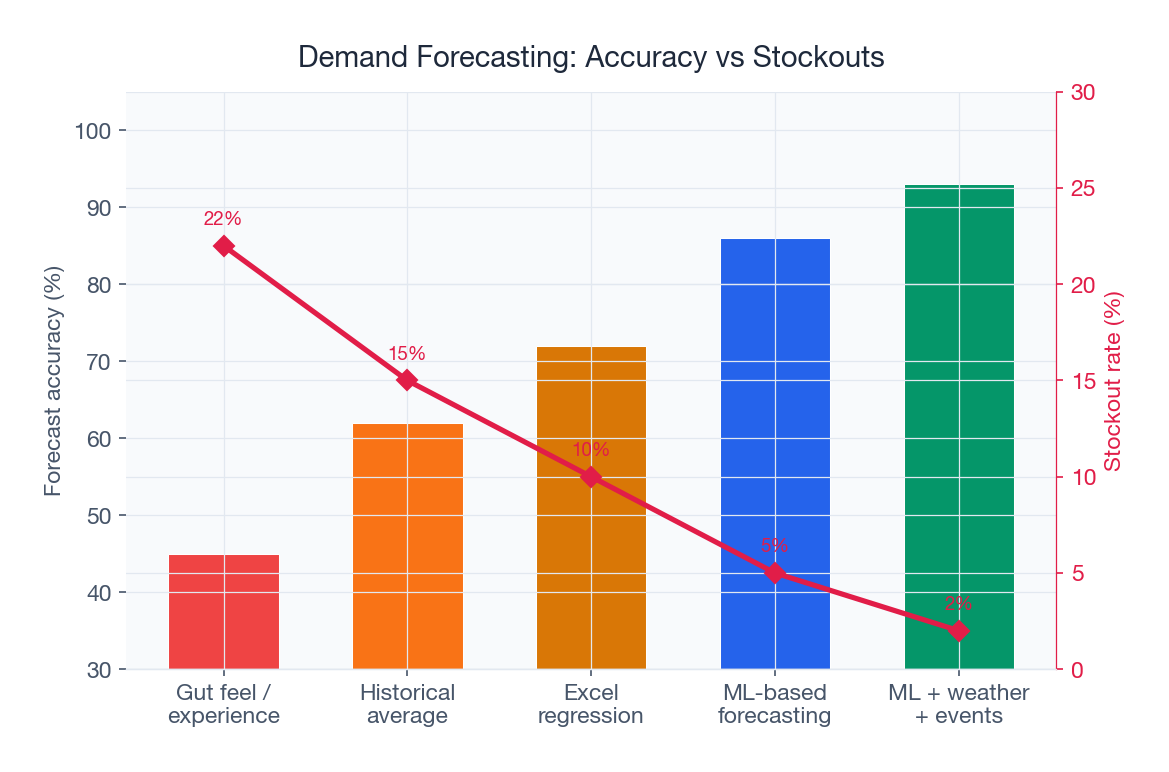
Traditional forecasting in Indian distribution relies on salesperson judgment, historical averages, and seasonal heuristics. A sales rep visiting a kirana store estimates that the shopkeeper will order 5 cases of biscuits because that is what they ordered last week. This approach delivers roughly 60-65% accuracy at the SKU level, meaning one in three predictions is materially wrong. AI-based forecasting ingests a far richer set of signals. It considers not just what the retailer ordered last week but what they ordered on the same day of the week over the past 52 weeks, how local festivals and events affect demand, how weather patterns shift buying behaviour, and how pricing and scheme changes ripple through the channel.
Modern demand forecasting models for FMCG distribution typically incorporate:
- Historical order data: 12-24 months of order history at the SKU-retailer level, including order frequency, quantity variance, and seasonal patterns
- Calendar features: Day of week, festivals (Diwali, Eid, Holi, regional harvests), school holidays, pay cycles, and month-end effects
- Weather data: Temperature forecasts are particularly valuable for ice cream, beverages, and dairy products. A 3-degree temperature rise in May can spike ice cream demand by 25-40%
- Scheme and pricing signals: Active trade schemes, price changes, competitor promotions, and their historical impact on order volumes
- Economic indicators: Local market activity, crop cycles (for rural distribution), and construction or industrial project timelines that affect worker population density
Accuracy Improvements
The accuracy gains from AI forecasting are well documented. Manual and spreadsheet-based forecasting delivers 60-65% SKU-level accuracy. Statistical models (moving averages, exponential smoothing) improve this to 70-75%. Machine learning models, once trained on 12+ months of clean data, consistently achieve 85-92% accuracy. For high-velocity SKUs with stable demand patterns, accuracy can exceed 95%. The practical impact is enormous: moving from 65% to 90% accuracy for a distributor handling 500 SKUs across 200 outlets means thousands fewer wrong predictions per week, each of which would have resulted in either a stockout (lost sale) or overstock (wasted capital and potential spoilage).
Platforms like SpireStock's sales analytics engine are making SKU-level demand forecasting accessible to mid-market distributors. Rather than requiring data science teams and custom model development, modern distribution management platforms embed forecasting directly into the order management workflow, surfacing recommended order quantities that sales reps can accept or adjust with a single tap.
Weather-Based Demand Prediction
For categories like ice cream, cold beverages, buttermilk, and lassi, weather is the single most powerful demand signal. AI models trained on weather-sales correlations can predict demand spikes 3-5 days in advance, giving distributors enough lead time to adjust procurement and delivery schedules. During the 2025 pre-monsoon heatwave in North India, distributors using weather-integrated forecasting reported 35% fewer stockouts on ice cream and cold beverage SKUs compared to those relying on manual forecasting. The key is not just current temperature but the rate of change. A jump from 35 degrees to 42 degrees over three days creates a demand spike that simple historical averages completely miss.
Intelligent Route Optimization
Route optimisation is the second highest-impact AI application for Indian FMCG distributors. The challenge is uniquely complex in India: narrow streets, unpredictable traffic, delivery windows dictated by retailer preferences rather than logistics efficiency, vehicle capacity constraints, and the need to serve both high-value modern trade outlets and low-value but high-frequency kirana stores on the same route. Traditional route planning, where a supervisor assigns beats based on geographic proximity and experience, leaves significant value on the table.
Beyond Shortest Path: Most Profitable Path
The critical insight of AI-powered route optimisation is that the shortest route is rarely the most profitable route. Consider a delivery vehicle with 120 cases of capacity serving 30 outlets. A traditional shortest-path algorithm minimises kilometres driven. An AI-powered route engine considers a far richer set of factors:
- Retailer purchase probability: Based on historical ordering patterns, the AI predicts which outlets are likely to place large orders versus which might have low or no demand today. High-probability outlets are prioritised in the route sequence.
- Dynamic traffic patterns: Traffic conditions in Indian cities change dramatically by hour. An AI model trained on historical traffic data and real-time feeds reroutes deliveries to avoid bottlenecks, potentially changing the outlet sequence mid-day.
- Delivery window compliance: Many retailers in modern trade and organised retail have strict receiving windows. AI ensures these time-critical deliveries happen on schedule while flexibly sequencing kirana stops around them.
- Vehicle capacity utilisation: The AI balances load distribution to minimise half-empty return trips and avoid overloading that causes product damage.
- Weather impact: Rainy days in cities like Mumbai or Kolkata can double delivery times. AI proactively adjusts routes on forecast rainy days, reducing the number of planned stops to ensure reliable service for priority outlets.
Measurable Impact
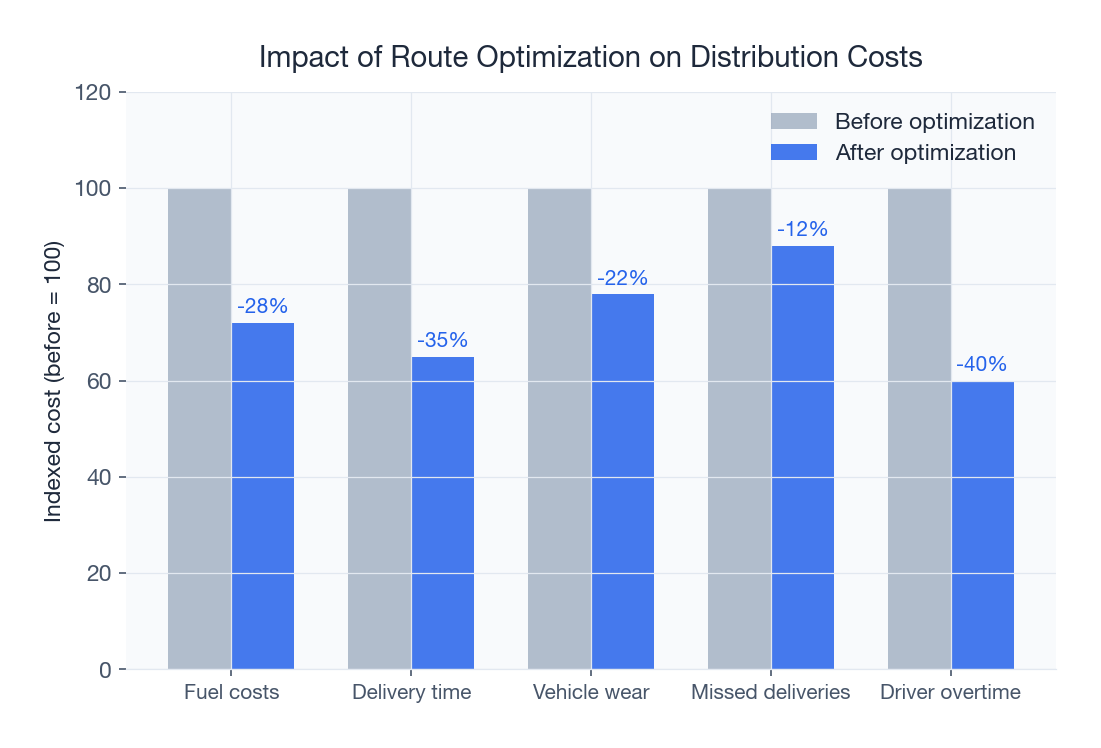
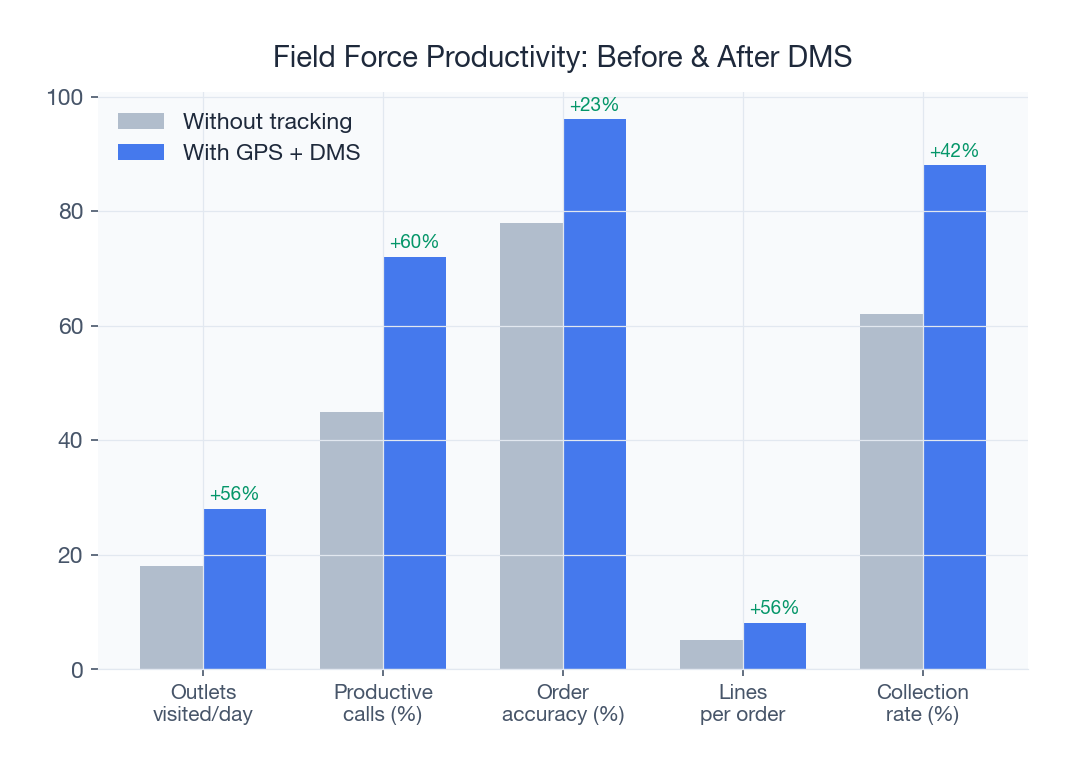
Distributors who have adopted AI-based route optimisation report consistent improvements across multiple metrics. Average delivery cost per drop falls by 20-35% as vehicles serve more outlets per trip. Fuel costs decline by 15-25% through more efficient routing. On-time delivery rates improve from 70-75% to 90-95%. Perhaps most importantly, the number of productive outlet visits per sales rep per day increases from 25-30 to 35-45, directly boosting revenue per route. For a distributor operating 20 delivery vehicles across a metro city, these efficiency gains can translate to Rs 15-25 lakh in annual savings.
SpireStock's route optimisation engine combines these AI capabilities with practical constraints that Indian distributors face daily, including vehicle type restrictions for narrow lanes, cash collection sequencing, and crate pickup coordination for dairy distribution operations.
Automated Scheme Optimization
Trade schemes are the lifeblood of FMCG distribution in India. Brands spend 15-25% of revenue on trade promotions, yet industry studies consistently show that 30-40% of this spending is wasted on schemes that subsidise existing sales rather than drive incremental volume. AI is finally bringing rigour to a domain that has operated on intuition and habit for decades.
A/B Testing Scheme Variants
The most straightforward application of AI in scheme management is structured experimentation. Instead of rolling out a single scheme nationally, AI enables brands to test 3-5 variants across comparable market clusters simultaneously. One cluster might receive a buy-10-get-1-free offer, another gets a 5% cash discount, a third gets a bundled scheme with a complementary product, and a control group receives no scheme. Within 2-3 weeks, the AI evaluates incremental lift, cannibalisation effects, and profitability per variant, then recommends the winning scheme for national rollout.
This approach eliminates the most expensive mistake in trade promotion: running schemes that feel successful because they generate volume but actually lose money because that volume would have occurred anyway. A leading snack brand in India tested this approach across 4 regions and discovered that their highest-volume scheme was actually their least profitable, subsidising purchases that retailers would have made regardless. Switching to the AI-recommended variant reduced scheme spending by 22% while maintaining 97% of the volume.
Real-Time Budget Reallocation
AI also enables dynamic budget allocation across running schemes. If a scheme targeting urban modern trade outlets is underperforming while a rural kirana scheme is overperforming, the AI can recommend reallocating budget in real time rather than waiting for the quarterly review cycle. This responsiveness is particularly valuable during seasonal peaks when demand patterns shift quickly and scheme effectiveness varies by region and channel.
For brands struggling with scheme leakage, AI-powered anomaly detection identifies suspicious redemption patterns that indicate fraudulent claims. Distributors or outlets showing redemption rates significantly above their sales velocity are flagged for investigation, potentially recovering 5-10% of total scheme spend that would otherwise leak out of the system.
Smart Inventory Management
Inventory management in Indian FMCG distribution involves a delicate balance. Stock too much and you tie up working capital, risk product expiry (especially for dairy and perishable goods), and incur storage costs. Stock too little and you lose sales, disappoint retailers, and risk them switching to a competitor's product. AI transforms this from a reactive guessing game into a predictive, automated system.
Predictive Replenishment
AI-driven inventory management starts with predictive replenishment. The system analyses demand forecasts, lead times from suppliers, current stock levels across all warehouse locations, and in-transit inventory to automatically generate purchase orders at the optimal time and quantity. The goal is to maintain target service levels (typically 95-98% fill rate) while minimising inventory holding days. For a typical FMCG distributor, AI-powered replenishment reduces stockouts by 35-45% and overstock situations by 25-35% compared to manual reorder point systems.
Automated Reorder Points
Traditional reorder points are static: when stock falls below X units, order Y units. AI makes reorder points dynamic. The system adjusts thresholds based on current demand velocity, upcoming events or promotions, supplier reliability (adjusted for recent lead time variance), and even cash flow constraints. During Diwali season, reorder points for gifting SKUs automatically increase 2-3 weeks before the festival. During lean periods, they drop to free up working capital. This dynamic adjustment happens at the SKU-warehouse level across thousands of combinations without human intervention.
Expiry Risk Scoring for Perishables
For perishable goods distributors, AI-powered expiry risk scoring is a game-changer. The system assigns a risk score to every batch in inventory based on remaining shelf life, current demand velocity, and historical wastage patterns for that SKU. Batches approaching high risk are automatically flagged for priority dispatch, scheme-based clearance, or channel redirection (for example, routing near-expiry curd to food service outlets that consume faster than retail). Dairy distributors using AI-based expiry management report 20-30% reduction in wastage, which directly flows to the bottom line given that product wastage is typically a 3-5% cost for perishable goods distributors.
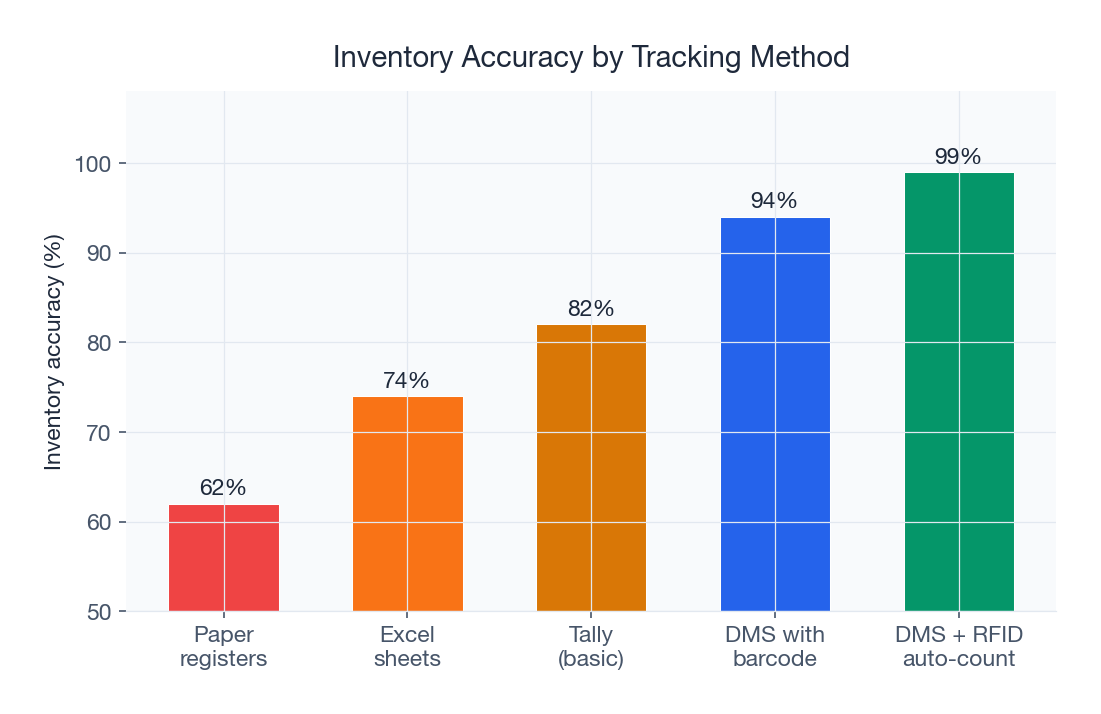
Image Recognition for Shelf Audits
Share of shelf is one of the most critical metrics in FMCG, yet measuring it has traditionally been one of the most unreliable processes. A field sales representative walks into a retail outlet, visually scans the shelves, and fills out a form estimating the brand's shelf space relative to competitors. This manual process is slow, subjective, inconsistent across reps, and easy to game. AI-powered image recognition is replacing it entirely.
How Computer Vision Works for Shelf Audits
The process is straightforward from the field rep's perspective. They open their mobile app, point the camera at the shelf, and take a photo. The AI model, typically running on the device or in a low-latency cloud inference pipeline, processes the image in seconds. It identifies every product on the shelf by brand, SKU, and variant. It measures share of shelf (percentage of facing space occupied by your brand versus competitors). It checks planogram compliance (whether products are placed according to the agreed layout). It detects out-of-stock positions. It identifies competitor products and any new competitor launches.
The accuracy of modern shelf audit AI exceeds 95% for product identification in well-lit retail environments. Even in the cluttered, inconsistently lit conditions typical of Indian kirana stores, accuracy is 85-90%, which is significantly better than the 60-70% reliability of manual shelf audits.
Practical Benefits
The benefits extend beyond accuracy. A manual shelf audit takes 8-12 minutes per outlet. AI-based image capture and analysis takes 30-60 seconds. This means field reps can audit every outlet on every visit rather than auditing selectively or skipping the process when time is short. The data is standardised, timestamped, and geotagged, creating an audit trail that is objective and verifiable. Brands using image recognition for shelf audits report 15-25% improvement in planogram compliance within the first quarter of deployment, directly driving sales lift through better product visibility and placement.
For brands managing distribution tracking across thousands of outlets, AI shelf audits provide a real-time view of in-store execution quality that was previously impossible to achieve at scale.
Distributor Health Scoring
Most FMCG brands discover that a distributor is underperforming only when the damage is already done: sales are declining, retailers are complaining, and the relationship is deteriorating. AI-powered distributor health scoring provides an early warning system that identifies at-risk distributors weeks or months before problems become visible in sales numbers.
What Goes Into a Health Score
An AI-based distributor health score combines multiple data streams into a single composite metric:
- Payment behaviour: Payment timeliness trends, outstanding amount trajectory, credit utilisation patterns. A distributor who gradually stretches payment cycles from 15 days to 25 days over three months is showing early financial stress.
- Order patterns: Order frequency, average order value trends, SKU breadth (is the distributor narrowing the range they stock?), and order consistency. Erratic ordering often precedes a distributor exit.
- Claim and complaint frequency: Rising complaint rates about product quality, delivery issues, or scheme settlements signal relationship deterioration.
- Growth trajectory: Is the distributor growing in line with market expectations? Below-market growth despite market tailwinds suggests operational or engagement issues.
- Market coverage: Outlet coverage rate, new outlet additions, and lost outlet rate indicate whether the distributor is actively working the territory or coasting.
- Operational metrics: Delivery reliability, return rates, and compliance with beat plans.
Early Warning and Intervention
The AI model assigns a health score (typically 0-100) to each distributor and flags those below a threshold for proactive intervention. More importantly, the model identifies the specific factors driving the score decline, enabling targeted action. If the issue is financial stress, the brand might offer revised payment terms. If the issue is operational capability, targeted training or additional support staff might help. If the issue is market dynamics, territory restructuring might be the right response.
Brands using AI health scoring report 40-50% reduction in surprise distributor exits and a 25% improvement in the average duration of distributor relationships. For distributor management teams overseeing hundreds of relationships, this predictive capability replaces reactive firefighting with proactive relationship management.
Conversational AI for Order Taking
One of the most practically impactful AI applications in Indian FMCG distribution is conversational AI for order taking. The concept is simple: instead of a retailer or sales rep manually entering orders into an app, they speak or type the order in natural language, in their preferred language, and the system processes it automatically. The implications for adoption and efficiency are profound.
WhatsApp and Voice-Based Ordering
India's FMCG distribution channel runs on WhatsApp. Retailers already communicate with their sales reps via WhatsApp, sharing photos, complaints, and informal orders. Conversational AI formalises this channel. A retailer sends a WhatsApp message, in Hindi, Marathi, Tamil, or any of India's major languages, saying something like "Amul taaza 20 packet, Nandini curd 500ml 15, aur Britannia Good Day 10 box bhejo kal subah" (send 20 packets of Amul Taaza, 15 Nandini curd 500ml, and 10 boxes of Britannia Good Day tomorrow morning). The NLP engine parses this natural language input, maps it to specific SKUs in the product catalogue, resolves quantities and units, identifies delivery timing preferences, and creates a structured order in the order management system.
Voice-based ordering takes this a step further. In many parts of India, retailers prefer speaking over typing. A voice-based ordering system accepts spoken orders in Hindi and other regional languages, converts speech to text, applies the same NLP parsing, and confirms the order back to the retailer for verification. The entire process takes 30-60 seconds compared to 3-5 minutes for manual order entry in a mobile app.
Impact on Efficiency
The efficiency gains from conversational ordering are dramatic. Order entry time drops by 70-80%. Error rates decrease because the AI cross-references orders against the retailer's typical ordering patterns and flags anomalies (for example, if a retailer who typically orders 10 cases suddenly orders 100, the system asks for confirmation). Field sales reps spend less time on data entry and more time on selling and relationship building. Perhaps most importantly, conversational ordering reduces the technology barrier for retailers and sales reps who are not comfortable with app-based interfaces, driving adoption in the exact segments where technology adoption has historically been lowest.
For dairy distributors handling daily recurring orders, conversational AI is particularly valuable. A retailer can simply say "same as yesterday" or "yesterday plus 5 more packets of paneer," and the system processes it instantly. This dramatically simplifies the daily ordering cycle for fresh products where orders need to be placed before early morning cutoffs.
Case Studies: Measurable AI Impact in Indian FMCG Distribution
Theory is useful, but evidence is better. Here are three documented examples of AI delivering measurable results in Indian FMCG distribution.
Case Study 1: Regional Dairy Brand Reduces Wastage by 28% with AI Forecasting
A mid-size dairy brand operating across Western India with 120 distributors and 8,000+ retail outlets was losing Rs 3.2 crore annually to product wastage. Their forecasting process relied on sales managers estimating demand based on experience, which consistently overestimated demand for slow-moving SKUs and underestimated demand for weather-sensitive products like buttermilk and lassi.
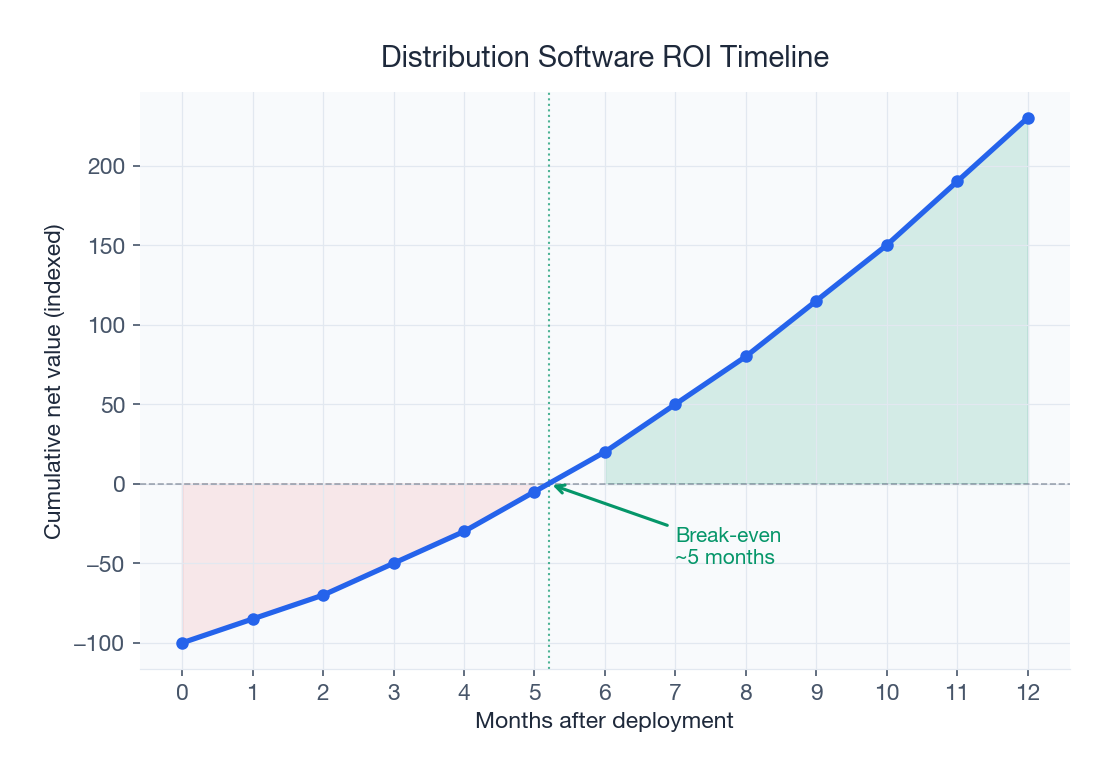
The brand implemented AI-powered demand forecasting integrated with their distribution management system. The model was trained on 18 months of historical order data combined with weather feeds and a festival calendar. Within 8 weeks of deployment, SKU-level forecast accuracy improved from 62% to 88%. Product wastage declined by 28%, saving Rs 89 lakh in the first year. The model proved particularly effective for weather-sensitive categories, correctly predicting demand spikes during heat waves and demand dips during monsoon onset. The brand's CEO noted that the AI system paid for itself within 11 weeks.
Case Study 2: National Snack Brand Saves Rs 1.8 Crore Annually Through Route Optimization
A national snack brand with 450 distributors and 2,200 delivery vehicles was spending Rs 14 crore annually on last-mile delivery. Their route planning was territory-based: each vehicle served a fixed set of outlets in a fixed sequence, regardless of daily demand variations, traffic patterns, or delivery priorities. AI-powered route optimisation was deployed across 5 metro cities initially, covering 380 vehicles.
The results after 6 months: average stops per vehicle per day increased from 28 to 37. Fuel costs per delivery dropped by 22%. On-time delivery improved from 73% to 94%. Total delivery cost reduction across the 5 cities was Rs 1.1 crore, projected to Rs 1.8 crore once rolled out nationally. The system's ability to dynamically reprioritise routes based on real-time traffic data from Google Maps API was cited as the most valuable feature, particularly in congested cities like Mumbai and Delhi where a single traffic jam can derail an entire day's delivery plan.
Case Study 3: Beverage Distributor Boosts Scheme ROI by 35% Using AI Optimization
A beverage company running 18 concurrent trade schemes across 3 channels (general trade, modern trade, and food service) suspected that many of their schemes were subsidising existing purchases rather than driving incremental volume, but could not prove it with their existing analytics. They deployed AI-powered scheme analytics that measured true incremental lift by comparing scheme outlets against statistically matched control outlets.
The analysis revealed that 7 of their 18 schemes were generating zero incremental volume. These schemes were popular with retailers (who enjoyed the discounts) but drove no additional purchasing. The remaining 11 schemes varied from 5% to 40% incremental lift. Based on AI recommendations, the company discontinued 5 underperforming schemes, reallocated budget to the 3 highest-performing schemes, and designed 2 new AI-optimised schemes. Net result: scheme spending decreased by 18%, but incremental volume from schemes increased by 35%. Annual scheme ROI improved from 1.2x to 2.4x.
Getting Started: AI Readiness Checklist
AI adoption in FMCG distribution does not require a data science PhD or a Silicon Valley budget. But it does require preparation. Many AI projects fail not because the technology does not work but because the underlying data, infrastructure, or organisational readiness was not in place. Here is a practical 5-step path to AI adoption for Indian distributors.
Step 1: Assess Data Quality
AI models are only as good as the data they learn from. Before investing in any AI tool, audit your data quality across these dimensions:
- Completeness: Do you capture every order, delivery, return, and payment digitally? If 30% of your orders are still paper-based, AI will only see 70% of the picture.
- Accuracy: Is your product master clean? Are SKU codes consistent across systems? Is your outlet master deduplicated?
- History depth: Most AI models need 12-18 months of clean historical data to train effectively. If you have only been digital for 6 months, start with rule-based automation and let AI wait until you have sufficient history.
- Granularity: Do you capture data at the SKU-outlet-day level or only at aggregated levels? AI forecasting requires granular data.
If your data quality is poor, the first investment should be a solid distribution management system that digitises and cleans your operational data. AI is step 2, not step 1.
Step 2: Identify High-Impact Use Cases
Do not try to implement all AI applications simultaneously. Identify 1-2 use cases where the pain is highest, the data is cleanest, and the potential ROI is largest. For most Indian distributors, demand forecasting and route optimisation are the natural starting points because they have the most mature AI solutions and the most directly measurable impact. Scheme optimisation and shelf audits are excellent second-wave applications once foundational AI capabilities are proven.
Step 3: Evaluate Infrastructure Requirements
AI applications need compute infrastructure, but modern cloud-based solutions have dramatically reduced the barrier. You do not need servers or GPUs. What you need is:
- A cloud-based DMS that can serve as the data platform (SpireStock, for example, handles this natively)
- Reliable internet connectivity at your central office and warehouse locations
- Smartphones for field staff (Android devices priced Rs 8,000-15,000 are sufficient for image recognition and voice ordering)
- API connectivity between your DMS, accounting software (typically Tally), and any third-party AI tools
Step 4: Build Organisational Readiness
Technology adoption fails when people are not ready. Prepare your team:
- Train sales managers to interpret AI recommendations rather than override them reflexively. The first instinct of experienced salespeople is to trust their gut over a model. Show them early wins to build trust.
- Identify AI champions within your organisation: tech-savvy team members who can learn the tools first and train others.
- Set realistic expectations. AI will not deliver magic in week 1. Forecasting accuracy improves over 4-8 weeks as the model learns. Route optimisation needs 2-3 weeks of operation data to calibrate. Communicate this timeline clearly.
- Create feedback loops. When the AI gets something wrong, capture that feedback and feed it back into the model. The best AI systems are those that learn from corrections.
Step 5: Start Small, Measure, Scale
Begin with a pilot: 5-10 distributors, one city or region, one AI application. Define success metrics before you start (forecast accuracy, delivery cost per drop, stockout rate). Run the pilot for 8-12 weeks. Measure results rigorously. If the numbers work, expand to additional regions and add new AI capabilities incrementally. This approach minimises risk, builds internal confidence, and creates the institutional learning needed to scale AI across your distribution network.
For guidance on selecting the right technology platform to support your AI journey, explore our pricing plans or schedule a consultation with the SpireStock team.
The Future: Autonomous Distribution
Looking beyond the practical applications available today, the trajectory of AI in FMCG distribution points toward a future that would seem science fiction to a 2020-era distributor: the autonomous distribution network. This is not a distant fantasy. The building blocks are being assembled right now, and the most forward-looking Indian FMCG companies are already laying the groundwork.
The Fully Automated Order-Dispatch-Deliver Cycle
Imagine a distribution network where: AI predicts what every retailer needs and generates orders automatically. The warehouse management system picks, packs, and stages orders without manual intervention. Route optimisation assigns orders to vehicles and sequences deliveries dynamically. Delivery staff follow AI-guided routes with real-time adjustments. Payment reconciliation happens automatically through digital payment integration. Replenishment orders to the factory are triggered by AI based on predicted depletion rates. The entire cycle, from demand signal to retailer shelf, operates with minimal human decision-making.
This is not 100% achievable today, but each component exists in some form. By 2028-2030, we expect the following capabilities to be production-ready for Indian FMCG distribution:
- Autonomous ordering (2026-2027): AI-generated orders with retailer approval via WhatsApp confirmation. The retailer reviews and taps "confirm" rather than placing the order from scratch. This is already piloting at several large FMCG companies.
- Predictive warehouse operations (2027-2028): AI that pre-stages inventory in the warehouse based on tomorrow's predicted orders, reducing pick-pack time by 40-50%.
- Dynamic pricing at scale (2027-2028): AI that adjusts distributor margins, retailer prices, and scheme intensities in real time based on demand elasticity, competitive pressure, and inventory positions.
- Drone and EV delivery for last mile (2028-2030): Autonomous or semi-autonomous delivery for specific use cases like urgent replenishment orders and high-value products in accessible urban areas. DGCA regulations are evolving to enable this.
- Self-healing supply chains (2029-2030): AI that detects disruptions (supplier delays, weather events, demand shocks) and automatically reroutes, reallocates, and rebalances the distribution network without human intervention.
What This Means for Distributors Today
The distributors who will thrive in this autonomous future are those who invest in digital infrastructure today. Clean data, connected systems, trained teams, and a culture of data-driven decision-making are prerequisites for every stage of AI maturity. The gap between digitally mature distributors and those still running on paper and phone calls is widening every quarter. By 2028, that gap will be unbridgeable.
The good news is that the path to AI readiness does not require massive upfront investment. Modern cloud-based platforms like SpireStock provide the digital foundation, data infrastructure, and embedded AI capabilities that distributors need, at a price point accessible to mid-market operations. The analytics, route optimisation, and order management capabilities available today are the building blocks of the autonomous distribution network of tomorrow.
AI in FMCG distribution is not a question of if. It is a question of when, and for early adopters, the when is now. Indian distributors who act today will compound their advantages over the next 3-5 years, building AI-literate teams, accumulating the training data that makes AI smarter, and establishing the operational discipline that turns AI recommendations into business results. Those who wait will find themselves playing catch-up in a market that rewards early movers disproportionately.
Ready to explore how AI-powered distribution management can transform your operations? Talk to the SpireStock team or explore our distribution tracking and analytics capabilities to see the foundation in action.
Sources & References
Frequently Asked Questions
AI is used across multiple functions in Indian FMCG distribution: demand forecasting at the SKU-retailer level (improving accuracy from 65% to 90%+), dynamic route optimization that reduces delivery costs by 20-35%, automated scheme optimization through A/B testing, predictive inventory management that cuts stockouts by 40%, image recognition for shelf audits, distributor health scoring for early warning, and conversational AI for WhatsApp/voice-based ordering in Hindi and regional languages.
AI-powered demand forecasting uses machine learning models trained on historical order data, weather patterns, festival calendars, scheme history, and economic indicators to predict what each retailer will order at the SKU level. For Indian FMCG distributors, this improves forecast accuracy from 60-65% (manual methods) to 85-92%, significantly reducing both stockouts and overstock situations. Weather-based forecasting is particularly valuable for temperature-sensitive categories like ice cream and beverages.
AI-powered route optimization typically delivers 20-35% reduction in delivery cost per drop, 15-25% savings on fuel costs, improvement in on-time delivery from 70-75% to 90-95%, and an increase in productive outlet visits from 25-30 to 35-45 per day. For a distributor operating 20 vehicles in a metro city, annual savings can reach Rs 15-25 lakh. The AI considers traffic patterns, delivery windows, retailer purchase probability, and vehicle capacity, not just shortest distance.
You need 12-18 months of clean historical data at the SKU-outlet level, including orders, deliveries, returns, and payments. Data must be digital (not paper-based), accurate (clean product and outlet masters), and granular (daily transaction-level, not weekly aggregates). If your data quality is poor, invest in a distribution management system first to digitise and clean your data before investing in AI tools.
Yes. Modern cloud-based distribution platforms like SpireStock embed AI capabilities directly into the software at no additional cost beyond the standard subscription. You do not need data scientists, custom models, or expensive infrastructure. Affordable smartphones (Rs 8,000-15,000) support image recognition and voice ordering. The key investment is in data quality and organizational readiness rather than technology spend.
Conversational AI allows retailers to place orders via WhatsApp messages or voice calls in Hindi and regional languages. The NLP engine parses natural language (e.g., 'Amul taaza 20 packet aur Good Day 10 box bhejo') into structured orders by mapping text to SKUs, resolving quantities, and creating orders in the management system. This reduces order entry time by 70-80% and removes the technology barrier for retailers uncomfortable with app interfaces.
Distributor health scoring is an AI-powered composite metric (0-100) that combines payment behaviour, order patterns, complaint frequency, growth trajectory, market coverage, and operational metrics to identify at-risk distributors before problems become visible in sales numbers. Brands using health scoring report 40-50% reduction in surprise distributor exits and 25% improvement in average relationship duration.
Modern AI image recognition achieves 95%+ accuracy for product identification in well-lit retail environments and 85-90% accuracy in typical Indian kirana store conditions. This compares favourably to 60-70% reliability of manual shelf audits. An AI shelf audit takes 30-60 seconds versus 8-12 minutes for manual audits, enabling field reps to audit every outlet on every visit rather than skipping audits when pressed for time.
Related SpireStock Features
Zone, town, and route-based delivery management with optimization.
Powerful dashboards with sales trends, MIS reports, and distribution analytics.
End-to-end order lifecycle from placement to delivery with multi-level approval workflows.
Flexible incentive schemes, flat, bulk-pack, and quantitative, applied automatically.
Real-time GPS tracking of vehicles and drivers with route optimization for faster deliveries.
Related Industries
Streamline FMCG distribution with order management, beat planning, retailer tracking, and GST billing. Built for Indian FMCG supply chains.
End-to-end dairy distribution software for milk, curd, paneer, and ghee brands. Manage orders, crates, cold chain, and GST billing in one platform.
Related Entities
Ready to Streamline Your Distribution?
Start your free 14-day trial and see how SpireStock can transform your dairy, FMCG or consumer-goods distribution operation, from order capture to crate recovery.

SpireStock Team
Distribution Technology Experts
SpireStock Team writes for SpireStock on distribution management, supply-chain optimisation and field operations for Indian dairy and FMCG brands.