
SpireStock vs Bizom at a Glance
SpireStock and Bizom are both cloud-based distribution management platforms serving the Indian FMCG market, but they were built for different segments and different problems. Bizom, developed by Mobisy Technologies, is an enterprise-grade retail intelligence and distribution management platform trusted by 550+ large FMCG companies. SpireStock is a purpose-built DMS for dairy, perishable, and mid-market FMCG distribution that prioritizes affordability, simplicity, and industry-specific features like crate tracking and expiry-based inventory management.
Before diving into feature-by-feature analysis, here is a quick snapshot of how the two platforms compare across the dimensions that matter most to Indian distributors and brands.
| Dimension | SpireStock | Bizom |
|---|---|---|
| Target segment | Mid-market FMCG, dairy, perishable goods | Large enterprise FMCG (500+ distributors) |
| Founded for | Dairy and perishable distribution | Retail intelligence and field force automation |
| Typical company size | 10-500 distributors | 200-5,000+ distributors |
| Pricing model | Transparent, flat monthly (Rs 5K-15K/month) | Enterprise pricing (typically Rs 50K-2L+/month) |
| Implementation time | 1-2 weeks | 4-12 weeks |
| Crate/returnable asset tracking | Native, built-in | Not available natively |
| Perishable inventory management | Core feature (FEFO, expiry alerts, cold chain) | Basic batch tracking |
| AI/ML analytics | Standard dashboards and reports | Advanced (Retail Intelligence platform) |
| Vernacular language support | Hindi, Marathi, Gujarati, Arabic | Hindi, select regional languages |
| Mobile app | Android and iOS (lightweight) | Android and iOS (feature-rich, data-heavy) |
| Offline mode | Full offline capability | Yes (with sync delays on heavy data) |
| GST e-invoicing | Built-in with auto-filing | Yes |
This table tells the high-level story: SpireStock is built for speed, affordability, and perishable distribution workflows. Bizom is built for scale, intelligence, and enterprise customization. The question is not which platform is objectively better, but which one fits your specific business needs. For a broader landscape comparison, read our Top 10 DMS Software in India for 2026.
Company Backgrounds
SpireStock: Built from the Ground Up for Dairy and Perishable Distribution
SpireStock was founded to solve a problem that most DMS vendors overlooked: the unique operational challenges of distributing perishable goods in India. Dairy distributors juggle daily recurring orders, returnable crate management, expiry-sensitive inventory rotation, cold chain compliance, and razor-thin margins that leave no room for software that costs lakhs per year. Traditional DMS platforms either ignored these needs entirely or treated them as edge cases that required expensive customization.
SpireStock was designed for the mid-market Indian distributor or brand with 10 to 500 distribution points. The platform focuses on operational simplicity: a clean user interface that field staff with limited technical literacy can learn in hours, not weeks. It supports Hindi, Marathi, Gujarati, and Arabic to serve the linguistic diversity of Indian distribution networks. Pricing is transparent and flat, starting at Rs 5,000 per month, with no per-user charges that punish growing teams. For more on what makes SpireStock different, explore our distributor management solution.
Bizom: Enterprise Retail Intelligence at Scale
Bizom, developed by Mobisy Technologies (founded in 2011 in Bangalore), has built an impressive position in the enterprise FMCG distribution space. The platform serves over 550 enterprises, connects with 7.5 million retailers, and processes retail transactions worth thousands of crores annually. Brands like ITC, Marico, Emami, and Godrej rely on Bizom for end-to-end distribution management and retail execution.
Bizom differentiates itself through its Retail Intelligence platform, which uses AI, machine learning, and computer vision to extract actionable insights from field data. Features like image-recognition-based shelf auditing, demand forecasting, and predictive analytics are genuinely impressive and unmatched at the mid-market level. Bizom is also deeply integrated with the enterprise IT ecosystem, offering connectors for SAP, Oracle, and other major ERPs.
The trade-off, however, is complexity and cost. Bizom requires dedicated IT resources for implementation and ongoing management. Its pricing model, while not publicly disclosed, typically runs between Rs 50,000 and Rs 2 lakh per month depending on the number of users and modules. For large enterprises with the budget and infrastructure to leverage it fully, Bizom delivers exceptional value. For mid-market brands, the platform can feel like buying a commercial airliner when you need a turboprop.
Feature Comparison Deep Dive
Order Management
Both SpireStock and Bizom offer strong order management capabilities, but the workflows are optimized for different use cases. Bizom excels at high-volume order processing across large distributor networks with complex approval hierarchies. Its order management integrates deeply with its retailer intelligence module, enabling features like suggested order quantities based on historical purchase patterns and outlet-level analytics.
SpireStock's order management is built for speed and simplicity with dairy-specific workflows baked in. The platform supports daily recurring orders, a critical feature for dairy distribution where the same retailers place similar orders every single day. Rather than re-entering orders manually, delivery staff confirm or adjust pre-populated orders on their mobile device. SpireStock also handles partial deliveries, returns with reason tracking, and replacement orders in a single workflow, reflecting the reality of perishable goods distribution where rejection rates can run 5-15%.
For general FMCG order management at enterprise scale, Bizom has the edge. For dairy and perishable distribution where recurring orders, partial deliveries, and returns are the norm rather than the exception, SpireStock's purpose-built workflows save significant time. Learn more in our comprehensive guide to distribution management software in India.
Scheme Engine
Trade schemes are the lifeblood of FMCG distribution in India, and both platforms handle them capably. Bizom offers a powerful, multi-layered scheme engine that supports complex enterprise schemes including slab-based discounts, combo offers, geography-specific promotions, and channel-specific pricing. Its scheme analytics provide visibility into which promotions are driving ROI and which are cannibalizing margins.
SpireStock's scheme engine covers the most common scheme types used by mid-market FMCG brands: buy-X-get-Y, percentage discounts, slab-based pricing, and cash discounts. The key differentiator is the UI-based configuration. Where Bizom often requires IT support or vendor assistance to set up complex schemes, SpireStock allows sales managers to configure, test, and launch schemes themselves through a visual interface. For mid-market brands that run 5-15 active schemes at any time, this self-service capability eliminates delays and vendor dependency.
Crate and Returnable Asset Tracking
This is SpireStock's single biggest differentiator, and it is not a marginal feature. In dairy distribution, returnable crates represent a significant capital investment. A mid-sized dairy distributor may have 5,000 to 20,000 crates in circulation at any given time, each worth Rs 150-300. That is Rs 7.5 lakh to Rs 60 lakh in assets that must be tracked, reconciled, and accounted for daily.
SpireStock's native crate management system tracks every crate from dispatch to return. Delivery staff record crate handoffs at the point of delivery on their mobile app. The system generates real-time reports showing crate balances by outlet, by route, and by delivery person. Automated alerts flag outlets with overdue crate returns. Monthly reconciliation reports identify shrinkage and prevent the gradual crate loss that bleeds dairy distributors of lakhs annually.
Bizom does not offer native crate or returnable asset tracking. Some Bizom implementations handle this through custom development, but it requires additional investment and is not part of the standard platform. For any business that manages returnable assets, whether dairy crates, beverage bottles, gas cylinders, or reusable packaging, this gap in Bizom is significant.
To understand why crate management matters so much for dairy operations, read our guide to dairy distribution in India.
Route Optimization
Both platforms offer route planning capabilities. Bizom provides AI-driven route optimization that factors in traffic patterns, delivery windows, and outlet priority. Its route planning is deeply integrated with beat planning and GPS tracking, giving managers real-time visibility into field operations. For enterprises managing hundreds of routes across multiple cities, Bizom's intelligence layer adds measurable value.
SpireStock's route optimization focuses on practical, day-to-day route management for mid-market operations. It supports multi-stop route planning, delivery sequence optimization based on geography and priority, and GPS-based tracking of delivery vehicles. The interface is designed for route supervisors who may not be tech-savvy, with drag-and-drop route editing and visual map views. While it lacks Bizom's AI-driven capabilities, it covers the needs of distributors managing 5-50 routes effectively.
Sales Analytics
This is where Bizom genuinely excels. Its Retail Intelligence platform goes well beyond basic sales dashboards. Bizom offers AI-powered demand forecasting, outlet-level performance analytics, sales team productivity benchmarking, territory-wise trend analysis, and custom report builders. For data-driven enterprises that make strategic decisions based on granular analytics, Bizom's intelligence layer is a strong differentiator.
SpireStock's sales analytics provides the reporting capabilities that mid-market brands need: daily/weekly/monthly sales dashboards, product-wise and route-wise performance reports, collection tracking, scheme effectiveness reports, and trend analysis. The reports are clean and actionable but do not venture into predictive analytics or machine learning territory. For most mid-market operations, SpireStock's analytics answer the critical questions without requiring a data science team to interpret the output.
Field Force and SFA
Bizom's sales force automation is among the most comprehensive in the Indian market. GPS-based tracking with geo-fencing, attendance management, beat adherence monitoring, in-store execution tracking with photo capture, and real-time activity feeds give sales managers complete visibility into field operations. Bizom also offers computer-vision-based shelf share analysis that automatically quantifies brand presence in retail outlets from field photos.
SpireStock's field force features cover the essentials: GPS tracking, attendance and check-in/check-out, beat planning adherence, order capture, delivery confirmation with proof of delivery, and daily activity reports. The mobile app is optimized for low-end Android devices common among Indian delivery staff, consuming less storage and data than enterprise-grade alternatives. This is not a minor point. When your delivery staff uses a Rs 8,000 smartphone with 2 GB of RAM and spotty 3G connectivity in semi-urban areas, app performance becomes a feature in itself.
Invoicing and GST
Both platforms support GST-compliant invoicing with e-invoice generation, e-way bill integration, and multi-GST rate handling. SpireStock's invoicing module includes automatic TCS/TDS calculations, credit note management, and direct Tally export, which is critical for the Indian market where Tally remains the accounting backbone for most distributors. Bizom offers comparable GST capabilities with additional support for enterprise accounting integrations including SAP and Oracle.
Mobile App and Offline Mode
Both platforms provide Android and iOS mobile applications with offline capability. The critical difference is app weight and performance. Bizom's app is feature-rich but data-intensive, which can create performance challenges on low-end devices. SpireStock's app is designed to be lightweight, consuming minimal storage and data bandwidth. In Indian distribution, where field staff often operate in areas with limited connectivity using budget smartphones, a lighter app that syncs quickly when connectivity returns is a practical advantage.
API and Integrations
Bizom has the clear advantage in enterprise integrations. Its API ecosystem supports connections with SAP, Oracle, Microsoft Dynamics, Salesforce, and other enterprise platforms. For companies with complex multi-system IT environments, Bizom's integration capability reduces data silos and enables unified reporting across operations.
SpireStock offers REST API access for integration with Tally, common accounting software, e-commerce platforms, and third-party logistics systems. Its integration library is growing but does not yet match Bizom's breadth. For mid-market companies whose IT stack typically consists of Tally plus a handful of cloud tools, SpireStock's integration capabilities are sufficient.
Feature Matrix Table
The following detailed feature matrix provides a checklist comparison across every major DMS capability. Use this as a quick reference when evaluating the two platforms against your specific requirements.
| Feature | SpireStock | Bizom |
|---|---|---|
| Order capture (mobile) | Yes | Yes |
| Recurring/standing orders | Yes (dairy-optimized) | Limited |
| Partial delivery and returns | Yes (single workflow) | Yes |
| Scheme engine | Yes (UI-based config) | Yes (enterprise-grade) |
| Crate/returnable tracking | Yes (native) | No |
| Cold chain monitoring | Yes | No |
| Expiry-based inventory (FEFO) | Yes | Basic batch tracking |
| Route optimization | Yes | Yes (AI-powered) |
| GPS field tracking | Yes | Yes (with geo-fencing) |
| Beat planning | Yes | Yes (AI-powered) |
| Sales analytics | Standard dashboards | Advanced (Retail Intelligence) |
| Demand forecasting (AI/ML) | No | Yes |
| Computer vision shelf audit | No | Yes |
| GST e-invoicing | Yes | Yes |
| E-way bill generation | Yes | Yes |
| Tally integration | Yes (direct export) | Yes (API) |
| SAP/Oracle integration | No | Yes |
| Multi-language UI | Hindi, Marathi, Gujarati, Arabic | Hindi, select regional |
| Offline mobile mode | Full offline | Yes |
| Proof of delivery (photo/sign) | Yes | Yes |
| Attendance and check-in | Yes | Yes |
| Credit note management | Yes | Yes |
| Payment collection tracking | Yes | Yes |
| Distributor onboarding portal | Yes (self-service) | Yes (managed) |
| Custom reporting | Standard templates | Advanced (custom builder) |
| API access | REST API | Extensive API ecosystem |
| White-labeling | Available | Available |
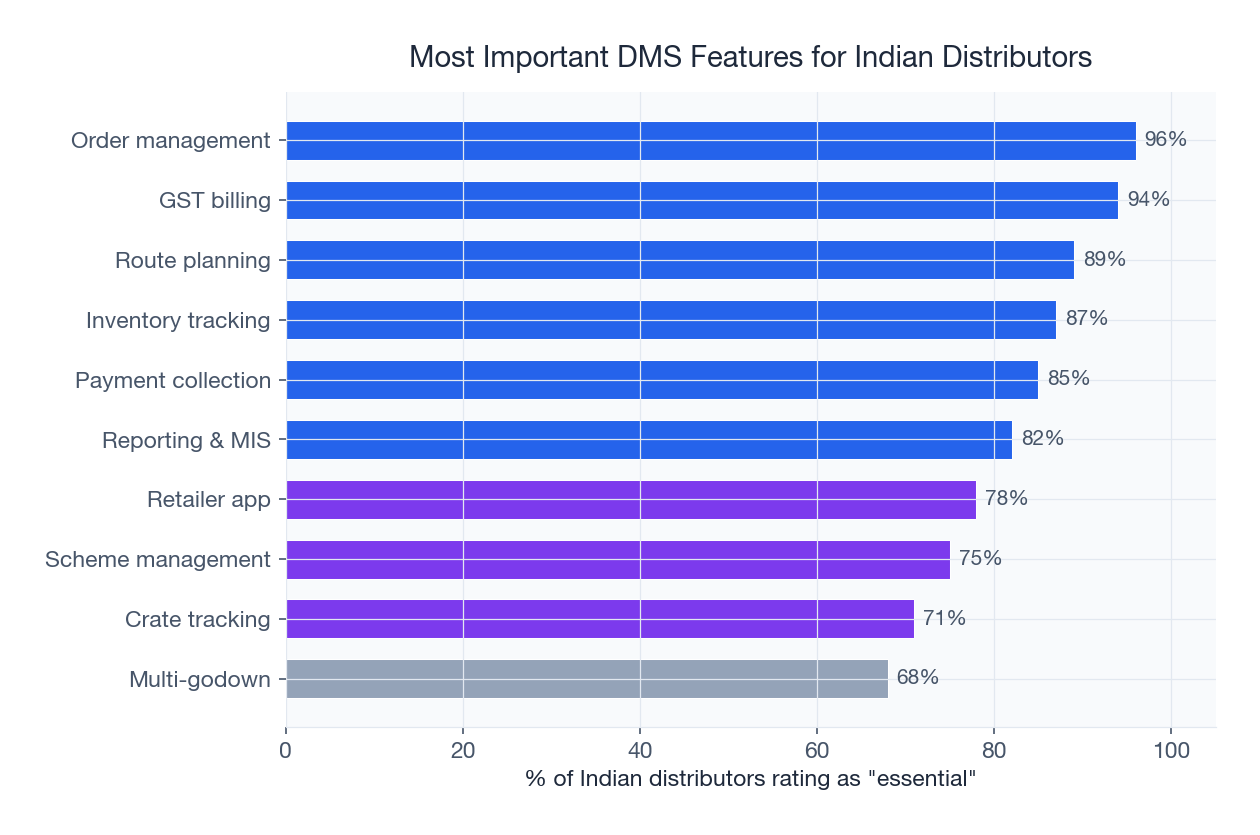
The pattern is clear: SpireStock leads on perishable-specific features (crates, cold chain, expiry management, recurring orders) while Bizom leads on enterprise intelligence features (AI analytics, computer vision, advanced integrations). For a broader feature checklist, see our What Is a DMS guide.
Pricing Comparison
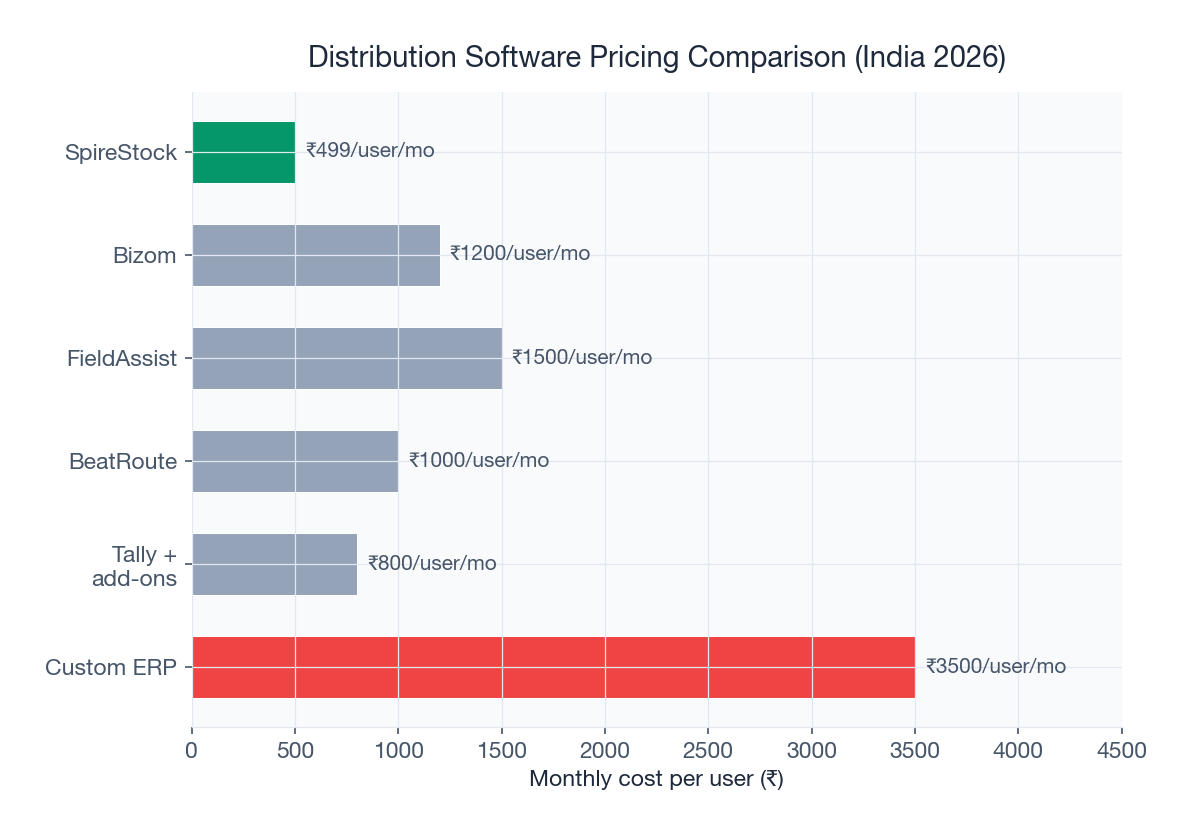
Pricing is often the deciding factor for mid-market Indian businesses, and this is where SpireStock and Bizom diverge most dramatically. SpireStock publishes its pricing transparently. Bizom does not publish pricing publicly and typically requires a sales consultation to receive a quote. Based on market data and user reports, here is how the two platforms compare on total cost of ownership.
| Cost Component | SpireStock | Bizom |
|---|---|---|
| Monthly subscription | Rs 5,000-15,000/month (flat) | Rs 50,000-2,00,000+/month (varies by users and modules) |
| Pricing model | Flat monthly fee, unlimited users | Per-user + module-based |
| Implementation fee | Rs 0 (included) | Rs 5-25 lakh |
| Training | Included (online + on-site) | Rs 1-5 lakh |
| Customization | Rs 0-50,000 (most needs met out of box) | Rs 2-15 lakh |
| Annual TCO (small, 10 users) | Rs 60,000-1.8 lakh | Rs 15-30 lakh |
| Annual TCO (mid, 30 users) | Rs 60,000-1.8 lakh | Rs 30-60 lakh |
| Annual TCO (large, 100 users) | Rs 1.2-1.8 lakh | Rs 80 lakh-1.5 crore |
| Free trial | Yes | Demo only (no self-service trial) |
| Contract lock-in | Monthly (no lock-in) | Annual contract typical |
The pricing difference is not subtle. A mid-sized dairy distributor with 30 field staff would pay Rs 60,000 to Rs 1.8 lakh annually with SpireStock versus Rs 30 to 60 lakh with Bizom. That is a 15-30x cost difference. For enterprise-scale operations, Bizom's pricing includes capabilities that SpireStock does not offer (AI analytics, enterprise integrations, dedicated account management), so the comparison is not apples-to-apples at the top end. But for mid-market businesses, the cost gap is difficult to justify unless you specifically need Bizom's enterprise features.
SpireStock's flat pricing model is particularly advantageous for growing businesses. With per-user pricing (like Bizom's), adding 10 more field staff means a proportional cost increase. With SpireStock's flat model, you can scale your team without your software bill scaling alongside it. For a complete pricing breakdown of the Indian DMS market, see our pricing page.
Best For: When to Choose SpireStock
SpireStock is the right choice when your distribution operation matches one or more of these profiles:
- Dairy and perishable goods distributors who need expiry-based inventory management (FEFO), cold chain compliance tracking, and daily recurring order workflows. No other DMS in the Indian market, including Bizom, offers these as native features. Explore our dairy distribution solution for details.
- Businesses managing returnable assets such as dairy crates, beverage bottles, gas cylinders, or reusable containers. SpireStock's crate management eliminates the spreadsheet chaos that most distributors use to track these assets.
- Mid-market FMCG brands and distributors with 10-500 distribution points who need a full-featured DMS without enterprise pricing. If your annual DMS budget is under Rs 2 lakh, SpireStock is your best option.
- Companies needing rapid deployment that cannot afford 8-12 weeks of implementation. SpireStock's simpler architecture and pre-built workflows enable go-live in 1-2 weeks.
- Vernacular-first operations where field staff are more comfortable in Hindi, Marathi, Gujarati, or Arabic. SpireStock's multi-language support goes deeper than token translations, covering the entire mobile app experience.
- Budget-conscious growing brands that need per-feature value without per-user charges that penalize growth. SpireStock's flat pricing model means your 50th user costs the same as your 5th.
- FMCG distributors in Tier 2 and Tier 3 cities where field staff use budget smartphones and connectivity is unreliable. SpireStock's lightweight app and robust offline mode are designed for these conditions.
For a comprehensive look at how SpireStock serves FMCG brands, visit our FMCG distribution industry page.
Best For: When to Choose Bizom
Bizom is the right choice when your distribution operation matches these profiles. We believe in honest comparisons, and Bizom has genuine strengths that SpireStock cannot match at its current stage:
- Large FMCG enterprises with 500+ distributors and thousands of field staff. Bizom's architecture is battle-tested at this scale, processing transactions worth thousands of crores annually for brands like ITC and Marico.
- Companies that need AI-powered retail intelligence including demand forecasting, predictive analytics, computer vision-based shelf auditing, and outlet-level performance modeling. Bizom's Retail Intelligence platform is genuinely sophisticated and adds measurable value for data-driven enterprises.
- Global or multi-country FMCG brands that need a DMS capable of operating across geographies with different tax regimes, languages, and distribution structures. Bizom has experience in international deployments.
- Organizations with complex IT ecosystems running SAP, Oracle, or Microsoft Dynamics that need deep ERP integration. Bizom's enterprise connector library is significantly more extensive than SpireStock's.
- Companies requiring advanced BI and custom analytics with dedicated data teams who can leverage Bizom's reporting engine to build custom dashboards, trend models, and performance benchmarks.
- Brands focused on retail execution excellence where in-store compliance, planogram adherence, and share-of-shelf metrics are critical KPIs. Bizom's computer vision and retail audit capabilities are unique in the Indian market.
In short, if your annual DMS budget exceeds Rs 20 lakh and you need enterprise intelligence capabilities, Bizom is worth serious evaluation. Its pricing reflects the depth of its platform, and for organizations that can leverage it fully, the ROI is there.
Migration Path: Switching Between Platforms
Migrating from Bizom to SpireStock
Companies typically consider switching from Bizom to SpireStock for three reasons: cost reduction, operational simplicity, or the need for perishable-specific features. If you are a mid-market dairy or FMCG distributor who adopted Bizom but found the platform over-engineered and overpriced for your scale, the migration path is straightforward.
- Data export and mapping (Week 1) - Export your product catalog, retailer master, pricing structures, route definitions, and outstanding balances from Bizom. SpireStock's onboarding team provides data mapping templates to ensure nothing is lost in translation.
- Configuration and setup (Week 1-2) - SpireStock's team configures your account with routes, beat plans, schemes, user roles, and mobile app settings. Because SpireStock's configuration is UI-based, changes that required Bizom support tickets can be self-managed going forward.
- Parallel run (Week 2-3) - Run both systems simultaneously for one to two weeks to verify data accuracy and workflow completeness. Field staff capture orders and deliveries in both systems during this period.
- Cutover and training (Week 3-4) - Switch to SpireStock as the primary system. SpireStock provides on-site or virtual training for field staff, supervisors, and managers. The simpler interface typically reduces the training period compared to Bizom onboarding.
Total migration timeline: 3-4 weeks. Cost: included in SpireStock's onboarding (no separate migration fee). Contact our team for a migration assessment specific to your setup.
Migrating from SpireStock to Bizom
If your business has outgrown SpireStock's capabilities and you need Bizom's enterprise features, the migration path involves more planning due to Bizom's more complex implementation process.
- Requirements workshop (Week 1-2) - Bizom's implementation team conducts detailed requirements analysis, including module selection, integration planning, and customization scoping.
- Data migration and setup (Week 3-8) - Data is exported from SpireStock and mapped to Bizom's schema. Custom configurations, integrations, and workflows are built during this period.
- UAT and training (Week 8-10) - User acceptance testing followed by structured training programs for different user roles.
- Phased rollout (Week 10-12) - Bizom typically recommends phased deployment, starting with a pilot group before full rollout.
Total migration timeline: 10-12 weeks. Cost: Rs 5-15 lakh for implementation, depending on customization needs.
Real User Perspectives
Software review platforms, industry forums, and conversations with distribution professionals reveal consistent themes about both platforms. Here is what users commonly report.
What SpireStock Users Say
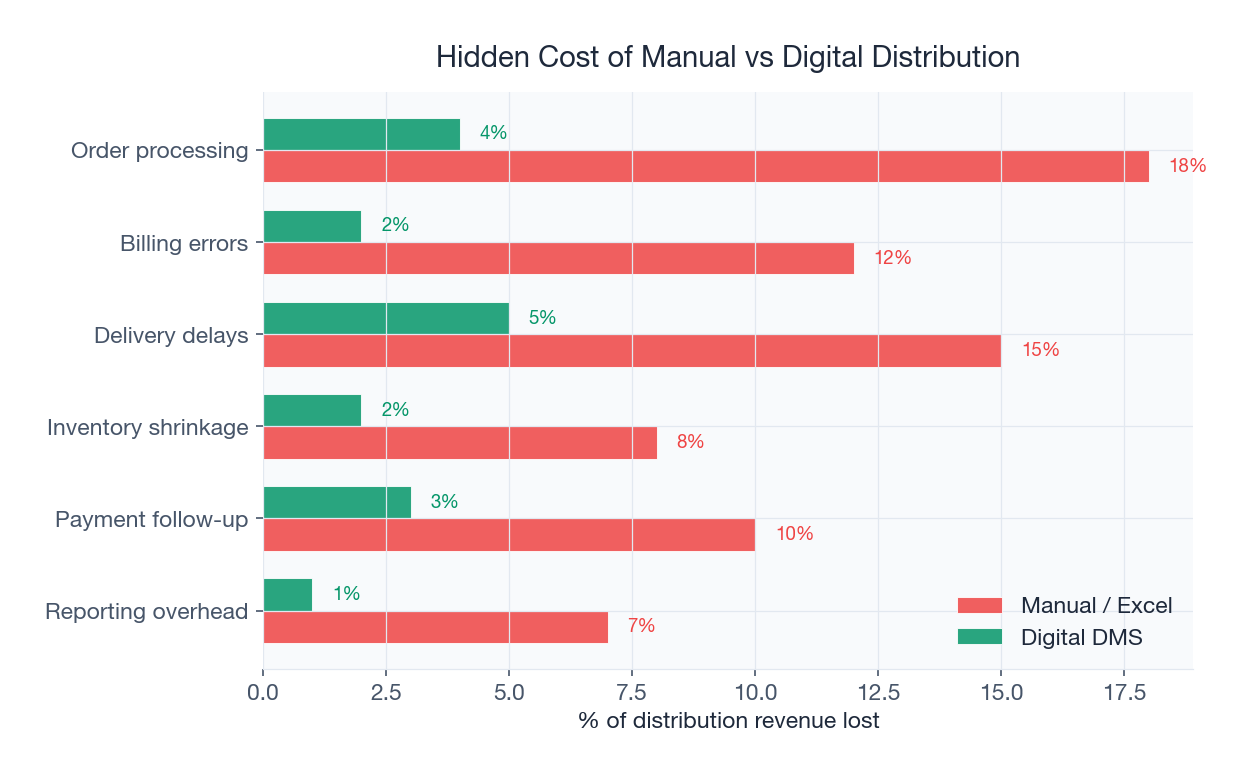
- Crate tracking is a game-changer - Dairy distributors consistently cite crate management as the feature that made them switch. Before SpireStock, most tracked crates in notebooks or spreadsheets, losing 8-15% of their crate inventory annually to poor tracking.
- Simple enough for my delivery boys - Field staff adoption is frequently mentioned as a strength. The vernacular language support and simplified mobile interface reduce training time from weeks to days.
- Affordable and transparent pricing - Users appreciate knowing exactly what they will pay each month without surprise charges for additional users, modules, or support requests.
- Limited advanced analytics - Users who need complex custom reports or predictive analytics note that SpireStock's reporting, while adequate for daily operations, does not match enterprise platforms.
- Growing integration library - Some users wish for deeper integration with platforms beyond Tally, particularly for e-commerce channels and logistics partners.
What Bizom Users Say
- Powerful analytics platform - Enterprise users praise Bizom's Retail Intelligence capabilities, particularly demand forecasting and territory-level analytics that inform strategic decisions.
- Comprehensive field force management - The GPS tracking, geo-fencing, and activity monitoring features provide granular visibility into field operations that is difficult to replicate with other platforms.
- Complex and expensive for small teams - Smaller brands that adopted Bizom frequently report feeling that the platform is over-engineered for their needs. Features they do not use still contribute to cost and complexity.
- Heavy mobile app - Some users report that the Bizom mobile app can be slow on lower-end devices and consumes significant data, which is a practical concern in Tier 2 and Tier 3 Indian cities.
- Long implementation cycles - Enterprise implementations frequently extend beyond initial estimates, with some users reporting 16+ week timelines for full deployment including customizations.
These perspectives reflect common patterns in user feedback and should not be taken as universal experiences. Both platforms have satisfied customers and both have areas for improvement. What matters is how their respective strengths and limitations align with your specific operational needs.
Verdict and Recommendation
SpireStock and Bizom are both capable distribution management platforms, but they serve different segments of the Indian market. Choosing between them requires honest self-assessment of your business size, budget, operational complexity, and specific distribution challenges.
Choose SpireStock if:
- You distribute dairy, perishable, or temperature-sensitive products
- You need returnable asset (crate) tracking
- Your business operates at mid-market scale (10-500 distributors)
- Your DMS budget is under Rs 2 lakh per year
- You want rapid deployment (under 2 weeks)
- Your field staff needs vernacular language support and a simple interface
- You prefer transparent, flat pricing without per-user charges
Choose Bizom if:
- You are a large FMCG enterprise with 500+ distributors
- You need AI-powered retail intelligence and predictive analytics
- You have SAP/Oracle integration requirements
- Your budget supports Rs 20+ lakh annually for DMS
- You need computer vision-based retail auditing
- You have a dedicated IT team for implementation and management
For the mid-market Indian FMCG or dairy distributor, SpireStock delivers the best combination of capability, affordability, and industry-specific features. It is purpose-built for the operational realities that mid-market distributors face daily: tight margins, perishable inventory, returnable assets, field staff with varying technical literacy, and budget constraints that make enterprise platforms impractical.
Bizom is the stronger platform for large enterprises that can leverage its intelligence capabilities and afford its premium pricing. There is no shame in choosing the platform that matches your current scale rather than aspiring to a platform you may not need for years.
The best DMS is the one your team will actually use every day. For many Indian distributors, that means choosing the platform that is powerful enough to solve real problems and simple enough that every delivery person, salesman, and supervisor adopts it willingly. We built SpireStock to be that platform.
Schedule a free demo to see SpireStock in action, or explore our transparent pricing to understand exactly what your investment will be.
Sources & References
- IBEF, India Brand Equity Foundation, FMCG Sector Report
- NielsenIQ, India FMCG Market Insights and Analytics
- NDDB, National Dairy Development Board, Technology Initiatives
- GST Council, Goods and Services Tax Council, E-Invoicing
Frequently Asked Questions
Yes, for mid-market FMCG and dairy distributors. SpireStock offers core DMS features at Rs 5,000-15,000 per month compared to Bizom's Rs 50,000-2,00,000+ monthly pricing. SpireStock also provides native crate tracking and perishable inventory management that Bizom lacks. However, Bizom is better suited for large enterprises needing AI analytics and advanced retail intelligence.
No, Bizom does not offer native crate or returnable asset tracking. This is a significant gap for dairy, beverage, and gas distribution businesses that manage thousands of returnable containers. SpireStock provides built-in crate management with per-outlet tracking, automated return alerts, and reconciliation reports.
Bizom does not publish pricing publicly. Based on market data and user reports, Bizom typically costs Rs 50,000 to Rs 2,00,000+ per month depending on the number of users and modules selected. Implementation fees range from Rs 5-25 lakh additionally. SpireStock's transparent pricing starts at Rs 5,000 per month with no hidden charges.
Yes, migration from Bizom to SpireStock typically takes 3-4 weeks. SpireStock's team handles data export mapping, system configuration, parallel running, and training. Migration assistance is included at no extra cost. The simpler architecture means field staff adapt quickly, often within days rather than weeks.
SpireStock is purpose-built for dairy distribution with native features like daily recurring orders, FEFO-based expiry management, cold chain compliance tracking, and returnable crate management. Bizom is a general FMCG platform without dairy-specific features. For dairy distributors, SpireStock provides better workflow fit at a fraction of the cost.
SpireStock supports Hindi, Marathi, Gujarati, and Arabic across the entire mobile and web application. Bizom supports Hindi and select regional languages but with more limited coverage. For distribution networks in Maharashtra, Gujarat, or the Middle East, SpireStock's deeper vernacular support improves field staff adoption.
Bizom is designed for large enterprises with 500+ distributors and is best utilized by companies that can invest Rs 20+ lakh annually in DMS. Small and mid-sized distributors often find Bizom over-engineered and overpriced for their needs. SpireStock is a more practical choice for businesses with 10-500 distribution points and annual budgets under Rs 2 lakh.
SpireStock can be fully implemented in 1-2 weeks thanks to its simpler architecture and pre-built workflows. Bizom implementations typically take 4-12 weeks for enterprise deployments, sometimes extending to 16+ weeks with heavy customization. For businesses that need to go live quickly, SpireStock's rapid deployment is a significant advantage.
Related SpireStock Features
End-to-end order lifecycle from placement to delivery with multi-level approval workflows.
Complete returnable crate tracking across plant, transporter, and retail levels.
Zone, town, and route-based delivery management with optimization.
Flexible incentive schemes, flat, bulk-pack, and quantitative, applied automatically.
GST-compliant invoicing with HSN codes, gate passes, and financial ledger.
Powerful dashboards with sales trends, MIS reports, and distribution analytics.
Mobile app for distributors, retailers, and delivery teams.
Related Industries
End-to-end dairy distribution software for milk, curd, paneer, and ghee brands. Manage orders, crates, cold chain, and GST billing in one platform.
Streamline FMCG distribution with order management, beat planning, retailer tracking, and GST billing. Built for Indian FMCG supply chains.
Related Entities
Ready to Streamline Your Distribution?
Start your free 30-day trial and see how SpireStock can transform your dairy, FMCG or consumer-goods distribution operation, from order capture to crate recovery.

SpireStock Team
Distribution Technology Experts
SpireStock Team writes for SpireStock on distribution management, supply-chain optimisation and field operations for Indian dairy and FMCG brands.