
SpireStock vs BeatRoute at a Glance
SpireStock and BeatRoute are both cloud-based distribution management and sales force automation platforms built for the Indian FMCG market, but they were designed around fundamentally different philosophies. BeatRoute, founded in 2016 in Jaipur, is built around its proprietary "Goal-Driven Distribution" model that emphasises channel engagement, retailer relationship management, and brand-driven execution across large distributor networks. SpireStock is a purpose-built DMS for dairy, perishable, and mid-market FMCG distribution that prioritises affordability, operational simplicity, and industry-specific features like crate tracking, cold chain compliance, and expiry-based inventory management.
Before diving into the feature-by-feature analysis, here is a quick snapshot of how the two platforms compare across the dimensions that matter most to Indian distributors and FMCG brands.
| Dimension | SpireStock | BeatRoute |
|---|---|---|
| Target segment | Mid-market FMCG, dairy, perishable goods | Large and mid-large FMCG brands with multi-tier channels |
| Core philosophy | Operations-first DMS for perishable distribution | Goal-Driven Distribution with channel engagement focus |
| Typical company size | 10-500 distributors | 100-3,000+ distributors |
| Pricing model | Transparent, flat monthly (Rs 5K-15K/month) | Per-user, module-based (typically Rs 30K-1.5L+/month) |
| Implementation time | 1-2 weeks | 4-10 weeks |
| Crate/returnable asset tracking | Native, built-in | Not available natively |
| Perishable inventory management | Core feature (FEFO, expiry alerts, cold chain) | Basic batch tracking |
| Channel engagement tools | Standard order and delivery workflows | Advanced (retailer engagement, loyalty programs, visual merchandising) |
| Goal-driven execution | KPI dashboards and reports | Core platform capability (goal cascading from brand to field) |
| Vernacular language support | Hindi, Marathi, Gujarati, Arabic | Hindi, select regional languages |
| Mobile app | Android and iOS (lightweight, offline-first) | Android and iOS (feature-rich) |
| Offline mode | Full offline capability | Yes (partial, with sync on reconnect) |
| GST e-invoicing | Built-in with auto-filing and Tally export | Yes |
The story these numbers tell is clear: SpireStock is built for speed, affordability, and perishable distribution operations. BeatRoute is built for strategic channel execution, retailer engagement, and goal-driven field force management. The question is not which platform is objectively superior, but which one aligns with your distribution model and business priorities. For a broader landscape view, read our Top 10 DMS Software in India for 2026.
Company Backgrounds
SpireStock: Purpose-Built for Dairy and Perishable Distribution
SpireStock was founded to solve a problem that most DMS vendors treated as an afterthought: the unique and demanding operational challenges of distributing perishable goods in India. Dairy distributors manage daily recurring orders with tight production cutoff windows, thousands of returnable crates circulating across hundreds of outlets, expiry-sensitive inventory that must follow first-expiry-first-out (FEFO) protocols, cold chain compliance documentation, and razor-thin margins that leave no room for overpriced software.
Traditional DMS platforms, whether enterprise-grade or startup-built, either ignored these perishable-specific workflows entirely or treated them as customisation requests that cost lakhs and took months to implement. SpireStock was designed from the ground up for the mid-market Indian distributor or brand operating 10 to 500 distribution points. The platform focuses on operational simplicity: a clean interface that field staff with limited technical literacy can learn in hours, not weeks. It supports Hindi, Marathi, Gujarati, and Arabic to serve the linguistic diversity of Indian distribution networks. Pricing is transparent and flat, starting at Rs 5,000 per month with no per-user charges that penalise growing teams. For a detailed look at what makes SpireStock different, explore our distributor management solution.
BeatRoute: Goal-Driven Distribution and Channel Engagement
BeatRoute was founded in 2016 in Jaipur by Vinod Kumar Meena, a veteran of consumer goods distribution who saw a gap between how brands set strategic goals and how those goals translated into field execution. The company raised venture funding, including a Series A round, and has grown to serve over 200 consumer brands across India and select international markets.
BeatRoute's defining concept is its "Goal-Driven Distribution" (GDD) model. Where most DMS and SFA platforms start with orders and deliveries, BeatRoute starts with goals. Brands define strategic objectives, whether increasing numeric distribution in a territory, improving share of shelf in a retailer segment, launching a new SKU across a channel, or boosting retailer engagement scores. The platform then cascades these goals down through the hierarchy, from national sales head to regional managers to area managers to individual salesmen, with each level seeing exactly what they need to accomplish and how their daily activities contribute to the larger objective.
This approach is genuinely differentiated. BeatRoute excels at turning brand strategy into field-level action plans, particularly for large FMCG companies with complex channel architectures spanning modern trade, general trade, institutional sales, and e-commerce. The platform also offers strong retailer engagement features including retailer loyalty programs, visual merchandising compliance tracking, and channel-specific promotion management.
The trade-offs mirror those of most ambitious platforms: complexity increases with capability, implementation timelines stretch to accommodate configuration depth, and pricing reflects the breadth of the platform. For brands that want a distribution management system that thinks in terms of strategic goals rather than transactional workflows, BeatRoute offers a compelling vision. For brands that need operational muscle, perishable handling, crate management, and GST-compliant billing at an affordable price, the fit is less clear.
Feature Comparison Deep Dive
Order Management
Both SpireStock and BeatRoute provide order management capabilities, but the philosophies differ meaningfully. BeatRoute frames order management within its goal-driven architecture. Orders are not just transactions; they are contributions toward distribution goals. The platform tracks whether order patterns align with brand objectives like SKU-wise distribution targets, outlet coverage goals, or channel-specific volume targets. This goal-linked order tracking is valuable for brands that manage complex channel strategies and need to ensure that field activity translates into strategic progress.
SpireStock's order management is built for operational speed with dairy-specific workflows embedded at every step. The platform supports daily recurring orders, a critical feature for dairy distribution where the same retailers place similar orders every single day. Rather than re-entering orders manually, delivery staff confirm or adjust pre-populated orders on their mobile device. SpireStock also handles partial deliveries, returns with reason tracking, and replacement orders in a single workflow, reflecting the reality of perishable goods distribution where rejection rates can run 5-15% on any given day.
For brands that need order management as a strategic execution tool tied to distribution goals, BeatRoute has the advantage. For dairy and perishable distributors who process hundreds of daily recurring orders with tight cutoff windows, SpireStock's purpose-built workflows save significant time. For a broader perspective, read our comprehensive guide to distribution management software in India.
Scheme Engine
Trade schemes drive FMCG distribution in India, and both platforms approach scheme management with different strengths. BeatRoute ties its scheme engine into the goal-driven framework, enabling brands to create schemes that are linked to specific distribution objectives. For example, a brand can design a scheme that rewards retailers not just for volume purchase but for stocking a minimum number of SKUs, maintaining display compliance, or achieving reorder frequency targets. This goal-linked scheme design is sophisticated and helps brands move beyond crude volume-based incentives toward outcome-based trade promotion.
SpireStock's scheme engine covers the scheme types most commonly used by mid-market FMCG brands: buy-X-get-Y, percentage discounts, slab-based pricing, cash discounts, and seasonal promotions. The key differentiator is the UI-based configuration that allows sales managers to configure, test, and launch schemes themselves through a visual interface without IT support or vendor tickets. For mid-market brands that run 5-15 active schemes at any given time, this self-service capability eliminates delays and reduces dependency on the software vendor.
BeatRoute's goal-linked scheme design is more strategically powerful. SpireStock's self-service scheme configuration is more operationally practical for mid-market teams without dedicated trade marketing analysts.
Crate and Returnable Asset Tracking
This is SpireStock's single most significant differentiator against BeatRoute, and it is not a marginal feature for the businesses that need it. In dairy distribution, returnable crates represent a major capital investment. A mid-sized dairy distributor typically has 5,000 to 20,000 crates in circulation at any given time, each worth Rs 150-300. That translates to Rs 7.5 lakh to Rs 60 lakh in assets that must be tracked, reconciled, and accounted for daily.
SpireStock's native crate management system tracks every crate from dispatch to return. Delivery staff record crate handoffs at the point of delivery on their mobile app. The system generates real-time reports showing crate balances by outlet, by route, and by delivery person. Automated alerts flag outlets with overdue crate returns. Monthly reconciliation reports identify shrinkage patterns and prevent the gradual crate loss that bleeds dairy distributors of lakhs annually.
BeatRoute does not offer native crate or returnable asset tracking. The platform was designed primarily for non-perishable FMCG distribution where returnable assets are less common. For businesses that distribute dairy products, beverages in returnable bottles, gas cylinders, or any product involving reusable containers, this gap in BeatRoute is a critical limitation. Some BeatRoute implementations address this through custom development or third-party integrations, but these add cost, complexity, and maintenance overhead that a native solution avoids.
To understand why crate management is so important for dairy operations, read our guide to dairy distribution in India.
Route Optimization
Both platforms offer route planning and management capabilities. BeatRoute provides route planning integrated with its beat management system, enabling managers to design beats that align with distribution goals rather than purely geographic efficiency. The platform tracks beat adherence in real time and provides analytics on route-level performance, helping managers identify which routes are contributing to goal achievement and which need intervention.
SpireStock's route optimization focuses on practical, day-to-day route management for distribution operations where delivery windows are tight and vehicle utilisation must be maximised. The platform supports multi-stop route planning, delivery sequence optimisation based on geography, priority, and delivery time windows, and GPS-based tracking of delivery vehicles. For dairy distribution where delivery windows can be as tight as 4 hours for fresh products, route efficiency is directly tied to product quality and customer satisfaction.
Sales Analytics and Reporting
BeatRoute's analytics are built around its goal-driven philosophy. Dashboards show goal achievement at every level of the hierarchy, from national to individual salesman. The platform tracks whether field activities are translating into goal progress, enabling managers to identify execution gaps in real time. BeatRoute also provides strong channel analytics, showing performance across modern trade, general trade, institutional, and other channels. For brands managing multi-channel distribution strategies, this channel-level visibility is valuable.
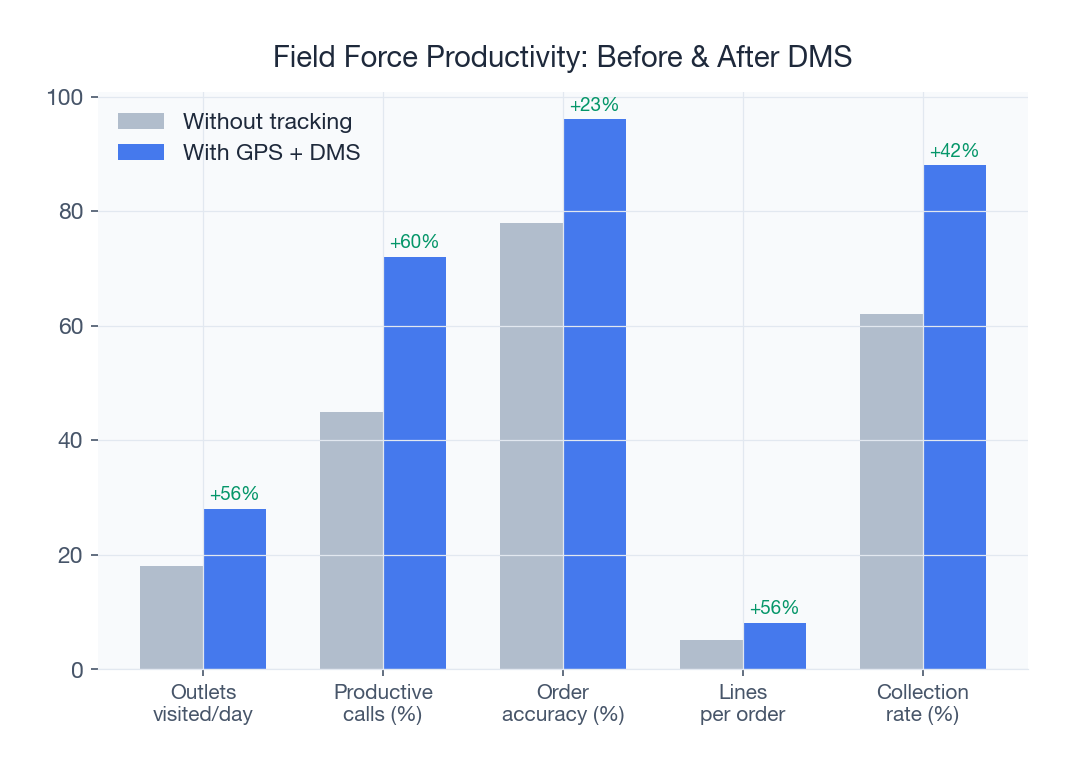
SpireStock's sales analytics provides the reporting capabilities that mid-market brands need for daily operations: daily, weekly, and monthly sales dashboards, product-wise and route-wise performance reports, collection tracking, scheme effectiveness reports, and trend analysis. The reports are designed to be clean and actionable, answering the operational questions that matter most without requiring a data science team to interpret the output. For most mid-market operations, SpireStock's analytics cover the critical ground without the configuration overhead of goal-driven dashboards.
Field Force and SFA
Sales force automation is a core strength of BeatRoute. The platform provides GPS-based tracking, attendance management with geo-fencing, beat adherence monitoring, and in-store activity tracking including photo capture for merchandising compliance. What sets BeatRoute apart is the goal-driven layer on top of standard SFA features: each field rep sees their daily goals, understands how their activities contribute to broader objectives, and receives real-time feedback on their progress. This motivational framework can drive higher engagement from field teams compared to purely transactional SFA tools.
BeatRoute also offers retailer engagement capabilities within its SFA module. Field reps can manage retailer loyalty programs, track retailer sentiment, and execute channel-specific engagement activities during their store visits. For brands that view the field force as relationship managers rather than order takers, this engagement layer adds value.
SpireStock's field force features cover the essentials comprehensively: GPS tracking, attendance and check-in/check-out, beat planning adherence, order capture, delivery confirmation with proof of delivery, and daily activity reports. The mobile app is optimised for low-end Android devices common among Indian delivery staff, consuming less storage, battery, and data than feature-rich alternatives. This lightweight design is not a limitation but a deliberate choice. When your delivery staff uses a Rs 8,000 smartphone with 2 GB of RAM and intermittent 3G connectivity in semi-urban or rural territories, app performance becomes a competitive advantage.
Billing, Invoicing, and GST Compliance
Both platforms support GST-compliant invoicing with e-invoice generation, e-way bill integration, and multi-GST rate handling. SpireStock's invoicing module provides deeper functionality in this area with automatic TCS/TDS calculations, credit note management for returns, multi-rate invoice handling critical for dairy (0% fresh milk, 5% packaged dairy, 12% butter and cheese, 18% ice cream), and direct Tally export capability. For the Indian market where Tally remains the accounting backbone for the majority of distributors, seamless Tally integration is not a nice-to-have but a requirement.
BeatRoute provides GST-compliant invoicing with standard features including e-invoicing, HSN code management, and tax calculation. Its billing capabilities are solid for general FMCG distribution but do not offer the depth of dairy-specific tax handling, credit note workflows, and accounting software integration that SpireStock provides. For brands where billing accuracy and GST compliance are critical operational priorities rather than back-office afterthoughts, SpireStock's invoicing module is the stronger choice.
Mobile App and Offline Mode
Both platforms provide Android and iOS mobile applications. BeatRoute's app is feature-rich with goal tracking, retailer engagement tools, merchandising capture, and comprehensive SFA functionality. The app is well-designed for field representatives who need to execute complex, multi-step workflows at each retail outlet.
SpireStock's app is designed to be lightweight and fast, optimised for the realities of Indian field operations where budget smartphones, limited storage, and unreliable connectivity are the norm rather than the exception. The app supports full offline mode, allowing delivery staff to process orders, record crate transactions, capture proof of delivery, and complete all daily workflows without internet connectivity. Data syncs automatically when the device reconnects. In territories across tier-2 and tier-3 cities where connectivity drops are frequent, this robust offline capability prevents workflow interruptions that cost time and money.
Feature Matrix Table
The following detailed feature matrix provides a checklist comparison across every major DMS and SFA capability. Use this as a quick reference when evaluating the two platforms against your specific requirements.
| Feature | SpireStock | BeatRoute |
|---|---|---|
| Order capture (mobile) | Yes | Yes |
| Recurring/standing orders | Yes (dairy-optimised) | Limited |
| Partial delivery and returns | Yes (single workflow) | Yes |
| Goal-driven execution | No (KPI-based reporting) | Yes (core platform capability) |
| Scheme engine | Yes (UI-based config) | Yes (goal-linked) |
| Crate/returnable tracking | Yes (native) | No |
| Cold chain monitoring | Yes | No |
| Expiry-based inventory (FEFO) | Yes | Basic batch tracking |
| Route optimisation | Yes | Yes |
| GPS field tracking | Yes | Yes (with geo-fencing) |
| Beat planning | Yes | Yes (goal-aligned) |
| Retailer engagement/loyalty | Basic | Yes (advanced) |
| Visual merchandising tracking | No | Yes |
| Goal cascading (brand to field) | No | Yes |
| Sales analytics | Standard dashboards | Goal-driven dashboards |
| Channel-specific analytics | Basic | Yes (MT, GT, institutional) |
| GST e-invoicing | Yes | Yes |
| E-way bill generation | Yes | Yes |
| Tally integration | Yes (direct export) | Yes (API) |
| Multi-GST rate handling | Yes (dairy-specific rates) | Yes |
| Credit note management | Yes | Yes |
| Multi-language UI | Hindi, Marathi, Gujarati, Arabic | Hindi, select regional |
| Offline mobile mode | Full offline | Partial (sync-dependent) |
| Proof of delivery (photo/OTP) | Yes | Yes |
| Attendance and check-in | Yes | Yes |
| Payment collection tracking | Yes | Yes |
| Distributor onboarding portal | Yes (self-service) | Yes (managed) |
| Custom reporting | Standard templates | Goal-driven report builder |
| API access | REST API | REST API |
| White-labelling | Available | Available |
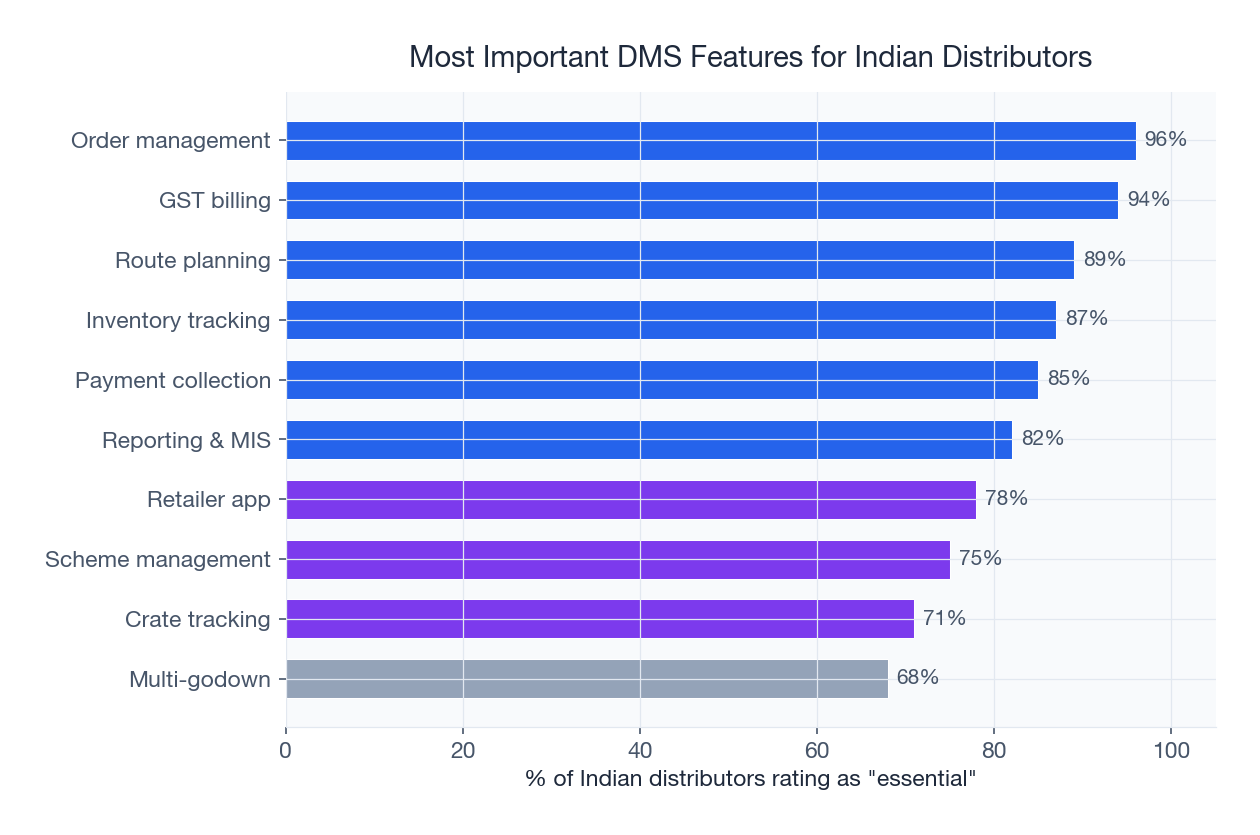
The pattern is consistent: SpireStock leads on perishable-specific features (crate tracking, cold chain, expiry management, recurring orders, GST billing depth) while BeatRoute leads on strategic execution features (goal-driven distribution, channel engagement, retailer loyalty, visual merchandising). The right choice depends on whether your primary challenge is operational efficiency for perishable distribution or strategic channel execution for multi-tier FMCG. For a broader feature checklist, see our What Is a DMS guide.
Pricing Comparison
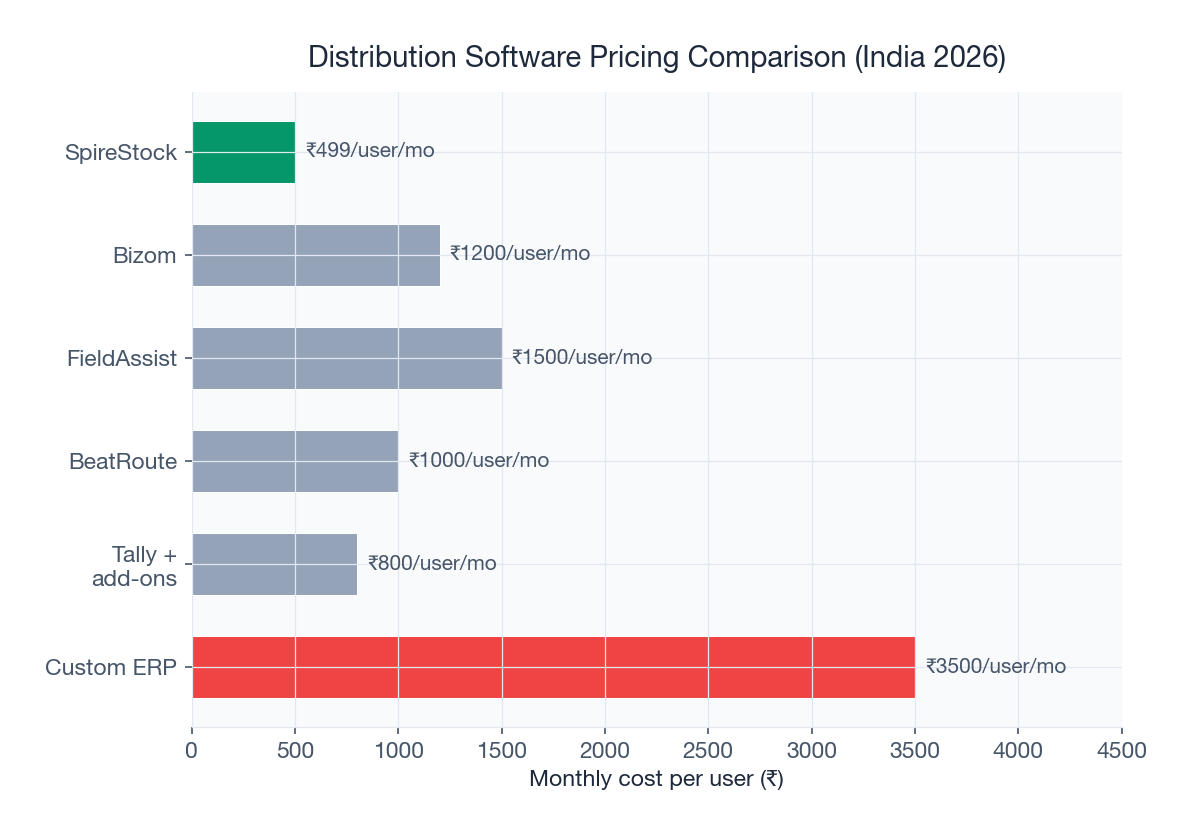
Pricing is frequently the deciding factor for mid-market Indian businesses, and this is where SpireStock and BeatRoute diverge significantly. SpireStock publishes its pricing transparently on its website. BeatRoute does not publish pricing publicly and typically requires a sales consultation to receive a quote. Based on market data, user reports, and publicly available information, here is how the two platforms compare on total cost of ownership.
| Cost Component | SpireStock | BeatRoute |
|---|---|---|
| Monthly subscription | Rs 5,000-15,000/month (flat) | Rs 30,000-1,50,000+/month (varies by users and modules) |
| Pricing model | Flat monthly fee, unlimited users | Per-user + module-based |
| Implementation fee | Rs 0 (included) | Rs 2-10 lakh |
| Training | Included (online + on-site) | Rs 50,000-3 lakh |
| Customisation | Rs 0-50,000 (most needs met out of box) | Rs 1-8 lakh |
| Annual TCO (small, 10 users) | Rs 60,000-1.8 lakh | Rs 8-20 lakh |
| Annual TCO (mid, 30 users) | Rs 60,000-1.8 lakh | Rs 18-40 lakh |
| Annual TCO (large, 100 users) | Rs 1.2-1.8 lakh | Rs 50 lakh-1.2 crore |
| Free trial | Yes (30 days) | Demo only (no self-service trial) |
| Contract lock-in | Monthly (no lock-in) | Annual contract typical |
The pricing difference is substantial. A mid-sized dairy distributor with 30 field staff would pay Rs 60,000 to Rs 1.8 lakh annually with SpireStock versus Rs 18 to 40 lakh with BeatRoute. That is a 10-20x cost difference at the mid-market level. For larger operations, BeatRoute's pricing includes capabilities that SpireStock does not offer, specifically goal-driven execution, retailer engagement programs, and advanced channel analytics, so the comparison is not apples-to-apples at the top end.
However, for mid-market businesses distributing dairy, perishable, or standard FMCG products, the cost gap is difficult to justify unless you specifically need BeatRoute's goal-driven distribution model. SpireStock's flat pricing is particularly advantageous for growing businesses. With per-user pricing models like BeatRoute's, adding 10 more field staff means a proportional cost increase. With SpireStock's flat model, your team can scale without your software bill scaling alongside it. For a complete pricing breakdown of the Indian DMS market, visit our pricing page.
Best For: When to Choose SpireStock
SpireStock is the right choice when your distribution operation matches one or more of these profiles:
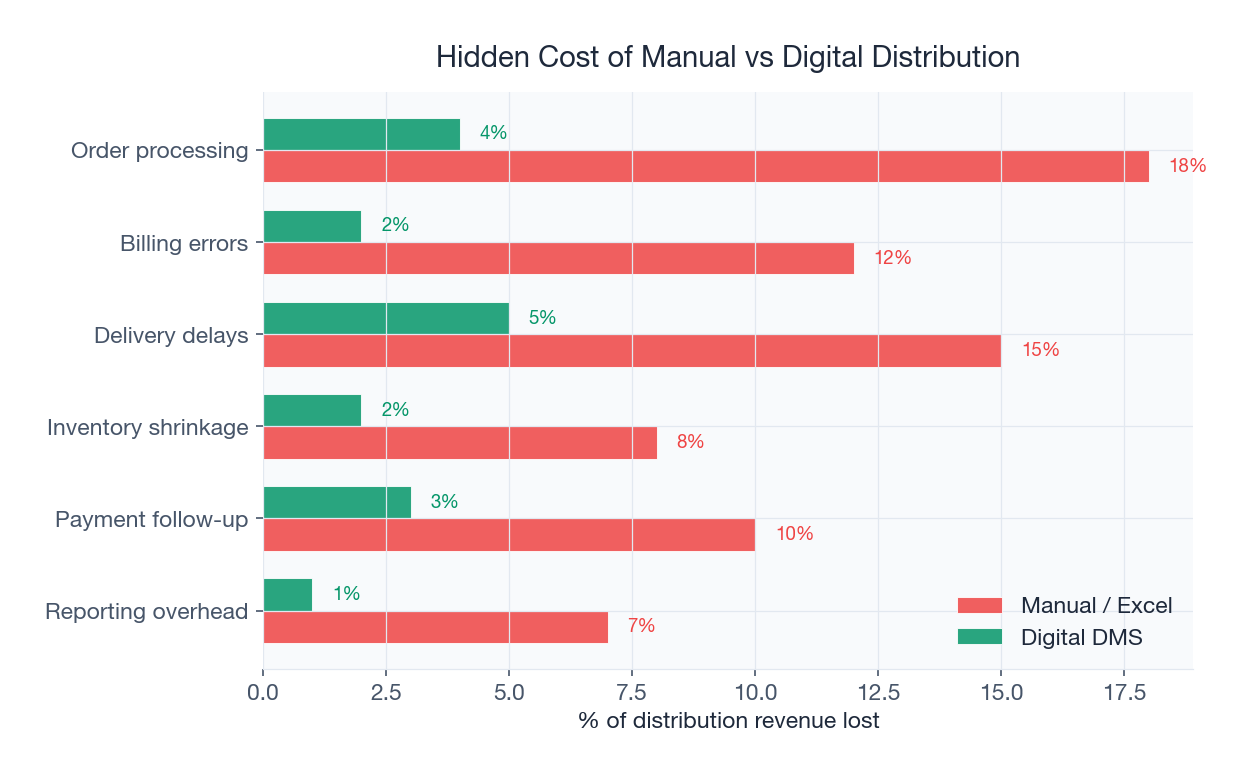
- Dairy and perishable goods distributors who need expiry-based inventory management (FEFO), cold chain compliance tracking, and daily recurring order workflows. No other DMS in the Indian market, including BeatRoute, offers these as native features. Explore our dairy distribution solution for details.
- Businesses managing returnable assets such as dairy crates, beverage bottles, gas cylinders, or reusable containers. SpireStock's crate management eliminates the spreadsheet chaos and manual register tracking that most distributors use to manage these high-value assets.
- Mid-market FMCG brands and distributors with 10-500 distribution points who need a full-featured DMS without enterprise pricing. If your annual DMS budget is under Rs 2 lakh, SpireStock is your most capable option in the Indian market.
- Companies prioritising GST compliance and billing accuracy that need robust invoicing with multi-rate GST handling, automatic TCS/TDS calculations, credit note workflows, and seamless Tally export. SpireStock's billing module is built for the Indian tax landscape.
- Companies needing rapid deployment that cannot afford 6-10 weeks of implementation. SpireStock's simpler architecture and pre-built perishable workflows enable go-live in 1-2 weeks.
- Vernacular-first operations where field staff are more comfortable in Hindi, Marathi, Gujarati, or Arabic. SpireStock's multi-language support covers the entire mobile app experience, not just surface-level translations.
- Budget-conscious growing brands that need per-feature value without per-user charges that penalise growth. SpireStock's flat pricing model means your 50th user costs the same as your 5th.
- Distributors in tier-2 and tier-3 cities where field staff use budget smartphones with limited storage and connectivity is unreliable. SpireStock's lightweight app and robust offline mode are designed for exactly these conditions.
For a comprehensive look at how SpireStock serves FMCG brands across India, visit our FMCG distribution industry page.
Best For: When to Choose BeatRoute
BeatRoute is the right choice when your distribution operation matches these profiles. We believe in honest comparisons, and BeatRoute has genuine strengths that SpireStock does not replicate:
- Large FMCG brands with complex channel strategies spanning modern trade, general trade, institutional sales, and e-commerce. BeatRoute's multi-channel architecture and channel-specific goal setting enable brands to manage fundamentally different distribution strategies for each channel from a single platform.
- Brands wanting a goal-driven approach to distribution where strategic objectives cascade from leadership to every field representative. If your distribution challenge is less about operational efficiency and more about ensuring that field activity aligns with brand strategy, BeatRoute's Goal-Driven Distribution model is genuinely differentiated.
- Companies that invest heavily in retailer engagement with loyalty programs, retailer tiering, visual merchandising compliance, and outlet-level relationship management. BeatRoute provides built-in tools for these engagement activities that go beyond what standard DMS platforms offer.
- Organisations focused on in-store execution where share of shelf, planogram compliance, and merchandising quality are critical KPIs. BeatRoute's photo-based compliance tracking and visual merchandising features support these use cases natively.
- Brands managing multi-tier distribution with super stockists, sub-distributors, and multiple levels of channel partners. BeatRoute's architecture handles complex distributor hierarchies and tracks goal achievement at every level of the network.
- Companies with dedicated trade marketing teams who can leverage BeatRoute's goal-linked scheme design and channel analytics to create and optimise sophisticated trade promotion strategies.
In short, if your distribution challenge is fundamentally about channel strategy execution and retailer engagement at scale, and your budget supports Rs 15+ lakh annually for DMS and SFA, BeatRoute delivers a unique value proposition. Its Goal-Driven Distribution model is not just marketing language; it represents a genuinely different approach to field force management that can drive measurable improvements in distribution quality for brands that need it.
Migration, Implementation, and Support
Implementation Approach
SpireStock's implementation follows a streamlined process: data import (product catalog, retailer master, route definitions, pricing structures), configuration of workflows and schemes, mobile app deployment, and field training. The entire process typically completes in 1-2 weeks for a mid-sized operation with 50-200 distributors. SpireStock includes implementation support in the subscription cost with no separate implementation fee.
BeatRoute's implementation is more involved, reflecting the platform's greater configuration depth. The process includes a requirements workshop to define goals and KPIs, system configuration aligned with the goal-driven framework, integration setup with existing systems, user acceptance testing, and phased rollout across the field force. Typical timelines run 4-10 weeks depending on the complexity of the channel architecture and the number of custom goals being configured. Implementation fees typically range from Rs 2-10 lakh.
Migrating Between Platforms
Companies considering a switch from BeatRoute to SpireStock typically do so for three reasons: cost reduction, the need for perishable-specific features (especially crate tracking), or a desire for operational simplicity over strategic complexity. The migration process follows a standard path: data export and mapping (Week 1), SpireStock configuration (Week 1-2), parallel run (Week 2-3), and cutover with training (Week 3-4). Total migration timeline is 3-4 weeks, and migration assistance is included in SpireStock's onboarding at no additional cost. Contact our team for a migration assessment specific to your setup.
Companies moving from SpireStock to BeatRoute would do so because their distribution has grown to a scale where goal-driven execution and channel engagement tools deliver strategic value that justifies the higher investment. This migration requires more planning, typically 6-10 weeks, to properly configure BeatRoute's goal framework, set up channel hierarchies, and train the field force on the new execution model.
Real User Perspectives
Software review platforms, industry forums, and conversations with distribution professionals reveal consistent themes about both platforms. Here is what users commonly report.
What SpireStock Users Say
- Crate tracking solved a real problem - Dairy distributors consistently cite crate management as the feature that made them choose SpireStock. Before implementing it, most were tracking crates in notebooks or spreadsheets, losing 8-15% of their crate inventory annually to poor tracking and reconciliation gaps.
- My delivery boys learned it in two days - Field staff adoption is frequently mentioned as a key strength. The vernacular language support, lightweight app, and simplified mobile interface reduce training time from weeks to days, even for staff with minimal smartphone experience.
- GST billing just works - Users appreciate the depth of the invoicing module, particularly the multi-rate GST handling, automatic TCS/TDS, and direct Tally export that eliminates double-entry for distributors whose accountants live in Tally.
- Pricing is honest - Users value knowing exactly what they will pay each month without per-user charges, module upsells, or surprise costs for support and training.
- No goal-driven dashboards - Users who want strategic distribution KPIs with goal cascading note that SpireStock's reporting, while adequate for daily operations, does not provide the strategic execution layer that platforms like BeatRoute offer.
What BeatRoute Users Say
- Goal-driven approach changes field behaviour - Users praise how the goal cascading model gives every team member clarity on what they need to accomplish and how their daily work contributes to larger objectives. This motivational framework is difficult to replicate with standard DMS tools.
- Strong retailer engagement tools - Brands that invest in retailer relationships appreciate the loyalty program management, retailer tiering, and engagement tracking that BeatRoute provides natively.
- Complex for simple operations - Smaller brands and distributors sometimes report that BeatRoute's goal-driven framework adds configuration overhead that does not justify itself for straightforward distribution operations. Setting up goals, targets, and cascading KPIs requires planning and ongoing management.
- No crate management - Users distributing dairy, beverages, or other products involving returnable assets consistently flag the lack of native crate tracking as a gap. Custom workarounds add cost and are often unreliable.
- Implementation takes time - Users report that configuring the goal-driven framework properly requires more upfront investment than expected. The platform delivers value once configured, but the configuration period can stretch beyond initial estimates.
These perspectives reflect common patterns in user feedback. Both platforms have satisfied customers and areas for improvement. What matters is how their respective strengths align with your specific distribution needs and operational priorities.
Verdict and Recommendation
SpireStock and BeatRoute are both capable platforms serving the Indian FMCG distribution market, but they were designed for different problems. Choosing between them requires an honest assessment of what your distribution operation actually needs, not what sounds impressive in a sales presentation.
Choose SpireStock if:
- You distribute dairy, perishable, or temperature-sensitive products
- You need returnable asset (crate) tracking
- Your business operates at mid-market scale (10-500 distributors)
- Your DMS budget is under Rs 2 lakh per year
- You want rapid deployment (under 2 weeks)
- GST compliance and billing accuracy are top operational priorities
- Your field staff needs vernacular language support and a lightweight mobile app
- You prefer transparent, flat pricing without per-user charges
Choose BeatRoute if:
- You are a large FMCG brand with complex multi-channel distribution
- You want goal-driven distribution with cascading KPIs from leadership to field
- Retailer engagement, loyalty programs, and merchandising compliance are priorities
- Your budget supports Rs 15+ lakh annually for DMS and SFA
- You have dedicated trade marketing resources to leverage goal-linked schemes
- You need multi-tier channel management with channel-specific strategies
For the mid-market Indian FMCG or dairy distributor, SpireStock delivers the best combination of capability, affordability, and industry-specific features. It is purpose-built for the operational realities that mid-market distributors face daily: perishable inventory with tight expiry windows, returnable assets that bleed money without tracking, field staff with varying technical literacy, GST compliance complexity, and budget constraints that make enterprise platforms impractical.
BeatRoute is the stronger platform for brands that have moved beyond basic distribution operations and need a strategic execution layer. Its Goal-Driven Distribution model is a genuine innovation in the Indian DMS market, and for brands with the scale, budget, and organisational maturity to leverage it, BeatRoute delivers differentiated value that no other platform matches.
The best DMS is the one your team will actually use every day. For many Indian distributors, that means choosing the platform that is powerful enough to solve real operational problems and simple enough that every delivery person, salesman, and supervisor adopts it willingly. For dairy and perishable distribution at mid-market scale, that platform is SpireStock. For strategic channel execution at enterprise scale, BeatRoute deserves serious consideration.
Schedule a free demo to see SpireStock in action, or explore our transparent pricing to understand exactly what your investment will be. You can also read how SpireStock compares to other platforms in our SpireStock vs Bizom comparison.
Sources & References
- IBEF, India Brand Equity Foundation, FMCG Sector Report
- NielsenIQ, India FMCG Market Insights and Analytics
- NDDB, National Dairy Development Board, Technology Initiatives
- GST Council, Goods and Services Tax Council, E-Invoicing
Frequently Asked Questions
Yes, for mid-market FMCG and dairy distributors. SpireStock offers core DMS and SFA features at Rs 5,000-15,000 per month flat compared to BeatRoute's Rs 30,000-1,50,000+ monthly pricing. SpireStock also provides native crate tracking, cold chain monitoring, and perishable inventory management that BeatRoute lacks. However, BeatRoute is better suited for large FMCG brands needing goal-driven distribution execution and advanced retailer engagement tools.
BeatRoute's Goal-Driven Distribution is a proprietary framework where brands define strategic objectives such as increasing numeric distribution, improving share of shelf, or boosting retailer engagement. These goals cascade down through the organisation hierarchy from national sales head to individual field representatives. Each team member sees their specific goals and how daily activities contribute to achievement. This is fundamentally different from traditional DMS platforms that focus on transactional workflows like orders and deliveries.
No, BeatRoute does not offer native crate or returnable asset tracking. The platform was designed primarily for non-perishable FMCG distribution. Dairy, beverage, and gas distribution businesses that manage thousands of returnable containers need to look at custom development or third-party integrations with BeatRoute, which adds cost and complexity. SpireStock provides built-in crate management with per-outlet tracking, automated return alerts, and monthly reconciliation reports.
BeatRoute does not publish pricing publicly. Based on market data and user reports, BeatRoute typically costs Rs 30,000 to Rs 1,50,000 or more per month depending on the number of users and modules selected. Implementation fees range from Rs 2-10 lakh additionally. SpireStock's transparent pricing starts at Rs 5,000 per month with no hidden charges, no per-user fees, and implementation included at no extra cost.
Yes, migration from BeatRoute to SpireStock typically takes 3-4 weeks. The process includes data export and mapping, SpireStock configuration, a parallel run period, and cutover with field training. Migration assistance is included in SpireStock's onboarding at no additional cost. Companies typically switch for cost savings, perishable-specific features like crate tracking, or a preference for operational simplicity over goal-driven complexity.
SpireStock is purpose-built for dairy distribution with native features including daily recurring orders, FEFO-based expiry management, cold chain compliance tracking, returnable crate management, and multi-rate GST handling for dairy products. BeatRoute is a general FMCG platform focused on goal-driven distribution and channel engagement without dairy-specific features. For dairy distributors, SpireStock provides better workflow fit at a fraction of the cost.
BeatRoute is designed for mid-large to large FMCG brands with complex channel strategies and can work for mid-sized companies, but its goal-driven framework adds configuration overhead that may not justify itself for straightforward distribution operations. The pricing, typically Rs 30,000 to Rs 1,50,000+ per month, also puts it out of reach for many mid-market budgets. SpireStock is a more practical and affordable choice for businesses with 10-500 distribution points and annual budgets under Rs 2 lakh.
SpireStock can be fully implemented in 1-2 weeks thanks to its simpler architecture, pre-built perishable workflows, and included onboarding support. BeatRoute implementations typically take 4-10 weeks because configuring the goal-driven framework, setting up channel hierarchies, and defining cascading KPIs requires more planning and setup time. For businesses that need to go live quickly, SpireStock's rapid deployment is a significant advantage.
Related SpireStock Features
End-to-end order lifecycle from placement to delivery with multi-level approval workflows.
Complete returnable crate tracking across plant, transporter, and retail levels.
Zone, town, and route-based delivery management with optimization.
Flexible incentive schemes, flat, bulk-pack, and quantitative, applied automatically.
GST-compliant invoicing with HSN codes, gate passes, and financial ledger.
Powerful dashboards with sales trends, MIS reports, and distribution analytics.
Mobile app for distributors, retailers, and delivery teams.
Related Industries
End-to-end dairy distribution software for milk, curd, paneer, and ghee brands. Manage orders, crates, cold chain, and GST billing in one platform.
Streamline FMCG distribution with order management, beat planning, retailer tracking, and GST billing. Built for Indian FMCG supply chains.
Related Entities
Ready to Streamline Your Distribution?
Start your free 30-day trial and see how SpireStock can transform your dairy, FMCG or consumer-goods distribution operation, from order capture to crate recovery.

SpireStock Team
Distribution Technology Experts
SpireStock Team writes for SpireStock on distribution management, supply-chain optimisation and field operations for Indian dairy and FMCG brands.