The Sustainability Imperative in Dairy Distribution
India's dairy industry distributes over 500 million litres of milk daily, and adjacent FMCG categories add another 2-3 billion units of packaged products every month. The packaging required for this scale is staggering, billions of pouches, bottles, cartons, and containers annually. While consumer-facing packaging gets most of the attention, the secondary and tertiary packaging used in distribution (crates, containers, pallets) represents an even larger environmental opportunity.
Returnable packaging, reusable containers that circulate through the distribution network rather than being discarded, is the dairy industry's biggest lever for sustainability in distribution. And with the right digital tracking technology, it's also a significant cost advantage. Brands like Amul, Mother Dairy, and Bisleri have operated returnable systems for decades; new entrants like Country Delight are rediscovering glass bottles for premium subscribers in Mumbai and Bangalore.
The Environmental Impact of Distribution Packaging
The Problem with Single-Use
- Corrugated boxes used once and discarded generate significant paper waste
- Shrink wrap, foam inserts, and plastic liners add to plastic pollution
- Single-use packaging represents a recurring cost that compounds at scale
- Manufacturing replacement packaging consumes resources and generates emissions
The Returnable Advantage
- A single plastic milk crate has a lifespan of 5-10 years, replacing hundreds of cardboard boxes
- Returnable containers reduce packaging waste by 80-90% compared to single-use alternatives
- Despite higher initial cost, returnables cost 60-70% less over their lifecycle
- Standardized returnable containers enable more efficient vehicle loading and warehouse stacking
Single-Use vs Returnable: Lifecycle Cost Comparison
Below is an indicative five-year lifecycle comparison for a dairy operation shipping 10,000 crate-equivalents per day. Numbers in INR, assuming 5% annual loss rate for a well-managed returnable system:
| Metric | Single-Use Corrugated | Returnable Crate (Managed) | Delta |
|---|---|---|---|
| Unit cost | Rs 25 | Rs 350 | +14x upfront |
| Annual uses per unit | 1 | 200-300 | 250x |
| Annual packaging spend (Year 1) | Rs 9.1 crore | Rs 35 lakh + Rs 15 lakh tracking tech | -Rs 8.6 crore |
| 5-year packaging spend | Rs 45.5 crore | Rs 8-10 crore (incl. replacements) | -Rs 35 crore |
| Packaging waste generated | 18,000 tonnes over 5 yrs | <800 tonnes | -96% |
| EPR liability | Full exposure | Materially reduced | -80%+ |
| Brand/ESG value | Neutral | Positive differentiator | Strategic |
Types of Returnable Packaging in Dairy Distribution
1. Milk Crates
The most common returnable asset in dairy distribution. Standard crates hold 12-20 litres of packaged milk products. Properly managed crates last 7-10 years and make thousands of distribution cycles. Digital crate tracking is essential for managing these assets at scale and is a core capability of any serious crate & asset management programme.
2. Insulated Containers
For products requiring enhanced temperature control (ice cream, chilled desserts), insulated returnable containers provide better cold chain than disposable insulated packaging at lower lifecycle cost. Used widely across dairy and fresh produce operations.
3. Reusable Pallets
Standardized pallets that circulate between production facilities, warehouses, and distributors. Pallet pooling systems reduce cost and waste compared to one-way pallets, especially helpful in multi-plant distribution setups.
4. Glass Bottles
The original returnable packaging. Glass milk bottles are making a comeback, driven by premium brands, sustainability consciousness, and nostalgia. They require robust return logistics, typically subscription-based delivery in Delhi, Pune, and Hyderabad.
5. Bulk Totes for Beverages and Liquids
Used in beverage distribution for syrups, concentrates, and bulk juice deliveries to HORECA customers.
The Technology Enabler: Digital Asset Tracking
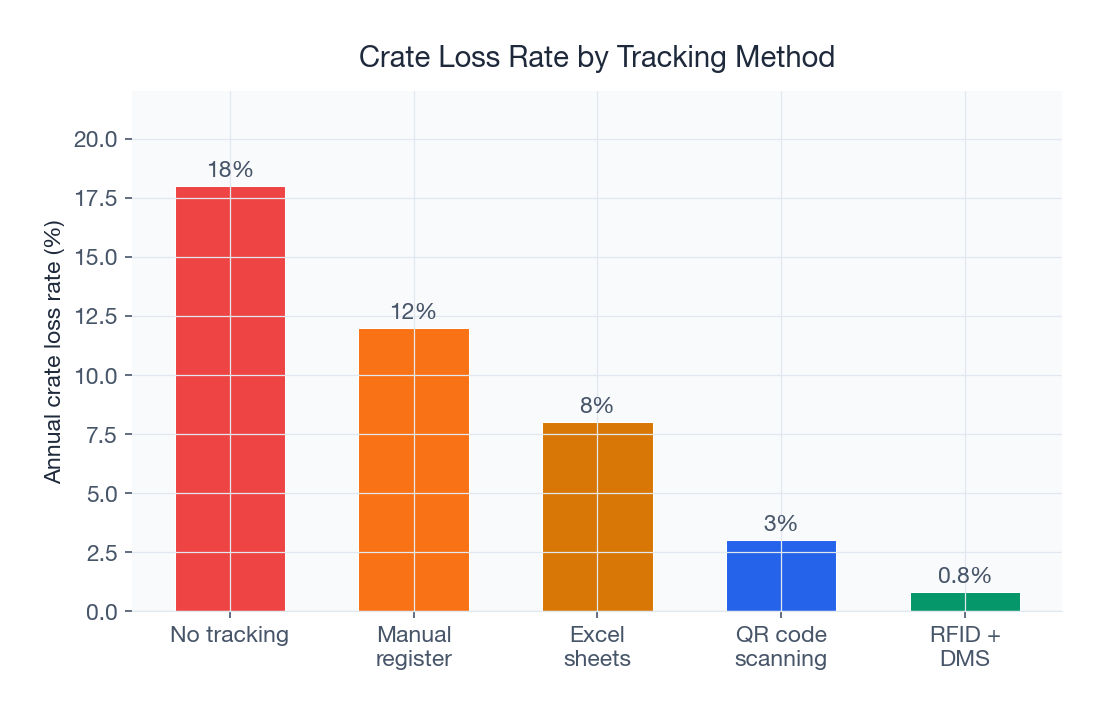
Returnable packaging only works if assets are actually returned. Without tracking, loss rates of 15-25% annually erode both the economic and environmental benefits. Digital asset tracking, linked to a mobile app, is the technology that makes returnable packaging viable at scale:
- Issue and return logging, Every asset movement is recorded with who, what, when, and where
- Real-time balance tracking, Know exactly how many assets are at each point in the network
- Overdue alerts, Automatic notifications when assets exceed return deadlines
- Loss analysis, Identify where in the distribution chain losses occur and why
- Lifecycle management, Track asset age, condition, and replacement scheduling
- Integration with billing, Automatic deposit and return adjustments on every invoice
The Business Case for Returnable Packaging
Cost Savings
- A dairy company distributing 1 lakh litres daily can save Rs 15-25 lakh annually by switching from single-use to well-managed returnable packaging
- Crate lifecycle costs are 60-70% lower than equivalent disposable packaging
- Standardized containers reduce vehicle loading time and improve space utilization
Brand Value
- Sustainability credentials increasingly influence B2B and B2C purchase decisions
- ESG (Environmental, Social, Governance) reporting requirements make measurable sustainability initiatives valuable
- Premium dairy brands use sustainability as a differentiation strategy
Regulatory Compliance
- India's Extended Producer Responsibility (EPR) regulations under the Plastic Waste Management Rules are tightening
- Returnable packaging reduces your EPR obligations for packaging waste
- Proactive sustainability measures position you ahead of regulatory requirements
- State-level plastic bans in Maharashtra, Tamil Nadu, and others make returnables a compliance necessity, not an option
Implementation Roadmap
- Audit current packaging, Calculate current single-use packaging costs and environmental impact
- Design returnable system, Choose appropriate container types, sizes, and materials
- Deploy tracking technology, Implement digital asset tracking before scaling returnable usage
- Pilot in one territory, Test with a subset of distributors, iron out collection logistics
- Scale with data, Use tracking data to optimize collection routes, reduce losses, and expand to more territories
- Measure and communicate, Quantify environmental impact (waste reduced, emissions avoided) and share with stakeholders
- Link to supplier scorecards, Roll returnable compliance into distributor management KPIs so partners own the outcome
ROI Timeline: When You Break Even
| Month | Activity | Cumulative Spend | Cumulative Savings |
|---|---|---|---|
| Month 0-2 | Audit, design, pilot plan | Rs 5 lakh | - |
| Month 3-4 | Crate procurement + tracking tech deploy | Rs 40-60 lakh | Rs 8 lakh |
| Month 5-8 | Pilot in 1 territory | Rs 45-65 lakh | Rs 30 lakh |
| Month 9-12 | Roll-out to full network | Rs 55-80 lakh | Rs 70 lakh |
| Month 13-18 | Steady state | Rs 60-90 lakh | Rs 1.2-1.6 crore |
Most mid-sized dairy and FMCG operators break even within 10-14 months, with every subsequent year delivering Rs 60 lakh to Rs 2 crore of savings depending on network size.
The Bigger Picture
Returnable packaging in dairy distribution is a rare win-win-win: lower costs for businesses, less waste for the environment, and better product protection for consumers. With digital tracking technology making asset management practical at any scale, the barriers to adoption have never been lower. The question isn't whether to adopt returnable packaging, it's how fast you can transition. Book a sustainability workshop with the SpireStock team, explore pricing plans, or read more on crate management in the blog.
Regulatory Landscape: EPR and Beyond
India's regulatory framework on packaging waste has tightened rapidly since 2022. Key provisions that every dairy and FMCG operator should understand:
Plastic Waste Management Rules (Amended)
The 2022 amendments introduced mandatory minimum recycled content for plastic packaging, phased out certain single-use items, and expanded EPR obligations to cover brands, importers, and producers. Non-compliance penalties can reach Rs 10 lakh per violation plus the cost of compliance credits.
Extended Producer Responsibility (EPR) Credits
Brands must register on the CPCB portal, declare their packaging volumes, and either recycle waste themselves or buy credits from registered recyclers. Returnable packaging dramatically reduces the base volume on which EPR is calculated, creating a direct link between sustainability investment and compliance cost.
State-Level Plastic Bans
Several states including Maharashtra (covering Mumbai and Pune), Tamil Nadu (Chennai), Karnataka (Bangalore), and Delhi have banned specific single-use plastic items. The enforcement is inconsistent but the direction of travel is clear.
GST Input Credit Treatment
Returnable assets can be treated as capital goods for GST input credit purposes, but the deposit/return mechanism must be correctly documented. Integration with digital billing simplifies this significantly.
Operational Playbook: How to Run a Returnable System at Scale
A returnable packaging programme only works if the operating model is airtight. Here is what mature operators do:
Deposit and Return Mechanics
Every crate is issued with a deposit (typically Rs 200-400 per crate) recorded in the distributor ledger. On return, the deposit is reversed or adjusted against the next invoice. Clean, automatic ledger management prevents disputes.
Asset Tagging
Crates are tagged with either numeric IDs, barcodes, QR codes, or RFID chips. RFID is the gold standard for high-volume operators but adds Rs 40-80 per crate. QR codes are the practical middle ground.
Scan-In, Scan-Out Workflow
Every movement is captured via the mobile app. Loading bay at plant, receipt at distributor, issue to retailer, return from retailer, each event is a timestamped, geotagged record.
Periodic Physical Reconciliation
Monthly physical counts at distributors reconcile system balance against actual inventory. Discrepancies trigger investigation and, if systemic, process changes.
Loss Charge-Back Policy
Assets lost beyond a defined tolerance (typically 3-5% per year) are charged to the responsible distributor. This single policy change often eliminates half of loss rates within three months.
Materials and Design Considerations
- HDPE vs polypropylene, HDPE is more durable but heavier; polypropylene is lighter but degrades faster in sunlight. Most milk crates are HDPE.
- Stackability, Crates should interlock when stacked empty and full. Saves 15-25% warehouse space.
- Ventilation, Critical for dairy and fresh produce to prevent condensation.
- Colour coding, Different colours for different product categories (dairy vs beverages vs bakery) aids sorting.
- Branding, Embossed logos prevent theft and resale, and serve as free advertising at retail.
Returnable Packaging Across Industries
While this article is dairy-focused, the same principles apply across adjacent industries:
- Beverages, Glass bottles for carbonated drinks, reusable PET containers for bulk water delivery, crates for packaged juice
- Bakery and confectionery, Insulated trays for cream cakes, reusable chocolate display units
- Fresh produce, Stackable crates with ventilation for vegetables and fruits
- Consumer goods, Reusable totes for HORECA deliveries, pallets for warehouse distribution
Case Study: A Regional Dairy in South India
A Rs 220 crore regional dairy in Karnataka had been running returnable crates for years without tracking. Loss rates were 22% annually, meaning they were replacing roughly one crate for every five in the field. After deploying digital crate asset management linked to their order management system, they achieved:
- Loss rate dropped to 4.5% in 9 months
- Crate replacement spend fell from Rs 85 lakh to Rs 17 lakh per year
- Working capital released from crate deposits improved by Rs 1.2 crore
- EPR compliance cost reduced by Rs 40 lakh annually
- Distributor disputes over deposits dropped to near-zero
Total project cost was Rs 45 lakh including technology and hardware; payback was under 8 months. The ops team now runs daily crate dashboards and treats asset velocity as a core KPI, not an afterthought.
Measuring Success
Track these metrics to know if your returnable programme is working:
- Monthly loss rate (target: under 1% per month)
- Average crate velocity (target: 20+ cycles per year)
- Days of deposit outstanding per distributor
- Physical vs system balance variance
- Packaging waste generated (tonnes per year)
- EPR compliance cost as percentage of revenue
- Crate-linked scheme or penalty uptake in distributor management scorecards
Closing Thought
Sustainability is often framed as a trade-off, you sacrifice cost for environmental benefit. Returnable packaging is the rare case where both win. The brands and distributors who invest in the operating muscle to run returnables well are the ones you see reporting lower costs, cleaner compliance, and stronger consumer preference year after year. The technology is ready, the economics are favourable, and the regulation is tailwind. The only remaining question is execution, and that depends on you.
Broader Sustainability Playbook
Returnable packaging is one lever. Operators committed to sustainable distribution should pair it with several complementary initiatives:
- Route optimisation, Less kilometres equals less fuel equals less emissions. Route optimization can reduce fleet fuel use by 20-30%.
- EV fleet pilots, Electric bikes and small trucks for last-mile delivery in metros like Delhi and Bangalore
- Solar-assisted cold storage, Reducing diesel genset dependency at depots
- Optimised cold-chain setpoints, Running compressors at efficient duty cycles rather than worst-case extremes
- Inventory optimisation, Reducing spoilage through better demand planning and sales analytics
- Paperless billing, Electronic invoices and digital signatures eliminate printing waste
- Supplier sustainability scorecards, Holding upstream vendors to the same sustainability standards
Reporting Your Sustainability Progress
If you invest in sustainability, measure and report it. Stakeholders, customers, investors, regulators, increasingly expect credible data, not slogans. Track:
- Tonnes of packaging waste avoided
- Tonnes of CO2 equivalent reduced through route optimisation and EV adoption
- Energy consumed per litre of product distributed
- Water footprint from operations
- EPR credits earned or avoided
- Recycled content percentage in your packaging
Report these numbers annually, audited by a credible third party, and your sustainability narrative will resonate far beyond marketing decks. It becomes a real commercial and compliance asset.
Sources & References
Frequently Asked Questions
Returnable packaging reduces costs by 60-70% over its lifecycle vs single-use alternatives, cuts packaging waste by 80-90%, improves product protection, enables more efficient vehicle loading, and supports sustainability goals. A dairy handling 1 lakh litres daily can save Rs 15-25 lakh annually.
A standard plastic milk crate has a lifespan of 7-10 years and can make thousands of distribution cycles. With proper tracking and management (preventing loss and damage), crates provide excellent long-term value compared to disposable packaging.
Digital asset tracking software like SpireStock's crate management module logs every issue, return, and transfer with timestamps and responsible parties. QR codes or barcodes on containers enable scanning at every handoff point, maintaining real-time balance visibility across the network.
The main challenges are asset loss (15-25% annually without tracking), collection logistics (getting containers back from distributed points), damage management, and initial capital investment. Digital tracking technology addresses the first three challenges effectively.
Yes. Returnable packaging programs generate measurable environmental metrics, tonnes of waste avoided, reduction in packaging-related emissions, and resource conservation. These metrics are increasingly valuable for ESG reporting and sustainability communications.
Related SpireStock Features
Related Industries
End-to-end dairy distribution software for milk, curd, paneer, and ghee brands. Manage orders, crates, cold chain, and GST billing in one platform.
Streamline FMCG distribution with order management, beat planning, retailer tracking, and GST billing. Built for Indian FMCG supply chains.
Related Solutions
Track returnable crates, bottles, and kegs across your distribution network. Automated ledger, shortage alerts, and loss prevention. Try free.
Manage your entire distributor network digitally. Onboarding, credit limits, outstanding tracking, and performance analytics. Start free trial.
Related Entities
Ready to Streamline Your Distribution?
Start your free 14-day trial and see how SpireStock can transform your dairy, FMCG or consumer-goods distribution operation, from order capture to crate recovery.

SpireStock Team
Distribution Technology Experts
SpireStock Team writes for SpireStock on distribution management, supply-chain optimisation and field operations for Indian dairy and FMCG brands.