The Critical Role of Schemes in FMCG Distribution
Trade promotions, schemes, offers, discounts, and incentives offered to distributors and retailers, are the lifeblood of FMCG distribution in India. They drive secondary sales, counter competition, clear slow-moving inventory, and build retailer loyalty. Indian FMCG companies spend 15-25% of their revenue on trade promotions, making it one of the largest line items after COGS. For a mid-sized FMCG business turning over Rs 500 crore annually, that is Rs 75-125 crore flowing into the trade every year.
Yet a staggering proportion of this spending is wasted. Research by Nielsen and Bain suggests that 40-60% of trade promotions in Indian FMCG fail to generate positive ROI. The problem is rarely the idea behind the scheme, it is poor scheme design, inconsistent execution across distributors in Mumbai versus Lucknow, and inadequate measurement once the scheme closes. Technology-enabled scheme management addresses all three gaps and is the single highest-leverage investment a distribution-led brand can make in 2026.
This guide walks through the full scheme lifecycle, from designing the right offer for a beverage distributor in Hyderabad to measuring incremental lift in a biscuit category in Kolkata, and shows how brands like Amul, Britannia, and Bisleri are rethinking trade marketing for a digital-first era.
Types of FMCG Trade Schemes in India
1. Volume-Based Schemes
Buy X cases, get Y free (or a discount). These drive volume but must be designed carefully to avoid stockpiling without genuine sell-through. Classic examples include "10+1" on biscuit cases or "buy 5 cases of 200ml beverages, get 1 case free", common during summer peak periods in Ahmedabad and Jaipur.
2. Slab-Based Incentives
Tiered rewards based on purchase volumes (e.g., buy 10-20 cases: 2% discount; 21-50 cases: 3.5%; 50+: 5%). These encourage distributors to push for higher slabs and work especially well for mid-velocity SKUs in bakery and confectionery categories.
3. Target-Based Rewards
Incentives tied to achieving monthly/quarterly targets. Effective for driving consistent performance but require robust tracking and analytics and a clean baseline. Dairy brands like Mother Dairy use target-based schemes for curd and paneer distributors in Delhi NCR.
4. Product Combo Schemes
Bundle fast-moving and slow-moving products (e.g., buy 10 cases of milk, get 2 cases of flavoured yogurt free). Useful for new product launches and inventory management, especially in dairy distribution where shelf life windows are tight.
5. Display and Visibility Schemes
Incentives for prominent in-store product placement. Particularly effective in modern trade and high-traffic kirana stores across metros. Beverage brands running summer campaigns in Chennai pay kiranas Rs 500-2,000 per month for dedicated chiller space.
6. Financial and Credit Schemes
Extended credit, early-payment discounts, and invoice financing offers. These help distributors manage working capital and are increasingly popular as UPI-linked payment collection makes settlement cycles shorter.
Scheme ROI Comparison: Which Types Actually Work?
The table below summarises typical ROI ranges observed across Indian FMCG categories when schemes are properly measured using digital analytics:
| Scheme Type | Typical Cost (% of Sales) | Avg ROI | Best For | Common Pitfall |
|---|---|---|---|---|
| Volume (Buy X get Y) | 8-12% | 1.2-1.8x | High-velocity SKUs | Forward buying |
| Slab-based | 3-6% | 1.8-2.4x | Mid-velocity FMCG | Top-slab gaming |
| Target-based | 2-5% | 2.0-3.0x | Established brands | Unrealistic baselines |
| Product combo | 10-15% | 1.5-2.2x | NPD launches | Cannibalisation |
| Display/visibility | 1-3% | 2.5-4.0x | Impulse categories | Compliance auditing |
| Credit/financial | 1-2% | 3.0-5.0x | Working-capital-constrained distributors | Credit risk |
Display and credit schemes consistently top the ROI charts because they are cheap to offer and hard to game. Combo schemes are most volatile, brilliant when targeted, disastrous when national.
Designing Effective Schemes: A Five-Step Playbook
Step 1: Define Clear Objectives
Every scheme should have a specific, measurable objective:
- Increase volume of Product X by 20% in Pune territory
- Improve numeric distribution from 60% to 75% in a retailer territory
- Launch New Product Z with 500+ retailer placements in month one
- Clear 10,000 cases of near-expiry inventory within 3 weeks
Step 2: Calculate Scheme Economics
Before launching, model the financials rigorously:
- Cost of the scheme per case/unit
- Incremental volume needed to break even
- Expected margin impact on base volume (the "cannibalisation tax")
- Comparison with alternative spend (advertising, pricing, field force productivity)
Step 3: Target Precisely
One-size-fits-all schemes waste money. Use distribution analytics to target:
- Specific territories where volume growth is needed (say, Bangalore east)
- Distributors who respond well to incentives (proven in historical data)
- Retail channels where the product needs a push, kirana versus modern trade
- Time periods that align with demand patterns (Diwali, monsoon, school-opening)
Step 4: Execute with Technology
A digital scheme engine ensures consistent execution across 500 distributors:
- Configure scheme rules (eligible products, quantities, territories, timeframe)
- Automatic scheme application at the point of ordering/billing through invoice automation
- Real-time tracking of scheme uptake and utilization
- Prevention of scheme abuse (double-dipping, fake claims, back-dating)
Step 5: Measure and Optimize
Post-scheme analysis should answer: did the scheme achieve its objective, what was the ROI, which territories responded best, were there unintended consequences, and what should change next time? Mature brands run a formal scheme review every month feeding into their scheme governance process.
Common Scheme Management Mistakes
- Too many simultaneous schemes, Confuses field teams and distributors. Run 2-3 focused schemes, not 10 overlapping ones.
- No ROI measurement, If you cannot measure it, you are probably wasting money. Insist on scheme analytics.
- Uniform national schemes, Market conditions in Mumbai versus Kolkata are fundamentally different. Tailor schemes to local competition and demand.
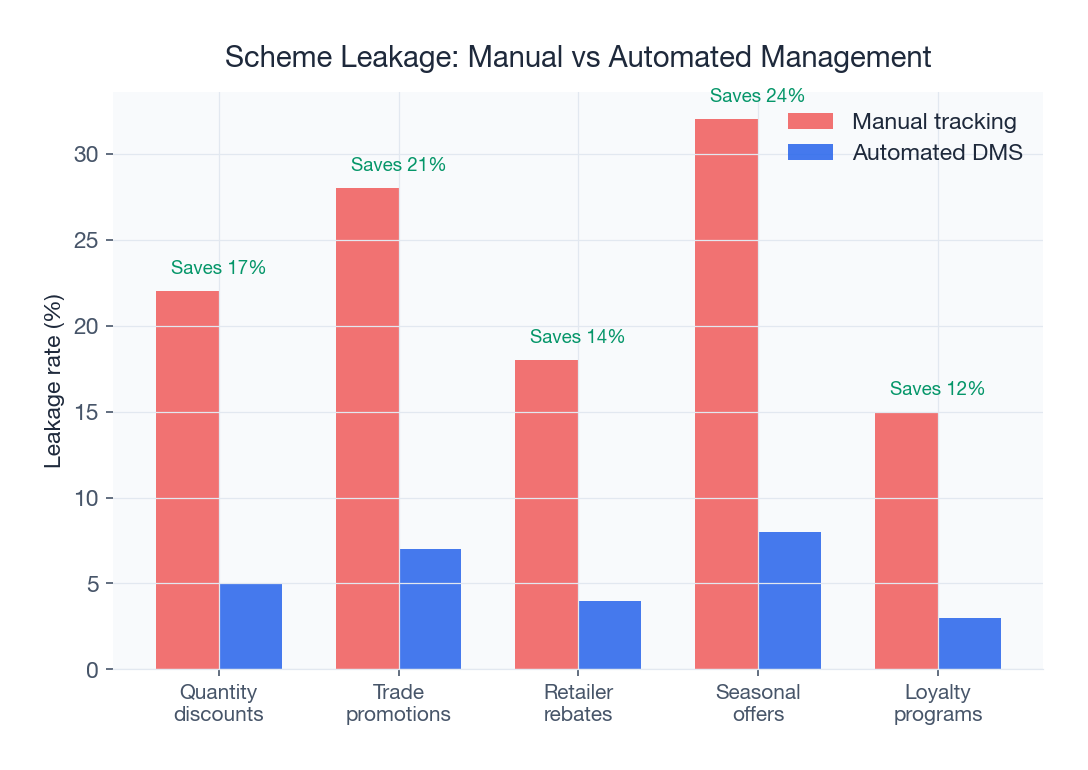
- Manual scheme tracking, Paper-based tracking leads to fake claims and delayed settlements. Use digital tools.
- Ignoring forward buying, Schemes that encourage stockpiling create artificial demand spikes followed by sales dips. Design schemes that incentivize sell-through, not just sell-in.
- No baseline data, Without knowing what sales would have been without the scheme, ROI numbers are fiction.
Scheme Management Technology: What to Look For
A modern scheme management engine should support all scheme types, territory-level configuration, automatic application during billing, real-time uptake tracking, multi-brand isolation via multi-tenant workspaces, and post-scheme ROI analytics. For FMCG, beverages, and bakery-confectionery players, the ability to run parallel schemes for beverages and bakery SKUs from one dashboard is critical.
This technology-first approach ensures every rupee of trade spend is invested, not wasted. If you are ready to move from spreadsheet-based scheme tracking to an integrated engine, get in touch with the SpireStock team or explore our pricing plans built for brands of all sizes. You can also learn more about related capabilities in our distribution blog.
Deep Dive: Scheme Design for Specific Categories
Dairy (Milk, Curd, Paneer, Butter)
Dairy scheme design has to account for short shelf life. A classic mistake is to push a 10+1 scheme on curd at the start of a month, distributors load up, stock sits in tier-3 retailers where offtake is slower, and by week three you have expiry returns coming back into the depot. The right dairy scheme mechanic is typically shorter (7-14 days), value-led (price-off on invoices), and tied to sell-through data from the previous cycle. Brands like Nandini run "freshness guaranteed" schemes where distributors get an extra margin only on stock sold within 5 days of despatch, a neat way to align incentives with dairy distribution realities.
Beverages
Beverages (both packaged water and carbonated drinks) have a strong seasonal skew. Summer schemes in Ahmedabad, Jaipur, and Hyderabad routinely deliver 3-4x ROI because base demand is pulling hard anyway. The design challenge is avoiding over-investment during the pull season. Bisleri and other packaged water brands use tight weekly caps and real-time dashboards to throttle schemes as soon as natural demand kicks in.
Bakery and Confectionery
In bakery and confectionery, display schemes dominate because shelf space is the scarce resource. A Rs 1,500 monthly "counter-rent" to a high-footfall kirana in Lucknow can deliver more incremental volume than a 5% trade discount spread across the same retailer set. Measurement requires photo-based compliance audits through the field app.
FMCG Staples
High-velocity staples (tea, biscuits, packaged flour, edible oil) are the hardest to discount effectively because forward buying is easy, distributors just front-load purchases during the scheme. The solution is sell-out-linked schemes: distributor gets the incentive only after proof of retailer billing via distribution tracking. This shifts the bulk of the payoff to genuine consumer pull rather than warehouse shuffling.
How to Budget Trade Spend Across the Year
Most Indian FMCG brands allocate trade spend as follows, adjusted for category seasonality:
| Month | Typical Spend Index | Main Scheme Focus |
|---|---|---|
| April-June (summer peak) | 130 | Beverages, ice cream, flavoured milk |
| July-September (monsoon) | 90 | Inventory clearance, display schemes |
| October-November (festive) | 140 | Combo packs, gifting, premium SKUs |
| December-January (winter) | 85 | Dairy, ghee, bakery |
| February-March (year-end) | 100 | Target-linked distributor rewards |
Governance: The Monthly Scheme Review
Mature brands treat scheme governance as a formal monthly cadence. The agenda typically runs to 60-90 minutes and covers:
- Previous month's scheme ROI scorecard by territory and category
- Outlier investigation, any scheme delivering under 0.8x ROI gets killed or redesigned
- Approval for next month's scheme calendar with budget guardrails
- Field-force feedback loop on execution friction
- Distributor feedback via distributor management dashboards
- Competitive scheme intelligence from market visits
The review is only useful if the underlying data is trustworthy. That is why mature brands invest in a single system of record for trade spend rather than pulling numbers together from Excel, Tally, and email chains.
Case Study: A Regional FMCG Brand in North India
A north-Indian snacks and namkeen brand with Rs 180 crore topline was spending roughly Rs 32 crore a year on trade schemes with no visibility into outcomes. After deploying a digital scheme engine with territory-level configuration and automatic invoice-time application, the commercial team discovered that 28% of schemes were net-negative, 41% were roughly neutral, and only 31% drove real incremental volume. Reallocating the bottom 28% freed up Rs 9 crore, which was redeployed into display and credit schemes on the top 31%, and full-year scheme ROI moved from 1.4x to 2.2x without any increase in total spend. The project paid for itself in under four months and the review rhythm became a permanent part of the commercial operating model.
What "Good" Looks Like in 2026
- Single source of truth for every scheme, accessible to sales, finance, and marketing
- Automatic application of schemes at invoice time, zero manual claim processing
- Pre-scheme ROI modelling with scenario comparison
- Real-time dashboards per territory and category
- Governance cadence of weekly scorecards and monthly reviews
- Distributor self-service portal showing earned, pending, and paid scheme values
- Audit trail for FSSAI, GST, and internal compliance
If any of these are missing from your current setup, the gap is probably costing you crores a year in leaked trade spend. Start with one category and one territory, prove the uplift, then scale the template across the business.
Scheme Fraud and How to Prevent It
Trade scheme fraud is an open secret in Indian FMCG. Common patterns include double-dipping (claiming the same scheme under two distributor codes), back-dating orders to fit a scheme window, fake retailer invoices to claim sell-out incentives, and collusion between field officers and distributors to file inflated claims. A well-designed scheme engine eliminates most of these:
- Unique transaction IDs prevent double claims
- Timestamped order capture via the mobile app makes back-dating impossible
- GPS check-ins tied to attendance tracking verify field presence
- Retailer-level secondary sales records validate sell-out claims
- Approval workflows for exceptional cases with full audit trail
Brands that move from manual to digital scheme management frequently report 5-15% savings simply from eliminating fraud that was previously invisible.
Training Your Commercial Team to Run Schemes Well
Technology is only half the battle. The other half is building a commercial team that designs and executes schemes like professionals. Three training priorities:
- Economic literacy, Every sales manager should be able to calculate scheme ROI on a whiteboard in under 90 seconds
- Data fluency, Comfort with dashboards, not just Excel; ability to challenge numbers, not just accept them
- Commercial storytelling, Ability to explain scheme decisions to distributors and brand teams in terms of objectives and outcomes
Investing in these capabilities typically takes 6-9 months but pays back for the next decade.
For the complete picture, see our scheme management guide.
This page covers one angle. For the broader treatment, see our scheme management and automation guide.
Sources & References
Frequently Asked Questions
Indian FMCG companies typically spend 15-25% of revenue on trade promotions (schemes, discounts, and incentives). This makes trade promotion one of the largest cost items after cost of goods sold.
Scheme ROI = (Incremental margin generated by the scheme - Cost of the scheme) / Cost of the scheme. To calculate this accurately, you need baseline sales data (what would have sold without the scheme), actual sales during the scheme period, and total scheme cost including product given free.
Effectiveness depends on your objective. Volume-based schemes drive tonnage, target-based rewards drive consistency, product combos support new launches, and slab-based incentives encourage higher purchase volumes. The most effective approach combines scheme types with precise targeting by territory and channel.
Technology enables precise scheme targeting, automatic application during billing (preventing errors), real-time tracking of uptake, prevention of scheme abuse, and post-scheme ROI analytics. SpireStock's scheme engine handles all of this in an integrated platform.
Best practice is 2-3 focused schemes at a time. Running too many simultaneous schemes confuses field teams and distributors, makes ROI measurement difficult, and often leads to unintended interactions between schemes.
Related SpireStock Features
Flexible incentive schemes, flat, bulk-pack, and quantitative, applied automatically.
Powerful dashboards with sales trends, MIS reports, and distribution analytics.
End-to-end order lifecycle from placement to delivery with multi-level approval workflows.
Related Industries
Related Solutions
Automate trade schemes, incentives, and promotional offers. Flat, bulk-pack, quantitative, and FOC schemes with ROI tracking. Try SpireStock.
Manage your entire distributor network digitally. Onboarding, credit limits, outstanding tracking, and performance analytics. Start free trial.
Related Entities
Ready to Streamline Your Distribution?
Start your free 14-day trial and see how SpireStock can transform your dairy, FMCG or consumer-goods distribution operation, from order capture to crate recovery.

SpireStock Team
Distribution Technology Experts
SpireStock Team writes for SpireStock on distribution management, supply-chain optimisation and field operations for Indian dairy and FMCG brands.