SpireStock vs Botree DMS at a Glance
Choosing between SpireStock and Botree DMS is not just a software decision. It is a strategic choice between two fundamentally different approaches to distribution management. Botree represents the legacy enterprise model: deep customisation, long implementation cycles, and pricing designed for India's largest FMCG conglomerates. SpireStock represents the modern SaaS model: cloud-native architecture, transparent pricing, rapid deployment, and purpose-built workflows for dairy and perishable distribution. Whether you run dairy operations in Pune or manage FMCG distribution across Maharashtra, this comparison will help you make the right call.
| Dimension | SpireStock | Botree DMS |
|---|---|---|
| Founded | Modern SaaS platform | 1997 (25+ years) |
| Architecture | Cloud-native, API-first, microservices | On-premise roots, gradually moving to cloud |
| Primary market | Mid-market dairy and FMCG brands | Large enterprises (500+ distributors) |
| Distributor network | Growing rapidly | 93,000+ distributors |
| Implementation time | 2-4 weeks (pilot) | 3-6 months (enterprise) |
| Pricing model | Transparent SaaS (Rs 5K-15K/month) | Enterprise pricing (quote-based) |
| Dairy/perishable focus | Purpose-built | General FMCG, not dairy-specific |
| Mobile UX | Modern, intuitive | Functional but dated |
| Ownership | Independent | Acquired by Mitsui and Co. |
This article goes deep into each of these dimensions with honest analysis of where each platform excels and where it falls short. If you want to skip ahead to a specific section, use the headings below as your guide.
Company Backgrounds
Botree DMS: The Legacy Enterprise Player
Botree Software (formerly Botree Technologies) has been a fixture in Indian distribution management since 1997. Over 25 years, the company has built an extensive network serving 93,000+ distributors across some of India's largest FMCG companies. Botree's client list reads like a who's who of Indian consumer brands, with deep penetration in packaged goods, personal care, and food distribution.
In 2022, Botree was acquired by Mitsui and Co., the Japanese trading conglomerate, in a deal that valued the company at approximately Rs 1,000 crore. This acquisition brought global resources but also introduced the kind of corporate layering that can slow product innovation. Botree's platform grew over two decades, accumulating features, customisations, and architectural decisions that reflect the technology constraints of each era it passed through.
Botree's strength lies in scale. When you need to manage 1,000+ distributors with deeply customised workflows, the platform's enterprise DNA kicks in. But this strength is also its limitation: the same enterprise architecture that handles massive scale creates friction for smaller, faster-moving brands that need agility over raw power.
SpireStock: The Modern Cloud-Native Challenger
SpireStock was built from scratch as a modern SaaS platform for dairy and FMCG distribution in India. Rather than trying to be everything to everyone, SpireStock focused on solving the specific pain points of mid-market brands distributing perishable and fast-moving goods: daily recurring orders, crate tracking, scheme management, and route optimisation with tight delivery windows.
The platform was designed with cloud-native principles from day one, no on-premise legacy to carry, no architectural compromises from a pre-cloud era. This means every feature, from order management to analytics, was built for real-time cloud delivery with mobile-first workflows. SpireStock's sweet spot is brands with 50-500 distributors that need to move fast, control costs, and deliver a modern experience to their channel partners.
Architecture: Cloud-Native vs Legacy
Architecture might sound like a technical detail that only developers care about, but it has profound implications for every user of the system. The architectural choices made 15-20 years ago still dictate what Botree can and cannot do quickly today. SpireStock, built in the modern cloud era, avoids those constraints entirely.
SpireStock: Born in the Cloud
SpireStock runs on a microservices architecture deployed on modern cloud infrastructure. Each major capability, orders, inventory, billing, analytics, field force, runs as an independent service that can scale, update, and recover independently. This means:
- Continuous updates delivered automatically, no scheduled downtime, no version upgrades to manage
- Independent scaling so that a spike in order volume does not slow down your analytics dashboards
- API-first design enabling seamless integration with Tally, SAP, and third-party tools
- Multi-tenant SaaS where every customer runs on the latest version without exception
- Geographic redundancy with data replicated across availability zones for disaster recovery
For a dairy company processing thousands of daily orders across Mumbai and Ahmedabad, this architecture means the system scales with demand and never requires weekend maintenance windows that disrupt Monday morning order cycles.
Botree DMS: On-Premise Roots Moving to Cloud
Botree's architecture reflects its on-premise heritage. The platform was originally built as a client-server application designed to run on local hardware in distributor offices and brand headquarters. Over the past several years, Botree has been transitioning toward cloud delivery, but architectural migrations of this scale take years and inevitably carry legacy constraints forward.
- Monolithic core that requires coordinated release cycles across modules
- Hybrid deployment with some components running on-premise and others in the cloud, creating integration complexity
- Version fragmentation where different customers may run different versions of the platform
- Upgrade overhead requiring planned downtime and testing cycles for major releases
- Integration via middleware rather than native APIs, adding latency and maintenance burden
None of this means Botree's technology is bad. It means it carries the weight of architectural decisions made in a different era. For enterprises with dedicated IT teams, this weight is manageable. For mid-market brands without large IT departments, it creates friction that a cloud-native platform like SpireStock eliminates entirely.
What Architecture Means for Your Business
The practical impact of architectural differences shows up in three areas that affect daily operations:
- Speed of updates: SpireStock ships feature updates weekly without downtime. Botree's enterprise release cycles mean new features can take months to reach your instance.
- Data accessibility: SpireStock's API-first design lets you pull real-time data into any BI tool or ERP. Botree's data access often requires custom reports built by their professional services team.
- Scalability cost: With SpireStock, adding 50 distributors costs proportionally more in subscription fees. With Botree, scaling often triggers re-architecture discussions, additional hardware provisioning, or middleware upgrades.
Feature Comparison Deep Dive
Both platforms cover the core distribution management capabilities that Indian FMCG and dairy brands need. The differences lie in depth, design philosophy, and how features are delivered. Let us walk through each major capability.
Order Management
SpireStock's order management module was designed around the daily recurring order patterns that define dairy and perishable distribution. Standing orders, production-unit-based cutoffs, multi-level approval workflows, and OTP-verified delivery are native capabilities. Distributors place orders via a modern mobile app with an intuitive interface that requires minimal training.
Botree's order management is comprehensive and battle-tested at scale. It handles complex order hierarchies, multi-brand processing, and large distributor networks with thousands of concurrent users. However, the user interface reflects its enterprise heritage, functional but dense, with deeper learning curves for field staff. Daily recurring order workflows require configuration rather than being native to the system.
Scheme Engine
Trade schemes drive FMCG distribution in India. Both platforms support scheme management, but the approach differs significantly. SpireStock's scheme engine provides a self-service configuration interface where brands can set up flat discounts, slab-based incentives, seasonal promotions, and product-specific offers without needing professional services. Schemes auto-apply during order processing, ensuring 100% accuracy and full transparency for distributors.
Botree's scheme management is powerful at the enterprise level, supporting complex multi-layered schemes across large product portfolios. But configuring new schemes typically requires involvement from Botree's implementation team, adding lead time and cost. For brands that run 15-30 concurrent schemes and need to modify them weekly based on market conditions, this dependency creates operational friction.
Claims Management
Claims settlement is one of the most contentious areas in Indian distribution. SpireStock handles claims digitally with full audit trails, automated approval workflows, and real-time status tracking for distributors. The process is transparent, which builds trust across the channel.
Botree offers claims management as part of its enterprise suite, with configurable approval matrices and integration with financial systems. The depth of claims handling is strong for large enterprises, but the workflow design assumes dedicated claims processing teams, which mid-market brands rarely have.
Analytics and Reporting
SpireStock's analytics dashboards provide real-time visibility into distributor performance, SKU-level trends, territory insights, and demand forecasting. Dashboards are visual, mobile-optimised, and accessible to non-technical users. Data is available the moment a transaction occurs, no batch processing or overnight report generation.
Botree's analytics leverage its deep data accumulation across 93,000+ distributors. The reporting engine is comprehensive, offering hundreds of pre-built reports and custom report builders. For data analysts and IT teams, this depth is valuable. For sales managers who need quick answers on mobile, the interface can feel overwhelming compared to SpireStock's streamlined dashboards.
Sales Force Automation
SpireStock includes GPS attendance, beat adherence scoring, retailer visit tracking, and photo proof of delivery as native features within its mobile app. The app is designed for Indian field conditions: offline capability, low data usage, and an interface that works well even on budget Android devices.
Botree's SFA module is mature and feature-rich, with advanced geo-fencing, outlet-level analytics, and deep customisation options. The trade-off is app complexity and device requirements. Botree's mobile app tends to be heavier, which can affect performance on the low-end smartphones that many Indian field staff use.
Route Planning and Optimisation
For dairy distribution, where delivery windows can be as tight as 4 hours, route optimisation is critical. SpireStock's route planning considers traffic patterns, delivery time windows, vehicle capacity, and product temperature requirements to generate optimal delivery sequences. The system learns from historical delivery data and improves suggestions over time.
Botree offers route planning capabilities as part of its distribution suite. The feature set is adequate for general FMCG routing but does not natively account for the perishable-specific constraints, cold chain timing, expiry-based prioritisation, and tight morning delivery windows, that dairy distribution demands.
Invoicing and GST Compliance
Both platforms support GST-compliant invoicing with e-invoicing capability. SpireStock auto-calculates GST across the complex rate structure of dairy products (0% for fresh milk, 5% for packaged dairy, 12% for butter and cheese, 18% for ice cream) and generates e-invoices in compliance with current mandates. Integration with Tally and Busy happens via API.
Botree's invoicing is enterprise-grade with support for multi-GSTIN operations, complex pricing structures, and financial system integrations. For companies already running SAP or Oracle, Botree's ERP connectors are well-established and tested at scale.
Mobile App Experience
This is where the generational difference between the two platforms is most visible. SpireStock's mobile app was designed mobile-first, clean, fast, and built for the field. It handles 90% of daily workflows, works offline in areas with patchy connectivity, and syncs automatically when internet is restored. The interface is intuitive enough that most field staff are productive within a day of training.
Botree's mobile app has improved significantly over the years, but its desktop-first origins show. The app tends to be feature-dense with smaller touch targets and more complex navigation. This affects adoption rates among less tech-savvy field staff, particularly in tier-2 and tier-3 markets where training time is limited.
Feature Matrix
| Capability | SpireStock | Botree DMS |
|---|---|---|
| Cloud-native architecture | Yes, born in the cloud | Hybrid (migrating from on-premise) |
| Daily recurring order management | Native | Configurable |
| Crate/returnable asset tracking | Yes, QR-coded | Limited |
| Perishable inventory management | Purpose-built | Basic batch tracking |
| Scheme engine (self-service) | Yes, no-code configuration | Requires professional services |
| Route optimisation (perishable-aware) | Yes, cold chain aware | General FMCG routing |
| GST-compliant e-invoicing | Yes | Yes |
| Mobile app (offline capable) | Modern, lightweight | Feature-rich but heavier |
| SFA and GPS tracking | Yes | Yes (advanced) |
| Claims management | Digital with audit trail | Enterprise-grade |
| Multi-plant distribution | Yes | Yes |
| Demand forecasting | AI-driven | Available in premium tiers |
| Real-time analytics dashboards | Visual, mobile-optimised | Comprehensive, desktop-optimised |
| API integrations | Open REST APIs | Middleware-based |
| Tally integration | Native API sync | Yes (via connector) |
| SAP/Oracle integration | Via API | Deep enterprise connectors |
| Vernacular language support | Hindi, Marathi, Tamil, Kannada, Telugu | Hindi, select others |
| Self-service configuration | Yes, admin portal | Limited (requires vendor support) |
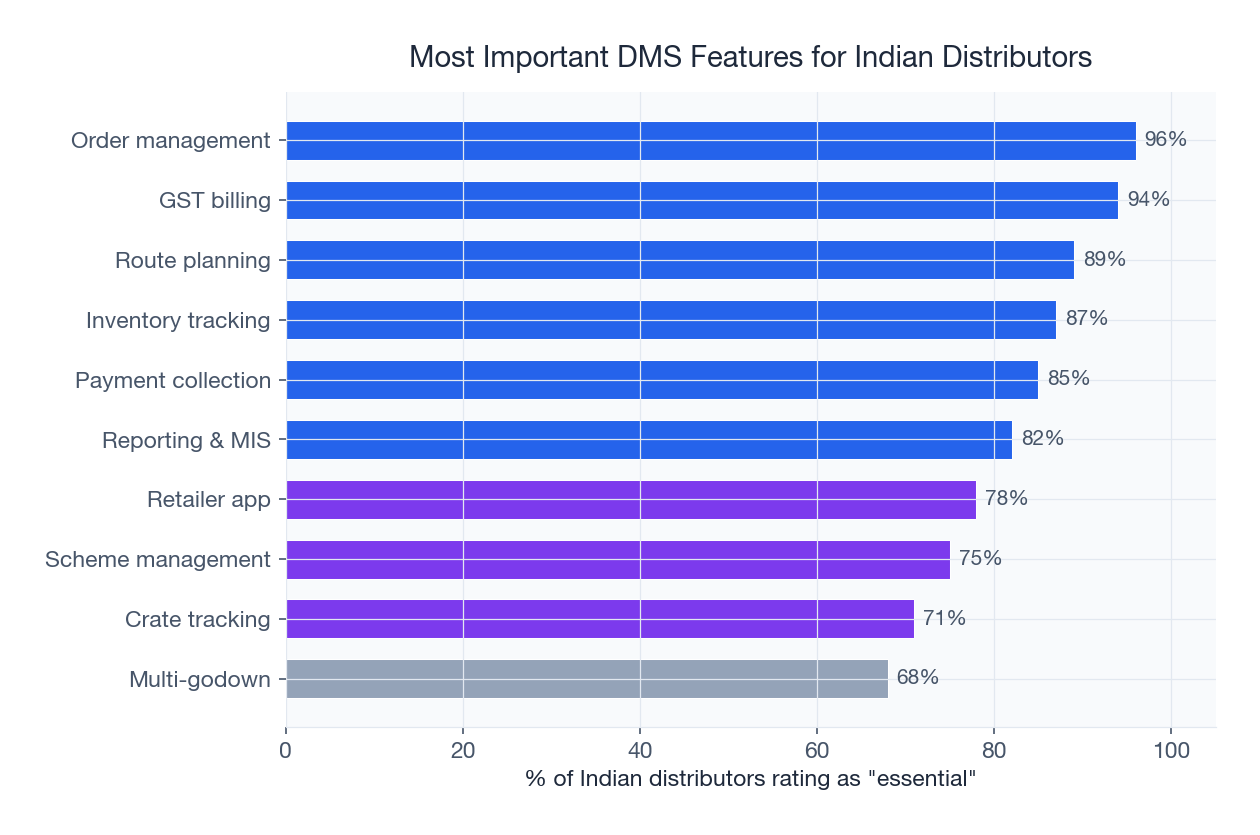
Implementation and Time to Value
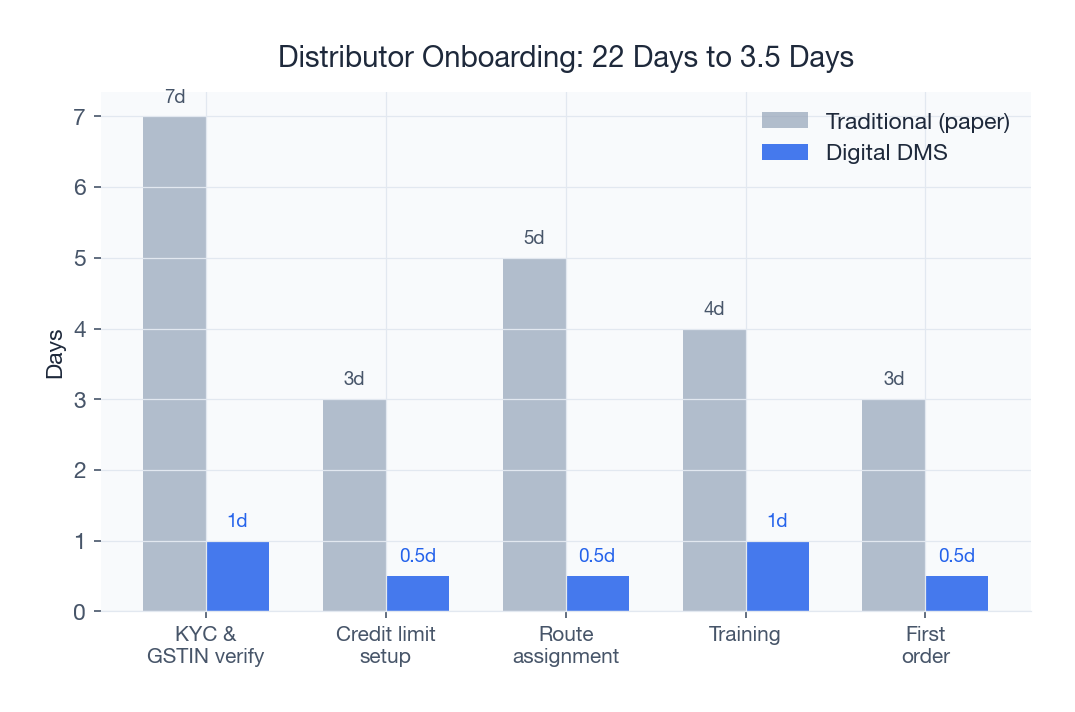
Implementation timelines are one of the starkest differences between these two platforms, and for growing brands, this difference can be the deciding factor.
SpireStock: 2-4 Weeks to Pilot
SpireStock's SaaS delivery model means there is no infrastructure to provision, no software to install, and no custom development required before you start. A typical implementation follows this timeline:
- Week 1: Account setup, data import (product catalog, distributor master, pricing), initial configuration of schemes and routes
- Week 2: Mobile app deployment to field staff, training sessions (typically 1-2 days per group), pilot with 20-30 distributors
- Weeks 3-4: Pilot refinement, workflow adjustments based on real-world usage, integration testing with Tally or accounting system
- Weeks 5-8: Full rollout across the distribution network
Self-service configuration means brands can modify schemes, routes, user permissions, and reporting without waiting for SpireStock's team. This independence accelerates time to value and reduces ongoing dependency. Read more about implementation best practices in our distribution management software guide.
Botree DMS: 3-6 Months Enterprise Implementation
Botree's enterprise implementation model reflects the platform's customisation depth and the complexity of deploying across large distributor networks:
- Months 1-2: Requirements gathering, solution design, customisation scoping, infrastructure setup
- Months 2-3: Custom development, integration building, data migration planning
- Months 3-4: UAT (user acceptance testing), pilot deployment, training rollout
- Months 4-6: Phased rollout across distributor network, stabilisation, fine-tuning
For large enterprises with 500+ distributors, complex multi-brand operations, and deep ERP integrations, this timeline is justified. The customisation that happens during months 1-3 ensures the platform fits the organisation's unique processes perfectly. But for a brand with 100 distributors that needs to digitise operations quickly, a 3-6 month timeline means delayed ROI and prolonged operational pain.
Pricing and Total Cost of Ownership
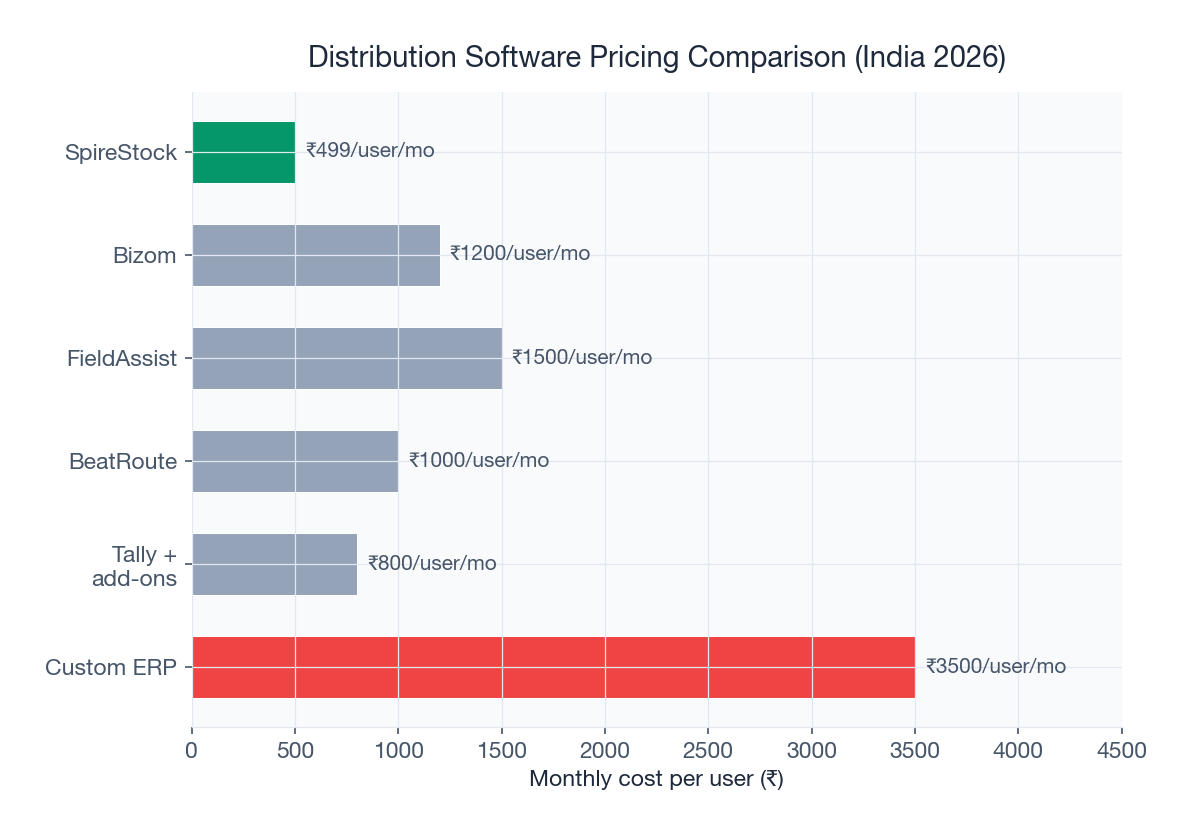
Pricing transparency is a significant differentiator between the two platforms, and for budget-conscious mid-market brands, it often becomes the deciding factor.
SpireStock: Transparent SaaS Pricing
SpireStock operates on a straightforward SaaS subscription model. Published pricing starts from Rs 5,000/month for small operations and scales to Rs 15,000/month for larger deployments. There are no hidden implementation fees, no annual lock-in contracts, and no surprise charges for standard features. Total cost of ownership for a 100-distributor operation typically looks like this:
| Cost Component | SpireStock (Annual) |
|---|---|
| Platform subscription | Rs 6-18 lakh |
| Implementation (one-time) | Rs 1-3 lakh |
| Training | Included |
| Infrastructure | Rs 0 (cloud-hosted) |
| Upgrades and maintenance | Rs 0 (included in subscription) |
| Support | Included |
| Year 1 Total | Rs 7-21 lakh |
| Year 2+ Total | Rs 6-18 lakh |
Botree DMS: Enterprise Pricing
Botree follows the traditional enterprise pricing model: quote-based pricing that varies based on the number of distributors, customisation requirements, and deployment complexity. Published pricing is not available, which makes budgeting difficult for brands in the evaluation phase. Based on market intelligence, typical costs for a similar 100-distributor operation look like this:
| Cost Component | Botree DMS (Annual) |
|---|---|
| Software license/subscription | Rs 15-35 lakh |
| Implementation and customisation | Rs 8-20 lakh (one-time) |
| Training | Rs 2-5 lakh |
| Infrastructure (if on-premise) | Rs 3-8 lakh |
| Annual maintenance and support | Rs 3-8 lakh |
| Upgrades | Rs 2-5 lakh per major release |
| Year 1 Total | Rs 33-81 lakh |
| Year 2+ Total | Rs 20-48 lakh |
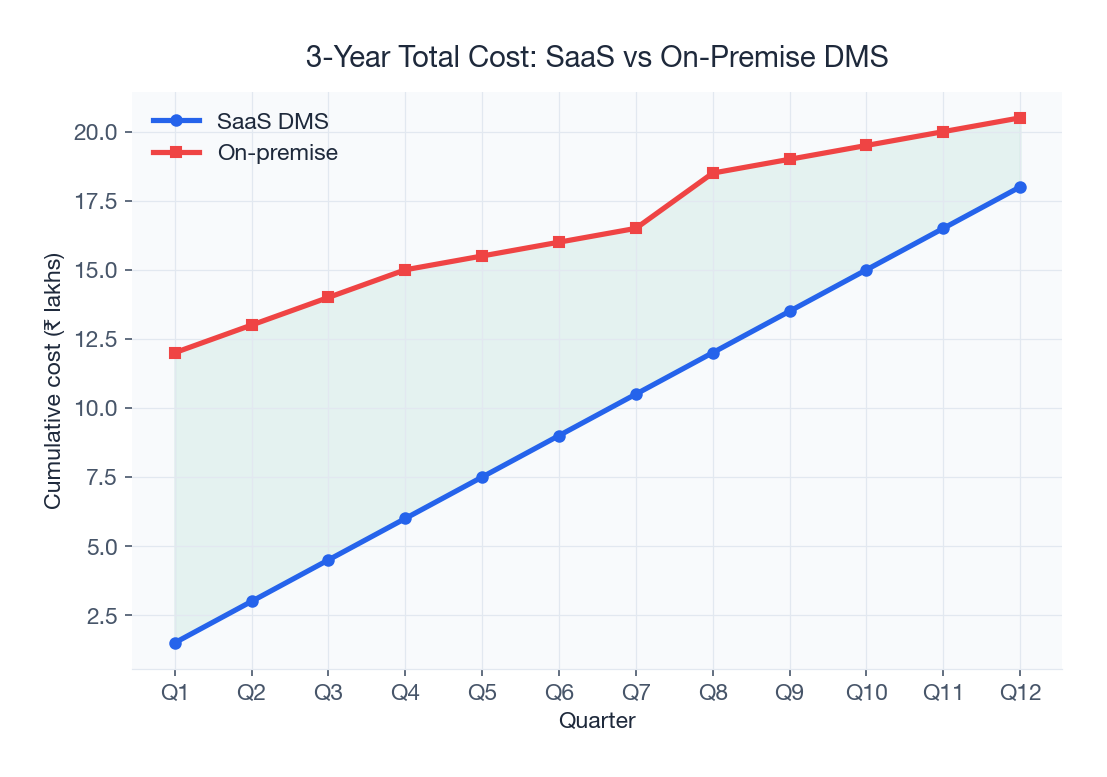
The TCO difference over a 3-year period can be 3-5x between the two platforms. For enterprises with large budgets and complex requirements, Botree's investment can be justified by the depth of customisation and scale it supports. For mid-market brands, the cost differential funds other growth initiatives. For a comprehensive analysis of pricing across the market, read our DMS pricing guide.
Best For: When to Choose SpireStock
SpireStock is the right choice when your requirements align with these scenarios:
- Mid-market brands (50-500 distributors) that need professional distribution management without enterprise complexity and cost
- Dairy and perishable distribution where daily recurring orders, crate tracking, expiry management, and cold chain awareness are non-negotiable requirements
- Fast implementation needed because you are losing money every month on manual processes and cannot wait 3-6 months for a system to go live
- Budget-conscious brands that need transparent pricing without multi-lakh implementation fees and annual lock-in contracts
- Modern mobile UX priority when your field staff turnover is high and you need a system that new hires can learn in a day, not a week
- Self-service configuration when you want to modify schemes, routes, and workflows without raising a support ticket and waiting for vendor bandwidth
- API-first integration when you need to connect your DMS with Tally, custom dashboards, or third-party logistics tools without middleware complexity
SpireStock is particularly strong for dairy companies that operate across categories. If you distribute milk, curd, paneer, buttermilk, and ice cream through overlapping networks, the distributor management solution handles multi-category complexity that general-purpose platforms treat as edge cases. Explore our dairy distribution page for more detail.
Best For: When to Choose Botree DMS
Botree DMS is the right choice in these situations:
- Large enterprises with 500+ distributors that need a platform proven at massive scale with reference customers in the same tier
- Heavy customisation requirements where standard workflows do not fit and you need deep platform modification to match unique business processes
- Existing Botree ecosystem when your company already uses Botree modules and switching costs outweigh the benefits of a newer platform
- Deep ERP integration with SAP or Oracle where Botree's established enterprise connectors reduce integration risk
- Multi-brand conglomerates managing diverse product portfolios across unrelated categories with complex inter-brand accounting
- Dedicated IT team available to manage implementation, customisation, and ongoing platform administration
- Long-term vendor stability important and the backing of Mitsui and Co. provides confidence in platform continuity
If you are a Rs 500+ crore FMCG company with a 20-person IT department and 1,000+ distributors, Botree's enterprise capabilities justify the investment. The platform's 25-year track record means your procurement team will find plenty of reference customers to validate the decision.
Migration: Moving from Botree to SpireStock
For brands that have outgrown Botree's cost structure or need faster iteration cycles, migration to SpireStock is a well-defined process. The key is planning the transition carefully to avoid disrupting daily distribution operations.
Data Migration Path
The critical data sets that need migration include:
- Master data: Distributor records, retailer databases, product catalogs, pricing structures, and GST configurations
- Transactional history: Outstanding balances, credit limits, pending claims, and active scheme records
- Route and beat data: Existing route plans, beat definitions, retailer-to-beat mappings, and delivery schedules
- Asset records: Crate balances, returnable asset positions, and outstanding deposit records
SpireStock's migration team provides CSV templates and API-based import tools for each data category. Most master data migration completes within 3-5 business days. Transactional history requires additional validation to ensure balances reconcile correctly between the old and new systems.
Parallel Running Strategy
The safest migration approach involves running both systems in parallel for 2-4 weeks. During this period:
- Orders are processed in SpireStock as the primary system
- Botree continues running in read-only mode for reference and validation
- Daily reconciliation reports compare outputs between the two systems
- Any discrepancies are investigated and resolved before full cutover
This parallel approach adds cost for the overlap period but eliminates the risk of a hard cutover that could disrupt distribution operations during the transition.
Training Considerations
Users migrating from Botree to SpireStock typically find the transition easier than expected. SpireStock's modern interface requires less training than Botree's feature-dense screens. Typical training timelines:
- Admin and supervisors: 2-3 days of structured training on configuration, reporting, and scheme management
- Dispatchers and warehouse staff: 1-2 days on order processing, dispatch planning, and crate reconciliation
- Field force: Half-day mobile app training, with the intuitive interface handling the rest through guided usage
- Finance team: 1 day on Tally integration setup, billing workflows, and financial reporting
SpireStock provides dedicated migration support for the first 4 weeks post-cutover, ensuring that any issues are resolved quickly without impacting daily operations. For more on choosing the right distribution software for your business, check our SaaS vs On-Premise guide.
Common Migration Risks and Mitigations
| Risk | Impact | Mitigation |
|---|---|---|
| Data quality issues in legacy system | Incorrect balances or duplicate records in new system | Pre-migration data audit and cleanup phase |
| Field staff resistance to change | Low adoption and workaround usage | Early involvement of field champions and incentive-aligned rollout |
| Scheme configuration differences | Incorrect scheme application during transition | Side-by-side scheme validation before go-live |
| Integration gaps | Data flow interruptions with ERP or accounting | Integration testing during parallel run period |
| Distributor confusion | Order processing delays during transition | Distributor communication plan with clear timelines |
Real-World Comparison Scenarios
Scenario 1: Regional Dairy Brand, 150 Distributors
A dairy company operating across Gujarat with 150 distributors handling milk, curd, paneer, and buttermilk evaluated both platforms. Botree quoted a 4-month implementation at Rs 42 lakh for Year 1. SpireStock went live in 3 weeks at Rs 12 lakh for Year 1. The dairy company's daily recurring order workflows, crate tracking needs, and 4 AM order cutoff schedules were native to SpireStock but required custom development in Botree. The company chose SpireStock and achieved full ROI within 14 weeks.
Scenario 2: Large FMCG Conglomerate, 800 Distributors
A packaged goods company with 800 distributors across 12 states needed deep SAP integration, multi-brand management, and customised reporting for its board. Botree's enterprise capabilities, specifically its SAP connector and custom analytics layer, made it the right choice despite the 5-month implementation timeline and Rs 65 lakh Year 1 investment. The scale and complexity of the operation justified the enterprise approach.
Scenario 3: Growing FMCG Brand, 200 Distributors
A fast-growing packaged food brand with 200 distributors across North India was using spreadsheets and Tally for distribution management. They needed to digitise quickly before the next season. Botree's 3-4 month timeline would have missed the seasonal window. SpireStock's 3-week pilot and 6-week full rollout allowed the brand to go digital before peak season, capturing Rs 28 lakh in scheme leakage recovery in the first quarter alone. See similar case studies in our comprehensive DMS guide.
The Honest Verdict
SpireStock and Botree DMS serve different segments of the Indian distribution market, and both serve their segments well. Trying to force one platform into the other's territory leads to frustration and wasted investment.
Choose SpireStock if you are a mid-market dairy or FMCG brand that values speed, transparency, modern UX, and purpose-built perishable distribution workflows. You will go live faster, spend less, and empower your field team with tools that feel contemporary rather than corporate.
Choose Botree if you are a large enterprise that needs deep customisation, massive scale, established ERP connectors, and a vendor with 25 years of enterprise deployment experience. You will invest more time and money upfront, but the platform's enterprise muscle will serve you well at scale.
If you are evaluating alternatives to Botree and want to see how SpireStock handles your specific workflows, book a free demo and bring your toughest use cases. We will show you exactly how the platform handles daily dairy orders, trade schemes, route optimisation, and crate management for your operation. Also review our comparison with other platforms: Tally vs Bizom vs FieldAssist, SpireStock vs Tally, and our Top 10 DMS Software India 2026 rankings.
This guide covers one part of the picture. For the category as a whole — what a DMS does, the modules that matter, how it differs from ERP and SFA, and what it costs in India — see our distributor management system guide.
Sources & References
- IBEF, India Brand Equity Foundation, FMCG Sector
- NDDB, National Dairy Development Board
- GST Council, Goods and Services Tax Council
- Botree Software, Botree Software International
Frequently Asked Questions
Botree DMS is an enterprise-grade distribution management system founded in 1997, now serving 93,000+ distributors across some of India's largest FMCG companies. It was acquired by Mitsui and Co. in 2022. Botree is primarily used by large enterprises with 500+ distributors that need deep customisation and have dedicated IT teams to manage the platform.
Yes, SpireStock is an excellent Botree alternative for mid-market dairy and FMCG brands (50-500 distributors). SpireStock offers cloud-native architecture, transparent pricing (Rs 5K-15K/month vs Botree's enterprise pricing), faster implementation (2-4 weeks vs 3-6 months), and purpose-built perishable distribution features that Botree treats as configurable add-ons.
SpireStock typically goes live with a pilot in 2-4 weeks and achieves full rollout in 6-8 weeks. Botree's enterprise implementation takes 3-6 months due to customisation requirements, infrastructure provisioning, and phased rollout across large distributor networks.
SpireStock uses transparent SaaS pricing from Rs 5,000-15,000/month with no hidden implementation fees. Botree uses enterprise quote-based pricing with implementation costs of Rs 8-20 lakh, training costs, annual maintenance fees, and potential infrastructure costs. Over 3 years, SpireStock's TCO is typically 40-60% lower for comparable deployments.
Yes, SpireStock provides a structured migration path from Botree including master data import, transactional history migration, parallel running for 2-4 weeks, and dedicated migration support. Most migrations complete within 4-6 weeks without disrupting daily distribution operations.
SpireStock is purpose-built for dairy and perishable distribution with native support for daily recurring orders, crate tracking, expiry management, cold chain-aware route optimisation, and production-unit-based order cutoffs. Botree handles general FMCG distribution well but treats dairy-specific requirements as configurable features rather than core capabilities.
Botree has been transitioning from its on-premise roots to cloud delivery over recent years. The platform now offers hybrid deployment options, but its architecture retains legacy characteristics including monolithic components and middleware-based integrations. SpireStock is cloud-native from day one with no on-premise heritage.
Not necessarily. While Botree has proven scale with 93,000+ distributors, SpireStock's cloud architecture scales efficiently for growing networks. The decision should be based on complexity (multi-brand, deep ERP integration, heavy customisation) rather than distributor count alone. Many 500+ distributor operations run well on SpireStock.
Related SpireStock Features
End-to-end order lifecycle from placement to delivery with multi-level approval workflows.
Complete returnable crate tracking across plant, transporter, and retail levels.
Zone, town, and route-based delivery management with optimization.
Flexible incentive schemes, flat, bulk-pack, and quantitative, applied automatically.
Powerful dashboards with sales trends, MIS reports, and distribution analytics.
Related Industries
End-to-end dairy distribution software for milk, curd, paneer, and ghee brands. Manage orders, crates, cold chain, and GST billing in one platform.
Streamline FMCG distribution with order management, beat planning, retailer tracking, and GST billing. Built for Indian FMCG supply chains.
Related Entities
Ready to Streamline Your Distribution?
Start your free 14-day trial and see how SpireStock can transform your dairy, FMCG or consumer-goods distribution operation, from order capture to crate recovery.

SpireStock Team
Distribution Technology Experts
SpireStock Team writes for SpireStock on distribution management, supply-chain optimisation and field operations for Indian dairy and FMCG brands.