Why Small FMCG Brands Need SFA Differently
Sales force automation for small Indian FMCG brands is not a scaled-down version of what large companies use. It is a fundamentally different problem. When Hindustan Unilever deploys SFA, they have a 50-person IT team, a Rs 10 crore technology budget, and 6 months to implement. When a small brand doing Rs 3–8 lakh per month in revenue considers SFA, they have the founder’s personal phone, a budget of maybe Rs 15,000–25,000 per month, and need results within weeks.
Yet small brands need sales force automation just as much as large ones — arguably more. A large brand can absorb the inefficiency of untracked field staff and missed retail visits. A small brand operating on 8–15% net margins cannot afford a single wasted sales call. Every day a salesman skips a beat, every retailer visit that does not convert to an order, and every scheme that is incorrectly applied directly threatens survival.
According to the India Brand Equity Foundation (IBEF), the Indian FMCG market has over 10,000 brands, with the vast majority being small and regional players. These brands collectively command significant market share in their local territories but lack the technology infrastructure that national brands enjoy.
What Small-Brand SFA Must Do (and Must Not Do)
The SFA requirements for a brand with 5–50 salesmen serving 200–2,000 retailers are specific:
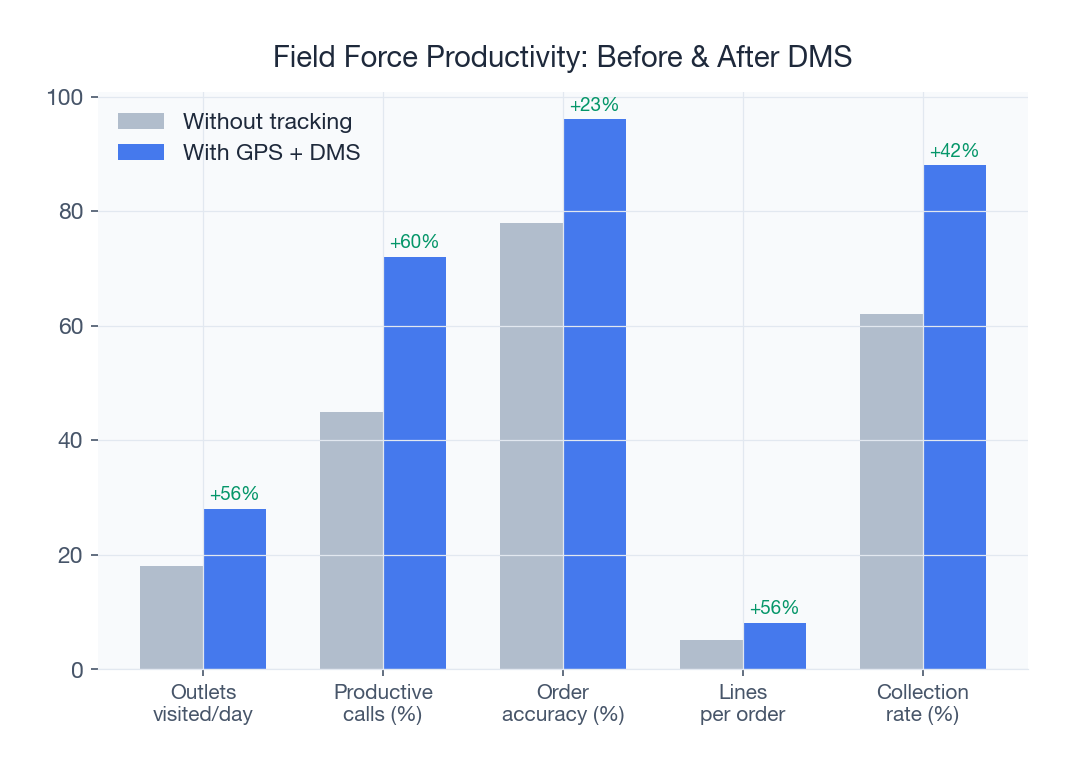
- Track where salesmen actually go — GPS-based visit verification, not just self-reported check-ins. This is the single most impactful SFA feature for small brands. Studies suggest that unmonitored field staff productive visit rates can be as low as 40–60%.
- Enforce beat adherence — Ensure salesmen follow their assigned beats and visit the retailers they are supposed to visit, in the sequence planned. Read our detailed guide on beat planning software for FMCG to understand why this matters.
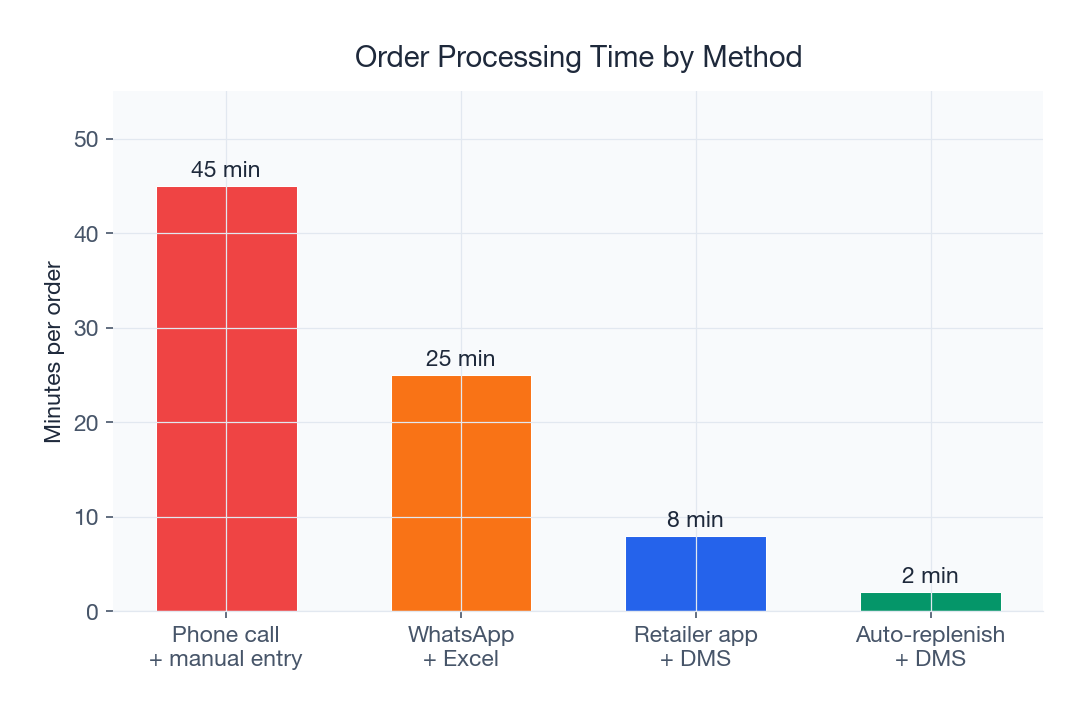
- Capture orders digitally — Eliminate the WhatsApp/phone-call order chain that loses information and delays processing.
- Calculate schemes automatically — Even small brands run trade schemes. Manual calculation leads to errors and disputes. A scheme management engine handles this cleanly.
- Provide daily performance visibility — The founder or sales manager needs a daily dashboard showing: visits completed, orders taken, value booked, and collection done.
- Work on cheap smartphones offline — Your salesmen use Rs 8,000–12,000 Android phones. The app must work on 2GB RAM devices with intermittent internet across tier-2 and tier-3 cities.
What small-brand SFA must NOT do is overwhelm users with enterprise features. AI-powered retail intelligence, computer-vision shelf audits, and predictive analytics sound impressive but add complexity and cost that a 10-person sales team does not need. Start simple. Add capabilities as you grow.
The Small Brand SFA Tech Stack
Here is the practical technology stack for a small FMCG brand with 5–50 salesmen:
| Component | Budget Option | Recommended Option | Monthly Cost |
|---|---|---|---|
| SFA mobile app | Basic SFA app (single function) | Integrated DMS with SFA module | Rs 1,500–3,000/user |
| Beat planning | Manual (Excel-based beats) | Software-generated optimal beats | Included in DMS |
| Order management | WhatsApp + Tally entry | Digital order capture with approval workflow | Included in DMS |
| Invoicing | Tally manual entry | Auto-generated GST invoices with Tally sync | Included in DMS |
| GPS tracking | Google Maps timeline (manual check) | Automated GPS with geo-fence verification | Included in DMS |
| Analytics | Excel pivot tables | Real-time dashboards | Included in DMS |
| Smartphones | Existing personal phones | Company-provided Rs 8,000–12,000 devices | Rs 500–800/mo (amortized) |
| Data plans | Personal data | Company-sponsored 1.5 GB/day plans | Rs 300–500/user/mo |
For a 10-person field team, the total monthly cost for a recommended SFA setup is Rs 25,000–45,000 — roughly the cost of one additional entry-level salesman. But it makes every existing salesman 30–50% more productive.
Beat Planning on a Budget
Beat planning is the foundation of field sales productivity. Without structured beats, salesmen visit easy retailers, skip difficult ones, and waste time on inefficient routes. For small brands, the field force tracking enabled by proper beat planning is transformative.
Step 1: Map Your Retailer Universe
Before any software, list every retailer your brand should be reaching. Include name, location, category (grocery, medical, general trade), and current monthly order value. For a small brand, this is typically 200–2,000 retailers across 1–5 cities.
Step 2: Define Beat Frequency
Not every retailer needs weekly visits. Segment by value:
- A-class retailers (top 20% by value) — Weekly visits, priority order taking.
- B-class retailers (next 30%) — Bi-weekly visits.
- C-class retailers (bottom 50%) — Monthly visits or tele-calling.
This ABC classification ensures your limited sales force spends maximum time on high-value outlets. A salesman visiting 25–30 outlets per day should cover all A-class retailers weekly and all B-class bi-weekly.
Step 3: Create Geographic Beats
Group retailers by geography to minimize travel time. A beat should be a compact geographic cluster that one salesman can cover in one day (25–35 visits). For a small brand in Pune, this might mean beats like “Kothrud-Karve Nagar,” “Hadapsar-Magarpatta,” or “Pimpri-Chinchwad.”
Step 4: Assign and Monitor
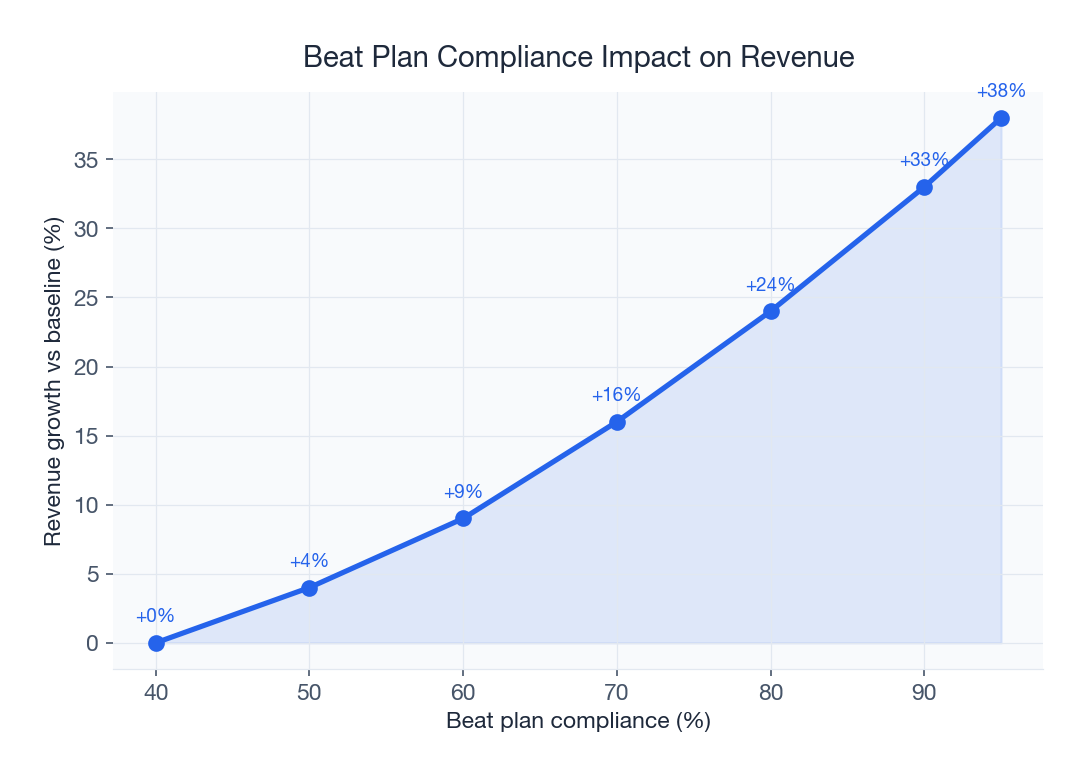
Assign beats to salesmen based on territory knowledge, language (critical in multi-lingual cities like Bangalore or Hyderabad), and relationship history. Then track adherence daily. The single most important metric is beat adherence rate — the percentage of planned visits actually completed. Target: 90%+ adherence.
Mobile-First SFA: What Actually Works in the Field
Enterprise SFA demos look great on large screens in air-conditioned conference rooms. What matters is how the app performs in a salesman’s hands on a hot day in Ahmedabad, with 2G connectivity, on a Rs 9,000 smartphone with 15 other apps fighting for memory.
Practical mobile SFA requirements for small Indian brands:
- App size under 50 MB — Large apps get deleted by salesmen running low on storage.
- Offline-first architecture — The app must function fully without internet and sync when connectivity is available. In tier-2 cities, connectivity drops are frequent.
- One-tap order capture — Pre-loaded retailer catalog with last-order history. A repeat order should take under 30 seconds.
- Auto-GPS logging — GPS tracking should be automatic and battery-efficient. Apps that drain battery by 50% in a day get disabled by salesmen.
- Vernacular interface — Hindi at minimum. Marathi, Tamil, Kannada, and Telugu for regional operations. If your salesman in Coimbatore cannot read the interface in Tamil, adoption will fail.
- Photo and note capture — Shelf photos, competitor displays, retailer feedback — all captured in-app and linked to the visit record.
Implementation Roadmap for Small Brands
Do not try to implement everything at once. Small brands should follow a phased approach:
| Phase | Duration | Focus | Expected Outcome |
|---|---|---|---|
| Phase 1: Track | Week 1–2 | GPS tracking + beat assignment | Visibility into field team activities |
| Phase 2: Capture | Week 3–4 | Digital order capture + Tally sync | Eliminate manual order entry errors |
| Phase 3: Optimize | Month 2 | Beat optimization + scheme automation | 20–30% improvement in productive calls |
| Phase 4: Analyze | Month 3 | Sales analytics + territory insights | Data-driven territory management |
Cost-Benefit Analysis for a 10-Person Sales Team
Here is the realistic math for a small FMCG brand with 10 salesmen, Rs 5 lakh monthly revenue, and 500 retail outlets:
- SFA software cost: Rs 2,500/user/month x 10 users = Rs 25,000/month (Rs 3 lakh/year).
- Smartphone provision: Rs 10,000 x 10 phones = Rs 1 lakh one-time (Rs 33,000/year amortized over 3 years).
- Data plans: Rs 400/user x 10 = Rs 4,000/month (Rs 48,000/year).
- Total annual SFA cost: Rs 3.8 lakh.
Against this, expected savings and revenue gains:
- Increased productive visits: From 60% to 85% adherence = 42% more actual selling time. At Rs 5 lakh monthly revenue, even a 10% conversion improvement adds Rs 50,000/month (Rs 6 lakh/year).
- Reduced order errors: Elimination of phone/WhatsApp ordering saves Rs 8,000–12,000/month in correction costs (Rs 1–1.4 lakh/year).
- Scheme accuracy: Eliminating 5–8% scheme leakage on Rs 20,000/month scheme budget saves Rs 12,000–19,200/year.
- Faster collections: Real-time outstanding visibility reduces collection cycle by 5–8 days, improving cash flow.
- Total estimated annual benefit: Rs 7–9 lakh.
Net ROI: 85–135% in the first year. Payback period: 5–7 months.
Common Mistakes Small Brands Make with SFA
Based on patterns across hundreds of small FMCG implementations in India:
- Buying enterprise software — A 10-person team does not need Bizom or SAP. Over-specifying leads to wasted budget and adoption failure.
- Skipping beat planning — Deploying SFA without structured beats is like installing a GPS without a destination. The software tracks activity but does not drive outcomes.
- Ignoring salesman resistance — Field staff often resist GPS tracking. Frame it as a productivity tool, not a surveillance tool. Show them how it reduces their paperwork.
- Not integrating with billing — SFA that does not connect to invoicing creates double work. Ensure orders captured in the app flow directly into GST invoice generation. The GST Council’s e-invoicing mandate (currently for businesses above Rs 5 crore turnover) makes digital invoicing a compliance necessity.
- Expecting instant results — SFA impact builds over 8–12 weeks. The first month is learning. Real productivity gains appear from month 2 onward.
Choosing the Right SFA for Your Small Brand
For small FMCG brands in India, the ideal SFA platform should cost Rs 1,500–3,000 per user per month, work offline on budget smartphones, include beat planning and GPS tracking, integrate with Tally, and offer quick implementation (under 2 weeks). Platforms that meet these criteria include SpireStock (especially strong for dairy and FMCG distribution), FieldAssist (good mid-market option), and BeatRoute (strong on engagement-driven selling).
If your brand handles dairy or perishable products, SpireStock’s integrated DMS+SFA platform gives you field force automation alongside crate management, expiry tracking, and cold chain compliance in a single system. Book a free demo to see how it works for small-brand operations, or explore our pricing plans designed for growing brands.
Sources & References
Frequently Asked Questions
For a 10-person sales team, expect Rs 25,000–45,000 per month total cost including software subscriptions (Rs 1,500–3,000/user/month), smartphone amortization, and data plans. Annual total cost is approximately Rs 3–5 lakh, which typically delivers Rs 7–9 lakh in annual benefits through increased productivity and reduced errors.
SFA becomes valuable with as few as 5 field salesmen. At this size, GPS-based tracking alone provides enough visibility improvement to justify the cost. For teams of 3 or fewer, basic tools like Google Maps timeline and WhatsApp may suffice, though even small teams benefit from structured beat planning.
Yes, modern SFA platforms designed for India support offline operation. Field staff can capture orders, record visits, take photos, and log GPS locations without internet. Data syncs automatically when connectivity is restored. This is essential for operations in tier-2 and tier-3 cities where internet is unreliable.
A small brand with 5–50 salesmen can implement basic SFA (GPS tracking + digital order capture) in 1–2 weeks. Full implementation including beat planning, scheme automation, and analytics takes 4–6 weeks. The phased approach — track first, capture second, optimize third — ensures smooth adoption without disrupting daily operations.
Beat planning is the process of assigning specific retail outlets to salesmen on specific days, creating an optimal visiting schedule. For small brands, beat planning is critical because it ensures every retailer gets visited at the right frequency, prevents salesmen from cherry-picking easy outlets, and maximizes productive selling time. Good beat planning can improve productive visit rates from 60% to 90%+.
No. For small brands, an integrated platform that combines sales force automation with distribution management (order processing, invoicing, inventory) is more practical and cost-effective than separate systems. SpireStock, for example, provides both SFA and DMS in a single platform, eliminating data duplication and integration headaches.
Related SpireStock Features
Related Industries
Related Solutions
Boost field sales team productivity with beat planning, GPS attendance, order capture, and performance analytics. Built for Indian FMCG teams.
Track and manage your retail network. Geo-tag outlets, capture secondary sales, manage beats, and monitor retailer performance. Try SpireStock.
Related Entities
Ready to Streamline Your Distribution?
Start your free 14-day trial and see how SpireStock can transform your dairy, FMCG or consumer-goods distribution operation, from order capture to crate recovery.

SpireStock Team
Product & Industry Insights
SpireStock Team leads product at SpireStock, where the team ships distribution management software for India's dairy, FMCG and consumer-goods brands.