Hyderabad: India's Emerging Cold Chain Hub
Hyderabad sits at the crossroads of India's pharma, biotech, dairy and frozen foods industries, four sectors that all depend on flawless cold chain logistics. The city's central geographic position, relatively smooth inter-state road connectivity and growing modern retail footprint have made it a natural hub for temperature-controlled distribution across South India and beyond. For operators serving Telangana and the surrounding states of Andhra Pradesh, Karnataka and Maharashtra, Hyderabad is often the anchor city for regional cold chain networks.
But the city's climate and scale put cold chain systems under constant pressure. Summer temperatures cross 44 degrees C, humidity varies wildly and demand for fresh dairy, ice cream and frozen ready-meals has grown by 18-22% annually. A cold chain failure isn't just an operational hiccup, it's a direct hit to margins, food safety and brand reputation.
Hyderabad Cold Chain Market Snapshot
| Metric | Hyderabad | Telangana |
|---|---|---|
| Population (2026) | 1.1 crore | 3.9 crore |
| Annual temperature-controlled FMCG market | Rs 4,200 crore | Rs 7,600 crore |
| Cold storage capacity (licensed) | 2.8 lakh MT | 5.1 lakh MT |
| Reefer vehicles in operation | 3,400+ | 6,800+ |
| Peak summer ambient | 44 degrees C | 46 degrees C |
| Dairy, frozen, pharma share | 48% / 22% / 30% | 51% / 18% / 31% |
| Growth rate | 18-22% | 14-17% |
Why Hyderabad's Cold Chain Is Uniquely Demanding
1. Four Industries in One City
Dairy (Heritage, Dodla, Creamline), ice cream (Cream Stone, Arun, Naturals), frozen foods (Tanzy, Sumeru, iD Fresh) and pharma (Dr. Reddy's, Divi's) all compete for cold chain infrastructure. Platforms serving Hyderabad need multi-industry flexibility, the same dairy distribution tool won't natively handle frozen ready meals without category-specific features.
2. Extreme Heat During Long Summers
Temperatures above 40 degrees C persist from March to June. Any break in the cold chain, even a 20-minute door-open at a retail outlet, can compromise product quality. Real-time distribution tracking with temperature alerts has become mandatory for any serious operator.
3. Long-Haul Distribution Responsibilities
Many Hyderabad warehouses serve secondary cities like Warangal, Karimnagar, Vijayawada and Vizag. Long reefer hauls require IoT-enabled vehicles, fuel-efficient routing and robust fleet management.
4. Retailer Fragmentation
Hyderabad has over 95,000 retail outlets, many of which have limited refrigeration. Distributors often need to balance delivery frequency (more frequent = lower outlet inventory needs) with route efficiency (less frequent = lower cost per drop). This trade-off can only be solved with route optimization that factors in per-outlet storage capability.
5. Regulatory and Quality Pressure
FSSAI requires documented cold chain records. Modern Trade chains demand temperature logs at goods-in. Pharmaceutical clients mandate GDP (Good Distribution Practice) compliance. A capable billing and documentation module that generates compliance-ready PDFs automatically is a significant time saver.
Technology Powering Hyderabad's Cold Chain
IoT Temperature Monitoring
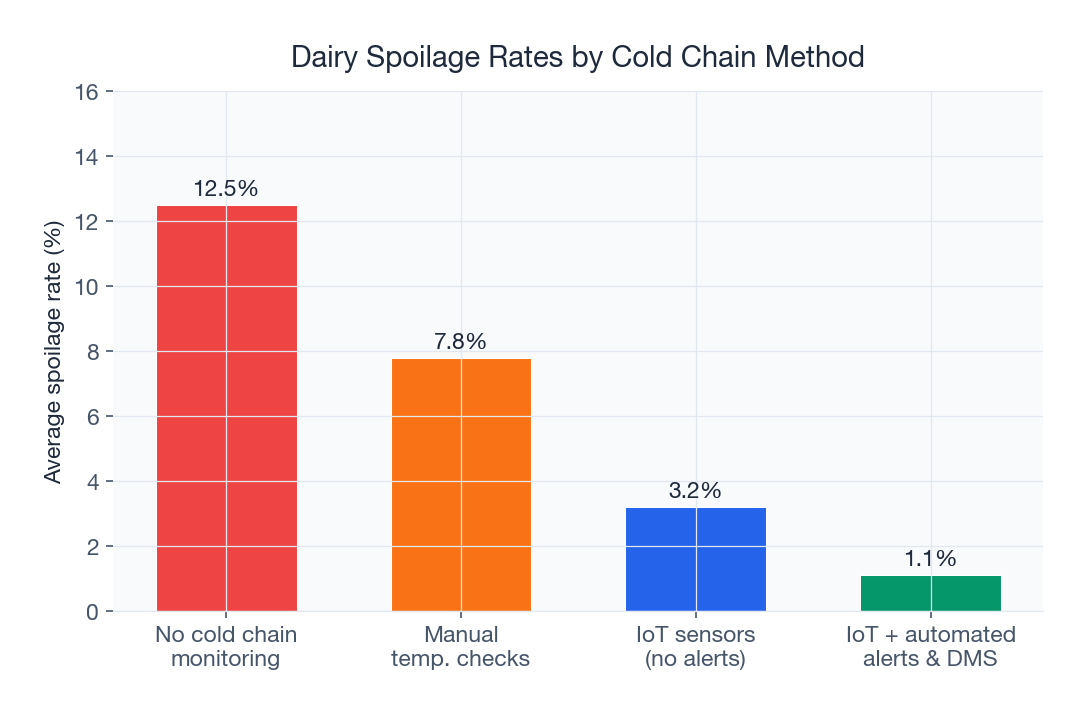
Sensors in reefers, BMCs and cold rooms transmit readings every 30-60 seconds. Alerts trigger the moment temperatures deviate from acceptable bands, giving supervisors minutes instead of hours to react.
Route Optimisation for Temperature-Sensitive Loads
Not all drops are equal. Temperature-sensitive drops should be sequenced first; less sensitive ones later. Route optimisation engines now incorporate SKU-temperature profiles to maintain cold chain integrity without sacrificing route efficiency.
Warehouse Management Integration
Cold rooms have zone-specific temperature ranges. A modern order management system integrated with warehouse zoning ensures pickers select from the correct zone, preventing cross-contamination and temperature shock.
Reefer Telematics and Driver Behaviour
Door-open frequency, cooling unit run time and average cabin temperature are all KPIs Hyderabad operators now monitor daily. Driver-level tracking tied to vehicle telematics exposes the beats where cold chain is being compromised.
Analytics for Spoilage Reduction
Cold chain failures leave a data trail. Analytics dashboards that compare spoilage by route, driver, vehicle and time-of-day help operators eliminate the root causes rather than fight symptoms.
Case Study: A Hyderabad Dairy Brand's Cold Chain Turnaround
A mid-sized dairy brand based in Cyberabad was losing Rs 18 lakh monthly to spoilage during summers. After deploying an integrated cold chain platform, IoT sensors, route optimisation, driver telematics and distribution tracking, spoilage dropped to under Rs 2 lakh monthly within 4 months. The platform paid for itself within 6 weeks, and the brand expanded into Vizag and Vijayawada on the strength of the new operational confidence.
Hyderabad Cold Chain Best Practices
- Pre-cool reefers for 30 minutes before loading
- Set temperature alerts at 2 degrees C above target, not at failure point
- Limit door opens to under 45 seconds per drop
- Use multi-compartment reefers for mixed-temperature loads
- Reconcile temperature logs daily, not monthly
- Train drivers on the cost of each cold chain break
- Invest in backup power for cold rooms, at least 4 hours of diesel backup
The Future of Hyderabad Cold Chain
Solar-powered reefers, autonomous last-mile vehicles and AI-based demand forecasting are all in pilot in Hyderabad. The operators that will dominate the next decade are those building flexible, data-driven cold chain operations today. To benchmark your own operation against leaders, review our 2026 distribution software rankings, compare options on SpireStock pricing, or talk to our Hyderabad cold chain team about a 30-day assessment.
Hyderabad's Cold Chain Zones in Detail
Cyberabad and HITEC City
The IT and biotech hub of Hyderabad is a cold-chain hotspot, not just for dairy but also for pharmaceutical cold-chain cargo bound for global markets. Shared cold storage facilities here must maintain multiple temperature zones simultaneously. Distributors serving IT canteens, premium retail and modern trade in this corridor benefit from IoT-enabled tracking that validates temperature integrity at every handover.
Banjara Hills and Jubilee Hills
Affluent residential with strong modern retail and HORECA presence. Premium SKUs dominate, imported cheeses, organic yogurt, artisanal butter and cold-pressed juices. Losing a batch here to cold chain failure costs 2-3x a regular batch due to SKU pricing.
Secunderabad and Old City
Traditional retail with dense kirana networks. Cold chain compliance here is more challenging because outlet-level refrigeration is less reliable. Distributors need to deliver multiple times per day rather than stocking one day's inventory at a single outlet.
Kompally, Medchal and Shamirpet
Northern suburbs with growing residential populations and emerging modern trade. Cold chain distribution here requires longer-haul reefer runs combined with efficient last-mile sequencing.
Multi-Category Cold Chain Complexity
A single Hyderabad cold chain operator may handle dairy (2-4 degrees C), frozen foods (-18 degrees C or lower), ice cream (-22 degrees C), chocolate (14-18 degrees C), fresh produce (5-12 degrees C) and pharmaceuticals (2-8 degrees C with strict GDP compliance). Each category demands distinct SOPs, vehicle compartments and handling protocols. Platforms that support multi-category workflows natively outperform generic distribution tools by a wide margin.
Cold Room Operations and Backup Power
Hyderabad's power supply has improved significantly, but summer outages of 30-60 minutes still occur in industrial zones. Cold rooms need 4-8 hours of diesel backup, and temperature excursions must be logged automatically. IoT-enabled cold rooms with cellular alerting ensure that a warehouse manager gets notified within 60 seconds of any temperature excursion.
Reefer Fleet Economics
A reefer truck costs Rs 18-28 lakh to acquire and Rs 45-70 per km to operate. Optimising utilisation is critical to unit economics. Distributors using integrated fleet management typically run reefers at 85%+ utilisation compared to 55-65% for paper-based operations. That's a 30% efficiency gap that compounds over years.
The Andhra Pradesh and Telangana Market Overlap
Many Hyderabad warehouses also serve Vijayawada, Vizag, Guntur, Kakinada and Tirupati. Inter-state operations add GST complexity, Andhra Pradesh has its own registration, e-way bill workflow and compliance calendar. Multi-GSTIN billing platforms handle this seamlessly, while generic tools force manual workarounds.
Pharmaceutical Cold Chain: A Special Case
Hyderabad is home to major pharmaceutical exporters, Dr Reddy's, Divi's, Biological E, Bharat Biotech. Their cold chain requirements include GDP (Good Distribution Practice) compliance, tamper-evident packaging, validated temperature logs, chain-of-custody documentation and audit-ready reports. Distribution software for pharma cold chain is a specialised segment, but the principles overlap significantly with food-grade dairy cold chain.
KPIs Hyderabad Cold Chain Operators Should Track
| KPI | Average | Top-Quartile |
|---|---|---|
| Temperature excursions per month | 12-18 | Under 2 |
| Spoilage rate (dairy) | 3-5% | Under 0.5% |
| Reefer utilisation | 60% | 85%+ |
| GDP compliance score | 82% | 98%+ |
| Cold room downtime | 4 hours/month | Under 30 min/month |
| Delivery on-time | 88% | 97%+ |
Emerging Technologies in Hyderabad's Cold Chain
- Solar-powered reefer trailers, Reducing diesel dependency on long-hauls to Vizag and Vijayawada
- IoT-based gate monitoring, Auto-logging every loading/unloading with photo-proof
- AI demand forecasting, Weather-aware reorder triggers for ice cream and flavoured milk
- Blockchain cold chain, Immutable temperature records for pharma and premium dairy
- Drone-based cold chain monitoring, Early-stage pilots at large warehouses
Investment Priorities for Hyderabad Cold Chain Operators
If you are operating cold chain in Hyderabad today, the top three investments to prioritise are:
- IoT-enabled temperature monitoring across every link in the chain
- Integrated fleet management with real-time visibility
- Multi-category-aware DMS that handles dairy, frozen, ambient and pharma simultaneously
Returns on these investments typically show up within 3-6 months in the form of reduced spoilage, better fleet utilisation and fewer compliance issues.
Final Word
Hyderabad's emerging status as South India's cold chain hub means the operators who build strong technology foundations now will capture disproportionate market share over the next 5 years. Explore our 2026 distribution software rankings, review SpireStock pricing for cold chain operators, or book a Hyderabad cold chain assessment with our specialists.
Cold Chain Infrastructure Map of Hyderabad
Hyderabad's cold chain ecosystem includes over 60 licensed cold storage facilities spanning Medchal, Shamshabad, Hayathnagar and Sanathnagar. Many of these are multi-tenant facilities shared across dairy, frozen foods and pharmaceutical cargo. Coordinating loading schedules, temperature zones and SKU-specific handling requirements across such a shared ecosystem demands strong operational software.
Reefer Fleet Management Realities
A reefer truck in Hyderabad typically covers 200-350 km daily between warehouse and retail. Fuel, maintenance, driver wages, refrigeration unit costs and depreciation add up to Rs 50-80 per km. Utilisation matters enormously: a reefer at 60% utilisation is barely breakeven, while one at 85% is strongly profitable. Modern fleet management tools that balance load assignment and route sequencing push utilisation toward the higher end.
Secondary City Expansion
From Hyderabad, distribution reaches Warangal, Karimnagar, Nizamabad, Vijayawada, Vizag, Tirupati and beyond. Each secondary city adds complexity, state borders, regional language support, different retail density. A capable DMS manages this via territory hierarchies, multi-GSTIN billing and language-adaptive mobile apps.
Pharma Cold Chain Standards Affecting FMCG
Hyderabad's strong pharma cold chain ecosystem has raised standards across the board. Food and dairy operators now routinely adopt GDP-like practices, documented temperature logs, chain-of-custody records, validated equipment, that were previously pharma-only. This creates a virtuous circle: higher standards reduce spoilage, which improves margins, which funds further investment.
Sustainability and Carbon Footprint
Reefer operations are carbon-intensive. Electric reefers, solar-assisted refrigeration and optimised routing all reduce fleet emissions. Modern trade chains increasingly demand carbon accountability reports from suppliers. Distributors that measure and minimise their cold chain carbon footprint gain a competitive edge in modern-trade negotiations.
Investment Priorities for the Next 24 Months
- IoT temperature monitoring across every reefer and cold room
- GPS-based fleet management with real-time alerts
- Multi-category workflows in DMS (dairy, frozen, pharma)
- Electric or hybrid reefer pilot programmes
- Advanced analytics for spoilage root-cause analysis
- Integration with carbon reporting tools
The Future of Hyderabad Cold Chain
Hyderabad's cold chain sector is poised for significant transformation over the next 3-5 years. Key developments to watch include the rise of sustainable packaging and EPR compliance, the shift toward electric reefer vehicles, the emergence of automated warehouses with robotic picking, the integration of blockchain-based temperature logs for pharma-grade traceability, and the growth of D2C frozen food brands that demand new cold chain capabilities.
Operator Recommendations
If you are a cold chain operator in Hyderabad today, our top three recommendations are: invest in IoT temperature monitoring across every link in your chain, deploy a distribution platform that supports multiple cold chain categories, and build strong analytics capabilities for spoilage root-cause analysis. These three investments reliably deliver 3x ROI within 12 months and set the stage for sustained competitive advantage.
Partnership Opportunities
Hyderabad's cold chain ecosystem is collaborative. Operators often share reefer capacity, warehouse space and even route information to optimise costs. Forming partnerships with complementary players can multiply effective fleet capacity without additional capex. Software platforms that support multi-party logistics coordination make these partnerships operationally feasible.
Sources & References
Frequently Asked Questions
Hyderabad's temperatures exceed 40°C for 4-5 months, making cold chain integrity essential for dairy and perishable goods. Without proper cold chain management, spoilage losses can reach 15-20% of revenue, significantly impacting profitability.
Hyderabad has a growing cold chain infrastructure including cold storage facilities, refrigerated transport fleets, and IoT monitoring solutions. However, gaps remain at the retail level where many stores lack adequate refrigeration.
Route optimization minimizes time-in-transit, which is the primary risk factor for cold chain breaks. By planning routes that prioritize speed over distance and schedule deliveries during cooler hours, distributors significantly reduce spoilage risk.
FSSAI requires documented temperature maintenance throughout the food distribution chain. This includes temperature logs during storage and transit, proper vehicle certification, and compliance documentation. Digital platforms automate this record-keeping.
Yes. SpireStock integrates with IoT temperature sensors, provides time-optimized route planning, and generates cold chain compliance reports. The platform is used by dairy distributors across South India, including operations in Hyderabad.
Related SpireStock Features
Related Industries
End-to-end dairy distribution software for milk, curd, paneer, and ghee brands. Manage orders, crates, cold chain, and GST billing in one platform.
Manage beverage distribution with cold chain tracking, crate management, route optimization, and real-time delivery monitoring. Try SpireStock free.
Related Solutions
GPS fleet tracking, driver management, and route optimization for dairy and FMCG delivery vehicles. Reduce fuel costs by 25%. Try SpireStock.
Manage your entire distributor network digitally. Onboarding, credit limits, outstanding tracking, and performance analytics. Start free trial.
Related Entities
Ready to Streamline Your Distribution?
Start your free 14-day trial and see how SpireStock can transform your dairy, FMCG or consumer-goods distribution operation, from order capture to crate recovery.

SpireStock Team
Distribution Technology Experts
SpireStock Team writes for SpireStock on distribution management, supply-chain optimisation and field operations for Indian dairy and FMCG brands.