What Is a CFA (Carrying and Forwarding Agent)?
A Carrying and Forwarding Agent (CFA) is a third-party logistics intermediary that receives goods from an FMCG manufacturer, stores them at a regional warehouse or depot, and forwards them to distributors on behalf of the brand. The CFA does not own the stock -- the inventory remains on the brand's books. The CFA earns a commission or handling fee for receiving, storing, and dispatching goods, making it a capital-light model for brands to extend their distribution reach without investing in warehouses across every region.
In India's FMCG distribution architecture, CFAs sit between the factory or mother warehouse and the distributor network. When a brand like Britannia or Dabur wants to serve distributors across Tamil Nadu without building its own warehouse in Chennai, it appoints a CFA in the region. The CFA receives truckloads from the factory, breaks bulk, and dispatches smaller consignments to individual distributors based on orders received from the brand's sales team or DMS.
The CFA model has been the dominant approach for FMCG regional distribution in India for over three decades. According to industry estimates, more than 80% of large FMCG companies in India rely on CFAs for at least part of their distribution footprint. Companies like Hindustan Unilever, ITC, and Nestle operate networks of 40-100+ CFAs each, covering every state and major consumption cluster in the country.
Why Brands Use CFAs for Regional Coverage
The economics of direct distribution in India are prohibitive for most brands. Setting up and operating a company-owned depot in every major city requires massive capital investment -- Rs 50 lakh to Rs 2 crore per location in land, infrastructure, cold storage, and staff. Multiply that by 30-50 locations to achieve national coverage, and the investment becomes viable only for the largest conglomerates. CFAs solve this by providing ready infrastructure, local labor, and operational expertise in exchange for a commission of 2-5% on the goods handled.
Beyond capital efficiency, CFAs offer three critical advantages. First, local market knowledge -- a CFA in Ahmedabad understands Gujarat's transport routes, local labor dynamics, and seasonal demand patterns better than a brand's central logistics team ever could. Second, regulatory compliance -- the CFA handles local licenses, FSSAI registrations, and state-level tax obligations. Third, scalability -- brands can appoint new CFAs in emerging territories without the 6-12 month lead time required to set up company-owned infrastructure. If you are managing a CFA network and looking to bring visibility and control to your operations, start your free 30-day trial of SpireStock to see the difference within the first week.
CFA vs Super Stockist vs Distributor
The Indian FMCG distribution chain has multiple intermediary layers, and confusion between CFAs, super stockists, and distributors is common -- even among industry veterans. The distinction matters because each layer operates under fundamentally different economic models, carries different levels of risk, and requires different management approaches.
| Parameter | CFA (Carrying and Forwarding Agent) | Super Stockist | Distributor |
|---|---|---|---|
| Ownership of stock | Brand owns stock; CFA holds on consignment | Super stockist buys and owns stock | Distributor buys and owns stock |
| Investment required | Low (warehouse infrastructure only) | High (Rs 50 lakh - Rs 5 crore working capital) | Moderate (Rs 10-50 lakh working capital) |
| Revenue model | Commission/handling fee (2-5% of dispatch value) | Margin on resale (3-8%) | Margin on resale (5-12%) |
| Territory size | State or multi-district region | Large district or multi-district cluster | Single district or town |
| Relationship with brand | Service provider; no sales risk | Trade partner; bears inventory risk | Trade partner; bears inventory and credit risk |
| Billing model | Brand invoices distributors directly; CFA dispatches | Brand invoices super stockist; super stockist invoices distributors | Purchases from brand/super stockist; sells to retailers |
| Credit risk | None (brand's stock, brand's billing) | Bears credit risk from downstream distributors | Bears credit risk from retailers |
| Typical count per brand | 30-80 nationally | 100-300 nationally | 2,000-50,000+ nationally |
| Returns handling | Receives and holds returns for brand disposal | Manages returns with own margin impact | Manages returns with own margin impact |
The choice between a CFA model and a super stockist model depends on the brand's strategic priorities. CFAs give the brand direct control over pricing, schemes, and distributor relationships because the brand invoices distributors directly. Super stockists reduce the brand's billing and collection burden but introduce a layer that controls local pricing and relationships. Many brands use a hybrid model -- CFAs in high-volume metros and super stockists in smaller towns where the volume does not justify a dedicated CFA. Read more about distributor appointment and channel design in our guide on FMCG distributor appointment agreements.
Setting Up a Depot or CFA
Whether a brand is setting up a company-owned depot or appointing a third-party CFA, the fundamentals of location selection, infrastructure, and licensing remain the same. Getting these right at the outset prevents years of operational friction, compliance headaches, and cost overruns.
Location Selection
Depot location is arguably the most consequential decision in regional distribution setup. The three primary criteria are proximity to distributors, transport connectivity, and cost.
- Proximity to distributors: The depot should minimize average last-mile distance to the distributors it serves. For a depot serving 80-120 distributors across a state, optimal placement reduces average delivery distance by 25-40% compared to a poorly located facility. In practice, this means placing depots near the geographic centroid of the distributor network, weighted by order volume. A depot in Pune serving western Maharashtra distributors will have dramatically lower transport costs than one placed in Nagpur for the same territory.
- Transport connectivity: Access to national highways, state highways, and railway freight corridors directly impacts inbound logistics cost and transit time from factories. A depot on the outskirts of a city near a highway junction can cut inbound freight costs by 10-15% compared to one located in a congested industrial area. For brands shipping from distant factories, proximity to a railway goods yard or inland container depot (ICD) is an additional advantage.
- Cost: Warehouse rental rates in India vary enormously -- from Rs 8-12 per sq ft per month in tier-2 cities to Rs 25-45 per sq ft in metro peripheries. For a 10,000 sq ft depot, the difference between a tier-2 location and a metro suburb translates to Rs 15-30 lakh annually in rental savings. Brands must weigh this against the transport cost implications of a more remote location.
Infrastructure Requirements
A functional FMCG depot requires more than empty warehouse space. Essential infrastructure includes:
- Loading docks: At minimum, one receiving dock and one dispatch dock. High-volume depots handling 200+ dispatches daily need 3-4 dispatch docks to avoid vehicle queuing during peak hours.
- Floor load capacity: FMCG goods stacked on pallets can exert 3-5 tonnes per sq meter. The warehouse floor must be rated for this load, with proper concrete thickness (minimum 150mm M25 grade for pallet racking).
- Height clearance: Minimum 6 meters clear height for pallet racking; 8-10 meters for multi-tier racking with forklifts. Many older Indian warehouses have only 4-5 meters of clearance, severely limiting storage density.
- Power supply: Reliable 3-phase power for lighting, material handling equipment, and office operations. For depots with cold storage, dedicated power with generator backup is mandatory -- a 4-hour power outage can destroy Rs 10-20 lakh worth of perishable inventory.
- Fire safety: NOC from the local fire department, fire extinguishers per BIS standards, smoke detectors, fire hydrant system for depots over 500 sq meters, and adequate escape routes.
- Security: Perimeter fencing, CCTV coverage of all storage and loading areas, controlled entry/exit gates, and a security office.
FSSAI Licensing for Food Products
Any depot storing food products -- which includes most FMCG goods -- requires FSSAI (Food Safety and Standards Authority of India) registration or license. Depots with annual turnover below Rs 12 lakh need basic registration; those above Rs 12 lakh require a state FSSAI license. Central FSSAI license is required if the depot operates across multiple states. The licensing process takes 30-60 days and requires documentation of storage conditions, pest control measures, water supply, and waste disposal systems. Non-compliance penalties range from Rs 25,000 to Rs 5 lakh, and repeated violations can result in closure orders.
Cold Storage for Dairy and Perishable FMCG
For brands distributing dairy products, ice cream, frozen foods, or temperature-sensitive goods, cold storage infrastructure is non-negotiable. This adds significant complexity and cost to depot setup:
- Ambient cold rooms (2-8 degrees C): For dairy products, fresh juices, and chocolates. Insulated panels (PUF panels, 80-120mm thickness), refrigeration units sized for the room volume, and temperature monitoring systems.
- Frozen storage (-18 to -25 degrees C): For ice cream, frozen snacks, and frozen dairy. Higher-capacity refrigeration, blast freezers for incoming warm loads, and anti-frost measures for dock doors.
- Temperature monitoring: Digital sensors logging temperature at 15-minute intervals with SMS/app alerts if temperature breaches threshold. FSSAI mandates temperature logs for perishable food storage.
- Cold chain dock design: Dock levelers with seals to prevent temperature loss during loading/unloading. A single open dock door for 10 minutes can raise cold room temperature by 3-5 degrees, compromising product quality.
Cold storage adds Rs 800-1,500 per sq ft in setup cost and Rs 15-25 per sq ft per month in energy costs, making it essential to right-size the cold storage area based on actual throughput rather than over-provisioning. For more on managing cold chain distribution effectively, see our guide on multi-plant distribution.
Depot Layout and Design
An efficiently designed depot layout can improve throughput by 30-40% compared to an ad-hoc arrangement. The layout should enforce a unidirectional flow of goods from receiving to dispatch, minimize cross-traffic, and clearly separate functional zones.
Key Zones in a FMCG Depot
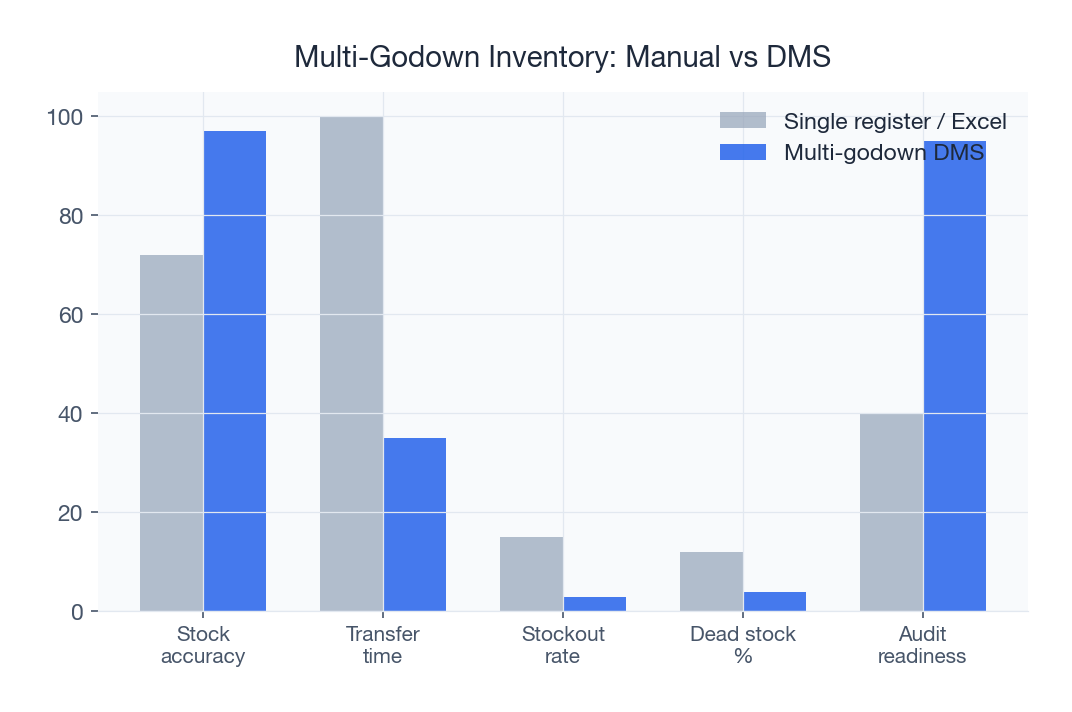
A well-designed FMCG depot has seven distinct functional zones arranged in a logical flow:
- Receiving dock: Where inbound vehicles are unloaded. Should accommodate the largest vehicle type (typically 16-tonne trucks from factory) with dock levelers for efficient pallet unloading. The receiving area includes space for staging incoming goods before quality check.
- Quality check area: Adjacent to the receiving dock, this zone handles inspection of incoming goods -- checking batch numbers, manufacturing dates, expiry dates, packaging integrity, and quantities against the goods receipt note (GRN). For food products, temperature verification of refrigerated shipments happens here.
- Storage zones: The main storage area is typically divided into ambient, chilled, and frozen zones based on product requirements. Within each zone, goods are organized by category and arranged in FEFO (First Expiry, First Out) lanes so that products closest to expiry are dispatched first.
- FEFO lanes: Within storage zones, products are slotted into lanes organized by expiry date. New stock enters from one end, and picking happens from the other end, ensuring automatic FEFO compliance without manual sorting. This is critical for FMCG products where shelf life management directly impacts retailer satisfaction and returns.
- Dispatch area: The staging zone where picked and packed orders are assembled by distributor before loading. Each distributor's consignment occupies a designated floor bay, clearly marked with the distributor code and vehicle assignment. The dispatch area connects directly to loading docks.
- Returns section: A quarantined area for processing returned goods -- near-expiry products, damaged packaging, wrong dispatches, and distributor rejections. Returns must be physically separated from saleable stock to prevent contamination of outbound shipments.
- Office and documentation: The administrative area housing the depot manager, billing staff, and data entry operators. Should have direct line-of-sight to both receiving and dispatch docks for operational oversight.
Flow Design Principles
The cardinal rule of depot layout is unidirectional flow -- goods should move in one direction from receiving to dispatch without backtracking. Cross-traffic between inbound and outbound operations creates confusion, delays, and increases the risk of dispatch errors. In practice, the ideal layout has receiving docks on one side of the building and dispatch docks on the opposite side, with storage zones in between. If the building geometry does not allow opposite-side docks, an L-shaped flow with receiving on one wall and dispatch on the adjacent wall is the next best option.
Aisle width should accommodate the material handling equipment in use -- minimum 3 meters for hand pallet trucks, 3.5 meters for powered pallet trucks, and 4.5 meters for counterbalance forklifts. Floor markings in industrial yellow should clearly delineate aisles, storage bays, staging areas, and pedestrian walkways.
Inventory Management at Depot Level
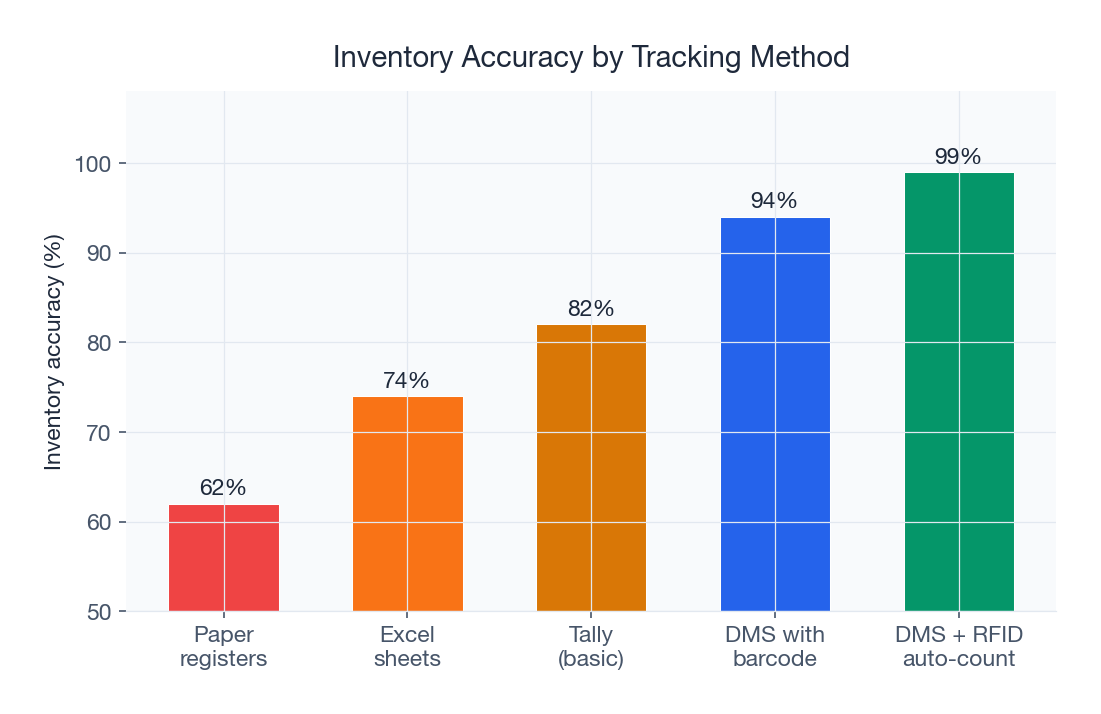
Depot-level inventory management for FMCG is fundamentally different from factory warehousing. The depot handles high SKU diversity, rapid stock rotation, batch-level traceability, and tight expiry management -- all while maintaining accuracy rates above 99% to avoid cascading errors downstream.
Stock Receipt and Goods Inward
Every inbound shipment triggers a structured receiving process. The depot team verifies the transporter's documents (lorry receipt, invoice, e-way bill) against the advance shipping notification from the brand. Physical verification includes piece count, batch number recording, manufacturing and expiry date verification, and condition assessment. Any discrepancies -- short shipments, damaged goods, wrong SKUs -- are documented in a discrepancy report and communicated to the brand within 24 hours.
Modern depots use barcode scanning during receiving to eliminate manual data entry errors. Each case or pallet is scanned against the expected shipment manifest, and the WMS automatically updates stock records with batch-level detail. This single step -- scanning at receiving -- eliminates the majority of inventory accuracy problems that plague manually-managed depots.
Batch Tracking and Shelf Allocation
FMCG inventory at the depot level must be tracked at the batch level, not just the SKU level. Two pallets of the same SKU with different manufacturing dates are effectively different inventory items because they have different expiry dates. The WMS assigns each batch to a specific storage location (rack, shelf, bin) and tracks its position throughout its time in the depot.
Shelf allocation follows a velocity-based approach -- fast-moving SKUs are placed closest to the dispatch area to minimize picking travel time, while slow-moving SKUs occupy deeper storage positions. Within each SKU location, batches are arranged by expiry date to enforce FEFO discipline.
FEFO Dispatch Discipline
First Expiry, First Out (FEFO) is the golden rule of perishable and semi-perishable FMCG inventory management. Violating FEFO means newer stock gets dispatched while older stock ages in the depot, eventually becoming unsaleable and creating returns. For a depot handling 500 SKUs with an average shelf life of 6 months, even a 5% FEFO violation rate translates to 2-4% stock wastage annually -- potentially Rs 20-40 lakh in losses for a mid-sized depot.
Enforcing FEFO requires three things: (1) accurate batch-level tracking so the system knows which batches are oldest, (2) storage organization that makes the oldest batch physically accessible for picking, and (3) system-enforced picking instructions that direct the picker to the correct batch. Without technology support, FEFO compliance relies entirely on the picker's discipline, which degrades under time pressure -- exactly the conditions during peak dispatch hours.
Stock Audits and Cycle Counts
Full physical stock audits should be conducted quarterly at minimum. However, for high-volume depots, quarterly audits alone are insufficient because errors accumulate and compound over 90 days. The best practice is ABC-based cycle counting: A-class SKUs (top 20% by value, representing 80% of depot value) are counted weekly, B-class (next 30%) are counted fortnightly, and C-class (bottom 50%) are counted monthly. This ensures every SKU is physically verified at least once a month, and the highest-value items are verified weekly.
Minimum Stock Levels and Reorder Triggers
Each depot maintains minimum stock levels (MSL) by SKU, calculated based on average daily dispatch rate, lead time for replenishment from the factory, and a safety stock buffer. The formula is straightforward: MSL = (Average Daily Dispatch x Lead Time Days) + Safety Stock. When current stock drops below MSL, the system triggers a replenishment request to the brand's supply chain team. Brands using order management systems like SpireStock can automate this entirely -- the system monitors depot stock in real time and generates replenishment orders when MSL is breached, eliminating the delays and errors of manual stock reporting.
Dispatch and Order Fulfillment
Dispatch is where the depot's value is realized. A depot that receives and stores goods perfectly but dispatches inaccurately or slowly destroys value for the entire distribution chain. The dispatch process must be engineered for speed, accuracy, and documentation completeness.
Order Aggregation from Distributors
Orders flow into the depot from distributors through multiple channels -- the brand's DMS, phone calls to the depot manager, WhatsApp messages from the sales team, or (ideally) a unified order management platform. The depot's first task is aggregating these orders into a single dispatch plan for the day. Orders received before the cutoff time (typically 2-4 PM for next-day dispatch) are consolidated into the day's dispatch batch. Late orders roll to the next dispatch cycle.
Effective order aggregation serves a dual purpose: it consolidates picking lists for warehouse efficiency, and it enables intelligent vehicle loading by grouping orders destined for the same route or geography. A depot dispatching to 60 distributors daily can reduce picking time by 40% and vehicle requirements by 20% through proper order aggregation compared to processing orders one at a time.
Pick-Pack-Dispatch Workflow
The pick-pack-dispatch workflow is the heart of depot operations. A well-structured process follows these steps:
- Pick list generation: The system generates consolidated pick lists organized by storage location, not by distributor order. This means the picker walks through the depot once, collecting all items needed for all orders in a zone, rather than making separate trips for each order. Location-sequenced picking reduces travel time by 50-60% compared to order-by-order picking.
- Picking: Pickers follow the pick list, collecting items from designated locations. Barcode scanning at the pick point verifies that the correct SKU and batch are being picked. If the picker grabs the wrong item, the scanner alerts immediately, preventing the error from propagating.
- Packing and consolidation: Picked items are brought to the dispatch staging area and consolidated by distributor order. Each order is verified against the original order -- SKU, quantity, batch, and expiry. Outer cases are labeled with the distributor name, order number, and piece count.
- Vehicle loading: Orders are loaded onto assigned vehicles in reverse delivery sequence -- the last delivery goes in first, the first delivery goes in last. This eliminates the need to unload and rearrange cargo at each delivery stop.
- Dispatch documentation: Each vehicle departs with a set of documents: distributor-wise invoices (generated through the billing system), delivery challans, e-way bills for interstate movement, and a vehicle loading sheet summarizing all consignments on the vehicle.
Delivery Scheduling and Route Optimization
Depot dispatch scheduling must align with distributor receiving windows and vehicle availability. Most FMCG distributors prefer morning deliveries (7-11 AM) so they can break bulk and dispatch to retailers the same day. This creates a peak loading period (4-7 AM) at the depot that must be staffed accordingly.
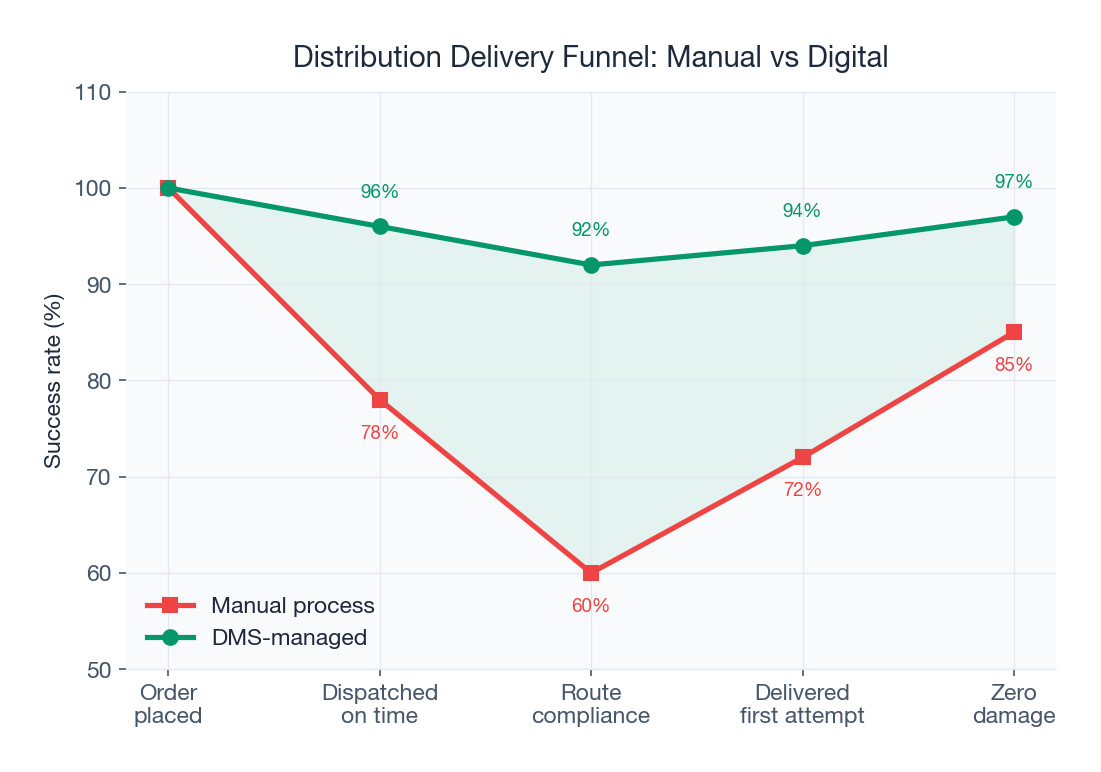
For depots serving a large geographic area, route-based dispatch scheduling groups distributors into delivery routes. Each route is assigned a vehicle and a delivery sequence optimized for distance and time. A depot serving 80 distributors across a state might operate 8-10 routes, each covering 8-12 distributors per trip. Distribution tracking capabilities allow both the brand and the distributor to monitor shipment status in real time, from dispatch to delivery confirmation.
CFA Performance KPIs
What gets measured gets managed. Brands that run CFA networks without rigorous KPI tracking inevitably face service deterioration, cost creep, and distributor complaints. The following seven KPIs form the minimum viable measurement framework for CFA performance.
| KPI | Definition | Target Benchmark | Measurement Frequency |
|---|---|---|---|
| Order fulfillment rate | Percentage of distributor orders fulfilled completely (all SKUs, full quantities) | 95% or above | Daily |
| Dispatch accuracy | Percentage of dispatches with zero errors (correct SKU, batch, quantity) | 99% or above | Daily |
| Inventory days on hand | Average number of days of stock held at the depot | 12-18 days (varies by category) | Weekly |
| Shrinkage percentage | Stock loss due to damage, theft, expiry, or handling errors as percentage of throughput value | Below 0.5% | Monthly |
| Dispatch cycle time | Time from order cutoff to vehicle departure | Under 12 hours for next-day dispatch | Daily |
| Cost per case handled | Total depot operating cost divided by total cases dispatched | Rs 3-8 per case (varies by region and category) | Monthly |
| Complaint rate | Number of distributor complaints (short delivery, wrong dispatch, damaged goods) per 1,000 dispatches | Below 5 per 1,000 | Monthly |
Brands should track these KPIs through their analytics dashboards and review them with each CFA during monthly or quarterly business reviews. KPI trends matter more than absolute numbers -- a CFA whose dispatch accuracy has dropped from 99.2% to 97.8% over three months needs intervention, even though 97.8% might seem acceptable in isolation.
Advanced KPIs for Mature Operations
Brands with mature CFA networks add additional metrics: dock-to-stock time (time from vehicle arrival at depot to goods being shelved and available for dispatch), perfect order rate (orders delivered on time, in full, with correct documentation, and no complaints), space utilization (percentage of available cubic storage space actually used), and labor productivity (cases handled per person-hour). These advanced metrics help optimize depot operations beyond the basic service level and into genuine operational excellence.
Technology for Depot Management
Technology transforms depot management from a manual, error-prone operation into a precision logistics function. The technology stack for a modern FMCG depot spans warehouse management, identification and scanning, connectivity with the brand's distribution network, and real-time visibility.
Warehouse Management System (WMS) Integration
A WMS is the operational brain of the depot. It manages receiving, put-away (assigning storage locations to incoming goods), picking (directing pickers to the correct location and batch), and dispatch (generating loading lists and documentation). For FMCG depots, the WMS must support batch-level tracking, FEFO enforcement, multi-temperature zone management, and returnable asset tracking.
The WMS should integrate bidirectionally with the brand's ERP -- receiving advance shipping notifications for inbound stock, and sending dispatch confirmations and inventory snapshots back to the brand. This integration eliminates the phone calls and emails that traditionally mediate information flow between brands and CFAs.
Barcode and RFID Scanning
Manual data entry is the single largest source of depot errors. Barcode scanning at every touchpoint -- receiving, put-away, picking, and dispatch -- reduces errors by 95% compared to manual processes. For high-volume depots handling 50,000+ cases per month, the investment in barcode infrastructure (scanners, label printers, and software integration) pays back within 3-4 months through reduced dispatch errors, fewer returns, and faster processing.
RFID (Radio Frequency Identification) takes this further by enabling bulk scanning without line-of-sight. A pallet tagged with RFID can be scanned as it passes through a dock door, automatically updating the WMS without any manual intervention. While RFID tag costs (Rs 5-15 per tag) make it impractical for individual FMCG cases, it is increasingly used for pallet-level tracking and returnable asset management -- particularly for crate tracking where the same asset circulates thousands of times.
DMS Connectivity
The depot does not operate in isolation. It is a node in the brand's distribution network, and its systems must connect seamlessly with the brand's Distributor Management System (DMS) and the distributors' own operations. DMS connectivity enables:
- Automated order flow: Distributor orders placed through the DMS flow directly to the depot's dispatch queue without manual re-entry
- Real-time stock visibility: Distributors and the brand's sales team can see current depot stock levels, enabling informed ordering and preventing orders for out-of-stock items
- Dispatch status tracking: Distributors receive automated notifications when their order is dispatched, with vehicle details and expected delivery time
- Returns processing: Return requests initiated through the DMS are reflected at the depot, ensuring proper receipt and documentation of returned goods
How SpireStock Connects Depot to Downstream
SpireStock's distribution tracking module provides end-to-end visibility from depot to distributor to retailer. When a depot dispatches an order, the system tracks it through delivery confirmation, generates digital proof of delivery, and updates the brand's central dashboard in real time. Distributors access their own portal showing pending orders, dispatch status, and complete order history. The distributor management solution gives brands a single pane of glass across all CFAs and distributors, replacing the fragmented spreadsheets and phone calls that typically characterize brand-CFA communication.
For brands managing depot operations across multiple locations, the multi-plant distribution capability consolidates stock visibility, order routing, and performance tracking across all depots into a unified dashboard. This is particularly valuable for brands operating 20+ CFAs where centralized oversight is impossible without technology.
CFA Appointment and SLA Management
Appointing the right CFA and managing the relationship through well-structured SLAs is as important as the operational aspects of depot management. A poorly chosen CFA or a loosely managed relationship will undermine even the best-designed operational processes.
CFA Appointment Criteria
Brands should evaluate prospective CFAs against the following criteria before appointment:
- Infrastructure: Warehouse space (minimum 5,000-10,000 sq ft for a mid-sized FMCG operation), dock facilities, material handling equipment, and cold storage capability if required. Physical inspection of the facility is mandatory -- photographs and self-reported specifications are unreliable.
- Financial stability: The CFA must have sufficient working capital to fund depot operations (labor, transport, utilities) during the typical 30-45 day payment cycle from the brand. Request audited financial statements for the past three years and bank references.
- Experience: Prior experience managing FMCG distribution is strongly preferred. A CFA that has handled similar products for other brands brings trained staff, established processes, and an understanding of FMCG-specific requirements like FEFO, batch tracking, and scheme application.
- Geographic coverage: The CFA's existing transport network and relationships with local transporters determine how effectively they can cover the target territory. A CFA with established routes to 80% of the target distributors will ramp up faster than one building a network from scratch.
- Technology readiness: Willingness and ability to adopt the brand's WMS, DMS, and reporting platforms. CFAs resistant to technology adoption create information black holes in the distribution chain.
- Compliance history: Clean track record on FSSAI, GST, labor law, and warehouse safety compliance. Non-compliance by the CFA creates legal and reputational risk for the brand.
SLA Terms and Structure
The CFA agreement should define explicit SLAs covering operational performance, financial terms, and compliance obligations. Key SLA terms include:
- Order fulfillment: Minimum 95% order fulfillment rate measured monthly. Partial fulfillment (dispatching 80% of an order and backordering the rest) counts as incomplete.
- Dispatch accuracy: Minimum 99% accuracy in dispatched consignments. Errors include wrong SKU, wrong quantity, wrong batch, and wrong distributor.
- Stock loss/shrinkage: Maximum 0.5% shrinkage on handled value. The CFA bears the cost of shrinkage above this threshold.
- Dispatch turnaround: All orders received before cutoff to be dispatched within 12-18 hours. Emergency orders within 6 hours.
- Reporting: Daily stock reports, weekly dispatch summaries, and monthly performance scorecards submitted through the brand's platform.
- Returns processing: Returns received from distributors to be inspected, categorized, and reported within 48 hours of receipt.
- Insurance: CFA maintains adequate insurance coverage for the brand's stock held at the depot, covering fire, theft, flood, and transit damage.
Performance Reviews and Incentive/Penalty Structure
Monthly performance reviews compare actual KPIs against SLA targets. Consistent underperformance triggers a graduated response: first month below SLA results in a warning letter, second consecutive month triggers a performance improvement plan with weekly reviews, and third consecutive month activates penalty clauses or contract termination proceedings.
The most effective CFA management models include positive incentives alongside penalties. Brands that share a portion of cost savings from efficiency improvements, or that offer volume-based bonus commissions when the CFA exceeds dispatch targets, see 15-25% better performance than those relying solely on penalty-driven compliance. The best brand-CFA relationships are genuine partnerships where both parties benefit from operational excellence. For guidance on structuring these agreements, see our detailed guide on FMCG appointment letter and agreement formats.
Case Studies
Case Study 1: Prashant Foods, Multi-State Snacks Brand
Prashant Foods, a packaged snacks brand based in Ahmedabad, operates 12 CFAs across Gujarat, Rajasthan, and Madhya Pradesh, serving 1,800 distributors. Before implementing a technology-driven depot management approach, the brand faced chronic challenges: average order fulfillment was stuck at 82%, dispatch errors ran at 4.2% (one in every 24 dispatches had some error), and the central supply chain team spent 6+ hours daily calling CFAs for stock updates and dispatch status.
The brand deployed SpireStock's distribution tracking and order management modules across all 12 CFAs over a 10-week rollout. Barcode scanning was implemented at receiving and dispatch points. Distributor orders were routed directly through the DMS to the relevant CFA's dispatch queue, eliminating phone-based ordering. Real-time stock dashboards replaced the daily stock-calling ritual.
Results after 6 months of operation:
- Order fulfillment rate: Improved from 82% to 96.4%
- Dispatch accuracy: Improved from 95.8% to 99.3%
- Stock visibility lag: Reduced from 24-48 hours (phone-based) to real-time
- Shrinkage: Reduced from 1.8% to 0.4% of throughput value
- Central team time on CFA coordination: Reduced from 6+ hours daily to 45 minutes
- Annual savings: Rs 1.2 crore across the 12-CFA network, against technology investment of Rs 18 lakh
The most impactful single change, according to the brand's supply chain head, was FEFO enforcement through the system. Before technology, CFAs routinely dispatched newer stock because it was physically more accessible, leading to Rs 35-40 lakh in annual near-expiry returns. After system-enforced FEFO picking, near-expiry returns dropped by 85%.
Case Study 2: Raghav Dairy Products, Regional Dairy Brand
Raghav Dairy Products operates from a single production facility near Jaipur, distributing milk, curd, paneer, lassi, and flavored milk across Rajasthan through 3 company-managed depots and 4 third-party CFAs. The dairy's primary challenge was cold chain integrity -- temperature excursions during depot handling were causing 3.5% product spoilage at the depot level, and an additional 2.1% was lost to FEFO violations where older batches were not dispatched first.
The brand implemented a depot management overhaul combining physical infrastructure upgrades with SpireStock's technology platform. Each depot and CFA installed temperature monitoring sensors integrated with the central dashboard, providing 15-minute temperature logs and instant alerts. Cold chain dock seals were installed at all receiving and dispatch doors. The WMS module enforced batch-level FEFO picking with barcode verification.
Results after 8 months:
- Product spoilage at depot: Reduced from 3.5% to 0.6%
- FEFO violation rate: Reduced from 12% of dispatches to 0.8%
- Near-expiry returns from distributors: Reduced from Rs 28 lakh annually to Rs 4 lakh
- Dispatch cycle time: Reduced from 18 hours to 8 hours (critical for dairy freshness)
- Cold chain temperature compliance: Improved from 78% of monitored hours within range to 98.5%
- Annual savings from reduced spoilage and returns: Rs 52 lakh against technology and infrastructure investment of Rs 24 lakh
The dairy's managing director noted that the real transformation was not just operational but strategic: "Before we had visibility into our depot operations, we were hesitant to expand to new territories because we could not control quality at the CFA level. Now we can monitor every depot's temperature, stock accuracy, and dispatch performance from our Jaipur office. We have added two new CFAs in southern Rajasthan in the last quarter, something we would not have attempted without this visibility." For brands facing similar challenges, see how our multi-plant distribution solution enables centralized control over distributed depot operations.
Ready to transform your depot and CFA operations? SpireStock helps FMCG brands bring technology-driven efficiency to their distribution hubs -- from inventory accuracy and FEFO compliance to real-time dispatch tracking and CFA performance monitoring. Book a free demo or explore our pricing plans to find the right fit for your distribution network.
Sources & References
Frequently Asked Questions
A CFA (Carrying and Forwarding Agent) is a third-party logistics intermediary that receives goods from an FMCG manufacturer, stores them at a regional warehouse, and dispatches them to distributors on behalf of the brand. The CFA does not own the stock -- inventory remains on the brand's books. CFAs earn a commission of 2-5% on goods handled, providing brands with regional distribution coverage without the capital investment of building company-owned depots.
The fundamental difference is stock ownership. A CFA holds stock on consignment for the brand (brand retains ownership and invoices distributors directly), while a super stockist buys stock from the brand and resells to distributors at a margin. CFAs earn a commission fee and bear no inventory risk; super stockists earn a trade margin but bear full inventory and credit risk. CFAs give brands more control over pricing and distributor relationships.
Setup costs vary significantly by city and infrastructure requirements. A basic 10,000 sq ft ambient depot in a tier-2 city costs Rs 15-25 lakh to set up (racking, docks, equipment) with monthly operating costs of Rs 3-5 lakh. Adding cold storage increases setup cost by Rs 800-1,500 per sq ft. In metro peripheries, total setup investment ranges from Rs 30-60 lakh. Third-party CFA models reduce brand investment to near zero as the CFA provides infrastructure.
Key licenses include FSSAI registration or license (mandatory for food product storage), GST registration, fire NOC from the local fire department, trade license from the municipal corporation, and pollution control board consent if using refrigeration systems with certain refrigerants. For depots storing hazardous materials (industrial chemicals), additional permissions from the factory inspectorate are required. FSSAI licensing takes 30-60 days.
The seven essential KPIs are: order fulfillment rate (target 95%+), dispatch accuracy (target 99%+), inventory days on hand (12-18 days), shrinkage percentage (below 0.5%), dispatch cycle time (under 12 hours), cost per case handled (Rs 3-8), and complaint rate (below 5 per 1,000 dispatches). Track these monthly and review trends rather than isolated numbers.
FEFO (First Expiry, First Out) ensures that products closest to their expiry date are dispatched first, preventing stock from aging and becoming unsaleable at the depot. Implementation requires batch-level tracking in the WMS, physical storage organization where older batches are accessible for picking, and system-enforced pick instructions directing pickers to the correct batch. Without technology, FEFO compliance relies on picker discipline and typically drops below 90%.
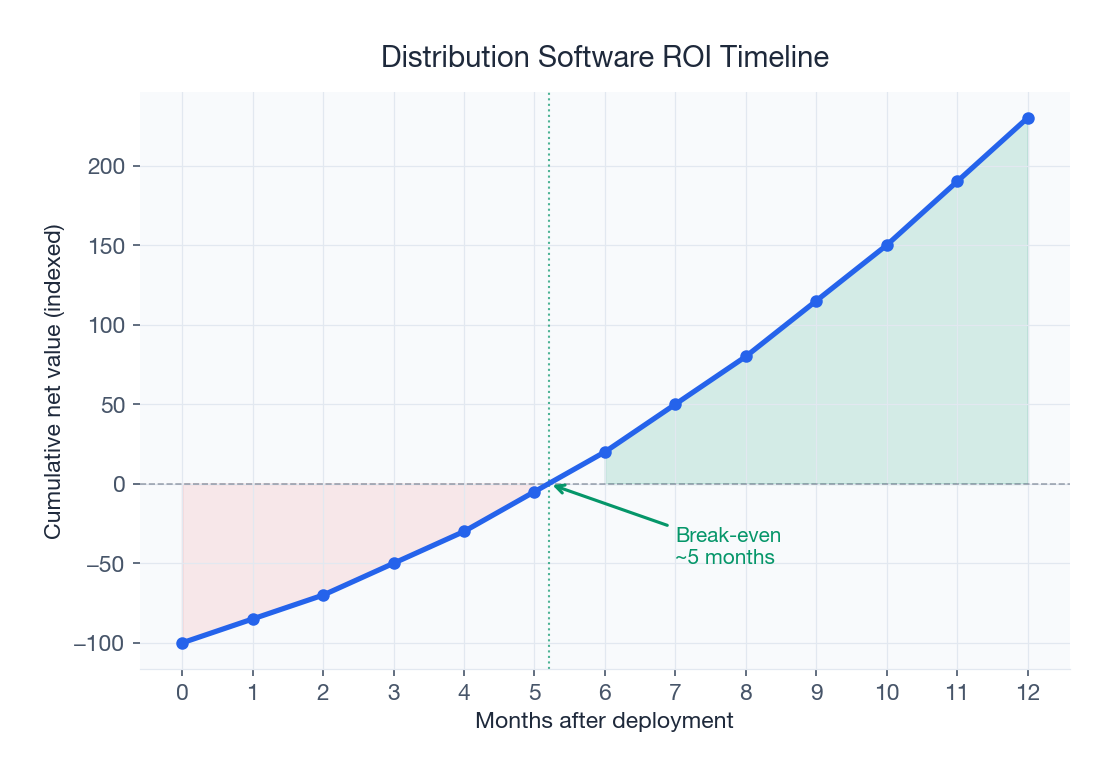
A modern depot needs: (1) a Warehouse Management System for receiving, put-away, picking, and dispatch, (2) barcode scanners at every touchpoint to eliminate manual entry errors, (3) DMS connectivity for automated order flow and real-time stock visibility, (4) temperature monitoring systems for cold storage areas, and (5) analytics dashboards for KPI tracking. The total technology investment for a mid-sized depot is Rs 5-15 lakh with ROI typically achieved in 4-8 months.
Company-owned depots offer maximum control but require Rs 50 lakh to Rs 2 crore per location in capital investment. CFAs require near-zero capital from the brand but offer less direct control. Most brands use a hybrid: company-owned depots in top 3-5 metro regions where volume justifies the investment, and third-party CFAs for remaining territories. The decision depends on volume, margin structure, product complexity (cold chain requirements favor company-owned), and available capital.
Related SpireStock Features
End-to-end order lifecycle from placement to delivery with multi-level approval workflows.
Real-time GPS tracking of vehicles and drivers with route optimization for faster deliveries.
Complete returnable crate tracking across plant, transporter, and retail levels.
GST-compliant invoicing with HSN codes, gate passes, and financial ledger.
Powerful dashboards with sales trends, MIS reports, and distribution analytics.
Related Industries
Streamline FMCG distribution with order management, beat planning, retailer tracking, and GST billing. Built for Indian FMCG supply chains.
End-to-end dairy distribution software for milk, curd, paneer, and ghee brands. Manage orders, crates, cold chain, and GST billing in one platform.
Related Solutions
Manage your entire distributor network digitally. Onboarding, credit limits, outstanding tracking, and performance analytics. Start free trial.
Manage distribution across multiple production units and plants. Centralized control with plant-level autonomy for dairy and FMCG brands.
Related Entities
Ready to Streamline Your Distribution?
Start your free 30-day trial and see how SpireStock can transform your dairy, FMCG or consumer-goods distribution operation, from order capture to crate recovery.

SpireStock Team
Product & Industry Insights
SpireStock Team leads product at SpireStock, where the team ships distribution management software for India's dairy, FMCG and consumer-goods brands.